
What Is 2D Animation? A Complete Guide for Businesses
Whether you are planning your first animated marketing video or evaluating a production partner, understanding what 2D animation is and how it works helps you buy smarter, brief better, and get results faster. This guide covers types, styles, production process, and how 2D animation drives real business outcomes.
What Is 2D Animation?
2D animation is the process of creating the illusion of movement in a two-dimensional space. Objects, characters, and environments are drawn or designed on a flat plane and animated along the x and y axes, producing video that feels fluid and alive without any three-dimensional depth rendering.
Unlike 3D animation, where models exist in a virtual three-dimensional environment and are lit and rendered like a real scene, 2D animation lives entirely on a flat canvas. This shapes everything about how it looks, how it is produced, and how quickly it can be delivered.
2D animation has been used in storytelling since the early 1900s. The same fundamental principles that made Disney's Snow White compelling in 1937 still apply to the best business explainer videos today: clear motion, well-timed transitions, and visual metaphors that make abstract ideas concrete.
For businesses, "what is 2D animation" often translates to: any flat, illustrated video used to explain, promote, or train. That includes explainer videos, animated ads, social media content, onboarding walkthroughs, and product demos. It is the most widely used animation format in commercial video production because it combines a broad stylistic range with practical production timelines and proven conversion results.
The Four Main Types of 2D Animation
Not all 2D animation is the same. The four main types differ in how they are made, how they look, and how long they take to produce. Understanding the difference helps you match the right technique to your brief and avoid scope mismatches with a production partner.
Frame-by-Frame Animation
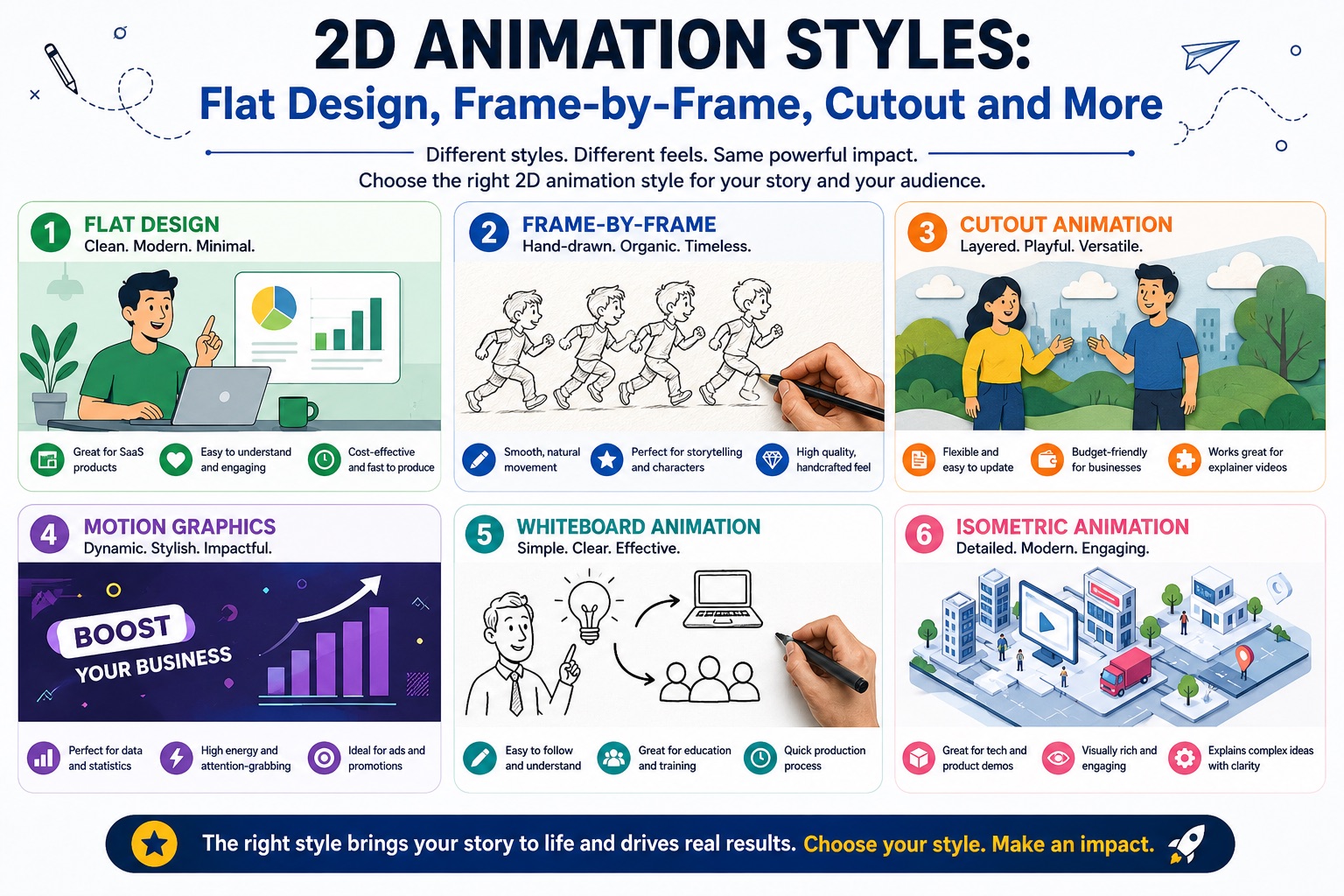
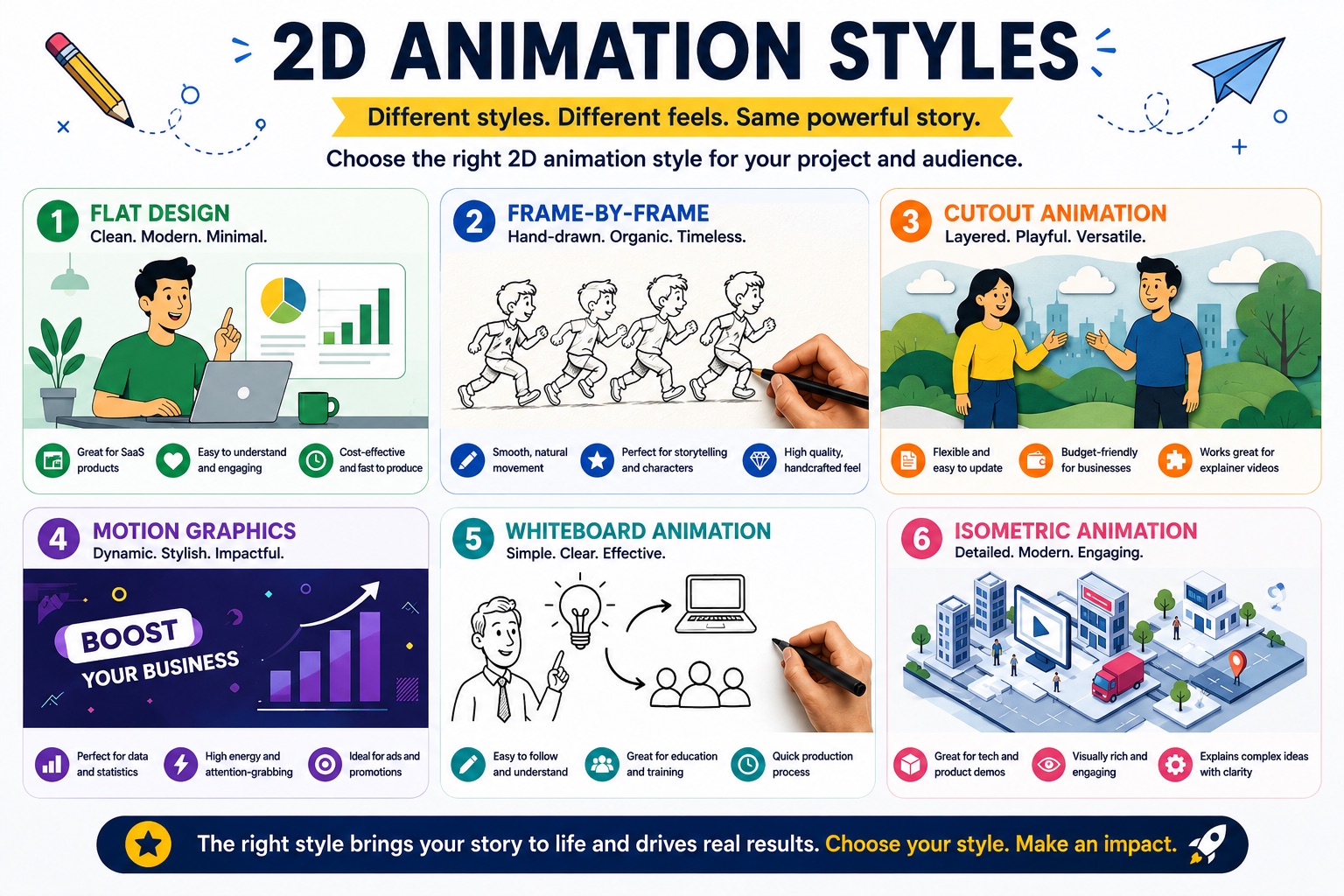
The traditional approach: each frame is drawn individually to create fluid, organic motion. Time-intensive but capable of the most expressive movement. Used for high-end character animation and premium brand work where craft is part of the message.
Vector Animation
Characters and scenes are built from digital vector shapes rather than hand-drawn frames. Assets can be reposed and reused without redrawing, making it faster and more cost-effective. The majority of modern business explainer videos use vector 2D animation.
Cutout Animation
Pre-made character parts, arms, heads, legs, are moved independently like jointed paper puppets. Fast to produce, immediately recognisable in style, and a natural choice for ongoing content series where the same characters appear across multiple episodes.
Motion Graphics
Animated text, icons, shapes, and data visualisations. Less character-driven, more information-driven. Ideal for product feature walkthroughs, UI screen demos, and financial communications where precision matters more than narrative.
2D Animation Styles Businesses Use Most
Within these four types, studios can produce 2D animation across a wide range of visual styles. The style you choose shapes how your audience perceives your brand, so the brief should include style direction before production starts.
Flat Design Animation
Clean, minimal illustrations with bold colours and simple geometry. No gradients, no drop shadows, no visual clutter. Flat design reads instantly across all screen sizes and is the default choice for SaaS, fintech, and technology brands that want to signal modernity and clarity. Most explainer videos from enterprise software companies fall into this category because it scales effortlessly from a 6-second pre-roll to a 90-second homepage hero.
Character Animation
Animated characters, human or otherwise, that carry a story and build emotional connection. This style works well for brands targeting consumers or wanting to humanise a complex product. Character-driven 2D animation performs strongly in longer-form content where the audience needs to be held for 90 seconds or more, and is the format of choice for healthcare, education, and HR content.
Whiteboard Animation
A hand appears to draw illustrations on a white background as a narrator explains a concept. Once enormously popular for educational content, whiteboard animation has declined in quality perception over the past several years but still performs reliably for internal training videos, compliance walkthroughs, and onboarding sequences where the audience is captive rather than browsing.
Kinetic Typography
Words animate onto the screen in sync with a voiceover or music track. Particularly effective for short-form social content, product launch announcements, and brand manifestos. Works as a standalone format or as an overlay on live-action footage, and can be produced quickly when a campaign needs fresh assets without a full production turnaround.
For a deeper breakdown of each style with visual examples, see the companion guide: 2D Animation Styles: Flat Design, Frame-by-Frame, and Cutout Compared.
 motion graphics" width="900" height="500" loading="lazy" />
What Businesses Use 2D Animation For
2D animation is used across industries and at every stage of the marketing funnel. These are the use cases where it consistently delivers the strongest measurable return.
Product Explainer Videos
A 60 to 90 second animated video that explains what a product does and why it matters. The most common business use case and the format with the most documented conversion impact, from Dropbox to Crazy Egg to Dollar Shave Club.
SaaS Onboarding Videos
Short walkthroughs that guide new users through key features. Animated onboarding reduces support tickets and improves feature adoption. For the strategic distinction between onboarding and explainer formats, see: SaaS Onboarding vs Explainer Video.
Paid Ad Creative
Short-form animated ads (6 to 30 seconds) for YouTube, Meta, LinkedIn, and TikTok. Animated ads outperform live action in A/B tests for technology products because they can visualise abstract benefits that cameras cannot capture.
Social Media Content
Looping animations, animated statistics, and short educational clips. 2D animation is natively suited to vertical formats and performs well in feed and story placements because every frame is composed by a designer, not captured by a camera on set.
Internal Training Videos
Compliance training, HR onboarding, and process documentation. Animation makes dry content more engaging and improves knowledge retention. It also removes the need to reshoot when processes change: update the script and reanimate only the affected scenes.
Investor and Pitch Content
A short animated overview of a business model or technology can replace five slides in a pitch deck. Many early-stage companies use 2D animation to communicate complex ideas to investors who have limited time and no technical background.
2D Animation vs 3D Animation: Which Is Right for Your Business?
The most common question business owners ask when commissioning animation is whether to use 2D or 3D. The answer depends on your product type and goals, not personal preference.
| Factor | 2D Animation | 3D Animation |
|---|---|---|
| Production time | Faster (3 to 6 weeks typical) | Slower (6 to 14 weeks typical) |
| Investment level | More accessible entry point | Higher for equivalent quality |
| Style range | Very broad: flat, character, cutout, motion graphics | Realistic, cinematic, or stylised 3D |
| Best for | SaaS, apps, services, fintech, healthcare, education | Physical products, architecture, gaming, film |
| Revision speed | Faster: no render farm required | Revisions require additional render time |
| Brand consistency | Distinctive, ownable visual style easier to maintain | Harder to differentiate without a high budget |
For most B2B software companies, SaaS platforms, and service businesses, 2D animation delivers better results at a practical investment. 3D is the right choice when the product itself needs to be shown in three-dimensional space, such as a physical device, an architectural render, or a gaming asset where depth is part of what you are selling.
For a full comparison with examples, see: 2D Animation vs 3D Animation: Which Is Right for Your Business?
Why 2D Animation Works So Well for Marketing
Understanding what is 2D animation also means understanding why it has dominated commercial video production for decades. It goes beyond production economics -- this format is better suited to how buyers process information when making purchasing decisions.
It Simplifies the Complex
Most products worth buying require explanation. A live-action video can show a product being used, but it cannot easily show why it works or what happens inside the system. 2D animation can make invisible processes visible, compress a 10-step workflow into a 45-second visual, and use metaphor in a way no camera can. This is why it became the standard format for software, fintech, and healthcare companies that need to communicate technical ideas quickly to non-technical buyers.
It Holds Attention
Motion captures attention by default. Every visual element in a 2D animation is deliberately designed to guide the viewer's eye toward what matters most. There is no accidental background noise, no distracting set dressing, no presenter who blinks at the wrong moment. The entire frame is under creative control, which means a well-made 2D animation delivers a more focused viewing experience than most live-action alternatives.
It Is Brand-Consistent
A 2D animation is built from your brand's exact colour palette, typography, and visual language. Unlike live-action, it does not depend on location availability, lighting conditions, or talent scheduling. Once your visual style is established, every new video reinforces it, building the kind of consistent visual identity that compounds in value over time.
It Converts
Landing pages with explainer videos convert 80% higher than text-only pages, and 93% of consumers report that watching a video influenced their purchase decision, according to the Wyzowl State of Video Marketing 2024 report. The most documented high-converting campaigns, from Dropbox to Dollar Shave Club to Crazy Egg, all used 2D or motion animation at their core. For the breakdown: 12 Explainer Video Examples That Convert.
How Magic Motion Studio Approaches 2D Animation
We are a specialist 2D animation studio working with SaaS companies, technology brands, and consumer businesses globally. Every project is produced using Toon Boom Harmony, the industry-standard platform used by broadcast studios and streaming services. We do not outsource production or use template libraries.
Toon Boom Harmony Studio
Professional production using the same platform powering major streaming and broadcast animation. Most commercial studios use template software at this price point. We do not.
14 Business Days
Standard delivery for a complete explainer video. Faster than the industry average without compromising on quality or revision rounds.
SaaS and Tech Specialists
We have animated software products, APIs, AI tools, and B2B platforms. We know how to explain technical ideas to non-technical buyers.
Conversion-Focused
Every creative decision is anchored to what drives viewer action. We brief like marketers and produce like animators.
How the 2D Animation Production Process Works
Understanding the production process helps you brief a project clearly, set realistic expectations internally, and avoid the revision cycles that most delays stem from. Here is how a professional 2D animation is made from brief to delivery.
Discovery and Script
We start with the brief: what is the video for, who is the audience, and what is the one thing they need to believe after watching? The script is the foundation. A weak script cannot be saved by strong animation.
Storyboard
A visual map of every scene, showing what appears on screen for each line of the script. Storyboard approval locks the structure before animation begins, avoiding expensive rework later in production.
Style Frames and Visual Design
Key frames are designed to establish the colour palette, character design, typography, and overall aesthetic. You approve the look of the 2D animation before full production begins, so there are no surprises at delivery.
Voiceover Recording
A professional voiceover artist records the approved script. The 2D animation is then timed to the voiceover, not the other way around, which produces a more natural, measured result.
Animation in Toon Boom Harmony
Assets are animated scene by scene. We apply motion principles (ease-in, ease-out, anticipation, follow-through) that give the video a considered feel rather than the mechanical movement of template-based tools.
Sound Design and Music
Licensed music and sound effects are layered in the final pass. Sound design is where many productions fall apart: the wrong music undermines even excellent 2D animation.
Review and Delivery
You review the completed video and provide consolidated feedback. After revisions, we export in all required formats: MP4 for web and social, MOV for broadcast, and platform-specific cuts as needed.
What Makes a Strong 2D Animation Brief
Most production delays and revision overruns trace back to a weak brief rather than a weak studio. A strong brief answers five questions before production starts, and answering them accurately cuts the total production time by 30% or more.
1. Who is the audience?
Be specific. "Marketing managers at mid-size SaaS companies evaluating our product" is more useful than "businesses." The more specific the audience, the more specific the script, and the better the conversion rate. 2D animation that speaks to everyone tends to connect with no one.
2. What is the single desired action?
Videos that ask viewers to do one thing convert better than videos that mention three calls to action. Name the one action you want: start a free trial, book a demo, download a report. The 2D animation should build toward that moment from the opening frame.
3. What visual style do you want?
Share two or three existing videos that have the visual tone you are after. References communicate aesthetic direction faster and more accurately than written descriptions. "Clean and modern" means different things to different people. A reference is unambiguous.
4. What is the target length?
60 to 90 seconds covers most SaaS explainer use cases. Longer videos require more script depth and risk viewer drop-off before the call to action. If you feel you need three minutes to explain the product, the positioning may need work before the video does.
5. Where will it live?
A homepage hero video has different specs to a YouTube pre-roll or a LinkedIn post. Knowing the destination upfront means the 2D animation can be optimised for the correct aspect ratio, safe zones, and viewing context from day one.
For a full guide to briefing animation that converts: How to Explain a Complex SaaS Product in Under 90 Seconds.
Common Mistakes Businesses Make with 2D Animation
Most animated videos that underperform have the same root causes. These are the mistakes that recur across industries and budgets, and how to avoid them before production starts.
Trying to explain everything in one video
A 90-second 2D animation can hold roughly 135 to 150 words of voiceover, which is enough to make one strong argument for one specific audience. Brands that try to cover five product features, three customer segments, and a company origin story in the same video end up with a video that persuades nobody. The fix is a single objective per video and a content series for the rest.
Writing the script after the budget is set
Animation is priced by complexity and length. If the script runs to three minutes but the budget was set for 90 seconds, one of them has to change. Brief the scriptwriter first, then get a production quote. Reversing this order is the most predictable source of scope overruns in 2D animation projects.
No clear call to action
A 2D animation without a single, direct call to action is a brand video, not a conversion tool. Before writing a word of script, decide what the viewer does next. Not "learn more" in general, but a specific action: start a free trial, book a demo, download the guide. The entire video should build toward that moment.
Choosing a studio by price alone
The cheapest 2D animation quote almost always reflects one of three things: offshore production with limited revision rights, template-based software that produces generic output, or a first-time studio building their portfolio at your expense. The right question is not "what is the lowest price?" but "what return has this studio's work delivered for clients like mine?"
Skipping the storyboard approval
The storyboard is where you lock the structure before any animation begins. Studios that skip it or rush through it are setting up a revision cycle that will cost more in time and money than the storyboard would have. Approve the storyboard in detail before production starts. This is the single most effective way to protect your timeline.
How to Choose a 2D Animation Studio
Not all 2D animation studios deliver the same quality, speed, or business results. These are the five criteria that separate studios worth working with from those that look good on the surface but underdeliver at production.
Portfolio Match
Does the portfolio contain work in a style that fits your brief? A studio that specialises in character animation for children's brands will not automatically produce strong flat-design SaaS videos. Look for style range, not just technical skill.
Production Tools
Ask what software they use for 2D animation. Toon Boom Harmony and Adobe Animate are professional tools. Studios using template platforms (Vyond, Animaker, Renderforest) produce output that looks like everyone else's output, because it is.
Client Results
A studio with documented results, conversion lifts, view counts, or client testimonials that reference business outcomes, is a studio that thinks beyond aesthetics. Ask for a case study before signing a contract.
Revision Policy
How many revision rounds are included, and at which production stages? Studios with unlimited revisions at any stage often have no process, which creates scope creep. Studios with one revision round at the end have a process that protects their margins but not your outcome. Two structured revision rounds tied to milestone sign-off is the industry best practice.
Turnaround Transparency
Get a written timeline that includes milestone dates, not just a final delivery date. A studio that cannot give you a milestone schedule does not have a production process capable of hitting it. Ask specifically what happens if a milestone slips: does the delivery date move, or does the studio absorb the delay?
Strategic Thinking
The best 2D animation studios ask about your business objectives before talking about visual style. If the first conversation is about colour palettes rather than conversion goals, you are being sold a production service rather than a business result.
The Future of 2D Animation for Business
2D animation has remained the dominant format in commercial video production for over two decades. Here is where it is heading over the next three to five years, and what that means for businesses investing in animated content now.
AI-Assisted Production
AI tools are entering the 2D animation pipeline at the production stage: automated lip-sync, background generation, and in-between frame interpolation are all areas where AI is reducing manual work. For businesses, this means faster iteration and shorter timelines for revisions. What AI does not change is the quality of the script, the strength of the concept, or the conversion effectiveness of the final video. Studios using AI responsibly are delivering more for less; studios using it irresponsibly are delivering faster at lower quality. Ask specifically what AI tools a studio uses and how.
Short-Form and Vertical Formats
TikTok, Instagram Reels, and YouTube Shorts have created a permanent demand for 15 to 60 second animated content in vertical aspect ratios. Brands that have a strong 90-second horizontal explainer video now need short-form vertical edits of the same content for paid social. Planning for multi-format delivery at the brief stage is becoming standard practice, not an afterthought.
Interactive 2D Animation
Interactive animated videos, where viewers make choices that branch the narrative, are moving from experimental to mainstream for e-learning, product demos, and onboarding sequences. The technology is available through platforms like Tolstoy, Vidyard, and Hihaho. 2D animation is naturally suited to interactive formats because the flat visual language works at any scale and translates cleanly to mobile.
2D and 3D Hybrid Styles
High-end commercial work is increasingly blending 2D character animation with 3D environments. This hybrid approach is being driven down from broadcast budgets into the mid-market as rendering costs fall. For most business explainers, this hybrid remains out of scope on a practical timeline. But for brands looking to produce genuinely distinctive animated content, the 2D/3D hybrid is the direction premium production is moving.
Already building your 2D animation content strategy? See how leading SaaS companies are using animation across the full funnel: Explainer Videos for SaaS Companies.
Frequently Asked Questions
What is 2D animation used for in business?
Businesses use 2D animation for explainer videos, product demos, social media content, onboarding tutorials, training videos, and advertising. It is particularly effective for SaaS companies, fintech brands, and any business that needs to explain an abstract product or process to a non-technical buyer.
How is 2D animation different from motion graphics?
2D animation typically involves characters and narrative scenes that move through a story. Motion graphics are design elements such as text, icons, and shapes animated to communicate data or abstract concepts. Many professional explainer videos blend both: character scenes for emotional engagement, motion graphics for product UI and data demonstrations.
How long does it take to produce 2D animation?
A professional 2D animation for business typically takes 4 to 8 weeks from brief to delivery depending on length and complexity. At Magic Motion Studio, standard delivery is 14 business days for a finished explainer video, from approved script through to final export with music and sound design.
Is 2D animation more affordable than 3D?
Yes. 2D animation is generally more accessible than 3D because it requires less rendering time and no specialised 3D modelling. For most business use cases, particularly software, services, and education, 2D animation delivers equal or better results at a more practical investment level.
What software do professional 2D animation studios use?
Professional 2D animation studios use tools like Toon Boom Harmony, Adobe Animate, and After Effects. Toon Boom Harmony is the industry standard for high-quality character animation and is used by studios producing major broadcast and streaming content. Magic Motion Studio operates as a Toon Boom Harmony studio, meaning every project uses production-grade tooling rather than template-based software.
What are the most common mistakes businesses make with 2D animation?
The most common mistakes are: writing a script that covers too many ideas for the video length, having no clear single call to action, choosing a studio based on price alone without reviewing client results, skipping storyboard approval before animation begins, and not planning for multi-format delivery. A focused 60 to 90 second video with one message consistently outperforms a longer video that covers too much ground.
What is 2D animation and how is it different from other video formats?
What is 2D animation compared to live-action or 3D? It is a production format where all movement is created in a two-dimensional digital space, with no cameras, sets, or three-dimensional rendering required. Unlike live-action, every element is fully designed and controlled. Unlike 3D animation, it does not require expensive model building or physics simulation. For businesses, this means faster delivery, lower cost, and a visual style that can be tailored precisely to brand guidelines.
How will AI affect 2D animation production?
AI is accelerating 2D animation production in specific areas: automated lip-sync, background generation, and in-between frame generation are reducing manual work at the production stage. For businesses, this means faster iteration and shorter revision timelines. However, AI does not yet replace the scriptwriting, creative direction, and character design that give a 2D animation its brand identity and conversion effectiveness. Studios using AI responsibly are delivering more value faster, not lower quality at a discount.
Ready to Brief Your 2D Animation?
Tell us about your project and we will send you a production plan within 24 hours. No commitment required.
Get a Free Production Plan