
How Long Does 2D Animation Take? The Complete Production Guide
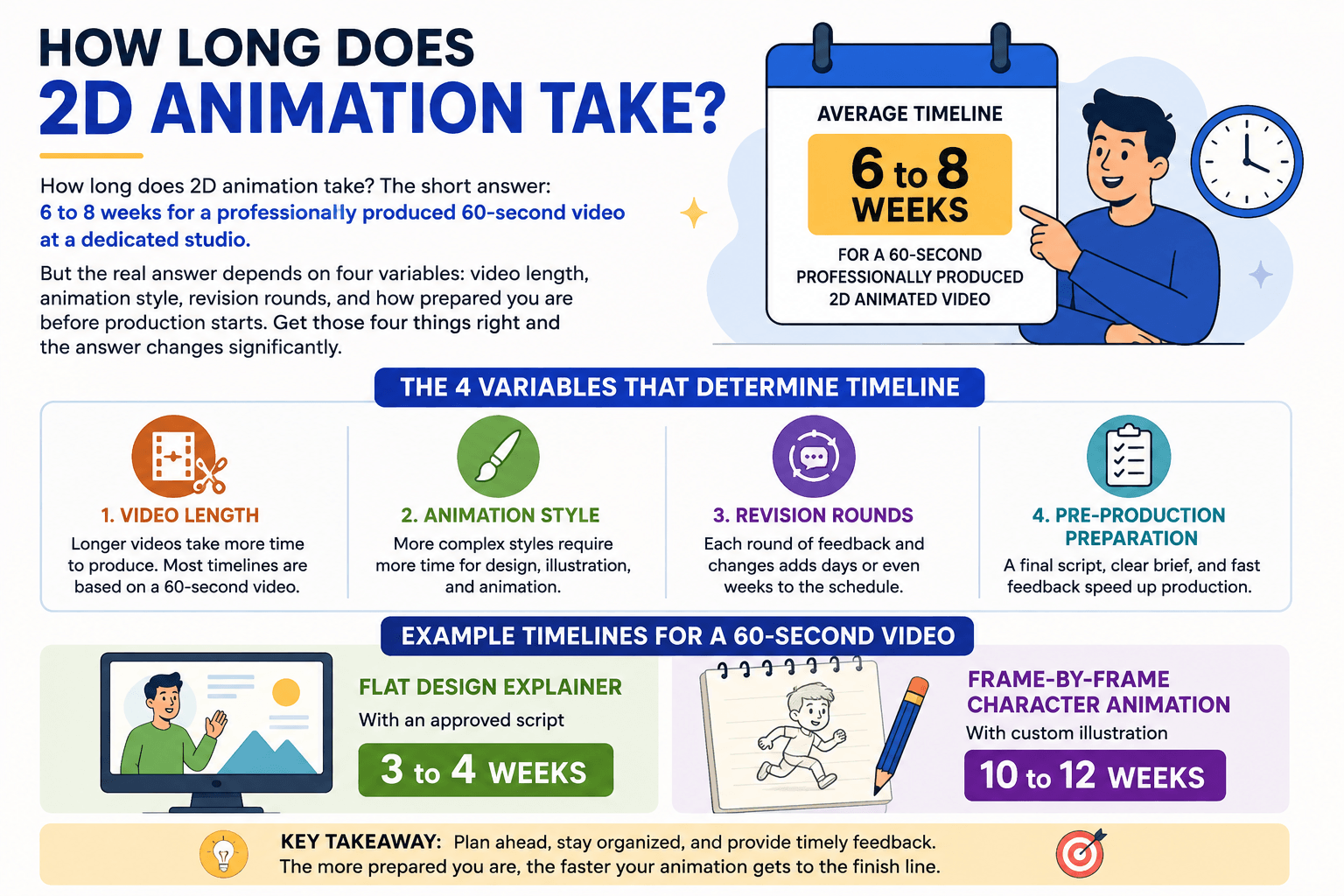
How long does 2D animation take? The short answer: 6 to 8 weeks for a professionally produced 60-second video at a dedicated studio. But the real answer depends on four variables: video length, animation style, revision rounds, and how prepared you are before production starts. Get those four things right and the answer changes significantly. A 60-second flat design explainer with an approved script can be completed in 3 to 4 weeks. The same length in frame-by-frame character animation with custom illustration takes 10 to 12 weeks.
This guide breaks down exactly how long does 2D animation take at every video length, every animation style, and every production phase, with specific day ranges at each stage so you can plan your launch date from the first conversation with a studio. Whether you need to know how long does 2D animation take for a 30-second social ad or a 3-minute product demo, the answer is here. If you have not yet decided on video length, read our guide on how long an explainer video should be before reviewing production timelines.
How Long Does 2D Animation Take by Video Length?
The table below is the quickest answer to how long does 2D animation take at each video length. Standard timelines assume two revision rounds per phase and client feedback within 48 hours. Fast-track assumes one revision round and 24-hour feedback throughout.
| Video Length | Standard Timeline | Fast-Track | Frame-by-Frame | Primary Driver |
|---|---|---|---|---|
| 30 seconds | 3–5 weeks | 10–14 business days | 6–8 weeks | Script complexity |
| 60 seconds | 6–8 weeks | 3–4 weeks | 10–12 weeks | Animation style |
| 90 seconds | 8–10 weeks | 4–5 weeks | 12–16 weeks | Revision rounds |
| 2 minutes | 10–12 weeks | 6–7 weeks | 16–20 weeks | Character and scene count |
| 3 minutes | 12–16 weeks | 8–9 weeks | 5–6 months | Scene complexity and assets |
| 5 minutes | 4–6 months | 3–4 months | 6–9 months | Team size and capacity |
How long does 2D animation take at Magic Motion Studio? 60-second explainer videos delivered in 14 business days. See our production pricing for full scope and delivery terms.
How Long Does 2D Animation Take? Phase-by-Phase Breakdown
Every 2D animation, regardless of style or length, passes through the same five production phases. Knowing how long does 2D animation take at each stage lets you plan your brief, your feedback windows, and your launch date with precision. Here is what happens inside each phase for a standard 60-second video.
Production cannot start until the script is locked. This phase covers the creative brief, target audience alignment, messaging hierarchy, and the final approved script. Most timeline overruns begin here: a script that goes through four rounds of internal revisions before the studio even sees it adds 1 to 2 weeks before a single frame is drawn. Arriving with a finalised script on Day 1 is the single biggest time-saver available to any client. For guidance on building a script that converts, see our explainer video production process.
How long does 2D animation take in the storyboard phase? Four to seven business days. The storyboard maps every scene, camera angle, and key action against the script. Style frames (typically 2 to 3 static illustrations) establish the visual language: colour palette, character design, typography, and motion feel. This phase is a checkpoint, not a formality. Approving style frames here prevents expensive illustration rework later. A change to the visual style after full illustration is approved adds 5 to 10 business days to the overall timeline. The storyboard review is the most important client touchpoint in the entire process. For a full breakdown of what this document contains, see our explainer video storyboard guide.
How long does 2D animation take in the illustration phase? Five to ten business days for 60 seconds, depending on asset count. All visual assets are built in full detail here: characters, environments, UI elements, icons, and product mockups. For a 60-second flat design video, expect 15 to 25 individual asset sets. For a 60-second character animation, expect 40 to 80 assets including rigged body parts. The more unique scenes in the script, the longer this phase takes. Reusing assets across scenes is the most common technique studios use to compress timelines without reducing visual quality. Illustration is where team size has the most direct impact on speed.
How long does 2D animation take in the animation phase alone? It is the longest single stage and the one most directly affected by style. A single animator working in flat design with motion graphics can produce 30 to 45 seconds of finished animation per day. The same animator working in traditional frame-by-frame produces 3 to 5 seconds per day. For a 60-second frame-by-frame video, the animation phase alone requires 12 to 20 days of pure animation work before any revisions. Professional studios running Toon Boom Harmony can dramatically reduce this through asset reuse and multi-animator pipelines. Revision turnaround within this phase typically adds 2 to 3 business days per round.
The final phase adds the audio layer: licensed background music, sound effects timed to visual beats, and voice-over sync if not already integrated. Final quality check, export in required formats (MP4, MOV, WebM, vertical crop for social), and delivery. How long does 2D animation take in this final phase? Two to four business days, making it the most predictable stage in the pipeline. The only common delay here is late-stage client requests for alternate edits or format variants not agreed in the brief. Specifying delivery formats in the original brief eliminates this risk entirely.
Need a 60-second video in 14 business days?
Magic Motion Studio delivers script, animation, and final production without the 8-week wait.
How Long Does 2D Animation Take by Style?
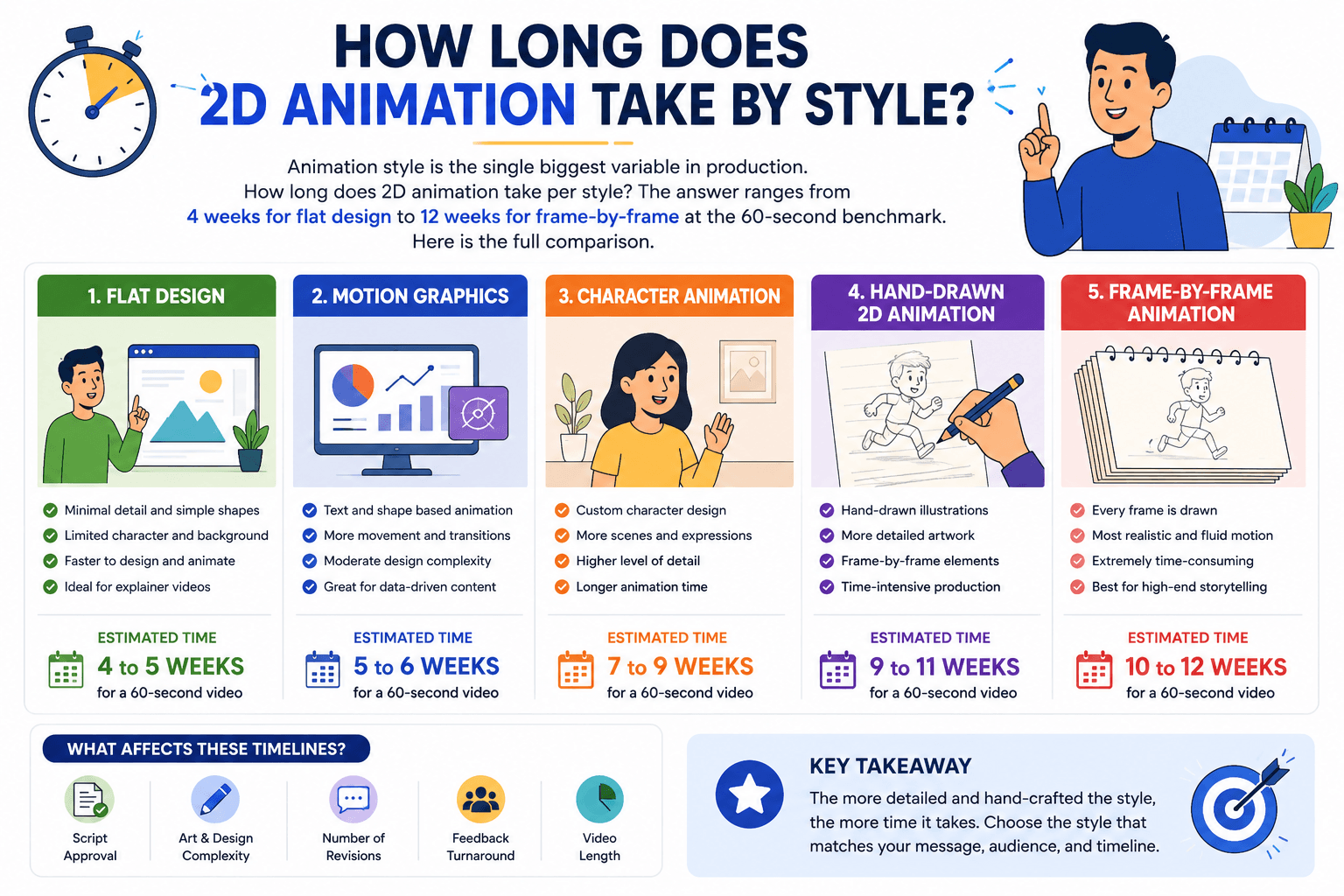
Animation style is the single biggest variable in production. How long does 2D animation take per style? The answer ranges from 4 weeks for flat design to 12 weeks for frame-by-frame at the 60-second benchmark. Here is the full comparison.
The fastest production style. For clients asking how long does 2D animation take in flat design, the answer is 4 to 6 weeks for 60 seconds. Clean vector assets, limited illustration complexity, and reusable scene components allow studios to work efficiently. Ideal for SaaS products, corporate communications, and process explainers where clarity matters more than visual detail. See all 2D animation styles compared.
How long does 2D animation take in motion graphics style? Four to six weeks for 60 seconds when the visual direction is clear. Typography, data, and abstract shapes driven by motion rather than illustration. Complex motion graphics with kinetic typography and 3D-style depth effects can extend to 6 to 8 weeks. Widely used in B2B and enterprise marketing for its professional visual signal.
How long does 2D animation take in cut-out style? Five to seven weeks for 60 seconds. Characters are built from layered parts and controlled by a rig system. The rigging phase adds time upfront but allows very fast animation once the rig is built. Highly scalable: if you need multiple videos with the same characters, each subsequent video is produced significantly faster. Popular for series and brand mascot content.
How long does 2D animation take with full character rigging? Six to eight weeks for a 60-second video with facial expressions, hand gestures, and walk cycles in a custom illustrated style. The first video in a character series is the most expensive and time-intensive. Subsequent videos reuse the character library and take 30 to 50% less time. Best for brand storytelling and long-term content strategy.
Traditional hand-drawn animation where each frame is illustrated individually at 12 to 24 frames per second. How long does 2D animation take in frame-by-frame? One minute requires 720 to 1,440 individual drawings and 10 to 12 weeks of dedicated production. This is the most time-intensive style and commands the highest production investment. Reserved for brand films, premium campaigns, and content where visual artistry is the brand signal itself.
How Long Does 2D Animation Take by Video Type?
How long does 2D animation take changes significantly depending on what the video is for. A social ad and a training module both involve 2D animation but have completely different scope, revision requirements, and delivery timelines.
The standard business explainer sits at 60 to 90 seconds and covers one product, one problem, and one call to action. How long does 2D animation take for this format? Six to eight weeks at standard pace, 3 to 4 weeks on fast-track, and 14 business days at Magic Motion Studio. The explainer video is the most produced format in B2B and SaaS marketing because its fixed length creates a predictable production scope. See real results in our explainer video examples that convert.
Timeline risks: multiple decision-makers in the approval chain, voice-over talent scheduling, and last-minute script changes after illustration is approved. All three are avoidable with a clear pre-production brief.
SaaS onboarding videos include animated UI mockups showing the product in action. How long does 2D animation take when the video requires accurate product screen animation? Add 1 to 2 extra weeks to the standard timeline, as UI assets need to match the current product interface and any updates between briefing and delivery need to be reflected. For a comparison of onboarding versus explainer formats, read SaaS onboarding vs explainer video. For the full SaaS explainer production approach, see SaaS explainer video, our startup explainer video page, and our guide on how to explain a complex SaaS product. For full context on production formats, see explainer videos for SaaS companies, and for SaaS video deployment strategy, see our guide on how to use explainer videos in a sales funnel.
UI animation requires that the product interface is finalised before illustration begins. A UI redesign mid-production resets the illustration phase entirely.
Short-form animation for Instagram Reels, TikTok, LinkedIn, and YouTube Shorts. How long does 2D animation take for social content? Two to four weeks for standalone pieces. When built as part of a series using a shared asset library from a longer video, individual social cuts can be delivered in 5 to 7 business days. Vertical format (9:16) adds minor reframing time. According to Wyzowl's Video Marketing Report, 89% of marketers say video gives them a positive ROI, with short-form social content generating the highest engagement rate per format.
Product demos are longer and more asset-intensive than standard explainers. How long does 2D animation take for a 90 to 120-second product demo? Eight to twelve weeks is the realistic range. Demos cover multiple features and require UI animation across several product screens. Eight to twelve weeks is the realistic range. The additional length and asset count extend the illustration phase, and demos typically go through more revision rounds because multiple stakeholders (product, marketing, sales) each have review input.
Long-form training and e-learning content is the most time-intensive format. When clients ask how long does 2D animation take for a 3 to 5-minute training video, the answer is 3 to 5 months at standard pace. Three to five months is the standard range, with character-heavy content at the longer end. These projects benefit most from a strong pre-production phase: scene-by-scene scripts, approved storyboards, and a confirmed voice-over artist before illustration starts. Asset reuse across modules is the primary tool for compressing timelines on multi-video training series.
8 Factors That Determine How Long 2D Animation Takes
How long does 2D animation take for your specific project depends on these eight variables. Each one operates independently, and most are within your control as the client. Understanding them before you brief a studio puts you in the best position to get an accurate and honest delivery date.
Script Readiness on Day One
When clients ask how long does 2D animation take, the answer almost always changes based on script readiness. A finalised, approved script on Day 1 eliminates Phase 1 rework entirely. An unfinished script adds 5 to 15 business days before a single frame is drawn. Studios can only start illustration once the word-for-word script is locked. Any script change after illustration begins creates rework that resets the affected phase.
Animation Style Complexity
How long does 2D animation take in flat design versus frame-by-frame? Flat design: 4 to 6 weeks per 60 seconds. Frame-by-frame: 10 to 12 weeks. The style choice alone can double or triple the production timeline. This does not mean simpler is always better: the right style for your audience builds more trust and converts better than a cheaper style that feels off-brand. For a full comparison, see our guide to 2D animation styles.
Number of Revision Rounds
How long does 2D animation take with extra revision rounds? Each additional round adds 2 to 3 business days at script and storyboard, and 3 to 5 business days at the animation stage. Standard agreements include two rounds per phase. Projects with multiple decision-makers commonly consume additional rounds. Setting a single internal reviewer as the point of contact before the project starts is the most effective way to control revision scope.
Number of Characters and Unique Scenes
How long does 2D animation take with multiple characters and unique scenes? Significantly longer. Each character requires a full illustration and rig build. Each unique background requires standalone illustration. A 60-second video with two characters and five unique scenes takes 30 to 50% longer than a 60-second video with one character and three looping environments. Experienced studios will flag this scope difference in the brief stage. Reusing characters and environments across scenes is the primary lever for compressing illustration time.
Voice-Over Talent Scheduling
How long does 2D animation take when voice-over talent is unavailable? The entire production holds until the recording is complete, because animators time lip sync and scene pacing to the audio track. A 1 to 2 week talent delay adds 1 to 2 weeks to the final delivery date with no work being done in between. Confirming the voice-over artist and their availability window before signing a production agreement prevents this from becoming a timeline dependency the studio cannot control.
Approval Chain and Feedback Speed
How long does 2D animation take when clients respond to feedback in 24 hours versus 5 days? The studio's production time is identical. The total elapsed calendar time differs by 1 to 2 weeks. Studios that offer 6 to 8 week timelines are budgeting 2 to 3 days per feedback window at each phase. Feedback within 24 hours across all review stages is the single most impactful thing a client can do once production has started.
Studio Team Size and Current Workload
How long does 2D animation take with one animator versus a team? A solo animator takes 2 to 3 times longer than a team of three working in parallel on illustration, animation, and sound simultaneously. Larger studios with dedicated pipeline teams compress timelines through specialisation: one illustrator builds assets while another animator begins work on completed scenes. Studio capacity at the time of briefing also matters: a busy studio may queue a new project for 1 to 2 weeks before starting. Ask about current workload and start date before signing.
Mid-Project Scope Changes
How long does 2D animation take when scope changes mid-project? Every change resets the affected phase. Adding a scene, redesigning a character, or requesting a new ending after illustration is underway requires rebuilding completed assets from scratch, not just editing them. Scope changes mid-animation are the most expensive and time-consuming delays because they require reworking completed assets rather than building from scratch. Every scope change should be assessed as a formal change request with a timeline and investment impact before being approved.
How Long Does 2D Animation Take When You Show Up Prepared?
Most delays are client-side, not studio-side. The question is not only how long does 2D animation take at the studio. It is how long does 2D animation take when the client is prepared versus unprepared. These six actions reduce your timeline before production even begins.
A locked script is the single biggest factor in how long does 2D animation take. Every internal round of script revisions before briefing is a week saved during production.
How long does 2D animation take with a committee versus one approver? Weeks longer. One named approver with sign-off authority cuts approval wait times by 40 to 60% and removes the most common cause of unplanned delays.
How long does 2D animation take when style frames come back wrong and need full revision? Three to five extra days per round. Approved hex codes, fonts, logo files, and reference videos on Day 1 prevent this entirely.
How long does 2D animation take when voice-over is delayed? As long as the talent is unavailable, plus the standard production time after recording. Confirm availability and recording date before the project brief is submitted.
How long does 2D animation take when the last reviewer responds one day late at every phase? The project runs 5 to 7 days over schedule with no change in studio performance. Set internal deadlines one day before the studio's to absorb this.
MP4 for web, MOV for broadcast, WebM for web performance, 9:16 for social. How long does 2D animation take to add a format variant after delivery? One to three extra days. Specifying formats in the brief means they are exported in the same production run.
Rush Delivery: When Speed Is Worth the Trade-Off
Clients often ask how long does 2D animation take when they have a fixed launch date that the standard timeline cannot meet. Rush production is possible, but the trade-offs are real. Here is when it makes sense and what you give up.
When rush delivery makes sense
- Product launch with a fixed public date that cannot move
- Trade show or conference deadline that was set externally
- Paid campaign with a booked start date and media budget committed
- Time-sensitive brand response to a market event or competitor move
- You have an existing asset library and only need a new edit or cut-down
What you sacrifice on a rush timeline
- Revision rounds are reduced: typically one round per phase instead of two
- Style options narrow to flat design and motion graphics only
- Custom music composition is replaced by licensed library tracks
- Complex character animation and frame-by-frame are off the table
- Any client feedback delay immediately pushes the delivery date back
Rush delivery works best when the scope is simple and the brief is complete on Day 1. How long does 2D animation take on a rush timeline? As few as 10 to 14 business days for a 30-second flat design animation with a finalised script. Asking how long does 2D animation take under rush conditions without a locked script will always produce an honest answer: we cannot know until the script is approved. For anything more complex, the honest answer is that rushing animation past a certain threshold produces a video that underperforms against what a standard timeline would have delivered. For a full breakdown of what investment levels look like across timeline options, see our 2D animation cost guide, explainer video pricing, and our guide on how to measure explainer video ROI.
14 Business Day Delivery. No Compromise on Quality.
The most common question after "how long does 2D animation take?" is "how long does 2D animation take at your studio specifically?" The follow-up is always "can it be done faster?" At Magic Motion Studio, 60-second 2D animations are delivered in 14 business days. Here is how we do it without cutting corners.
Dedicated pipeline per project
Illustration, animation, and sound run in parallel rather than sequentially. When one phase completes approved scenes, the next phase begins without waiting for the entire phase to close.
Script-first production model
We do not begin illustration until the script is word-for-word approved. This prevents rework at the most expensive stage. We help clients finalise scripts before the production clock starts.
Toon Boom Harmony studio
Our animators work in Toon Boom Harmony, the industry's professional pipeline for efficient asset reuse, multi-layer rigging, and export automation across all delivery formats.
Single point of contact
One producer manages your project from brief to delivery. Decisions are not queued waiting for internal handoffs. Feedback is actioned within one business day of receipt.
Fixed deliverables, no scope creep
Every project brief includes a defined scene count, revision allowance, and delivery format list before work begins. Scope changes are flagged and agreed before they affect the timeline.
Proven across SaaS and B2B
We produce explainer videos, SaaS onboarding content, product demos, and social media animation for technology businesses. See our full explainer video service.
Frequently Asked Questions
How long does 2D animation take for a 60-second video?
A professionally produced 60-second 2D animation takes 6 to 8 weeks from briefing to final delivery. Flat design and motion graphics styles can be completed in 4 to 6 weeks. Frame-by-frame and detailed character animation at the same length take 8 to 12 weeks. Magic Motion Studio delivers 60-second 2D animations in 14 business days through a dedicated parallel production pipeline.
How long does 2D animation take compared to 3D animation?
2D animation typically takes 20 to 40% less time than 3D animation at equivalent quality. A 60-second 3D animation with character rigging and rendering takes 10 to 16 weeks at most studios. The equivalent 2D animation takes 6 to 8 weeks. 3D adds time because of modelling, lighting, and rendering stages that have no equivalent in 2D production. For most explainer video and marketing use cases, 2D is the faster and more cost-effective production path. Read our full comparison of 2D animation types to understand which approach suits your project.
What is the fastest a 2D animation can be produced?
The fastest realistic timeline for a 30-second flat design animation is 10 to 14 business days, provided the script is finalised, brand guidelines are supplied, and there is one approver available to give feedback within 24 hours at each stage. Magic Motion Studio's standard delivery for 60-second animations is 14 business days. Rush timelines below 10 business days are possible but limit the animation style to simple motion graphics and remove custom music.
How long does each production phase take?
For a standard 60-second 2D animation: script finalisation takes 3 to 5 business days, storyboard and style frames take 4 to 7 business days, illustration and asset build takes 5 to 10 business days, animation takes 8 to 15 business days, and sound design plus final delivery takes 2 to 4 business days. Total: 22 to 41 business days under standard conditions. Client feedback speed at each phase has a direct impact on whether the project stays at the low or high end of those ranges.
What causes animation projects to run over schedule?
The most common causes, in order of frequency: scripts not finalised before production starts, multiple stakeholders in the approval chain without a nominated decision-maker, revision rounds that go beyond the agreed number, style changes after illustration is approved, voice-over talent delays, and mid-project scope changes such as adding characters or new scenes. Every one of these factors is client-side and preventable with strong pre-production planning. According to industry surveys, 38% of animation projects take 15 to 20% longer than projected, with client-side delays accounting for the majority of that overrun.
How long does 2D animation take for social media content?
A standalone 15 to 30-second social animation takes 2 to 4 weeks. When produced from an existing asset library (for example, cut-downs from a longer hero video), individual social assets can be delivered in 5 to 7 business days. Vertical 9:16 format for Reels and TikTok adds 1 to 2 days for reframing. Producing social content as a batch (multiple assets briefed together) reduces per-asset time by 25 to 40% because the asset build and style development costs are shared across the batch.
How can I speed up my 2D animation project?
How long does 2D animation take when the client is fully prepared versus unprepared? The same studio, working at the same speed, typically delivers 2 to 3 weeks faster when the client arrives with a finalised script, one named approver, complete brand guidelines, confirmed voice-over talent, and a specified delivery format list. These six actions are the most controllable variables in how long does 2D animation take from brief to delivery. Implement all six and you eliminate the most common delay categories entirely. For full cost and scope context, see our 2D animation cost guide.
Now You Know How Long Does 2D Animation Take. Start Your Project.
Tell us what you need and we will confirm exactly how long does 2D animation take for your specific brief before you commit to anything.
Related Guides
- What Is an Explainer Video? Types, Styles and Examples
- What Is 2D Animation? Complete Guide for Businesses
- 2D Animation Studio: Character Animation & Motion Graphics
- What Are Motion Graphics? Guide for Businesses
- 2D Animation Styles: Flat Design, Frame-by-Frame, Cutout and More
- 2D Animation vs Motion Graphics: Which Should You Choose?
- Explainer Video Examples That Convert: 12 Real-World Results
- 2D Animation Cost: Complete Pricing Guide for Businesses