
 explainer videos" width="1136" loading="eager">
Most businesses approaching an animation studio for the first time face the same question: should the video be 2D or 3D? The 2D animation vs 3D animation decision shapes your budget, your timeline, your production process, and whether the video actually converts. The wrong choice does not just cost money. It costs the time and attention of the audience you are trying to reach.
This guide breaks the decision down from a production studio perspective. You will find a clear comparison of costs, timelines, use cases, and industry fit, so that by the end you know exactly which style your project needs and why.
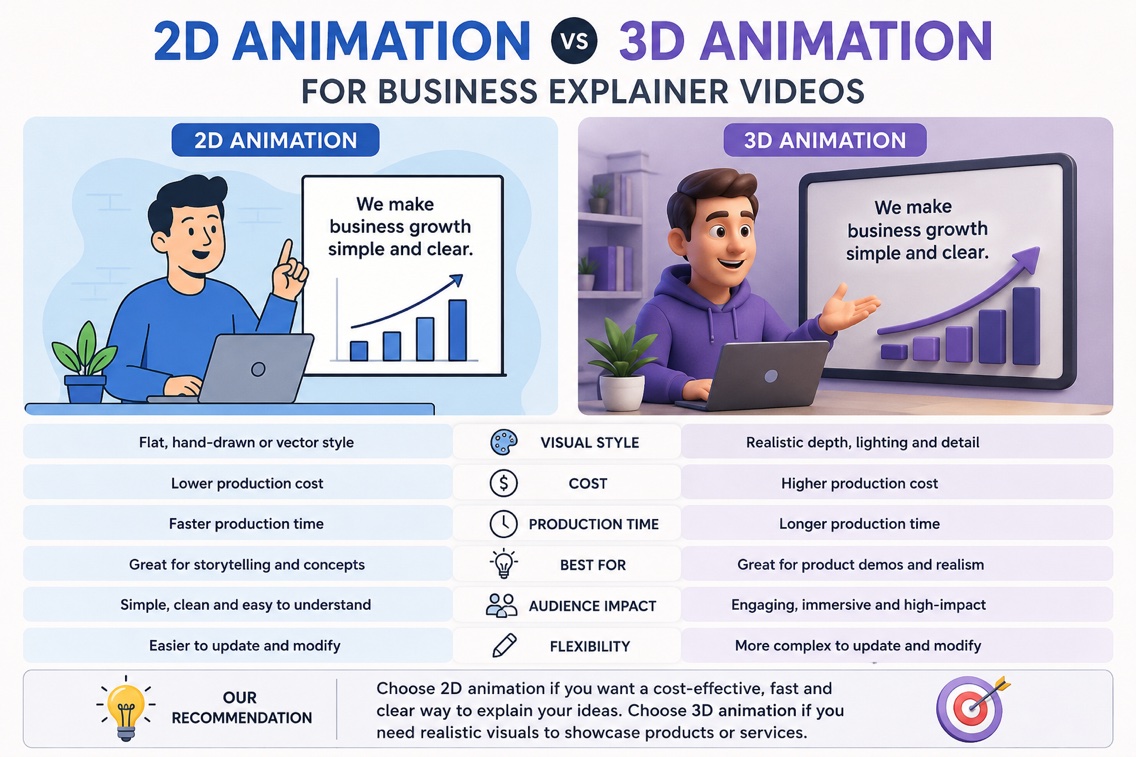
In the 2D animation vs 3D animation decision, 2D is the better choice for most business explainer videos, marketing content, SaaS, startups, fintech, and healthcare. It is faster, more cost-effective, and performs equally well for the majority of commercial use cases. 3D animation is the right choice when your project requires physical product visualisation, photorealistic rendering, or spatial depth that flat illustration cannot replicate. For most brands, 2D animation delivers better ROI for the same budget.
What Is the Core Difference Between 2D and 3D Animation?
Before choosing between them, you need to understand what separates the two formats at a technical level. The 2D animation vs 3D animation difference is not purely visual. It determines how your video is produced, how long it takes, what it can and cannot show, and how it performs across different platforms and audiences.
2D animation creates motion within a flat, two-dimensional plane. Characters, backgrounds, and graphic elements are drawn and animated across height and width, with no depth dimension in the production environment. In modern commercial production, studios use rigged digital characters built in software such as Toon Boom Harmony, Adobe Animate, or After Effects puppet tools, rather than drawing every frame by hand. The result is a flat, illustrated visual style that can range from clean minimal flat design to complex, expressive character animation depending on the style chosen.
3D animation builds digital objects and characters inside a three-dimensional virtual space. Models are constructed, textured, lit, and rendered from any camera angle. The viewer sees depth, shadow, reflection, and spatial perspective in ways that flat 2D illustration cannot replicate. Production software such as Cinema 4D, Autodesk Maya, and Blender handles the modelling, rigging, and rendering pipeline. Each rendered frame is essentially a digital photograph of a virtual three-dimensional environment.
The production workflow difference is where most budget and timeline decisions are actually made. A 2D production requires character illustration, rigging, and animation. A 3D production requires modelling, texturing, lighting setup, rigging, animating, and rendering. That is a significantly longer pipeline with more technical specialists required at each stage, which is why 3D costs more and takes longer at every quality tier.
Flat plane, illustrated style
Motion in two dimensions. Characters and environments are illustrated and rigged. Styles range from flat design to detailed frame-by-frame. Tools: Toon Boom Harmony, After Effects, Adobe Animate. Best for: explainer videos, marketing, SaaS, startups, healthcare, education, fintech.
Depth, volume, and realism
Motion in three dimensions. Models are built, lit, and rendered in a virtual 3D space. Can achieve photorealism. Tools: Cinema 4D, Maya, Blender, Unreal Engine. Best for: product visualisation, architecture, medical devices, engineering, VR, and high-end brand films.
Key Technical Differences at a Glance
| Factor | 2D Animation | 3D Animation |
|---|---|---|
| Visual space | Flat, two-dimensional plane | Three-dimensional virtual space with depth |
| Production workflow | Illustrate, rig, animate | Model, texture, light, rig, animate, render |
| Primary software | Toon Boom Harmony, After Effects, Adobe Animate | Cinema 4D, Maya, Blender, Unreal Engine |
| Rendering time | Fast (no 3D render required) | Long (each frame rendered from a 3D scene) |
| Camera angles | Fixed; new angles require redrawing the scene | Any angle instantly (camera moves freely in 3D space) |
| Asset reuse | Characters reused; scenes need redrawing for new compositions | Models repositioned, re-lit, and re-rendered for any new scene |
| Cost per minute | Lower at equivalent quality tier | Higher due to longer production pipeline |
| Ease of revision | Fast (illustration layers edited directly) | Slow (changes often require re-modelling and re-rendering) |
| Best for showing | Concepts, processes, characters, abstract value | Physical products, architecture, medical devices, environments |
When 2D Animation Is the Right Choice
For the majority of business video projects, 2D animation vs 3D animation resolves clearly in favour of 2D. The reasons are not purely financial. 2D is faster to produce, easier to revise, and better suited to the kind of storytelling that drives conversions in most commercial contexts. Here are the specific scenarios where 2D animation consistently outperforms 3D.
Explainer videos for services and software
When the goal is to explain what a product does and why a viewer should care, 2D animation is the most effective format. Explainer videos built with illustrated characters and clear scene transitions communicate abstract value propositions far more efficiently than 3D. The viewer does not need photorealism. They need clarity and emotional resonance, and 2D delivers both.
SaaS and technology companies
SaaS products live in screens and dashboards, not physical space. Showing a software product in 3D adds unnecessary complexity without adding clarity. 2D animation lets studios show the product interface, highlight the user journey, and explain the value in a flat, readable style that matches the product's own visual language. The result converts better because the audience can immediately visualise themselves using the product.
Startups and investor pitch videos
Early-stage companies need maximum impact from a limited production investment. 2D animation produces a polished, high-quality video at a fraction of the cost of 3D, with a faster turnaround that fits pre-launch timelines. For startups pitching investors or launching a product, a well-produced 2D animated explainer consistently outperforms a lower-budget attempt at 3D that looks unfinished. See our guide to explainer videos for startups and investors.
Healthcare patient education
Trust is the primary driver of engagement in healthcare. When a patient or carer evaluates a treatment option, a service, or a health app, they respond to warmth and relatability. A 2D animated character who looks like the viewer, experiencing the viewer's health situation, creates identification and trust that clinical 3D renders cannot replicate. Healthcare explainer videos that use 2D animation consistently outperform 3D equivalents in patient engagement and comprehension.
Education, training, and employee onboarding
Learning content benefits from the simplicity and visual hierarchy that 2D animation naturally provides. An illustrated character walking a learner through a process, combined with clear motion graphic overlays for data or steps, holds attention for longer than 3D equivalents and is easier to update when course content changes. 2D animation is the preferred format for corporate training and employee onboarding, where the goal is comprehension and retention, not visual spectacle.
Social media and paid advertising
Short-form content for social platforms requires fast production cycles and the ability to test and iterate quickly. 2D animation is quicker to produce and easier to revise than 3D, making it the practical choice for brands running multiple creative tests or updating messaging regularly. Most 15 to 30 second social ads perform just as well in 2D as in 3D at a fraction of the production investment.
Fintech and financial services
Financial products live in abstract concepts: savings rates, loan structures, investment returns, compliance frameworks. None of these benefit from 3D visualisation. 2D animation communicates abstract financial concepts with clarity, using illustrated characters and motion graphic overlays for data. It also carries a professional, trustworthy tone that resonates with regulated industry audiences. See how Magic Motion Studio approaches fintech explainer videos.
Where 2D animation has limitations
2D animation cannot show a physical product from multiple angles simultaneously without rebuilding scenes. It cannot achieve photorealistic rendering. For product categories where tactile realism drives purchase decisions, such as consumer hardware, luxury goods, or architectural spaces, the flat illustrated style can feel insufficient. These are precisely the scenarios where 3D animation earns its cost premium.
When 3D Animation Is the Right Choice
The 2D animation vs 3D animation decision shifts toward 3D when your project requires physical depth, photorealistic rendering, or the ability to show a product or environment in a way that feels tangible. These are the specific scenarios where the additional cost and timeline of 3D production are justified.
Physical product visualisation and e-commerce
When the product is a physical object and the viewer's purchase decision depends on understanding its form, materials, or function, 3D animation is the superior format. A rotating 3D render showing texture, materials, and ergonomics from every angle drives purchase intent in ways that flat illustration cannot. Consumer electronics, furniture, fashion accessories, and packaged goods are all categories where 3D earns its cost premium.
Architecture and real estate development
Property developers and architects use 3D animation to show buildings, interiors, and spaces that do not yet exist. A photorealistic walkthrough of an apartment building, a retail fitout, or a master-planned community communicates scale, light, and spatial relationships in ways that 2D illustration cannot replicate. For off-the-plan property sales and development approvals, 3D architectural animation is the industry standard.
Medical device and pharmaceutical visualisation
Medical devices, biological mechanisms, and pharmaceutical delivery systems often require three-dimensional visualisation to communicate accurately. Showing how a drug molecule interacts with a receptor, how a surgical device deploys inside the body, or how an implant interfaces with bone tissue demands the depth and realism that only 3D animation provides. Medical-grade animation for clinical or regulatory contexts is almost exclusively produced in 3D.
Gaming, VR, and immersive experiences
Interactive applications, virtual reality environments, and game cinematics require three-dimensional assets by definition. There is no meaningful 2D alternative for content that must exist within or interact with a 3D virtual space. Animation for gaming and VR is 3D by necessity, and the production pipeline for these projects intersects with game development rather than commercial video production.
Automotive, aerospace, and industrial engineering
Complex mechanical systems, vehicle interiors, and engineering components are explained most clearly through 3D animation. An exploded-view render of an engine, a cutaway of an aircraft hydraulics system, or a walkthrough of an industrial manufacturing process requires the spatial depth and mechanical precision that 3D modelling provides. These are high-investment productions where the complexity of the subject justifies the additional production cost.
High-end brand films and broadcast content
Premium consumer brands and broadcast television productions sometimes demand the cinematic quality of 3D animation for brand identity reasons. A luxury watch brand, a flagship vehicle launch, or a title sequence for a broadcast channel may require the visual richness that only 3D production delivers. These are brand-level decisions, not purely performance-driven ones, and the cost is absorbed by premium brand budgets.
Where 3D animation has limitations
3D animation has limitations that are frequently underestimated at the briefing stage. The production timeline is significantly longer than 2D, making it unsuitable for projects with firm deadlines under 10 weeks. Revisions mid-production are expensive, because changes to 3D models or scenes often require rebuilding assets rather than editing illustration layers. And for abstract or concept-driven content, 3D animation frequently over-engineers the visual when a clean 2D approach would communicate the same message more clearly, at lower cost and faster turnaround.
Not sure which animation style fits your project?
Submit a brief and Magic Motion Studio will recommend the right format based on your goal, audience, and timeline. No calls required.
2D Animation vs 3D Animation: Cost Comparison
Cost is the most immediate practical factor in the 2D animation vs 3D animation decision for most businesses, and the difference is significant. At the same quality tier, 3D animation costs considerably more than 2D, for structural production reasons that are worth understanding rather than just accepting as a given.
Industry data from animation production guides published in 2025 and 2026 consistently puts the cost gap between comparable 2D and 3D productions at approximately 2 to 3 times per minute of finished video. A 2D animation project at the professional tier costs a fraction of what a 3D project of equivalent length and quality would require. The reasons come down to pipeline length and the specialist skills required at each stage.
Here is what the 3D pipeline adds that 2D does not have:
- 3D modelling: every object, character, and environment must be built as a three-dimensional model before any animation begins. This is a specialised skill that adds significant pre-production time and cost.
- Texturing and shading: 3D models require detailed surface materials, textures, and shading to look convincing on screen. This is a separate discipline from both modelling and animation.
- Lighting setup: virtual lighting must be designed and adjusted for every scene. In 2D, lighting is part of the illustration and does not require a separate technical production stage.
- Rendering: every frame of a 3D animation must be rendered, a computationally intensive process that can take minutes to hours per frame for photorealistic output. 2D animation has no equivalent step.
- Compositing and post-production: rendered 3D elements often require compositing work before delivery. This adds time and cost that 2D productions typically absorb within the animation stage itself.
For businesses making the budget decision, the practical implication is this: at an equivalent production investment, a 2D animated video will typically be longer, more polished, or both, compared to what a 3D production can achieve for the same spend. The 2D version is also more likely to arrive on schedule, because the 3D pipeline is more prone to delays at the rendering and revision stages.
For a full breakdown of animation pricing by style and video length, see our 2D animation cost guide. Magic Motion Studio publishes transparent pricing at explainer-video-pricing with no discovery call required to get started.
2D Animation vs 3D Animation: Production Timeline
Timeline is the second major practical factor in the 2D animation vs 3D animation decision, and the gap is as significant as the cost difference. The production pipeline for 3D animation is fundamentally longer than 2D at every stage, which means longer delivery times, more revision cycles, and greater exposure to schedule overruns.
A professionally produced 60-second 2D animated explainer video typically takes 6 to 8 weeks from brief to delivery. This covers scriptwriting, storyboarding, illustration and character design, animation, voiceover, sound design, and final output. Simpler motion graphic styles can be delivered in 4 to 6 weeks. Detailed character animation with complex environments may take 8 to 12 weeks depending on scope.
A 60-second 3D animation at equivalent quality takes 8 to 12 weeks as a base estimate, with complex productions frequently running to 16 weeks or longer. The additional time comes entirely from the 3D-specific pipeline stages: modelling, texturing, lighting, and rendering. Rendering alone, for photorealistic output, can add multiple weeks to a production schedule. Each revision round after the initial render adds further delays because changes require re-rendering, not just file adjustments.
For businesses working to a launch date, conference presentation, or campaign deadline, the timeline difference between 2D animation production and 3D is often the deciding factor entirely independent of budget. A 3D production that takes twice as long is simply not available as an option when the deadline is firm.
| Video length | 2D Animation | 3D Animation |
|---|---|---|
| 30 seconds | 3 to 5 weeks | 6 to 9 weeks |
| 60 seconds | 6 to 8 weeks | 8 to 12 weeks |
| 90 seconds | 8 to 10 weeks | 12 to 16 weeks |
| 2 minutes | 10 to 14 weeks | 16 to 22 weeks |
| Revision speed | Fast — illustration layers edited directly | Slow — changes require re-modelling and re-rendering |
2D Animation vs 3D Animation by Industry
Industry context shapes the 2D animation vs 3D animation decision as much as budget and timeline do. Different industries have different audience expectations, different visual conventions, and different content goals. Here is how the choice maps across the sectors Magic Motion Studio works with most frequently.
| Industry | Recommended | Reason |
|---|---|---|
| SaaS and B2B Technology | 2D Animation | Product is software; 2D shows UI and user journeys more clearly. Professional audience expects clarity, not realism. |
| Healthcare (Patient-Facing) | 2D Animation | Trust and emotional connection drive engagement. Character animation builds empathy with patients and carers. |
| Healthcare (Medical Device / Clinical) | 3D Animation | Physical device mechanics, biological mechanisms, and surgical procedures require dimensional accuracy. |
| Fintech and Financial Services | 2D Animation | Abstract concepts explained through characters and data overlays. Professional tone. Regulated messaging. |
| Startups and Investor Pitches | 2D Animation | Narrative-driven and budget-efficient. Investor pitch videos benefit from storytelling, not photorealism. |
| E-commerce and Consumer Products | 3D Animation | Physical products require dimensional presentation. Tactile realism is a direct driver of purchase intent. |
| Architecture and Real Estate Development | 3D Animation | Spaces and structures require photorealistic walkthroughs for off-the-plan sales and development approvals. |
| Education and E-learning | 2D Animation | Character guides, simplified visuals, long-form attention retention. Easier to update as course content changes. |
| Government and Public Sector | 2D Animation | Plain language communication, accessible design standards, process explanation. Budget-efficient format. |
| Automotive and Industrial Engineering | 3D Animation | Mechanical systems and engineering components require spatial depth and dimensional precision. |
| Gaming and VR/AR | 3D Animation | Three-dimensional assets required by definition. No meaningful 2D equivalent for interactive 3D environments. |
| Consumer Apps and DTC Brands | 2D Animation | Brand personality and emotional engagement drive consumer conversions. 2D storytelling performs best. |
The Hybrid Approach: Using 2D and 3D in the Same Video
The 2D animation vs 3D animation debate sometimes presents a false binary. Many high-performing commercial videos combine both styles within a single production, using each format for the type of content it handles best. Understanding the hybrid approach can open options that a strict either-or decision closes off.
How hybrid animation works in practice
A hybrid video uses 2D illustration and character animation for the narrative and emotional arc, while integrating 3D renders for specific product moments, technical visualisations, or environmental details that require dimensional realism. The two styles coexist in the same video because they serve different content functions.
A typical hybrid structure: the video opens with a 2D animated character experiencing the target audience's problem. As the solution is introduced, a 3D render of the physical product appears, showing its form and function from multiple angles. The character interacts with the outcome (2D handles the character; 3D handles the product close-ups). The video closes with a motion graphic call-to-action. The viewer gets emotional engagement from the 2D narrative and product clarity from the 3D render in a single piece.
This approach costs more than pure 2D, typically 20 to 30 percent more depending on the complexity of the 3D elements. But it costs significantly less than a full 3D production, because only the specific moments requiring 3D are produced in that format. For companies with a physical product that also needs to explain an abstract value proposition, the hybrid approach is often the most commercially effective choice.
The hybrid approach is also useful for brands producing multiple video assets at different budget levels. A full 2D animated brand video serves as the primary homepage asset, while individual 3D product renders are integrated into shorter social or sales content. The two styles complement each other across a content ecosystem rather than competing within a single production decision.
For more on animation style decisions, see our guide to 2D animation vs motion graphics, which covers a related style distinction that frequently comes up alongside the 2D vs 3D question.
2D Animation vs 3D Animation: How to Choose
The 2D animation vs 3D animation decision becomes straightforward once you can answer five questions about your project. These are the questions Magic Motion Studio works through at the start of every brief to determine which format will perform best for a given client goal.
Is the subject a physical product or an abstract concept?
Physical products with form, material, and function that drive purchase decisions: lean toward 3D. Abstract services, software, financial products, healthcare services, and value propositions: lean toward 2D. If the answer is both, the hybrid approach is worth evaluating.
What is your production budget?
At the same quality tier, 3D costs 2 to 3 times more than 2D per minute of finished video. If budget is a real constraint, 2D will deliver a more polished, complete result for the same spend. A low-budget attempt at 3D almost always looks less professional than a well-executed 2D video at equivalent cost.
What is your delivery deadline?
If you have a firm launch date or campaign deadline within 10 weeks, 3D animation carries significant schedule risk. A complex 3D production for a 60-second video can take 12 to 16 weeks. 2D animation at the same length delivers in 6 to 8 weeks at most professional studios, with simpler styles available even faster.
Who is the audience and what tone do they expect?
Consumer audiences, healthcare patients, students, and startup ecosystems respond well to the warmth and character of 2D animation. Enterprise technical buyers, engineering decision-makers, and premium consumer brand audiences may expect or benefit from the spatial realism of 3D. Industry visual conventions carry more weight than most brands realise.
Will the content need updating within 12 months?
SaaS products, growing companies, and any brand with evolving messaging benefit from the update-friendliness of 2D animation. Revisions to a 2D video are handled at the illustration and animation layer. Revisions to a 3D video often require re-rendering entire scenes, which is time-consuming and expensive. For frequently updated content, 2D is the lower total cost of ownership over the life of the video.
Choose 2D Animation when:
- Your product is a service, software, or concept
- Budget efficiency is a priority
- Timeline is under 10 weeks
- Audience responds to warmth and storytelling
- Content may need updating in the next year
- Industry: SaaS, healthcare, fintech, education, startups, government
Choose 3D Animation when:
- Your product is physical and requires dimensional presentation
- Photorealism or spatial depth is essential to the message
- Timeline allows 12 to 16+ weeks
- Budget supports a 2 to 3x premium over 2D
- Content is stable and unlikely to need revision soon
- Industry: e-commerce, architecture, medical device, automotive, VR/gaming
How Magic Motion Studio Approaches Animation Style Selection
Magic Motion Studio is a Toon Boom Harmony studio with over a decade of experience producing 2D animation and motion graphics for clients across Australia, the United States, and the United Kingdom. The production team includes illustrators, character animators, riggers, and motion graphic designers working across the full range of 2D animation styles, from flat design and UI animation to detailed character animation and expressive illustrated storytelling.
For clients who need 3D product renders or architectural elements alongside 2D explainer content, we coordinate hybrid productions that deliver both styles to a consistent visual standard within the same project. The 3D elements are produced to match the colour palette, tone, and visual identity of the 2D work, so the finished video feels coherent rather than assembled from two different production pipelines.
For clients who are unsure which format best fits their project, we offer a brief review process that assesses content goals, audience, budget, and timeline before any production commitment is made. This typically produces a clear recommendation within 24 hours. View our explainer video examples to see 2D animation across different industries and use cases, and see our animation styles guide to understand the range of visual approaches available within the 2D format alone.
Once a style is chosen, measuring the performance of the finished video is as important as the production decision itself. Our guide to measuring explainer video ROI covers the framework for tracking results regardless of whether the video is 2D or 3D.
Frequently Asked Questions
Ready to start your animation project?
View Magic Motion Studio's transparent pricing for 2D animation and explainer video production. No discovery call required to get started.
Video marketing statistics sourced from Wyzowl State of Video Marketing 2026. Production cost and timeline data referenced from Vidico Animation Cost Guide 2026. Last updated September 2026.
Related Guides
- What Is 2D Animation? Complete Guide for Businesses
- 2D Animation Cost: Complete Pricing Guide
- 2D Animation Styles: Which Style Fits Your Brand?
- How Long Does 2D Animation Take to Produce?
- 2D Animation vs Motion Graphics: How to Choose
- What Is an Explainer Video? Types, Styles and Examples
- Explainer Video Examples That Convert
- How to Measure Explainer Video ROI