
Explainer Videos for Healthcare and Medical Devices: The Complete 2026 Guide
Explainer videos for healthcare serve six distinct functions: patient education, medical device demonstration, mechanism of action (MOA) animation, clinical trial explanation, staff training, and telehealth onboarding. Each type requires a different script register, visual approach, length, and compliance consideration. This guide covers all six video types, the difference between patient-facing and HCP-facing content, HIPAA and FDA compliance requirements, platform placement, and how to brief an animation studio on a medical project.
The healthcare industry has a communication problem that costs lives. According to the U.S. Department of Health and Human Services, only 12% of American adults have proficient health literacy. That means 88% of patients cannot reliably navigate standard medical documents, interpret prescription instructions, or fully understand a diagnosis explained in clinical language. Explainer videos for healthcare directly address this gap by translating complex medical information into formats that any patient can understand, remember, and act on.
But healthcare video is not one category. A 90-second animated video explaining a patient's upcoming knee replacement surgery is built entirely differently from a 2-minute mechanism of action animation presented to oncologists at a medical conference. Both are healthcare explainer videos. Both require medical accuracy and careful scripting. Beyond that, they share almost nothing: different audiences, different language registers, different visual approaches, different regulatory frameworks, and different success metrics.
This guide covers both sides of the category in full. It is written for hospital marketing teams, medical device manufacturers, pharmaceutical and biotech companies, health tech startups, and the agencies and studios that produce content for them. Every section covers the practical requirements of the format, the compliance considerations that shape production, and the measurable outcomes each video type is designed to achieve.
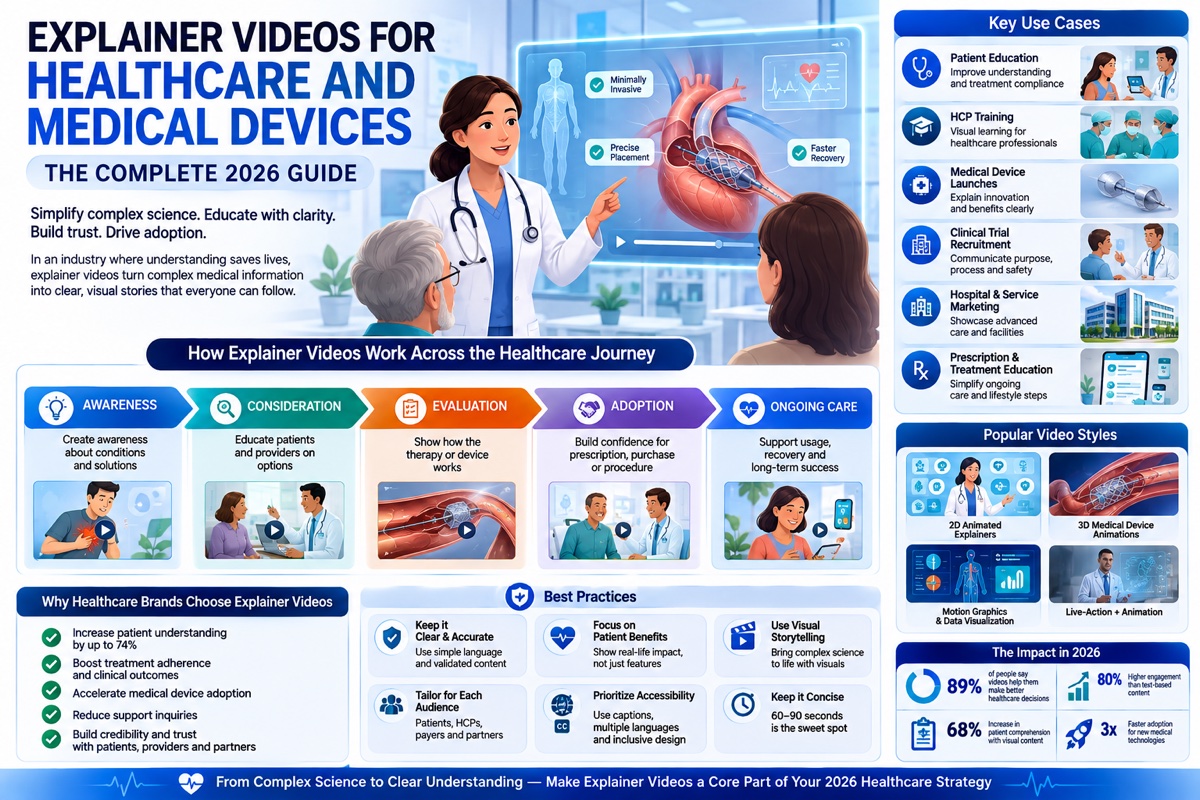
Sources: U.S. Department of Health and Human Services; Wyzowl State of Video Marketing 2026; Unbounce landing page research.
What Is a Healthcare Explainer Video?
The term covers a broad range of formats, but the definition is specific enough to distinguish it from general brand video or corporate communications.
A healthcare explainer video is an animated or live-action video that simplifies complex medical, clinical, or device-related information for a defined audience: patients, caregivers, healthcare professionals (HCPs), or medical device purchasers. Unlike general marketing video, healthcare explainer videos must balance accessibility for comprehension with medical accuracy, regulatory compliance, and audience-appropriate language and visual conventions.
The category includes patient education videos, mechanism of action (MOA) animations, medical device demonstrations, clinical trial explanation videos, healthcare staff training content, and telehealth onboarding videos. Each has distinct production requirements, script standards, and compliance considerations.
Why Brands Choose Explainer Videos for Healthcare Marketing and Education
The case for video in healthcare is stronger than in almost any other vertical, for a specific reason: the stakes of miscommunication are higher. When a patient misunderstands a medication dosing schedule, or a surgeon misinterprets a device implant technique, the consequences are clinical, not commercial. Animation gives healthcare communicators precise control over every visual and verbal element of the message in a way that live video, brochures, or verbal explanation cannot match.
- 1
The Health Literacy Gap Is Structural, Not Incidental
With 88% of U.S. adults lacking proficient health literacy, written patient materials written at a clinical level are functionally inaccessible to most of the people they are meant to serve. Animated video with plain language narration and visual demonstration of concepts removes the reading comprehension barrier entirely. Research published in the Journal of Medical Internet Research consistently shows that video-based patient education improves comprehension and recall compared to written materials across a range of conditions and interventions.
- 2
Animation Shows What Photography and Live Video Cannot
A cardiac catheter navigating an arterial pathway. A biologic binding to a receptor site. An implant being seated in a vertebral body. These are processes that no camera can capture cleanly in a clinical or commercial context. Medical animation visualises mechanisms, anatomical pathways, and device functions at any scale, from the molecular to the whole-body, with full control over perspective, lighting, and detail. This capability is irreplaceable in MOA animation, device demonstration, and surgical technique education.
- 3
Video Improves Treatment Compliance and Informed Consent
Patients who receive video-based pre-procedure education report better understanding of what to expect, lower pre-procedural anxiety, and higher rates of follow-through on post-procedure care instructions. For healthcare providers, better-informed patients reduce the volume of inbound calls asking questions that have already been answered, and increase the efficiency of in-person consultations because the baseline understanding is already established before the appointment begins. This is why explainer videos for healthcare have become a standard patient engagement tool across hospital systems, specialty clinics, and telehealth platforms alike.
- 4
Medical Device Companies Need Controlled, Scalable HCP Education
A sales representative can deliver a device presentation to a finite number of surgeons or specialists per week. A device demonstration video, accurately scripted and medically reviewed, can be delivered simultaneously to every target HCP across every territory, in every sales tool, at every conference booth, and via every digital channel without additional marginal cost. The message is consistent. The clinical claims are controlled. And the presentation quality does not vary by sales rep.
- 5
Animation Is Inherently Regulatory-Safe for Sensitive Medical Topics
Live video in healthcare carries significant risks: patient privacy concerns, the impossibility of showing real surgical procedures in marketing contexts, and the challenge of depicting clinical outcomes without misrepresenting results. Animation sidesteps these risks because illustrated characters are not real patients, depicted procedures are stylised rather than documentary, and every visual element is deliberately designed rather than captured. This gives medical marketers and compliance teams a level of control over the final content that live production cannot offer.
6 Types of Explainer Videos for Healthcare: A Complete Reference
Not all explainer videos for healthcare serve the same purpose. Understanding which type matches your communication goal is the first decision in any healthcare video project.
Patient Education Videos
Explain conditions, diagnoses, treatment options, and post-procedure care to patients and caregivers. Use plain language (Grade 6 to 8 reading level), relatable animated characters, and empathetic framing designed to reduce anxiety and build understanding rather than alarm.
Medical Device Demo Videos
Show healthcare professionals exactly how a device works, how it is implanted or operated, what the clinical benefit is, and how it differs from existing solutions. These require close collaboration with clinical and regulatory teams to ensure all depicted claims are on-label and supported by cleared data.
Mechanism of Action (MOA) Animations
Visualise how a drug, biologic, or therapeutic intervention works at a cellular, molecular, or physiological level. Produced for pharmaceutical and biotech companies targeting prescribing physicians, clinical researchers, and payers. Require scientific accuracy review by a qualified medical advisor before animation begins.
Clinical Trial Explanation Videos
Help eligible patients understand what participation in a clinical trial involves: the protocol, the timeline, the randomisation process, the risks and benefits, and the consent process. Reducing the information barrier to trial enrolment is one of the most direct ways animation contributes to evidence generation in medicine.
Healthcare Staff Training Videos
Onboard new clinical and administrative staff, explain updated protocols, demonstrate correct technique for equipment use, and communicate compliance requirements across a distributed workforce. Longer than patient-facing content because the viewing context is structured and completion is often required rather than voluntary.
Telehealth Onboarding Videos
Walk new patients through the process of accessing and using a digital health platform: booking an appointment, joining a video consultation, navigating the patient portal, and uploading documents. These reduce inbound support requests and increase the rate of successful first telehealth appointments for patients who are unfamiliar with digital health tools.
Medical Device Explainer Videos: What Makes Them Different
Medical device video is a specialised subset of explainer videos for healthcare that operates under a distinct set of commercial, clinical, and regulatory requirements. The primary difference is audience: where patient education videos are written for people with limited medical knowledge, medical device videos are produced for clinicians who will scrutinise the accuracy of every depicted detail.
HCP Audiences Have Zero Tolerance for Clinical Inaccuracy
A surgeon watching a device demonstration animation will immediately notice if the depicted anatomical approach does not match accepted surgical technique, if the device is shown in an implant position that conflicts with the instructions for use, or if the illustrated mechanism does not accurately represent what the device physically does. Unlike consumer marketing where a degree of creative licence is acceptable, medical device video that contains clinical inaccuracies will actively damage the credibility of the product and the company behind it. Every frame that depicts clinical use must be validated by a clinical expert before the animation is finalised.
Mechanism of Action Animation for Pharma and Biotech
MOA animation is one of the most technically demanding formats in the medical video category. The animation must accurately represent the biological mechanism at the correct anatomical scale, show the drug or biologic interacting with its target in a scientifically defensible way, and do so in a visual language that is accessible to the prescribing physician audience without oversimplifying to the point of inaccuracy. The production workflow for MOA animation requires a scientific accuracy review at script stage, a second review at storyboard stage when the visual representation is first committed to, and a final review of the finished animation before distribution. Studios that skip any of these review stages expose their pharma clients to significant regulatory and reputational risk.
Conference and Trade Show Use
Medical device explainer videos are a primary asset at industry conferences including HIMSS, AdvaMed MedTech, EuroPCR, and specialty society meetings. Conference booth screens run looping device demo videos that stop floor traffic and communicate the core value proposition in the 60 to 90 seconds a passing attendee is willing to give. These must be immediately compelling in the first 5 seconds, work without sound (conference floors are loud), and convey the key clinical message even to viewers who only watch 30 seconds of a 90-second video. Designing for partial viewing is a specific production skill that general marketing animation studios often lack.
Surgical Technique and Training Applications
Beyond marketing, medical device companies produce surgical technique videos for use in cadaver lab training, surgical residency programmes, and continued medical education (CME) content. These longer-form videos (often 4 to 12 minutes) walk through the complete surgical approach step by step, showing correct instrument handling, anatomical landmarks, implant positioning, and intraoperative decision points. Animation is used alongside or instead of live surgical footage because it provides a consistent, idealized view of the technique that live footage cannot always capture cleanly. For medical device manufacturers evaluating the full range of explainer videos for healthcare, long-form surgical technique animation represents one of the highest-stakes applications in the category.
HIPAA and Regulatory Compliance for Healthcare Video
One of the most common questions from healthcare marketing teams commissioning explainer videos for healthcare is whether the production process creates compliance exposure. The short answer is that well-produced animated healthcare video is one of the most compliance-friendly formats available, precisely because it gives producers complete control over every element depicted. Here is what actually matters for compliance.
This section provides general guidance on compliance considerations for healthcare video production. It is not legal advice. Healthcare organisations should consult their compliance and legal teams before finalising any regulated video content.
HIPAA and Patient Privacy
Animated characters are not real patients and do not constitute protected health information (PHI) under HIPAA. A video that uses illustrated patient characters to depict a medical condition, treatment journey, or healthcare experience carries no HIPAA risk in the animation itself. HIPAA compliance becomes a production concern only when the video incorporates real patient images, real patient testimonials, identifiable case data, or footage from actual clinical encounters. In those cases, written patient authorisation is required before any such content is captured, used, or published.
- ✓Animated characters: No HIPAA concern. Illustrated characters are not real patients and do not contain PHI.
- ✓Real patient testimonials: Require written HIPAA-compliant authorisation before filming and before publication.
- ✓De-identified case data: May be used in scripts without patient authorisation if all 18 HIPAA identifiers are removed.
- ✓Staff and clinician appearances: Require informed consent from every individual who appears on camera or whose voice is recorded.
- ✓Archive or stock clinical footage: Verify rights and patient authorisation status before incorporating into any published video.
FDA Guidelines for Medical Device Marketing Video
The FDA regulates promotional materials for medical devices including video content used in marketing, sales, and training. Key requirements for device marketing video include: all clinical performance claims must be supported by cleared or approved indications for use; the video must not make off-label claims about uses that have not been reviewed and cleared by the FDA; any quantitative outcome data shown must be based on valid clinical study data; and the video must not be misleading through omission of material risk information. Animation is widely used in FDA-regulated device marketing precisely because every frame is designed rather than captured, making it easier to ensure all depicted content stays within cleared indications. Working with a studio that has experience in regulated medical device content is essential to avoid costly post-production compliance revisions.
Accessibility Requirements
Healthcare video distributed through federally funded healthcare providers or through platforms subject to Section 508 of the Rehabilitation Act must meet accessibility standards. At minimum, this means accurate closed captions on all dialogue and narration, audio descriptions of key visual elements for visually impaired viewers, and content that meets WCAG 2.1 AA standards when embedded in a web page. For patient-facing content distributed to a general public audience, meeting these standards is both a legal requirement in many contexts and a quality signal that reflects the organisation's commitment to equitable care access. Any studio commissioned to produce explainer videos for healthcare should confirm accessibility deliverables as part of the standard production scope before work begins.
Producing a healthcare or medical device video?
We produce medically accurate animated explainer videos for hospitals, device manufacturers, pharma, and health tech companies.
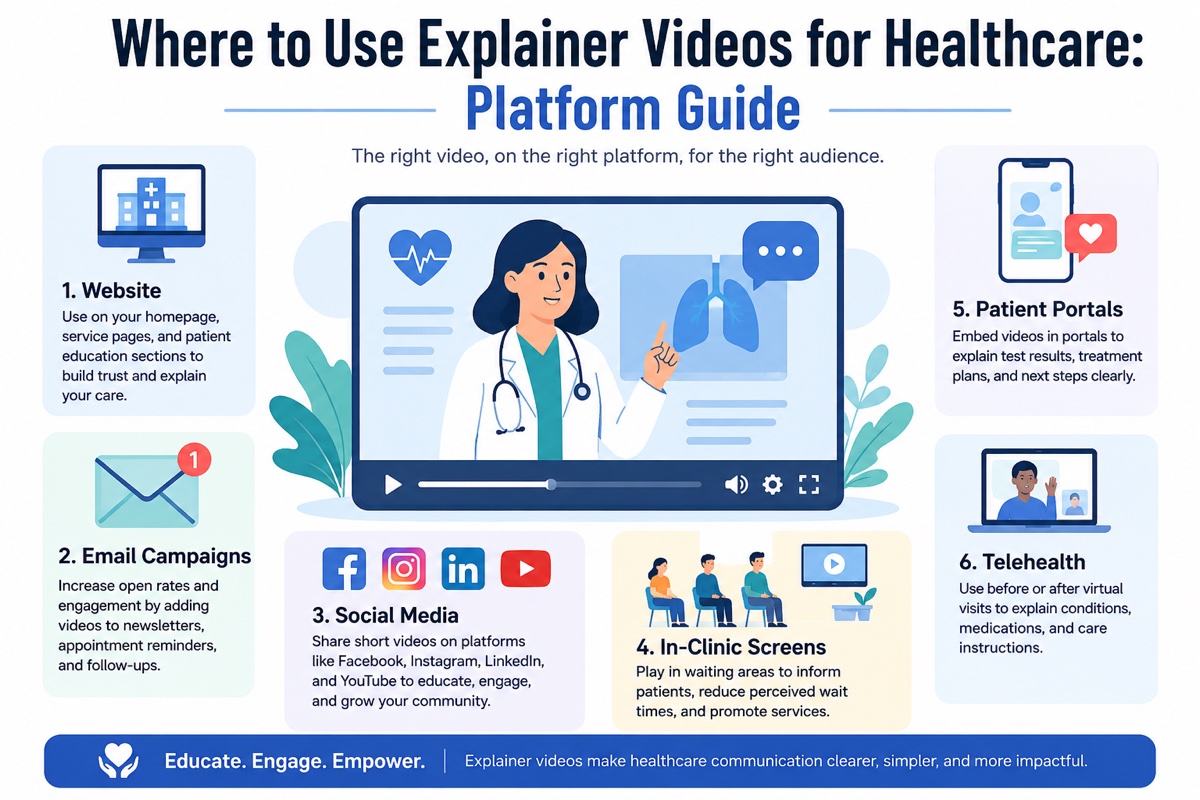
Where to Use Explainer Videos for Healthcare: Platform Guide
The most effective healthcare video strategies are not built around a single asset on a single channel. Each video type belongs on specific platforms that match where the target audience is at the moment they need that information most.
Patient Portals and Hospital Websites
The primary home for patient education content. Embed procedure preparation videos on appointment confirmation pages, condition explanation videos on condition-specific landing pages, and post-procedure care videos in the patient portal after a procedure is completed. Video at this placement reaches patients at exactly the moment they need the information, reducing anxiety-driven phone calls and improving care compliance.
- Condition and diagnosis explanation videos
- Pre-procedure preparation videos
- Post-procedure care instruction videos
- Telehealth platform onboarding videos
HCP Sales Presentations and Detail Aids
Medical device demo videos and MOA animations embedded in sales representative presentation decks deliver a consistent, controlled clinical message to target HCPs during one-on-one detailing sessions. A 60 to 90-second device demonstration that a rep can trigger mid-conversation is significantly more persuasive than verbal description alone because it shows rather than tells. Digital detail aids (iPad-based or browser-based) can embed these videos with interactive elements that allow HCPs to explore specific device features.
- Medical device demonstration videos
- MOA animations for pharma detailing
- Competitive differentiation animations
- Surgical technique overview videos
Medical Conferences and Trade Shows
Conference booth video screens running looping device demonstrations and MOA animations stop floor traffic and communicate clinical value to passing HCPs who have no time to read a brochure. Videos designed for conference use must work without sound (subtitles required), be visually compelling in the first 3 to 5 seconds, and convey the core clinical message to a viewer who only watches 20 to 30 seconds of a longer piece. Conferences like HIMSS, AdvaMed, ESC, and the major specialty society meetings attract the most concentrated audiences of target HCPs of any channel available.
- Device demo loops for booth screens
- MOA animations for symposium presentations
- Product launch announcement videos
YouTube and Social Media
YouTube is the second-largest search engine and the primary platform where patients research their conditions before, during, and after a clinical encounter. Patient education videos optimised for YouTube search capture high-intent viewers at the moment they are actively seeking to understand their diagnosis or treatment options. LinkedIn is the primary B2B channel for medical device and health tech marketing, reaching hospital administrators, procurement decision-makers, and clinical leadership. Patient-facing content performs well on Facebook and Instagram for condition awareness campaigns targeting specific patient communities. Across all platforms, explainer videos for healthcare perform best when produced for the specific viewing context (sound-on or sound-off, short-form or long-form) rather than repurposed from an asset built for a different channel.
- YouTube: patient education, condition explainers
- LinkedIn: device launches, health tech B2B
- Facebook/Instagram: patient awareness campaigns
Healthcare Video Use Cases: Full Reference Table
The following table maps the most common healthcare explainer video use cases to the relevant video type, audience, platform, goal, and ideal length. Use this as a planning reference when scoping a new healthcare video project.
| Use Case | Video Type | Audience | Platform | Length |
|---|---|---|---|---|
| Explaining a hip replacement procedure | Patient education | Patient | Hospital website, patient portal | 90-120 sec |
| Launching a new cardiac stent | Medical device demo | HCP | Sales deck, conference booth | 60-90 sec |
| Explaining a biologic's mechanism | MOA animation | HCP / Researcher | Medical conference, detail aid | 90-180 sec |
| Recruiting for a Phase III trial | Clinical trial explainer | Patient | Trial recruitment sites, advocacy groups | 90-150 sec |
| Onboarding new nursing staff | Staff training video | Clinical Staff | Internal LMS, intranet | 3-8 min |
| Guiding patients through telehealth app | Telehealth onboarding | Patient | App onboarding, welcome email | 60-120 sec |
| Explaining medication dosing schedule | Patient education | Patient | Pharmacy portal, patient portal | 60-90 sec |
| Demonstrating surgical implant technique | Surgical technique training | Surgeon / Resident | Cadaver lab, CME platform | 4-12 min |
| Health tech platform investor pitch | Product demo explainer | Investor / Payer | Pitch deck, website hero | 60-90 sec |
5 Best Practices for Explainer Videos for Healthcare
The most common reasons explainer videos for healthcare underperform are not production quality issues. They are strategic and process failures that could have been prevented before a single frame of animation was produced.
1. Segment Your Audience Before Writing a Single Line of Script
The single most impactful decision in any healthcare video project is defining the specific audience with precision before scripting begins. A patient education video written for a 65-year-old patient with limited digital literacy requires a completely different script, visual approach, and reading level than a device demo written for an interventional cardiologist with 20 years of clinical experience. Scripts that try to serve both audiences simultaneously serve neither. Define one primary audience per video. If your project requires content for multiple distinct audiences, produce multiple videos rather than one compromised piece.
2. Complete Medical Accuracy Review Before Animation Begins
The most expensive mistake in healthcare video production is discovering a clinical inaccuracy after the animation is complete. Animation is labour-intensive to revise: changing the depicted position of an anatomical structure, altering the illustrated mechanism of a device, or correcting the sequence of a depicted procedure can require redrawing and re-animating dozens of individual frames. All of this cost is avoided by conducting a thorough medical accuracy review at the script stage and a second visual review at the storyboard stage, before any animation is produced. Studios that skip these review stages in the interest of moving faster invariably produce slower, more expensive projects overall.
3. Match Video Length to Content Complexity and Viewing Context
Patient education videos should stay between 60 and 120 seconds for most condition and procedure topics. MOA animations can run to 180 seconds for complex biologics targeting specialist physician audiences. Medical device demos for use in sales presentations should stay at 60 to 90 seconds so a representative can play the video mid-conversation without losing the HCP's attention. Staff training videos are the exception to the brevity rule because viewing is required, structured, and the content volume genuinely requires more time to cover adequately. Forcing any of these formats into the wrong length either compresses information to the point of uselessness or pads content to the point of disengagement.
4. Build Accessibility Into the Production Brief, Not as an Afterthought
Closed captions, audio descriptions for key visual sequences, and plain language scripts are not optional additions to healthcare video — they are baseline requirements for equitable health communication and, in many contexts, legal obligations. Captions added post-production from auto-generated transcripts are frequently inaccurate, particularly for medical terminology. Script-accurate captions should be produced during post-production as part of the standard deliverable set, not retrofitted later. Audio descriptions for complex visual sequences (animated MOA content, device implant animations) should be scripted and recorded in parallel with the primary narration track, not added at the end of the project.
5. Conduct Regulatory Review at Script Stage for Any Device or Drug Video
For medical device and pharmaceutical companies, regulatory review of promotional video content is not a post-production step. It is a pre-production requirement. Having your regulatory affairs team review and approve the script before animation begins means that every visual element subsequently produced is based on a reviewed and approved narrative. Regulatory changes requested after animation is complete — removed claims, amended risk disclosures, altered mechanism depictions — add significant time and cost to any project. For any video that will be used in the promotion of an FDA-regulated product, regulatory sign-off on the script is the single most important process control available.
How to Brief an Animation Studio on a Healthcare Video Project
Commissioning explainer videos for healthcare from an animation studio that does not work regularly in the medical space is one of the most avoidable sources of project delays, compliance risk, and budget overruns. The brief is the document that establishes whether the studio you are working with understands the requirements. A comprehensive healthcare video brief covers the following elements.
Primary Audience Definition
Name the specific audience for this video: patients with a specific condition, cardiologists in a defined clinical context, nursing staff at a specific hospital system, or clinical trial recruiters targeting a particular demographic. Include the estimated health literacy level if the audience is patient-facing. Include the clinical speciality and level of training if the audience is HCP-facing. The studio's script approach, language choices, visual style, and animation complexity are all driven by this single input more than any other.
Regulatory and Compliance Context
State upfront whether the video is subject to FDA, TGA, CE marking, or other regulatory frameworks. Provide the cleared or approved indications for use for any device or drug content. Name the regulatory affairs reviewer who will need to sign off on the script before animation begins, and establish the expected review timeline. If the video will be used in any context that triggers Section 508 or WCAG accessibility requirements, state this in the brief so the studio can build compliant caption and audio description deliverables into the production schedule from the start.
Medical and Scientific Reference Materials
Provide all relevant clinical and technical documentation: instructions for use (IFU), clinical study reports, published literature supporting mechanism or efficacy claims, anatomical reference images, device engineering drawings or 3D CAD files where available, and any existing brand or creative assets. Studios that work in the healthcare space will use these materials as the primary reference for animation accuracy rather than general anatomical or stock imagery. The more complete the reference package provided at brief stage, the fewer accuracy revisions are required during production.
Approval Workflow and Stakeholder Map
Healthcare video projects characteristically involve more approval stakeholders than general commercial video: marketing, medical affairs, regulatory affairs, legal, and sometimes clinical leadership or an external medical advisor. Establishing the approval workflow, the order of review, the number of revision rounds included in the project scope, and the turnaround time expected from each reviewer before production begins is essential for maintaining a realistic project timeline. Undefined approval processes are the most common cause of healthcare video project delays — not animation production speed. See the full storyboard and approval process we follow for all production projects.
Frequently Asked Questions
What is a healthcare explainer video?
A healthcare explainer video is an animated or live-action video that simplifies complex medical, clinical, or device-related information for a defined audience: patients, caregivers, healthcare professionals, or medical device purchasers. The category includes patient education videos, mechanism of action animations, medical device demonstrations, clinical trial explanation videos, staff training content, and telehealth onboarding videos. Each type has distinct production requirements, script standards, and compliance considerations. See our full guide to what an explainer video is for a broader overview of the format.
Are healthcare explainer videos HIPAA compliant?
Animated healthcare explainer videos are inherently HIPAA-friendly because they use illustrated characters rather than real patient images or identifiable health information. HIPAA compliance becomes relevant when a video includes real patient testimonials, photos, or identifiable case data — in those cases, written authorisation from the patient is required before production. The animation script itself is not protected health information, so the production process carries no HIPAA risk when working with a professional studio on a fully animated project.
How long should a medical explainer video be?
Length depends on the audience and content type. Patient education videos perform best at 60 to 120 seconds. Mechanism of action animations for HCPs can run 90 to 180 seconds because the audience is trained and motivated to engage with detail. Medical device demos for sales presentations work well at 60 to 90 seconds, and 2 to 4 minutes for in-depth training applications. Staff training videos are the exception — these can run 3 to 8 minutes because the viewing context is structured and completion is typically required. For more context on video length strategy, see our guide on explainer video production.
What is a mechanism of action (MOA) animation?
A mechanism of action (MOA) animation is a medically accurate animated video that shows how a drug, biologic, or therapeutic intervention works at a cellular, molecular, or physiological level. MOA animations are used by pharmaceutical and biotech companies to explain drug mechanisms to prescribing physicians, at medical conferences, in clinical training, and in regulatory submissions. They require close collaboration between the animation studio and a medical or scientific reviewer to ensure the depicted biology is accurate and the visual representation does not mislead about the mechanism.
Can animated explainer videos be used for FDA-regulated medical devices?
Yes, animated explainer videos are widely used in FDA-regulated medical device marketing and education. All clinical claims in the video must be supported by cleared indications for use, and the video must not make off-label claims. Animation is particularly useful for device marketing because it can show internal mechanisms, correct implant technique, and anatomical placement with complete visual control — without any risk of depicting a specific patient's procedure or capturing footage that conflicts with cleared indications. Regulatory affairs review of the script before animation begins is essential for any FDA-regulated device video.
What is the difference between a patient education video and an HCP-facing medical video?
Patient education videos use plain language, relatable animated characters, and empathetic framing designed to reduce anxiety. HCP-facing videos — device demos, MOA animations, surgical technique videos — assume clinical training, use correct anatomical terminology, and are designed to inform clinical decision-making rather than reduce fear. Both types require medical accuracy review, but the tone, depth, visual style, and language register are fundamentally different. Understanding which type your project requires is the first decision in commissioning explainer videos for healthcare from any animation studio. See our healthcare video production services for full details on both formats.
Healthcare video done right
We produce medically accurate animated explainer videos for hospitals, medical device manufacturers, pharmaceutical companies, and health tech brands. Every project includes clinical accuracy review, compliance-ready deliverables, and accessible caption files.
See Our Healthcare Video Services →Free strategy call included. No obligation.
Related Guides
The guides below provide additional context for healthcare organisations and medical brands commissioning explainer videos for healthcare. Each covers a format or decision directly relevant to medical and health tech video projects.
- What Is 2D Animation? Complete Guide for Businesses
- 2D Animation Studio: Character Animation & Motion Graphics
- What Is an Explainer Video? Types, Styles and Examples
- Explainer Video Examples That Convert: 12 Real-World Results
- How to Measure Explainer Video ROI
- Explainer Video Storyboard: What to Expect
- Explainer Videos for Government and Education
- Explainer Video Cost in the USA: 2026 Pricing Guide
- Patient Education Videos: Animated vs Live Action
- Medical Device Explainer Videos: The Compliance Guide
- Healthcare Explainer Video Examples: 12 Verified Breakdowns