
Medical Device Explainer Videos: The Compliance-First Guide
Medical device explainer videos differ from every other kind of marketing video in one decisive respect: the script is a regulated document. What the video claims, what it shows, and even which single word it uses to describe regulatory status can put a manufacturer in breach. Most device marketing content fails not because the animation was weak but because the claim was not substantiated, the visual depicted an unapproved use, or the voiceover said FDA approved when the device was FDA cleared. Get the compliance layer right at script stage, segment for the six real audiences, and the production itself becomes straightforward.

Note on scope. This article is general guidance for marketing and communications teams planning medical device explainer videos. It is not legal or regulatory advice. Regulatory requirements vary by device classification, by market, and by the specific claims made. Confirm any claim strategy with your own regulatory affairs and legal teams before production begins.
Cleared is not approved. Most devices reach the United States market through 510(k) clearance, not premarket approval. Saying FDA approved about a cleared device misstates its regulatory status.
Visuals can promote off-label, even when the script does not. An animation showing use outside the cleared indication is itself promotional content.
Six audiences, not one. Clinicians, patients, hospital value analysis committees, sales teams, investors and trainees need materially different medical device explainer videos.
Regulatory review belongs at script and storyboard. Review at picture lock turns a wording change into a rebuild.
A United States master script rarely clears in Australia unchanged. TGA restricted representations require approval before the advertisement runs.
Almost every guide to medical device explainer videos treats them as ordinary explainer videos with clinical subject matter. They are not. A consumer software explainer that overstates a benefit produces a disappointed customer. A device video that overstates a benefit can render the product misbranded.
That difference should shape every decision in medical device explainer videos, and in most published guidance it shapes nothing. The two most substantial pages currently ranking for this topic devote a single passing mention to regulatory status between them. For a marketing manager whose script has to survive review by regulatory affairs, medical affairs and legal, that is the part that actually determines whether the project ships.
This guide to medical device explainer videos starts with the compliance layer, then covers audience segmentation, format selection, the review workflow, and measurement. For the broader category see our overview of explainer videos for healthcare, and for patient-facing work specifically, our comparison of animated and live-action patient education videos.
The Compliance Layer in Medical Device Explainer Videos
This is the section on medical device explainer videos that does not exist anywhere else in the search results for this topic, and it is the one that determines whether a project reaches release. Four issues account for most regulatory problems in device video.
1. Cleared is not approved, and the distinction is not cosmetic
There are two principal routes to the United States market, and they confer different regulatory statuses with different permitted language.
| Pathway | What it demonstrates | Correct term | Typical devices |
|---|---|---|---|
| 510(k) premarket notification | Substantial equivalence to a legally marketed predicate device | Cleared | Most Class II devices, such as MRI scanners and intravenous infusion pumps |
| Premarket approval (PMA) | Reasonable assurance of safety and effectiveness, generally supported by clinical trials | Approved | High risk Class III devices, such as pacemakers |
| Class I general controls | Compliance with general controls, many devices exempt from premarket notification | Neither term applies | Low risk devices, such as bandages and nonelectric wheelchairs |
Classification and pathway per the United States Food and Drug Administration. Sources listed at the end of this article.
The practical consequence for medical device explainer videos is specific. A 510(k) pathway device is cleared. Describing it as FDA approved in a voiceover, an on-screen caption, or a video description misstates its regulatory status. It is among the most frequent errors in device marketing content and among the easiest to avoid, because it is a single word.
It also appears in places teams forget to review. The script goes through regulatory affairs. The YouTube description, the thumbnail text, the social caption and the landing page headline frequently do not.
2. Intended use and off-label promotion
Regulators determine a device's intended use from a broad body of evidence, and medical device explainer videos sit squarely inside it. That evidence includes including labelling claims, advertising material, and written or spoken statements by the manufacturer. A promotional video is squarely within that body of evidence.
The asymmetry that catches teams out is this. A clinician may use a device off-label at their own clinical discretion. The manufacturer may not encourage, suggest or promote that use. So a practice that is common, clinically reasonable, and widely discussed at conferences can still be something your video cannot depict.
In written material, off-label risk lives in the claims. In medical device explainer videos it frequently lives in the visuals, where nobody is looking for it.
A script can be entirely compliant while an animated sequence shows the device deployed in an anatomical location outside the cleared indication, used in a patient population it was not cleared for, or positioned alongside a step that implies a broader workflow than the labelling supports. The animator was working from a clinical reference image and had no way to know the distinction mattered.
This is why storyboard review by regulatory affairs matters as much as script review. The script is not the only thing making claims.
3. Claim substantiation in medical device explainer videos
Claims made in medical device explainer videos must be supported by scientifically valid evidence at the time the claim is made. In practice this means every comparative or performance statement in a device video needs a source attached before it reaches a storyboard.
Statements that require substantiation include anything about speed, accuracy, durability, patient outcomes, complication rates, or comparison against alternatives. Marketing language that would pass without comment in another sector, such as describing something as the most advanced or the safest option available, becomes a substantiation problem here. If there is no study behind it, it cannot go in.
A useful discipline is to build a claims matrix before scripting: every claim in one column, its evidentiary source in the next, and the reviewer who signed it off in the third. Scripts written from an approved claims matrix move through review far faster than scripts written first and evidenced afterwards.
4. Medical device explainer videos for products not yet cleared
Pre-clearance communication is tightly constrained, and medical device explainer videos made at this stage carry specific obligations. Display of a device under a pending 510(k) notification at a trade show is permitted for the intended use that is the subject of that pending notification, and must carry a clear statement that the device is pending 510(k) and not available for sale within the United States.
For video this means a pre-clearance asset needs that statement designed into it rather than added as a caption afterwards, and it means the asset has a defined expiry: once clearance arrives, the disclaimer has to be removed, which is a scheduled edit that somebody must own.
5. Australia and the TGA
Teams localising medical device explainer videos from a United States master script routinely assume Australian release is a formality. It is not. The Therapeutic Goods Administration operates a system of restricted and prohibited representations that has no direct United States equivalent.
Restricted representations refer to serious conditions, defined as those requiring a health professional to diagnose, follow up or treat. They must not be used in advertising directed at the public unless approval or permission is in place before the advertisement runs. Published examples of restricted representations include references to diabetes, foot nervous system damage and amputation. Approval is granted only where the representation is accurate, balanced and not misleading.
The practical implication for medical device explainer videos is that a script written for a United States audience may name a condition that cannot be named in Australian public-facing advertising without prior approval. That is a scripting decision, not a localisation decision, and it needs to be identified before production rather than during Australian release.
Build a house list and circulate it to whoever writes scripts. At minimum it should flag: approved (correct only for PMA devices), proven, safe, painless, cure, eliminates, guaranteed, best, most advanced, first, only, and any unqualified comparative such as better than or faster than.
None of these are automatically prohibited. Each is a point where a writer must be able to name the evidence or accept that the word comes out. Flagging them at draft stage costs minutes. Discovering them at legal review costs weeks.
The Six Audiences for Medical Device Explainer Videos
The second structural failure in medical device explainer videos, after compliance, is producing one general asset for an audience that is really six audiences with incompatible needs. Content pitched at all of them persuades none of them.
Clinicians and specialists
They want mechanism, evidence, and procedural specifics. They are sceptical by training and will disengage from anything that reads as promotional rather than informational. Clinical terminology is appropriate here and simplification is counterproductive.
Patients and carers
Usually anxious, frequently encountering the device for the first time, and reading well below their usual comprehension level because of stress. Needs plain language, reassurance, and a clear account of what will actually happen to them.
Hospital value analysis committees
The audience that actually authorises purchase in most health systems, and the one device marketing most consistently ignores. They are not evaluating clinical elegance. They are evaluating total cost, workflow disruption, training burden, supply reliability, and comparative value against what they already own.
Field sales and clinical specialists
They need assets usable inside a short meeting, often on a tablet in a corridor, sometimes without audio. Short, modular, and segmented by objection rather than by feature, so a representative can play the one section that answers the question just asked.
Investors and partners
Market size, differentiation, regulatory milestones and commercial trajectory, with clinical detail only insofar as it supports the commercial case. The register is closer to corporate communication than to clinical education.
Training and in-service education
Nurses, technicians and theatre staff who must operate the device correctly and repeatedly. This audience needs procedural accuracy above everything, delivered in a sequence that matches the real workflow step by step, with the failure modes and error states included rather than edited out. Training content is where medical device explainer videos most often need live action, because staff are learning physical handling they will have to replicate exactly.
The efficient approach to medical device explainer videos is not six separate productions. It is one production planned from the outset to yield several audience cuts, sharing a 3D asset library, a design system and an approved claims matrix, with the script and edit varying per audience. That structure also simplifies review, because the underlying claims have already been cleared once.
Planning a device launch video programme?
Magic Motion Studio produces medical device explainer videos for manufacturers across Australia and the USA.
Medical Device Explainer Videos Across the Product Lifecycle
Medical device explainer videos run on a longer and more structured timeline than most sectors, and different assets belong at different points. Planning the full sequence up front allows a shared asset library rather than five unrelated commissions.
Pre-clearance
Investor communication, internal alignment, and constrained trade show presence. Claims are at their most restricted here and the required disclaimers are specific. Assets built at this stage should be designed with the expectation that disclaimers will later be removed, which means not baking them into artwork that would need rebuilding.
Launch
The core asset set. Clinician-facing mechanism content, a patient-facing explainer, a value analysis version for procurement, and sales modules. This is the point at which building one 3D asset library to serve all four pays for itself, because the device model is the expensive component and it is identical across every audience.
Adoption
Content addressing the specific objections that emerged in the first months of selling, which are rarely the ones anticipated at launch. Short, targeted pieces answering a single question outperform revisiting the general overview, and they can usually reuse existing approved assets, which keeps review light.
Training and in-service
Procedural content for staff who will operate the device. Often the longest-lived asset in the set and the one most tied to quality system documentation, so it needs explicit version control and a defined review trigger whenever instructions for use change.
Post-market
Updates following labelling changes, expanded indications, new evidence, or field safety notices. This is where the update economics of animation matter most: an expanded indication is an asset and script revision, where the live-action equivalent means reassembling a clinical shoot.
Animation, 3D, or Live Action for Medical Device Explainer Videos
Medical device explainer videos lean on 3D more heavily than any other vertical, for a straightforward reason: most of what makes a device interesting happens inside something, where no camera can go.
| Content | Best format | Why |
|---|---|---|
| Internal mechanism once implanted or inserted | 3D animation | No camera position exists, and the geometry needs to be understood in three dimensions |
| Interaction with tissue or anatomy | 3D animation | Requires cutaway views and anatomical context that cannot be filmed |
| Data, algorithms, and connected software | 2D motion graphics | Abstract information, better served by diagrammatic clarity than by realism |
| Physical handling, setup, assembly | Live action | Staff must replicate real movement, and stylisation loses the detail that matters |
| Clinical environment and workflow context | Live action | Procurement audiences want to see the real setting the device sits in |
| Patient experience and reassurance | 2D animation | Allows control of emotional intensity, and avoids patient consent obligations |
| Full procedure, start to finish | Hybrid | Contains filmable handling and unfilmable internal stages in sequence |
Format guidance for scoping. Regulatory constraints on what may be depicted apply regardless of the format chosen.
A common and effective structure for medical device explainer videos opens in live action to establish the clinical setting, transitions into 3D for the mechanism, and returns to live action for handling and workflow. The transition itself carries meaning: it signals to the viewer that they are now seeing something the camera could not show, which is useful rather than jarring when handled deliberately. Our overview of 2D animation styles covers the range available for the diagrammatic and patient-facing portions.
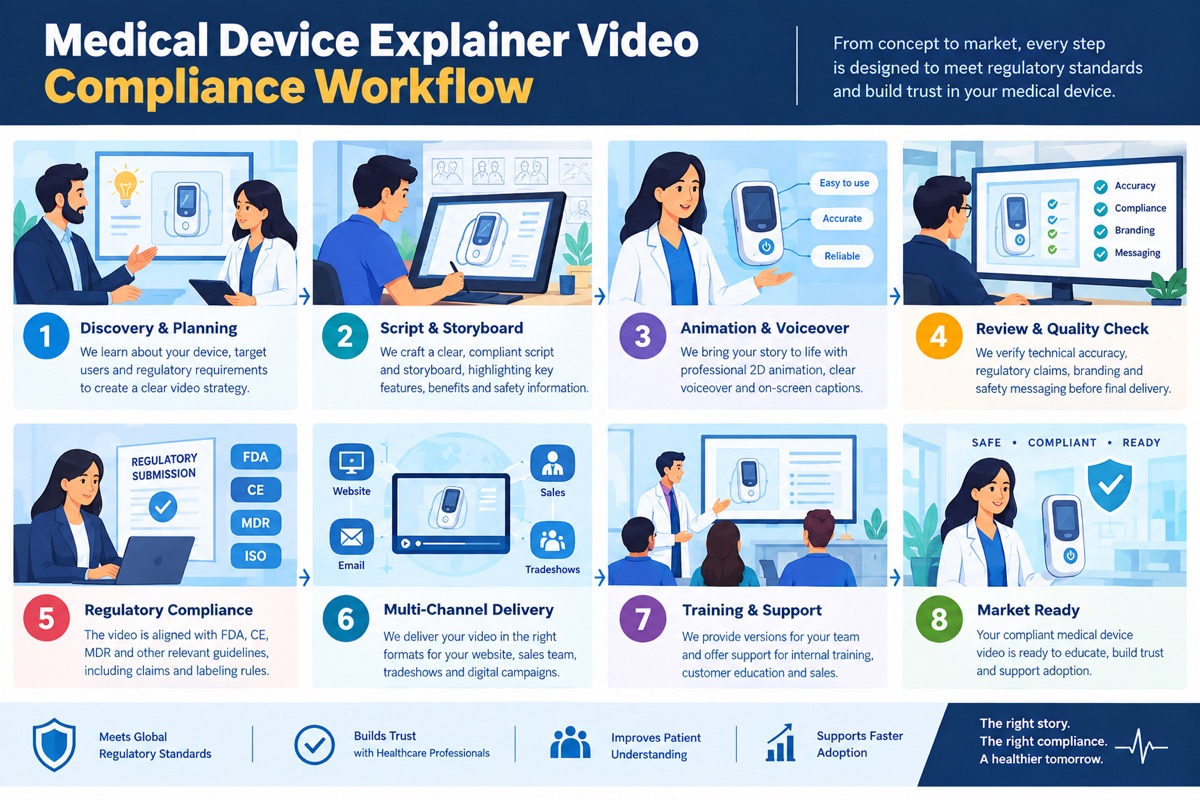
A Review Workflow for Medical Device Explainer Videos That Does Not Blow Up
The single largest avoidable cost in medical device explainer videos is regulatory review arriving too late. A wording change requested at script stage costs an afternoon. The same change requested at picture lock can invalidate every visual built around the claim.
Claims matrix
Every claim listed with its evidentiary source, approved before a script exists.
Script sign-off
Regulatory, medical and legal approve the words. Named approvers, formal sign-off.
Storyboard sign-off
The same reviewers approve what is shown, catching off-label depiction before animation.
Animatic
Timing and sequence confirmed. Changes here are still comparatively cheap.
Final review
Confirmation only, not first review. Nothing new should surface at this point.
Two gates for every medical device explainer video, both before animation begins. The reason for a separate storyboard gate is the point made earlier: the script is not the only thing making claims. Reviewers who approved wording have not yet seen what will be depicted, and depiction is where off-label risk concentrates in video.
What makes the medical device explainer video review process work
- Name the approvers, not the departments. Sign-off from a named individual in regulatory affairs, medical affairs and legal. Sending a script to a function and hoping produces delay without accountability.
- Give reviewers the claims matrix with the script. Reviewing a claim without its evidence attached forces the reviewer to go and find it, which is where weeks disappear.
- Consolidate feedback into one round per gate. Sequential individual comments from five reviewers produce contradictions that the production team cannot resolve on their own.
- Build review time into the schedule honestly. If your regulatory process realistically takes three weeks, a timeline assuming five days is not a schedule, it is a wish.
- Version everything, especially training content. Where video forms part of quality system documentation, the reviewed version must be traceable and the superseded version must be withdrawn.
Global Rollout of Medical Device Explainer Videos
Manufacturers commissioning medical device explainer videos rarely sell in one market, and a master asset that cannot be adapted per market creates a recurring problem. Three things change across borders and all three should be anticipated at script stage.
Regulatory status differs. A device may be cleared in one market, approved in another under a different framework, and still under assessment in a third. Any on-screen statement of regulatory status therefore has to be a swappable element rather than baked into artwork.
Permitted claims differ. The Australian restricted representation rules described earlier are the clearest example, but indications themselves can differ between markets, meaning a use depicted legitimately in one country constitutes off-label promotion in another. This is a scripting and storyboarding constraint, not a translation issue.
Language and length differ. Translated text commonly runs longer than English, so layouts need slack. Keeping on-screen text as live editable text rather than flattened artwork is what separates a straightforward localisation from a rebuild, and it costs nothing if specified at the start.
The practical approach for multi-market medical device explainer videos is a market-neutral master: mechanism, anatomy and workflow that hold everywhere, with regulatory status, indication-specific sequences, and claims built as modular inserts. Each market then assembles from approved components rather than commissioning fresh work.
Why the 3D Asset Library Is the Real Investment in Medical Device Explainer Videos
There is an economic structure specific to medical device explainer videos that teams commissioning their first one rarely anticipate, and understanding it changes how a programme should be scoped.
In most animation work, cost scales with the number of scenes. In device work, a disproportionate share of the effort sits in one place: building an accurate 3D model of the device and the relevant anatomy. That model has to be dimensionally correct, it usually has to be derived from or checked against engineering data, and it frequently needs internal geometry that never appears in any marketing photograph. It is the expensive component, and it is built once.
Everything after that is comparatively cheap. A second video reusing the same model needs new camera moves, new sequencing and a new script, but not a new device. This is why commissioning medical device explainer videos one at a time is the most expensive possible approach, and why a programme scoped as a set is frequently cheaper in total than two separately commissioned pieces.
What this means when scoping medical device explainer videos
Scope the set, not the first video. Tell the studio at briefing that clinician, patient, procurement and training versions are all coming, even if only the first is funded now. A model built with that knowledge is built to a specification that supports the rest. A model built for one 90 second overview may not hold up under the closer scrutiny a training video demands.
Establish who owns the model. This matters more here than in general animation, because the asset is expensive and durable. If the manufacturer owns the 3D assets, a future supplier can build on them. If the studio retains them, the manufacturer is committed to that studio for the life of the product, or paying to rebuild. This belongs in the agreement, not in a conversation two years later.
Plan for the device to change. Products get revised. A model built in modular components, where a housing or a connector can be swapped without rebuilding the assembly, absorbs a product revision far more cheaply than a single fused mesh. Ask for it explicitly.
Treat anatomy as reusable too. Manufacturers usually operate within one anatomical region across a product family. Anatomy built once for a cardiac device serves the next cardiac device, which compounds the advantage across a portfolio rather than a single product.
The result is that the second and third medical device explainer videos in a well-scoped programme cost meaningfully less than the first. That is only true if the first was commissioned with the others in mind, which is a briefing decision rather than a production one.
Measuring Medical Device Explainer Videos
Device sales cycles are long, involve committees rather than individuals, and rarely attribute a decision to one asset, which makes measuring medical device explainer videos genuinely difficult. Sales cycles and rarely attribute cleanly to a single asset. View counts are close to meaningless.
| Audience | Meaningful measure | How to capture it |
|---|---|---|
| Clinicians | Completion rate and repeat viewing | A sceptical specialist watching to the end is a genuine signal |
| Patients | Comprehension and reduced pre-procedure queries | Short knowledge check, plus clinic query volume before and after |
| Value analysis committees | Progression to next evaluation stage | Track whether submissions including the video advance more often |
| Sales teams | Usage rate in the field | An asset representatives do not play has failed, regardless of quality |
| Training | Competency assessment and error rate | Compare assessment pass rates and in-service support calls |
| All audiences | Sales team time saved per explanation | Often the most measurable return, and the easiest to evidence internally |
Sales asset usage rate is frequently the most revealing metric available, because it reflects whether the people closest to the customer find the asset useful.
For a fuller treatment of measurement design, see our guide on measuring explainer video ROI, and for examples of structure that converts, explainer videos that convert.
Six Mistakes in Medical Device Explainer Videos
1. Saying approved when the device is cleared
A single word that misstates regulatory status, and it appears in voiceovers, captions, video descriptions and social posts, several of which never reach regulatory review.
Fix: include every piece of surrounding copy in the review scope, not just the script.
2. Reviewing words but not pictures
Approving a compliant script and then animating a sequence that depicts use outside the cleared indication. The animator worked from a clinical reference and had no way to know the boundary existed.
Fix: make storyboard sign-off a formal gate with the same reviewers as the script.
3. One video for six audiences
A general overview that gives clinicians too little mechanism, patients too much jargon, and procurement nothing about workflow or cost at all.
Fix: plan audience cuts from one production sharing an asset library and approved claims.
4. Ignoring the value analysis committee
Marketing exclusively to clinicians in health systems where a committee makes the purchasing decision. The clinician may want the device and still be unable to authorise it.
Fix: produce a version addressing workflow impact, training burden and comparative value explicitly.
5. Treating international release as translation
Assuming a cleared United States master will run in Australia or Europe with a new voiceover. Regulatory status, permitted claims and named conditions can all differ.
Fix: build a market-neutral master with status and claims as swappable modules.
6. Scheduling regulatory review as a final step
Booking legal and regulatory review after animation is complete, then discovering a claim needs qualifying in a way the visuals cannot accommodate.
Fix: two gates before animation begins, with honest review durations in the schedule.
Bringing It Together
Medical device explainer videos are a regulated communication problem before they are a production problem. The studio question of whether to use 2D, 3D or live action is real, but it is downstream of the questions that actually determine whether the project ships: what may be claimed, what may be shown, who is being addressed, and who signs it off.
Teams that handle medical device explainer videos well tend to do three unglamorous things. They approve a claims matrix before anyone writes a script. They put regulatory reviewers in front of the storyboard as well as the words, because depiction carries claims too. And they plan the full audience set at the outset so one asset library serves clinician, patient, procurement, sales and training versions rather than five disconnected commissions.
For related work see our healthcare explainer video overview, the comparison of animated versus live-action patient education, what an explainer video is, and our explainer video production process.
Frequently Asked Questions
Only if the device went through premarket approval. Most devices reach the United States market through the 510(k) premarket notification pathway, which demonstrates substantial equivalence to a legally marketed predicate device, and those devices are FDA cleared rather than approved. Premarket approval is a separate, more stringent pathway generally required for high risk Class III devices such as pacemakers, where the manufacturer must demonstrate a reasonable assurance of safety and effectiveness. Describing a cleared device as approved misstates its regulatory status.
It occurs when a manufacturer markets a device for a use, indication or patient population outside what regulators cleared or approved. The asymmetry catches teams out: a clinician may use a device off-label at their own discretion, but the manufacturer cannot encourage or promote that use. In video the risk is often visual rather than verbal. A compliant script can sit alongside an animated sequence showing the device used in an anatomical location or patient group outside the cleared indication, which can itself constitute promotion.
Six distinct audiences needing materially different content. Clinicians want mechanism, evidence and procedural detail. Patients need plain language and reassurance. Hospital value analysis committees evaluate cost, workflow impact and comparative value rather than clinical elegance. Sales teams need short modular assets usable in a brief meeting. Investors want market and differentiation framing. Training audiences need procedural accuracy and repeatability. One general video for all six is the most common structural mistake in device marketing.
At script stage and again at storyboard, never first at picture lock. Review after animation is complete is the most expensive sequence possible, because a required change to a claim frequently invalidates the visuals built around it, turning a wording amendment into a rebuild. Treat script and storyboard sign-off as formal gates with named approvers from regulatory affairs, medical affairs and legal. Adding those gates usually shortens the overall timeline despite adding steps, because it prevents late rework.
Yes, in ways that surprise teams working from a United States master. The Therapeutic Goods Administration operates a system of restricted and prohibited representations. Restricted representations refer to serious conditions requiring a health professional to diagnose, follow up or treat, and must not be used in advertising to the public without prior approval or permission from the TGA. Published examples include references to diabetes, foot nervous system damage and amputation. Approval is granted only where the representation is accurate, balanced and not misleading, and must be in place before the advertisement runs.
Most programmes need both, and many need 3D specifically. Animation, particularly 3D, is the only practical way to show internal mechanism: what a device does once implanted, how it interacts with tissue, or how components move inside a closed system. Live action is stronger for physical handling, setup and technique a clinician must replicate, and for the workflow context procurement audiences want to see. A common structure opens in live action to establish the setting, moves into 3D for mechanism, then returns to live action for handling.
Sources
- Premarket Notification 510(k). United States Food and Drug Administration. fda.gov
- Premarket Approval (PMA). United States Food and Drug Administration. fda.gov
- Device Approvals and Clearances. United States Food and Drug Administration. fda.gov
- Restricted and prohibited representations in advertising. Therapeutic Goods Administration, Australia. tga.gov.au
Medical device explainer videos built to clear review
Magic Motion Studio produces 2D, 3D and hybrid medical device explainer videos for manufacturers across Australia and the USA.