
What Is an Explainer Video? Types, Styles and Examples (2026 Guide)
An explainer video is a short animated or live-action video that explains what a product, service, process, or idea is and why it matters, typically in 60 to 90 seconds. It uses a structured narrative, professional voiceover, and purposeful visuals to turn a complex proposition into something a general audience can understand and act on. This guide covers the full definition, all 8 main types, how to choose the right style for your brief, the production process, what good ones have in common, and what they cost in the Australian market in 2026.
The term is used casually across the marketing industry, but there is a precise meaning behind it. What is an explainer video, exactly? It is not a brand film. It is not a product demo. It is not a testimonial or a highlight reel. An explainer video has one job: take something that is hard to explain in text and make it instantly clear on screen, in under two minutes, to someone encountering it for the first time.
Understanding that distinction is important before you commission one, because it defines the brief, the format, the length, and the animation style that will produce the best result for your specific communication objective. A business that commissions a brand film when it needs an explainer video ends up with content that looks impressive and explains nothing. A business that commissions a screencast tutorial when it needs an animated homepage explainer ends up with something that only converts users already deep in the funnel.
This guide gives you everything you need to understand the format clearly and make the right production decisions.
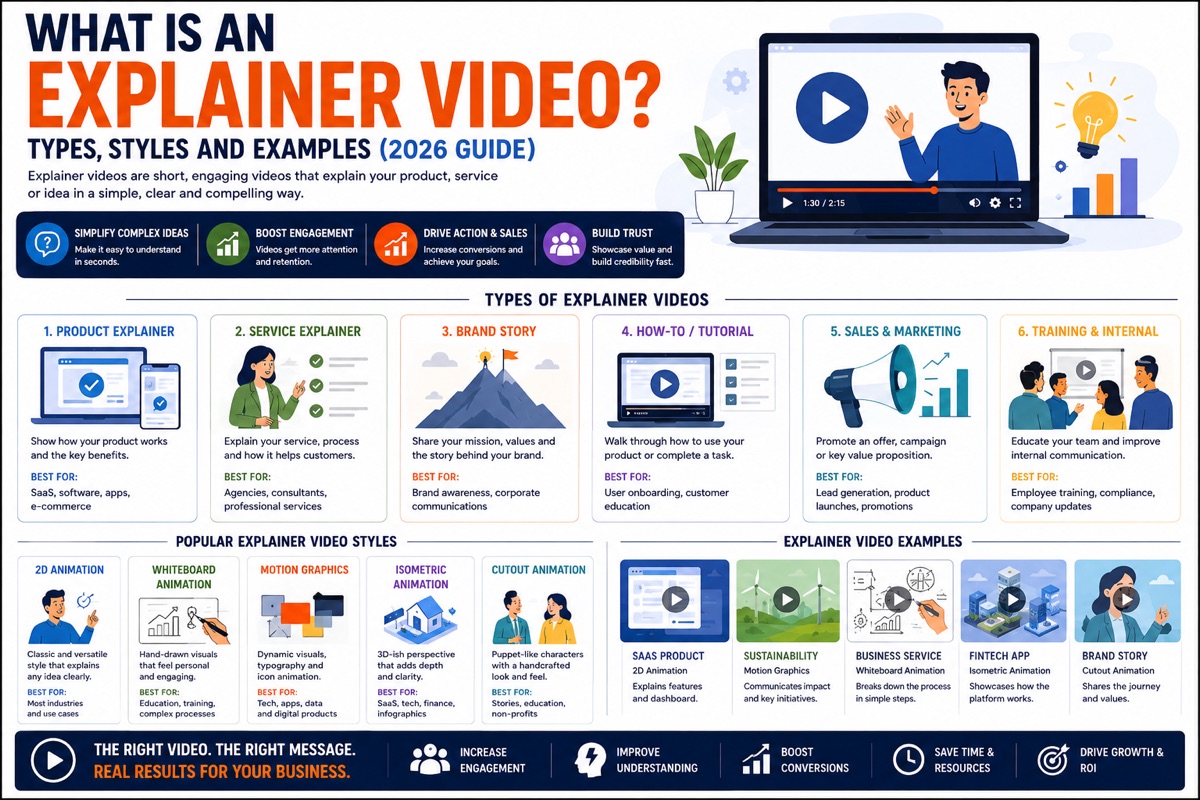 2D animation, motion graphics, whiteboard, 3D animation, live action, screencast, kinetic typography and mixed media styles" width="1200" height="800" loading="lazy">
Source: Wyzowl Video Marketing Statistics 2026, survey of 266 video marketers and consumers
What Is an Explainer Video?
An explainer video is a short, purposefully structured video, typically 60 to 90 seconds long, that communicates a specific product, service, process, or idea to a defined audience using animation, voiceover, and narrative storytelling. Its primary objective is comprehension and conversion, not brand impression.
The most direct way to understand what is an explainer video is to compare it to its alternative: text. The format emerged from a simple problem: text is slow, and people do not read. A 500-word product description on a homepage takes two to three minutes to read at an average pace, requires sustained attention, and depends entirely on the reader constructing their own mental picture of how something works. An explainer video delivers the same information in 60 to 90 seconds, combines visuals and narration to reduce cognitive load, and guides the viewer toward a specific action at the end.
The practical result of that efficiency is significant. Wyzowl's 2026 Video Marketing Statistics report, drawn from 12 consecutive years of data collection, found that 96% of people have watched an explainer video to learn about a product or service, and 85% have been convinced to buy after watching video content. These numbers reflect a buying behaviour shift that has been consistent for a decade: when given the choice between reading about something and watching it explained, the overwhelming majority of buyers choose the latter.
What separates a genuine explainer video from other short-form video content is its structure. A professional explainer video follows a narrative arc: it opens by naming a problem the viewer recognises, introduces the product or service as the solution, shows how that solution works at a functional level, and closes with a specific call to action. This structure holds whether the video is animated or live-action, 30 seconds or 2 minutes, designed for a government agency or a SaaS startup. That structural consistency is what makes what is an explainer video a distinct format, not a catch-all term for any short video a business produces.
What an Explainer Video Is Not
Understanding the boundaries of the format is as useful as understanding the definition. If you are deciding what is an explainer video you actually need, start by ruling out the formats it is commonly confused with. An explainer video is not:
- A brand film. Brand films build emotional connection and organisational identity. They use cinematic production, music-led pacing, and narrative that serves impression over comprehension. An explainer video serves comprehension first.
- A product demo. A product demo shows the interface or features of a specific product in evaluation-stage detail. An explainer video communicates the value proposition at a higher level, for a viewer who has not yet decided whether to look deeper.
- A testimonial video. Testimonials build social proof through customer voices. An explainer video communicates the product proposition directly, not through a third-party narrative.
- An advertisement. A 15-second pre-roll ad is a recall trigger, not an explanation. Explainer videos are designed for viewers who are actively seeking to understand something, not passively receiving a brand impression.
- A tutorial. Tutorials are step-by-step instructional content for users already using a product. Explainer videos are for audiences who have not yet committed to using it.
These distinctions matter because the brief you hand to a production studio determines which format is produced. A brief that mixes brand film objectives with explainer video structure produces content that does neither job well. Being clear on what is an explainer video versus what is a brand film, demo, or tutorial is the foundation of a well-directed production brief.
Ideal Length for an Explainer Video
The standard length for an explainer video is 60 to 90 seconds. Part of understanding what is an explainer video at a functional level is understanding why this length exists: it covers a complete problem-solution narrative with a clear call to action without exceeding the natural attention span of a viewer who is not yet committed to the product. Wyzowl's 2026 survey found that 71% of video marketers consider 30-second to 2-minute videos most effective.
At a natural voiceover pace of 130 to 150 words per minute, a 60-second explainer video holds approximately 130 to 150 words of script. That is enough to name the problem, introduce the product, explain three to five key benefits, and deliver a call to action. Complex technical briefs covering multiple features, regulatory context, or multi-step processes can extend to 2 minutes. Beyond 2 minutes, the format should be restructured as a multi-chapter series rather than a single continuous piece.
The 8 Main Types of Explainer Videos
There is no single format for an explainer video. The eight types below cover the full range of production approaches, from hand-drawn illustration to live-action filming to kinetic text animation. Each has specific strengths, cost implications, production timelines, and ideal use cases. Choosing the wrong type for your brief is one of the most common and costly production mistakes in the explainer video market. The eight types below cover every version of what is an explainer video currently produced at professional level in the Australian market.
2D Animation
2D animation is the most widely used explainer video style in professional B2B, government, healthcare, and SaaS communications. It uses flat illustrated characters, environments, and motion sequences to communicate a narrative visually, without the constraints of real-world filming. Every element is custom-designed for the brief, including character appearance, environment, colour palette, and animation behaviour.
Professional 2D animation uses software such as Toon Boom Harmony or Adobe Animate, which enables frame-by-frame character movement, rigged character animation, and complex scene transitions. This is categorically different from template-based SaaS animation tools such as Vyond or Powtoon, which assemble pre-built character assets from a library and do not produce custom illustration.
2D animation works for virtually any brief type. It can represent abstract software workflows, show physical products in an idealised context, demonstrate clinical processes without live footage of medical procedures, and adapt its visual tone from playful and character-driven to clean and corporate with a change of illustration style.
Motion Graphics
Motion graphics explainer videos animate text, icons, shapes, and data visualisations rather than characters or environments. The style communicates through dynamic movement of abstract design elements rather than narrative storytelling. Charts animate on screen, icons transform into related concepts, text builds and highlights key phrases, and transitions carry conceptual meaning rather than plot progression.
Motion graphics are particularly effective for financial services, technology infrastructure, cybersecurity, and data-heavy propositions where the core message is best expressed as information architecture rather than human-centred story. They are also faster and less expensive to produce than full 2D character animation, making them a strong option for organisations with tighter production budgets that still need a professional output.
The limitation of motion graphics is emotional engagement. Without characters and narrative arc, it is harder to create the empathy that drives conversion in consumer or health-focused briefs. For abstract B2B and technical communications, however, this limitation rarely applies.
Whiteboard Animation
Whiteboard animation simulates the hand-drawing of illustrations and text on a white background, with the drawing hand visible as each element appears. The style creates a strong sense of explanation unfolding in real time, which makes it particularly effective for educational content, step-by-step process communication, and internal training material.
The cognitive appeal of whiteboard animation is well established in educational research: watching something being drawn activates the same mental processes as watching a teacher explain at a board, which increases information retention compared to static presentation. This makes it the strongest format for compliance training, health literacy content, and public information campaigns where comprehension and recall are the primary metrics.
Whiteboard animation has fallen out of favour for premium commercial explainer videos as the visual style has become strongly associated with low-cost template production. For educational and training contexts, however, it remains one of the most effective formats available, and custom-illustrated whiteboard animation produced by a professional studio looks substantially different from template outputs.
3D Animation
3D animation creates environments, characters, and objects with depth, texture, and spatial realism. It is the strongest format for physical product explainers where dimensional accuracy matters, such as medical devices, engineering components, industrial equipment, architectural projects, and consumer hardware products. A 3D animation can rotate a product, reveal internal mechanisms, and show spatial relationships that 2D illustration cannot represent with the same fidelity.
The trade-off for that visual power is cost and timeline. 3D animation requires significantly more production time than 2D animation for equivalent output length, and the production cost at professional quality is considerably higher. For briefs where 2D animation can effectively communicate the same information, 3D is rarely the economically justified choice. For briefs where dimensional accuracy is the core communication requirement, 3D is frequently the only format that fully delivers.
Live Action
Live action explainer videos use real people, real environments, and film production to communicate a product or service proposition. The format creates the highest emotional authenticity of any explainer type because viewers see and hear real human faces delivering the message. This makes live action the strongest choice for consumer-facing briefs where the product involves a human relationship, such as professional services, personal care, hospitality, retail, and founder-led brand stories.
Live action explainers are also the most practical format for businesses where the physical product or service environment is the core communication asset: a restaurant showing its kitchen and chef, a hotel showing its rooms and facilities, a clinical practice showing its consultation environment. Animation cannot match the authenticity of real footage in these contexts.
The limitations of live action are flexibility and update-friendliness. An animated explainer can be partially re-voiced and updated for a price change, a product update, or a new market without a full reshoot. A live action video is locked to the people and environments filmed, which makes it more expensive to update as the business evolves.
Screencast and Tutorial Videos
Screencast explainer videos record the actual digital interface of a software product, showing exactly how the product works step by step, with a voiceover or on-screen annotations guiding the viewer through each action. The format is the most practical choice for SaaS onboarding content, software comparison demos, customer how-to documentation, and internal IT training.
Screencast videos show the real product, which builds confidence in evaluation-stage buyers who want to see the actual interface before committing. They are also significantly faster and less expensive to produce than custom animated explainers, making them practical for high-volume onboarding content, feature update announcements, and help centre video libraries where freshness and update speed matter more than production polish.
The limitation of screencasts is that they require a stable, polished UI to be effective. A product in active development, a complex interface with many competing elements, or a product that is better understood through an idealised use case than through the literal interface is better served by an animated explainer than a screencast.
Kinetic Typography
Kinetic typography explainer videos animate text as the primary visual element, with each word, phrase, or sentence moving, scaling, or transforming to the rhythm of the voiceover or music. The format creates high visual energy from minimal production elements and performs strongly in social media environments where text-on-screen substitutes for voiceover when the viewer's sound is off.
Kinetic typography is the most cost-effective professional explainer video format for short-form social content, advertising campaigns, key quote clips, and brand statement videos. It is not appropriate for complex product explanations where visual demonstration of how something works is required, as the format lacks the representational capacity to show products, environments, or processes.
Mixed Media and Hybrid Animation
Mixed media explainer videos combine two or more animation styles or production formats within a single video. Common combinations include 2D animated characters in a live-action environment, motion graphics data overlaid on filmed footage, 3D product renders within a 2D illustrated scene, or animation combined with documentary-style live interviews. The result is a visual richness that a single format cannot achieve.
Mixed media production is used for premium brand campaigns where visual distinction is part of the brief, for complex technical explanations that require both human context and abstract data visualisation simultaneously, and for award submissions and investor presentations where production quality signals organisational capability. The format requires a production team with cross-discipline capability and commands a higher budget than single-format alternatives.
Explainer Video Types Compared: A Side-by-Side Reference
The table below compares all eight explainer video types across the five factors that most affect production decisions: the primary use case, the typical Australian production cost range for a 60-second video, the standard production timeline, whether the format leads with logic or emotional appeal, and whether it is suitable for Australian government sector use. Use it to match what is an explainer video type to your specific brief.
| Type | Primary Use Case | AU Cost Range (60 sec) | Timeline | Logic vs Emotion | Govt Suitable |
|---|---|---|---|---|---|
| 2D Animation | SaaS, government, healthcare, defence | $6,000 to $14,000 | 3 to 6 weeks | Both | ✓ Highest fit |
| Motion Graphics | FinTech, data, cybersecurity, infrastructure | $4,000 to $10,000 | 2 to 4 weeks | Logic | ✓ Strong fit |
| Whiteboard | Training, public health, compliance | $3,500 to $8,000 | 2 to 4 weeks | Logic | ✓ Strong fit |
| 3D Animation | Medical devices, engineering, hardware | $12,000 to $40,000+ | 6 to 12 weeks | Logic | ~ Product-dependent |
| Live Action | Consumer brands, hospitality, services | $5,000 to $30,000 | 3 to 6 weeks | Emotion | ~ Brief-dependent |
| Screencast | SaaS onboarding, IT training, help docs | $1,500 to $5,000 | 1 to 2 weeks | Logic | ~ Training only |
| Kinetic Typography | Social media, brand campaigns, ads | $2,000 to $6,000 | 1 to 2 weeks | Emotion | ✗ Rarely appropriate |
| Mixed Media | Premium campaigns, investor content | $15,000 to $50,000+ | 6 to 10 weeks | Both | ~ Specialist briefs |
Cost ranges are general Australian market estimates for custom professional production. Sources: Global Pictures AU (2026), Vidico AU Production Rates (2026). Ranges vary by complexity, animation style, and studio. See our explainer video pricing guide for detailed breakdowns.
How to Choose the Right Type of Explainer Video for Your Business
The best explainer video type for your brief is determined by four variables: your audience and what emotional register they respond to, the complexity and abstraction of your product or service, your sector's specific compliance requirements, and your production budget and timeline. The buyer guide below maps sector to format recommendation with brief reasoning for each. It answers, by sector, what is an explainer video style most likely to deliver the outcome your brief requires.
Government and APS Agencies
2D AnimationGovernment communication must meet WCAG 2.1 accessibility standards, follow plain language guidelines from the Australian Government Style Manual, and accommodate multi-stage internal approval cycles. 2D animation is the most compliant and flexible format. It allows unlimited revision at script and storyboard stage before production locks, adapts to any communication register from ministerial to public-facing, and delivers with WCAG-compliant closed captions as standard.
SaaS and Technology Startups
2D Animation or ScreencastFor homepage and top-of-funnel explainer videos, 2D animation is the strongest performing format because it shows an idealised use case unconstrained by the current state of the UI. For evaluation-stage buyers comparing platforms, a well-produced screencast showing the actual interface builds conversion confidence that animation cannot replicate. Many SaaS companies benefit from commissioning both: an animated homepage explainer and a screencast demo for the pricing or features page.
Healthcare and Medical Research
2D AnimationHealthcare animation must work simultaneously for patient, clinician, and regulatory audiences, often within the same video. 2D animation handles this challenge best: it can represent clinical processes without live footage of procedures, adapt its visual complexity from public health literacy level to specialist clinician level, and include WCAG-compliant captions and audio descriptions as required for TGA-regulated or government-funded content.
Defence and AUKUS Supply Chain
2D AnimationDefence capability communication frequently requires representing systems and processes that cannot be filmed: classified platforms, tactical scenarios, technology that exists only in specification, and sensitive capability claims. 2D animation is the format of choice because it communicates at whatever level of abstraction the brief requires, with no footage that could inadvertently reveal operational detail. In-house production is mandatory; offshore subcontracting of defence content creates IP and security exposure.
Education and Training
2D Animation or WhiteboardLearning content benefits from animation styles that emphasise information unfolding sequentially. Whiteboard animation is the highest-recall format for step-by-step processes and compliance content. 2D character animation performs better for student-facing content where engagement and identification with characters matters. For professional development and internal training, motion graphics with data visualisation works well for process and systems content that is logic-driven rather than narrative-driven.
NFP and Community Organisations
2D Animation or Live ActionNot-for-profit explainer videos often need to balance two objectives: communicating a service or program in functional terms, and building emotional connection with the people the organisation serves. 2D character animation achieves both when the characters reflect the actual community being served. Live action is a strong option for NFPs where authenticity and real faces build trust more effectively than illustration, particularly for donor-facing and advocacy content.
Not sure which type is right for your brief?
If you are still deciding what is an explainer video type that fits your sector, or ready to commission one, tell us your sector, audience, and communication objective. We will recommend the right format and send a written production plan.
How an Explainer Video Is Made: The Production Process
Understanding the production process for an explainer video helps you plan your internal review timeline, prepare your team for the right inputs at the right stages, and evaluate whether a studio's proposed timeline is realistic. Professional explainer video production follows four sequential stages, each with a defined deliverable and client approval point before the next stage begins. Knowing this process also helps answer what is an explainer video production commitment in terms of your team's time, review effort, and internal sign-off cycles.
Discovery and Script
The studio runs a brief session to extract the core message, target audience, communication objective, tone, and call to action. A professional scriptwriter produces a timed script at roughly 130 to 150 words per 60 seconds at a natural voiceover pace. The script is the most important stage: every subsequent decision in production flows from it.
Storyboard and Style Frames
Once the script is approved, the creative team produces a visual plan showing how each script line translates to a visual scene, along with two or three style frame options showing the illustration aesthetic, colour palette, and animation tone. No animation begins until storyboard and style are approved in writing.
Voiceover and Animation
The approved voiceover is recorded by a professional voice actor matched to the brief's tone and audience. Animation then begins to the approved storyboard, with the voiceover locked as the timing reference. This is the longest production stage. Most studios provide a draft animation at approximately 80% completion for a pre-final review before the last refinements.
Delivery
The final animation is rendered and delivered in agreed formats: MP4 for web embedding, MOV for broadcast and editing, SRT or VTT subtitle files for WCAG accessibility compliance, and social media format versions if included in scope. Perpetual commercial IP is transferred to the client on final invoice with no ongoing licence fees or usage restrictions.
Standard production turnaround from brief to final delivery is four to eight weeks for a 60 to 90 second animated explainer, depending on studio team size, brief complexity, and internal client approval speed. Specialist studios with streamlined in-house processes can deliver within 14 business days for standard brief types. Government and defence projects with structured multi-stage internal approval requirements should budget seven to ten weeks regardless of the studio's standard timeline. Realistic timeline communication is one of the clearest signals of what is an explainer video studio worth working with.
What Makes a Good Explainer Video? 5 Non-Negotiable Elements
Across all eight format types, the explainer videos that consistently outperform on conversion, comprehension, and completion rate share five structural elements. These are not stylistic preferences; they are production standards that distinguish professionally commissioned explainer videos from the vast majority of in-house produced or template-generated content. They also define what is an explainer video of genuine professional quality versus a template-assembled imitation.
A Hook in the First 5 Seconds
The first five seconds must name a problem the viewer recognises or make a claim that demands attention. Videos that open with brand name, logo animation, or general welcome text lose a significant portion of viewers before the explanation begins.
One Core Message Only
Every additional message in a 60 to 90 second explainer video reduces the impact of the primary one. The most effective explainer videos identify a single core proposition and resist the instinct to add secondary messages, feature lists, or qualifying statements that dilute focus.
Professional Voiceover
Voiceover quality has an outsized impact on perceived production value. A professional voice actor matched to the brief's register and audience demographic lifts completion rate and comprehension score even when the animation quality is moderate. AI voiceover tools have improved significantly but remain distinguishable from human recording in tone and pacing.
A Specific Call to Action
Every explainer video must end with a single, specific next step. "Learn more," "visit our website," and "contact us today" are generic instructions that produce lower click-through rates than specific CTAs: "Book a free demo," "Download the guide," or "Get a quote in 24 hours." Specific actions reduce decision friction at the moment of highest viewer engagement.
Closed Captions as Standard
Approximately 85% of social media video is watched without sound. WCAG 2.1 requires captions for all video content on Australian government websites. Closed captions are a distribution necessity and a legal requirement for government clients, not an optional accessibility extra. A professionally delivered explainer video includes SRT or VTT subtitle files in the final deliverable package.
For any video intended for public communication in Australia, WCAG 2.1 Level AA compliance is a legal obligation under the Disability Discrimination Act 1992 and the Web Content Accessibility Guidelines adopted across Commonwealth agencies. This means closed captions for all spoken audio, audio descriptions for visual-only information, and a minimum colour contrast ratio of 4.5:1 for on-screen text. Government briefs should confirm WCAG 2.1 compliance as a contractual deliverable, not a post-production add-on. Agencies receiving content that does not include a subtitle file cannot legally publish it on a government website.
What Does an Explainer Video Cost in Australia?
Australian explainer video production pricing varies significantly by format, studio type, animation complexity, and whether production is done in-house or through offshore subcontractors presenting under an Australian brand. Before requesting quotes, buyers should understand what is an explainer video scope they are actually commissioning, as studios often price very different production models under the same label. The ranges below reflect professionally produced, custom content from Australian studios with in-house production teams, based on general market data from 2026.
- Budget tier ($3,000 to $6,000 AUD): Typically whiteboard or simple motion graphics, limited revision rounds, and lower illustration complexity. Some studios in this range use template-based animation software rather than custom production. Suitable for internal training content or short social media clips where brand-level production is not required.
- Mid-market tier ($6,000 to $12,000 AUD): Custom 2D animation or motion graphics with professional voiceover, full script and storyboard service, and two to three revision rounds per stage. This range covers the majority of professional commercial explainer video briefs for Australian businesses.
- Premium tier ($12,000 to $30,000+ AUD): Full custom character animation with complex environments, premium voice acting, original music composition, multiple format deliverables, and extended revision processes. Appropriate for national campaigns, investor-facing content, and government communications requiring highest production standard.
- 3D and mixed media ($15,000 to $50,000+ AUD): 3D product animation, broadcast-quality mixed media, and multi-format campaign packages. Production timelines extend to eight to twelve weeks at this tier.
Quotes significantly below the mid-market range for claimed "custom" 2D animation almost always indicate one of three things: template-based software rather than custom illustration, offshore animation subcontracted to studios in South or Southeast Asia, or a significantly reduced scope of revisions and deliverables. Understanding what is an explainer video genuinely costs in the Australian market protects you from scoping errors and offshore bait-and-switch. See our explainer video pricing guide for a full breakdown of what each cost tier includes and what to look for in a quote.
When comparing studios, always request an itemised quote that separates scripting, storyboarding, animation, voiceover, file delivery formats, and subtitle file production. Studios that quote a single package price without itemisation make it difficult to assess whether the production scope matches your brief. For a broader comparison of Australian studios across cost tiers, see our guide to the best explainer video companies in Australia.
Where to Use an Explainer Video: 7 High-Value Placements
One of the most underappreciated aspects of what is an explainer video as a production asset is its versatility across distribution channels. An explainer video commissioned without a distribution plan is an underutilised asset. The format is one of the most versatile content investments a business can make because a single well-produced video can be deployed across multiple placements with different performance objectives. The seven placements below consistently deliver the highest return from a commissioned explainer video.
- Homepage hero section. The highest-value placement for most B2B and SaaS businesses. A 60 to 90 second explainer in the above-the-fold hero position communicates the core value proposition to visitors with minimal time investment, reducing homepage bounce rate and increasing time on page.
- Paid advertising. A 30 to 60 second cut-down of the hero explainer performs strongly in LinkedIn, YouTube, and Meta advertising contexts. The hook-first structure of a professionally written explainer script translates directly to paid media without requiring a separate brief.
- Sales proposals and pitch decks. Embedding a video link in a proposal or pitch deck gives prospects a self-serve explanation of your product that arrives before the follow-up call. Vidico's 2026 production rates report notes that B2B pages with embedded explainer content see conversion lifts exceeding 100% in controlled testing.
- Email marketing. The word "video" in a subject line increases open rates. Linking to an explainer video from an outreach or nurture email gives prospects a low-friction path to product understanding without requiring them to navigate your website.
- Social media and organic content. Social platform format cuts (square for Instagram and Facebook, vertical for Reels and TikTok, horizontal for LinkedIn and YouTube) extend the life of a single hero video into a full social content library without additional production investment.
- Trade show and event screens. An autoplay loop of your explainer video running on a screen at your exhibition stand communicates your value proposition to passersby who have not approached your team, effectively expanding your effective reach at events.
- Investor and stakeholder communications. For Series A and above fundraising, an animated explainer video in the data room or pitch deck communicates product capability at a level of clarity and professionalism that text descriptions and static diagrams cannot match.
Frequently Asked Questions
An explainer video is used to communicate a complex product, service, process, or idea in a short, visually engaging format. The most common applications are homepage hero videos, product launch announcements, SaaS onboarding content, sales proposal embeds, internal training, and government and healthcare public communications. According to Wyzowl's 2026 Video Marketing Statistics report, 96% of people have watched an explainer video to learn about a product or service, and 93% of video marketers say video has improved their audience's understanding of their product. These numbers consistently demonstrate that what is an explainer video is one of the highest-ROI content investments available to a marketing team.
The standard length is 60 to 90 seconds for a single core message. Complex technical briefs can extend to 2 minutes without a significant drop in completion rate. Beyond 2 minutes, the format should be restructured as a multi-chapter series. Wyzowl's 2026 survey found that 71% of video marketers consider videos between 30 seconds and 2 minutes to be most effective. At a natural voiceover pace of 130 to 150 words per minute, a 60-second explainer holds approximately 130 to 150 words of script. This length discipline is a fundamental part of what is an explainer video as a format distinct from longer tutorial or training content.
An explainer video has one specific objective: explain what a product or service does and why it matters, in under two minutes, to a viewer encountering it for the first time. A corporate video is a broader category covering brand films, company culture content, event highlights, annual report videos, and executive communications. Corporate videos build brand familiarity; explainer videos drive comprehension and conversion. The two formats serve different stages of the buyer journey and should not be treated as interchangeable. The distinction matters when briefing a studio: what is an explainer video brief and what is a corporate video brief require fundamentally different creative structures, lengths, and production approaches.
For most SaaS products, 2D animation is the strongest top-of-funnel format because it shows an idealised user experience without being constrained by the current UI. For evaluation-stage buyers comparing platforms, a screencast showing the actual interface builds conversion confidence that animation cannot replicate. Many SaaS companies benefit from commissioning both: a 2D animated homepage explainer and a screencast demo for the pricing or features page. For a 2D animation specialist, see our 2D animation studio services. For any SaaS team asking what is an explainer video format that converts top-of-funnel visitors, 2D animation with a problem-first hook is the most evidence-backed starting point.
A professionally produced 60-second custom 2D animated explainer video from an Australian studio typically costs between $6,000 and $14,000 depending on animation complexity and revision scope. Motion graphics sit slightly lower. 3D animation and mixed media sit considerably higher. Quotes below $3,000 for claimed custom animation almost always indicate template software or offshore production. See our explainer video pricing guide for a full breakdown by format, scope, and what each cost tier includes.
Yes. Government agencies use animated explainer videos to communicate policy, service availability, and eligibility information to general population audiences. Healthcare providers use them for patient education, clinical trial recruitment, and medical device demonstration. For Australian government content, WCAG 2.1 compliance is a legal requirement: closed captions, audio descriptions for visual-only information, and minimum 4.5:1 colour contrast for on-screen text. Agencies should confirm WCAG 2.1 deliverables are included as standard, not a paid add-on, before signing with any studio. For any government agency or healthcare provider asking what is an explainer video that meets Australian procurement and accessibility requirements, WCAG 2.1 compliance should be the first deliverable specified in the brief.
The full production process for what is an explainer video follows four stages: (1) Discovery and script, where the brief is extracted and a timed script is written; (2) Storyboard and style frames, where the visual plan and animation aesthetic are established and approved before production begins; (3) Voiceover recording and animation, the longest stage, which proceeds only after storyboard approval; and (4) Delivery, where the final animation is rendered in agreed formats including MP4, subtitle files for accessibility, and social media cuts if in scope. Standard turnaround is four to eight weeks. Specialist in-house studios can deliver within 14 business days for standard briefs.
Ready to commission your explainer video?
Whether you are still researching what is an explainer video or ready to move to production, tell us your sector, your audience, and what your video needs to achieve. We will respond within one business day with a format recommendation, a written production schedule, and transparent pricing.
Get a Free Quote →Explainer Video Guides: Go Deeper
Everything you need to brief, commission, and measure an explainer video:
- Explainer Video Examples That Convert: 12 Real-World Results
- Explainer Video Storyboard: What to Expect at Every Stage
- How to Measure Explainer Video ROI
- How to Use Explainer Videos in a Sales Funnel
- How Much Does an Explainer Video Cost in Australia?
- How Much Does an Explainer Video Cost in the USA?
- Explainer Videos for SaaS Companies
- Explainer Videos for Startups and Investors
- Explainer Videos for Healthcare and Medical Devices
- Explainer Videos for Fintech and Financial Services
- Explainer Videos for Government and Education
- 2D Animation vs Motion Graphics: Which Should You Choose?
- What Are Motion Graphics? Guide for Businesses
- What Is 2D Animation? Complete Guide for Businesses
- Best Explainer Video Companies in Australia