
2D Animation Services in San Francisco: The Complete 2026 Guide
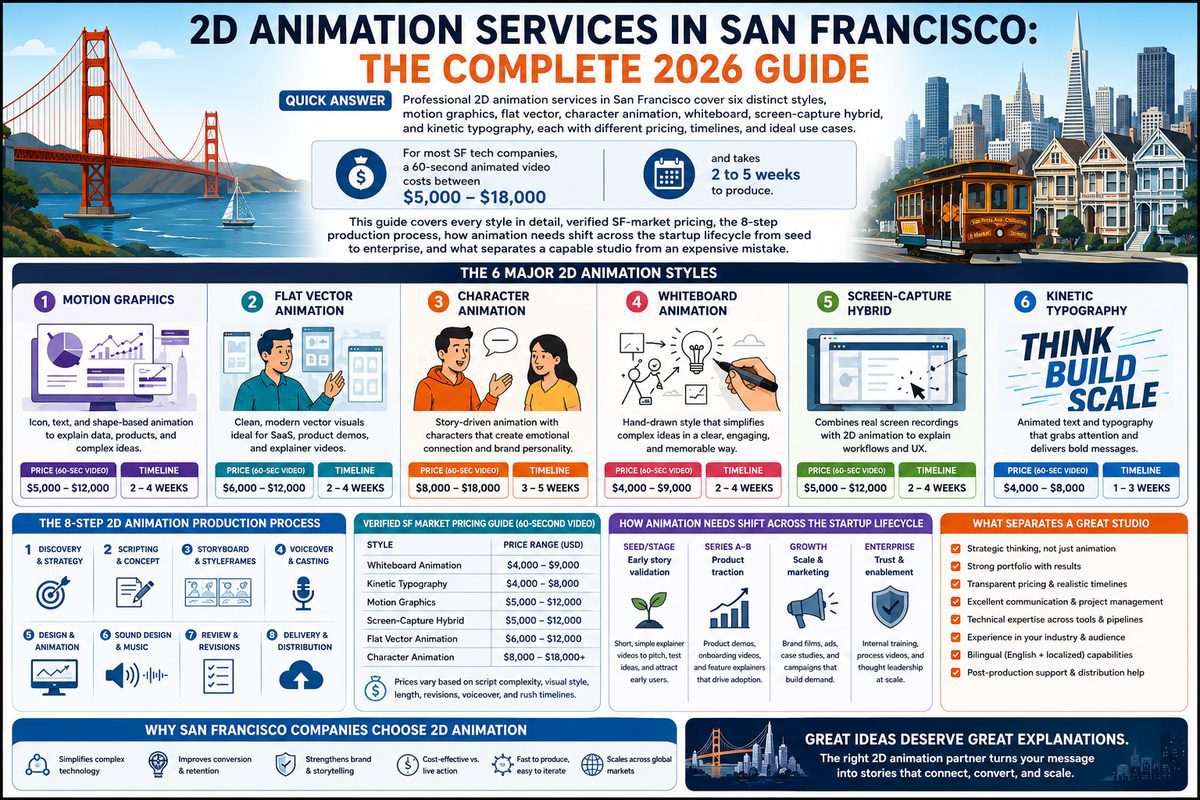
Professional 2D animation services in San Francisco cover six distinct styles, motion graphics, flat vector, character animation, whiteboard, screen-capture hybrid, and kinetic typography, each with different pricing, timelines, and ideal use cases. For most SF tech companies, a 60-second animated video costs between $5,000 and $18,000 and takes 2 to 5 weeks to produce. This guide covers every style in detail, verified SF-market pricing, the 8-step production process, how animation needs shift across the startup lifecycle from seed to enterprise, and what separates a capable studio from an expensive mistake.
San Francisco's density of AI labs, SaaS platforms, biotech firms, fintech companies, and venture-backed startups creates a demand for 2D animation services unlike any other city in the world. AI generates 52% of all SF startup capital. Enterprise SaaS captures another 18%. Every company in this ecosystem faces the same fundamental communication problem: their most valuable products are invisible, and animation is the only format that makes them visible.
Understanding which animation style is right for your company's stage and sector, what it realistically costs in the SF market, and how to evaluate the studio you hire is the difference between a marketing asset that performs for years and a video that never makes it off the staging server.
What Is 2D Animation? (And How It Differs From 3D and Motion Graphics)
2D animation creates movement in a two-dimensional flat plane. Characters, backgrounds, and objects are illustrated and animated within a flat visual world. Unlike 3D animation, which builds dimensional models in virtual space, 2D animation exists entirely on a flat canvas, giving it a distinctive visual quality, faster production timelines, and significantly lower production costs at comparable creative quality levels.
The term "2D animation" is used loosely in the market and frequently causes confusion. Three terms get conflated most often:
2D Animation vs. Motion Graphics
Motion graphics is a subcategory of 2D animation. It uses animated shapes, text, icons, and data visualizations without characters or narrative. Motion graphics communicates information; 2D character animation tells a story. For San Francisco tech companies, the distinction is practical: motion graphics excels at explaining how a product works, while 2D character animation excels at creating emotional connection to why it matters. Many productions use both within a single video.
2D Animation vs. Live-Action Video
Live-action requires physical locations, actors, film crews, permits, and post-production workflows that can take months to coordinate. For SF tech companies whose core product is invisible software, AI models, or biotech mechanisms, live-action cannot show the product in action. 2D animation services have no such constraints. A 2D animated video can show a machine learning model making a real-time recommendation, a fintech platform processing a transaction, or a drug binding to a cellular receptor, all in 90 seconds.
2D Animation vs. 3D Animation
3D animation renders dimensional models that can be viewed from any angle with physical depth and lighting. It is the right format for physical hardware products, architectural visualization, and premium consumer brand films. For the majority of SF tech applications. SaaS platform explainers, AI product demos, biotech investor communications, and enterprise software overviews: 2D delivers superior results at a fraction of the timeline and cost. The next section addresses this comparison directly.
2D vs 3D Animation for San Francisco Tech Companies: Which Is Actually Better?
This is the first question most SF founders and marketing leaders ask when commissioning animation for the first time. The 3D vs 2D debate is often framed as a quality question, it is not. It is a use-case question. Here is the honest answer for the industries that dominate San Francisco.
- 3 to 5 times faster to produce than comparable 3D
- 50 to 70% lower cost at equivalent creative quality
- Brand assets are reusable across an entire video series
- Updates and version revisions are fast and low-cost
- Motion graphics variant performes strongly on mute (LinkedIn, conference)
- Style ages more gracefully than 3D rendering trends
- Full commercial rights and source files delivered in standard contracts
- Physical hardware product requires dimensional visualization
- Architectural walkthroughs or spatial accuracy is the primary objective
- Premium consumer brand film with cinematic lighting is the brief
- Game engine environments or VR/AR content requires 3D by definition
- Medical device mechanical animation with moving parts and tolerances
For the overwhelming majority of companies commissioning their first professional animation in San Francisco, an AI SaaS startup, a Series A fintech company, a biotech communicating a mechanism of action to investors, or an enterprise software brand building a video library — 2D animation services deliver better ROI, faster timelines, and higher long-term asset value than 3D. The 3D premium is only justified when the output literally cannot be achieved in 2D.
The 6 Types of 2D Animation Services and Which SF Industries Use Each
The choice of animation style is the most important creative and commercial decision in any production. It determines the budget, the timeline, the visual tone, and how well the video performs with its specific audience. Here are the six 2D animation styles most commonly commissioned in San Francisco, with verified pricing and best-use context for each.
Animated shapes, text, data, and icons in motion, no characters, no narrative. The dominant format for SF's AI, fintech, and enterprise SaaS companies. Communicates complex product logic with precision. Performs strongly on mute, which matters for LinkedIn auto-play and conference presentation environments. The fastest and most cost-efficient professional animation format for technology brands.
Custom-illustrated characters with expressive movement in a clean, modern flat design aesthetic. The standard format for Series A and B companies making their first significant brand investment. Characters and visual assets built for the first video become reusable brand infrastructure, the second video using existing assets costs 30 to 50% less than the first. The highest-recall format for consumer-facing SaaS and tech platforms.
Real product UI screen recordings combined with motion graphics overlays, animated callouts, and voiceover. The most cost-effective format for demonstrating a software product that already has a visual interface. Updates efficiently when the product UI changes, only the screen capture portion needs re-recording. The go-to format for product-led growth companies and SaaS onboarding sequences where showing the actual product accelerates activation.
Simulated hand-drawing on a clean white background. The visual simplicity creates an educational, authoritative tone that performs well for complex clinical content, compliance explanations, and technical training where clarity matters more than brand personality. Less common among SF's startup sector but widely used in biotech investor presentations and healthcare provider education where the academic register adds credibility.
Text as the primary visual element, choreographed to voiceover or music. The most affordable professional format and the strongest performer without audio. Widely used for conference content, brand manifesto videos, social media campaigns, and keynote presentations where the message itself carries the creative. At SF events including TechCrunch Disrupt, Web Summit SF, and Y Combinator Demo Day supplemental content, kinetic typography provides high impact at low cost.
Every frame individually illustrated, the most labor-intensive and highest-quality 2D animation format. Produces fluid, organic movement with a hand-crafted aesthetic that reads immediately as premium. Reserved for brand films where the production quality is itself a signal of brand values, entertainment IP, and campaigns where cinematic 2D quality is the non-negotiable brief. Rarely the right choice for standard B2B tech explainer production.
2D Animation Pricing in San Francisco: What to Budget in 2026
Pricing transparency is consistently the biggest gap in the SF animation market. Most local studios require a discovery call before sharing numbers, a process designed to size the quote to the budget rather than to the project. Here is a verified breakdown of what 2D animation services in San Francisco actually cost in 2026, by format and by studio tier.
| Style | Price per Minute (SF market) | 60-sec Project Estimate | Timeline |
|---|---|---|---|
| Kinetic Typography | $1,200 – $3,500 | $2,000 – $5,000 | 1 – 2 weeks |
| Whiteboard Animation | $1,500 – $4,500 | $2,500 – $6,000 | 1 – 3 weeks |
| Screen-Capture Hybrid | $2,000 – $5,000 | $3,000 – $7,000 | 2 – 3 weeks |
| Motion Graphics | $1,500 – $6,000 | $3,000 – $9,000 | 2 – 4 weeks |
| Flat / Vector 2D Character | $3,000 – $12,000 | $5,000 – $18,000 | 3 – 6 weeks |
| Frame-by-Frame Traditional 2D | $8,000 – $18,000+ | $14,000 – $30,000+ | 6 – 14 weeks |
Source: Pixune Animation Cost Guide 2026; Clutch.co SF 2D animation market data; Vidico 2026 animation pricing benchmarks. Highlighted rows represent the most commonly commissioned formats for SF B2B tech companies.
Why SF Animation Pricing Is Higher Than the National Average
San Francisco animation production carries a premium above US national averages for reasons that extend beyond studio overhead:
- Talent premium: SF-based creative talent commands among the highest day rates in the US market, reflecting Bay Area cost of living and the competitive demand for skilled animators from both studios and large tech companies
- Market sophistication: SF buyers have seen more professional animation than buyers in almost any other market. The bar for what gets approved versus sent back for revision is genuinely higher here
- Deadline urgency: Demo Days, funding rounds, and product launches happen on fixed calendars. Studios that reliably hit tight timelines command a premium that reflects real organizational capability
- Local SoMa studio overhead: Studios with physical SF addresses carry office lease costs in one of the world's most expensive commercial real estate markets. That overhead is priced into production rates, it does not affect output quality
Remote-First Studios Serving the SF Market
The most important pricing insight for SF companies is that physical proximity to a studio has zero impact on animated video quality. Script, storyboard, voiceover, animation, and delivery all happen digitally. A professional remote-first studio serving the SF market with SF creative standards and time-zone alignment delivers identical output at lower cost than a SoMa-lease studio. For SF tech companies managing runway carefully, this distinction can save $3,000 to $8,000 per production without any reduction in quality. See Magic Motion Studio's published pricing for full package details.
The 8-Step Production Process: From Creative Brief to Final File
Every professional 2D animation studio follows the same eight-phase production sequence. Understanding what happens at each phase, and what decisions must be locked before the next phase begins, is the most effective way to protect your timeline and avoid costly late-stage revisions.
Target audience, core message, single desired action, animation style direction, brand guidelines, distribution platform, and competitive context. For SF companies, the brief should specify the primary use case: investor pitch, homepage conversion, product onboarding, or sales enablement. Each use case requires different structural decisions at the script stage. A studio that skips the brief and jumps to script will produce the wrong script.
Professional scriptwriting at 130 to 150 words per 60 seconds at natural voiceover pacing. The script is the single most important production asset. A weak script produces a weak animation regardless of illustration quality. For SF tech companies, the script must simplify complex technology without oversimplifying the product promise, and must be structured around the viewer's problem rather than the founder's product. Review and approve before any artwork begins, script revisions are free; animation revisions are expensive.
Visual mapping of every scene, character position, on-screen text, and scene transition. The storyboard is the last checkpoint before production begins, the highest-leverage revision opportunity in the process. For SF companies with multiple internal stakeholders across product, marketing, and executive functions, the storyboard review is the right alignment moment. Changes at storyboard stage take hours. The same changes after animation is produced take days.
Voice talent selection from a curated roster matched to the product category, audience, and brand tone. The animation is timed and synchronized to the approved voiceover, so this stage must be locked before animation begins. For SF companies selling to enterprise buyers, procurement committees, and international investors, voiceover talent should signal authority and precision rather than consumer friendliness. The voice sets the register for the entire video.
Static illustrations of 2 to 3 key scenes establishing the full visual language: color palette, character design, typography, background style, and motion graphic element design. Style frames are the final creative checkpoint before full illustration and animation production begins. Approving style frames carefully locks the aesthetic for the entire production. Visual direction changes after this stage are the most time-consuming revisions in the process.
Every background, character, icon, and on-screen element is built as a production asset. For flat 2D character animation, this includes character expression sheets, body position libraries, and rig construction. For motion graphics, this is icon design, data element creation, and scene composition. All assets are built as reusable components, the first production creates the brand infrastructure that every subsequent video draws from at significantly reduced cost.
Assets animated in sequence and synchronized to the voiceover track. For motion graphics, transitions, text reveals, and data animations are choreographed. For character animation, movement, expression, and timing are refined against the voiceover. A rough cut is delivered for review before sound design begins. Structural issues identified at rough cut stage should be addressed here, after sound design, additional structural revisions add time and cost.
Licensed background music selected to match brand tone and pacing. Sound effects added to key visual moments. Final audio mix balancing voiceover, music, and effects. Delivery in MP4 (web-optimized), MOV (broadcast quality), and social cuts at 1:1 and 9:16 aspect ratios. Full commercial rights and source files included in professional packages. For SF companies planning to deploy video across investor materials, landing pages, and LinkedIn campaigns simultaneously, confirming all format deliverables before signing is essential.
Ready to commission 2D animation for your SF tech company?
Magic Motion Studio delivers custom 2D animation for San Francisco's AI, SaaS, fintech, and biotech companies in 14 business days. Pricing published upfront.
View Our 2D Animation Work2D Animation Across the SF Startup Lifecycle
One of the most underappreciated aspects of 2D animation services for San Francisco companies is how dramatically the right format, budget, and production strategy changes with company stage. A seed-stage startup and a Series B company commissioning animation have different objectives, different audiences, different budgets, and different timelines, and the studio brief for each should reflect that. Here is how animation needs evolve through the four core stages of the SF startup lifecycle.
- Primary need: Investor pitch video and initial homepage explanation
- Audience: Angels, pre-seed VCs, early adopter users
- Core message: What the problem is and why this team solves it
- Key constraint: 60 seconds maximum; investors have 300 pitches this week
- Asset reuse: Pitch video doubles as homepage video until Series A
- Primary need: First major brand animation, characters, visual world, tone
- Audience: Mid-market buyers, Series A/B investors, growth-track users
- Core message: Product-market fit proof and category leadership signal
- Key opportunity: Brand characters built now reuse across the next 10+ videos
- Asset reuse: Homepage hero, investor update, onboarding, LinkedIn ads from one shoot
- Primary need: Video library across buyer personas and product lines
- Audience: Enterprise buyers, procurement committees, international markets
- Core message: ROI, security, compliance, and enterprise integration
- Key advantage: Series A brand assets redeployed across multiple variants
- Asset reuse: 3 to 5 videos produced from same brand library at 30 to 50% lower cost
- Primary need: Consistent animation across global markets and product lines
- Audience: Enterprise, regulated industries, global enterprise accounts
- Core message: Platform breadth, security posture, global capability
- Key challenge: Maintaining brand consistency at production volume
- Asset reuse: Modular scene library enabling rapid new video production
The compounding value of a well-planned Series A animation investment is significant. A startup that builds custom characters, backgrounds, and a brand motion system at Series A typically reduces per-video production cost by 30 to 50% for every subsequent production through Series C. A startup that commissions a series of disconnected one-off videos pays full production cost every time. Over 10 to 15 videos, the difference in total spend can exceed $100,000 at comparable quality levels.
2D Animation for San Francisco's Key Industries
San Francisco's industry mix creates specific animation requirements that differ from every other major US market. Here is what 2D animation services deliver for the six sectors that drive the SF economy, and what makes animation the right format for each.
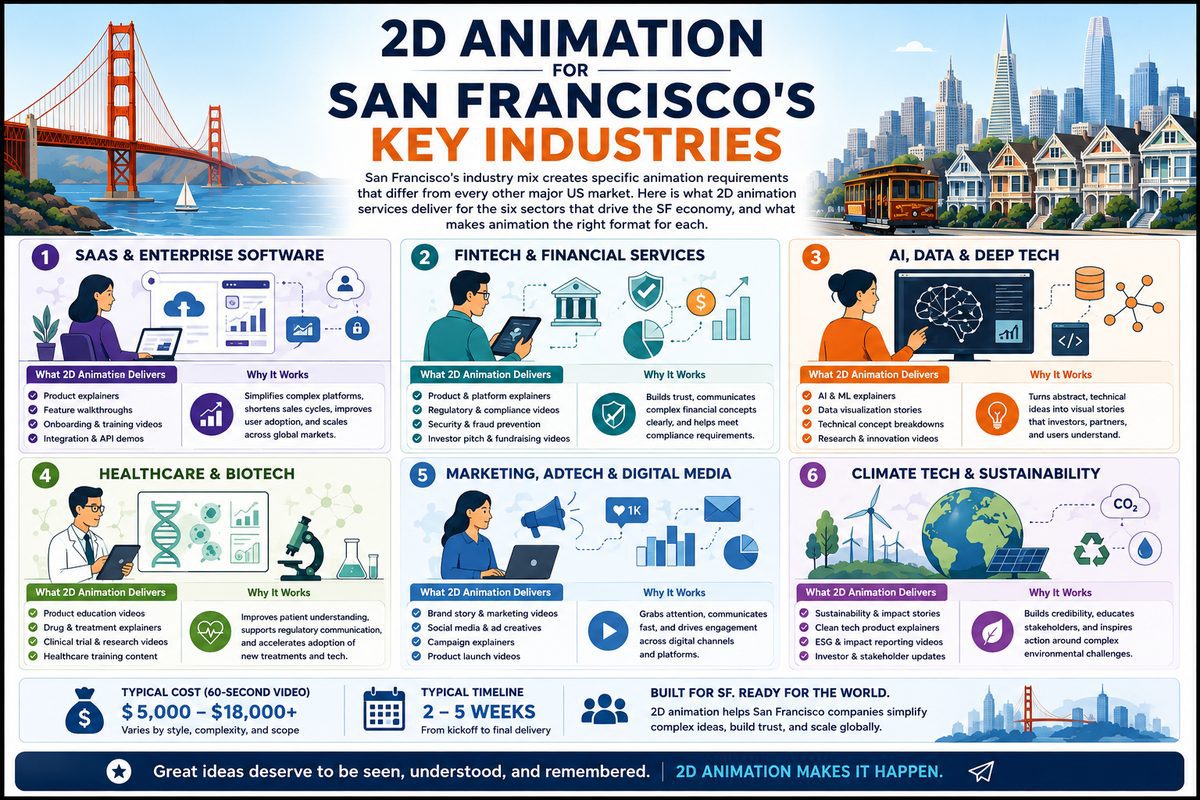
AI captured 52% of all SF startup capital in 2025, with the Bay Area attracting more than 75% of all US AI investment. The core communication challenge for every AI company is identical: the product's most important capability, the model itself, is completely invisible. Motion graphics makes AI logic visible: training pipelines, recommendation surfaces, decision trees, and inference workflows can all be animated clearly in 60 seconds. For AI companies at Series A and B, a well-produced motion graphics overview that makes the model legible to a non-technical investor is typically the first professional marketing asset commissioned.
SF's developer tools sector spans API platforms, CI/CD tools, observability products, and the infrastructure software that the tech industry runs on. PLG (product-led growth) companies face a specific animation challenge: buyers need to see the actual product working, not an illustrated version of it. Screen-capture hybrid animation solves this by combining real UI recordings with motion graphics callouts and voiceover explanation. When the product UI updates, only the screen capture needs re-recording, the motion graphics framework, voiceover, and music carry forward, making update cycles fast and affordable.
Mission Bay anchors one of the world's most concentrated biotech corridors, with the UCSF campus anchoring a dense cluster of drug discovery, genomics, and computational biology companies. Biotech/HealthTech accounted for 9% of SF startup capital in 2025, approximately $10 billion. 2D animation for biotech serves three distinct audiences with different format needs: investors require clear mechanism-of-action explanations and pipeline visualizations; clinical partners and physicians require scientific accuracy in a professional format; patients require accessible explanations of treatment pathways. Whiteboard animation provides the academic authority for clinical content, while motion graphics delivers the visual precision for investor-facing mechanism-of-action videos.
The Financial District is home to Visa, Charles Schwab, Wells Fargo, and hundreds of fintech startups building the next generation of payment rails, lending infrastructure, and wealth management platforms. Fintech products carry regulatory complexity and trust requirements that live-action video cannot address without compliance risk. 2D animation communicates how payment flows work, how lending risk models calculate, and how compliance workflows execute with the precision that both regulators and enterprise customers require. For consumer-facing fintech, flat 2D character animation adds the emotional warmth that drives app download and onboarding completion.
SF's enterprise software sector includes Salesforce, Okta, and hundreds of companies selling complex multi-stakeholder platforms to large organizations. Enterprise 2D animation serves a different function than startup animation: it must satisfy a buying committee rather than a single decision-maker. That means modular production, a core 90-second overview with 30-second industry-specific variants for IT, finance, and executive buyer personas. Motion graphics is the dominant format for enterprise buyers because it communicates ROI, security architecture, and integration capability with the precision and neutrality that procurement committees require.
San Francisco's crypto sector includes Coinbase and a dense network of Web3 protocol and DeFi application companies across SoMa. The central challenge for every Web3 company is trust: blockchain technology is counterintuitive for mainstream audiences and carries significant skepticism from the broader financial market. Motion graphics is the primary format because it makes distributed consensus, tokenomics, smart contract execution, and liquidity mechanics visually accessible without misrepresentation. For Web3 products targeting mainstream consumer adoption, flat 2D character animation bridges the technical-to-human gap that pure motion graphics alone cannot close.
How to Choose a 2D Animation Studio in San Francisco: 6 Things to Check
SF's animation market ranges from established studios with strong creative reputations to freelancers operating under a company name. The quality gap between these tiers is significant, and a well-designed website does not reliably predict production quality or on-time delivery. Here is a six-point checklist for evaluating any 2D animation studio in San Francisco before signing a contract.
- Portfolio consistency across multiple recent projects. Ask for the studio's last five completed projects, not their five favourite pieces. Consistent quality across recent work is a stronger signal than one exceptional video from two years ago. If the reel shows five outstanding videos and nothing else exists, those videos are outliers, not benchmarks.
- Scriptwriting as a dedicated role, not bundled with animation. Ask who specifically writes scripts and request standalone script examples. The script determines the video's performance more than any visual element. A motion designer who also writes copy is not a scriptwriter. For SF tech companies with complex products, the scriptwriter must demonstrate understanding of your product category and the ability to explain technology to a non-technical audience without oversimplifying the value proposition.
- A written revision policy with numbered rounds per production stage. A professional studio specifies how many revision rounds are included at script, storyboard, and animation stages, and what the per-round rate is for additional revisions. Unlimited revisions is not a revision policy, it signals an absence of production structure and will result in timeline slippage. Get the revision policy in writing before signing, not in a summary email after.
- A milestone production schedule with specific dates before signing. A professional studio provides a milestone schedule: script delivery date, storyboard delivery date, rough cut date, and final delivery date. "4 to 6 weeks" without milestone dates means no production accountability. For SF companies working against Demo Days, board meeting presentations, and product launch dates, milestone specificity is not optional.
- Clarity on IP ownership and deliverable file formats before signing. Confirm in writing that you receive full commercial rights to all produced assets, that source files are included, that background music is fully licensed for your intended usage (website, paid ads, broadcast), and that voiceover talent rights cover all distribution platforms. IP ownership terms in animation contracts have more variables than most clients expect, clarifying before signing is always easier than negotiating after delivery.
- Pricing transparency before any discovery call. A professional studio can give you a price range for a 60-second flat 2D animated video without a 45-minute sales call. If pricing is gated behind a consultation, the quote will be calibrated to the budget they think you have rather than the budget the project should cost. Pricing transparency is the single clearest indicator of a studio's confidence in the product it offers. For full upfront pricing, see Magic Motion Studio's published pricing guide.
Does 2D Animation Deliver ROI for San Francisco Tech Companies? The 2026 Data
Commissioning 2D animation services is a real budget decision. For SF companies managing runway or tracking cost per acquisition, the ROI question is not abstract. Here is what verified 2026 research shows about animated video performance across B2B and tech categories.
Source: Wyzowl Video Marketing Statistics Report 2026; Levitate Media B2B Video Marketing Statistics 2026.
For SF companies specifically, animated video delivers ROI across four distinct business functions simultaneously:
- Investor fundraising: A 60-second animated video embedded in a pitch deck or sent before a partner meeting demonstrates communication discipline and product clarity in a competitive field where most companies deliver pitch decks alone
- Homepage conversion: Landing pages with an embedded animated overview convert at up to 86% higher rates than text-only pages, the single highest-leverage conversion element for most B2B SaaS homepages
- User onboarding: SaaS products that include an animated overview in the first onboarding screen see measurably higher activation rates because users understand the product's core value proposition before they encounter its complexity
- Paid acquisition: LinkedIn video ads consistently outperform static image ads for B2B SaaS at the awareness stage. A 30-second cut of a professionally produced animated video deployed as a LinkedIn ad generates significantly lower cost per lead than equivalent spend on non-video formats
The compounding effect is the strongest financial argument for a serious first animation investment. A video produced for fundraising can be redeployed on the homepage, in onboarding, across LinkedIn campaigns, in sales enablement emails, and at conference booths without additional production cost. For SF companies with high customer acquisition costs and tight runway, an animated video that performs across five channels from a single production budget is among the highest-ROI marketing investments available.
Frequently Asked Questions About 2D Animation Services in San Francisco
How much do 2D animation services cost in San Francisco?
2D animation services in San Francisco range by style and studio tier. Motion graphics runs $1,500 to $6,000 per finished minute. Flat vector 2D character animation costs $3,000 to $12,000 per minute. Full rigged character animation with lip-sync runs $5,000 to $15,000 per minute. A professionally produced 60 to 90-second flat 2D animated video for an SF tech company costs between $5,000 and $18,000 from a professional studio serving the market. Remote-first studios serving SF deliver comparable quality at lower overhead than local SoMa-address studios. See Magic Motion Studio's full pricing guide.
How long does 2D animation production take for an SF tech company?
Motion graphics takes 1 to 3 weeks per 60 seconds. Flat vector 2D character animation takes 2 to 4 weeks. Full custom character animation takes 3 to 6 weeks. The fastest professional studios serving the San Francisco market deliver a complete 60 to 90-second animated video in 14 business days, covering all eight production phases with included revision rounds. For SF companies working against Demo Day, board meeting, or product launch deadlines, 14-day delivery is achievable without quality compromise.
What is the difference between 2D animation and motion graphics?
Motion graphics is a subcategory of 2D animation that uses animated shapes, text, and data without characters or narrative. It communicates information efficiently and performs well on mute. Full 2D animation adds custom illustrated characters with personality and expression that guide viewers through a story, driving higher emotional connection and brand recall. For most SF tech companies, the right choice depends on whether information delivery or brand connection is the primary objective. Many productions use both within the same video.
What 2D animation style works best for an AI or SaaS startup in San Francisco?
Motion graphics and flat vector 2D are the dominant formats for SF AI and SaaS startups. Motion graphics is right for explaining AI logic, visualizing data flows, and demonstrating software platform capabilities where precision matters most. Flat vector 2D with a brand character works best when the startup is investing in brand identity at Series A or B and wants a visual asset that scales across multiple future productions. For seed-stage companies under budget pressure, motion graphics delivers the fastest high-quality output at the lowest cost per video.
Is 2D animation better than 3D animation for most SF business applications?
For the majority of SF B2B applications, yes. 2D is faster to produce, significantly more cost-effective at comparable quality, easier to update when products or messaging changes, and more scalable across a video series using shared brand assets. 3D is the right choice when physical product visualization, dimensional spatial accuracy, or cinematic premium brand quality is the objective. For SaaS, AI, fintech, biotech communications, and enterprise software, 2D is the professional standard that delivers higher ROI per dollar invested.
What should I prepare before briefing a 2D animation studio in San Francisco?
Prepare: a one-paragraph product and problem description; your target audience by role and company size; the single action you want viewers to take; brand guidelines including logo, color palette, and typography; three to five visual references showing the animation style direction you prefer; and the primary distribution platform for the video. Companies that arrive with this brief get significantly better first-pass scripts and visual directions, reducing revision rounds and total timeline.
How many revision rounds should a 2D animation studio in San Francisco include?
A professional 2D animation studio should include at minimum two revision rounds at each of the three main production stages: script, storyboard, and animation. That is six total revision touchpoints. Script and storyboard revisions are free because no animation has been produced. Animation revisions are the most expensive, identify structural issues at the rough cut stage, not after sound design is complete. Always confirm the revision policy in writing before signing.
Can 2D animation assets be reused across multiple videos?
Yes. This is one of the strongest financial arguments for investing in custom 2D animation at Series A. Brand characters, background environments, icon libraries, and motion graphic systems built for the first video reuse across every subsequent production. A second video using existing brand assets costs 30 to 50% less than the original. Over 10 to 15 videos through Series B and Series C, the compounding cost saving from a well-planned initial brand animation investment can exceed $100,000 compared to commissioning disconnected one-off productions each time.
More 2D Animation Services Guides by City
Magic Motion Studio produces custom 2D animation for tech companies across the United States. For guides covering other major markets:
- 2D Animation Services in Los Angeles: The Complete 2026 Guide
- 2D Animation Services in Chicago: The Complete 2026 Guide
- 2D Animation Services in Miami: The Complete 2026 Guide
For the full overview of explainer video production for SF companies, formats, pricing, and how to hire, see our companion guides: Explainer Video Company in San Francisco and our dedicated San Francisco explainer video production service page. For anime-style and frame-by-frame 2D, see our anime animation studio page.
Further reading for San Francisco businesses:
- What Is 2D Animation? Complete Guide for Businesses
- 2D Animation Styles: Flat Design, Frame-by-Frame, Cutout and More
- How Long Does 2D Animation Take to Produce?
- 2D Animation Cost: Complete Pricing Guide for Businesses
- Explainer Video Examples That Convert: 12 Real-World Results
Ready to start your San Francisco animation project?
Custom 2D animation for SF's AI, SaaS, fintech, and biotech companies. Delivered in 14 business days. Every style from motion graphics to full character animation. Pricing published upfront.
View Our 2D Animation Work