
Explainer Video Company in San Francisco: The Complete 2026 Buyer's Guide
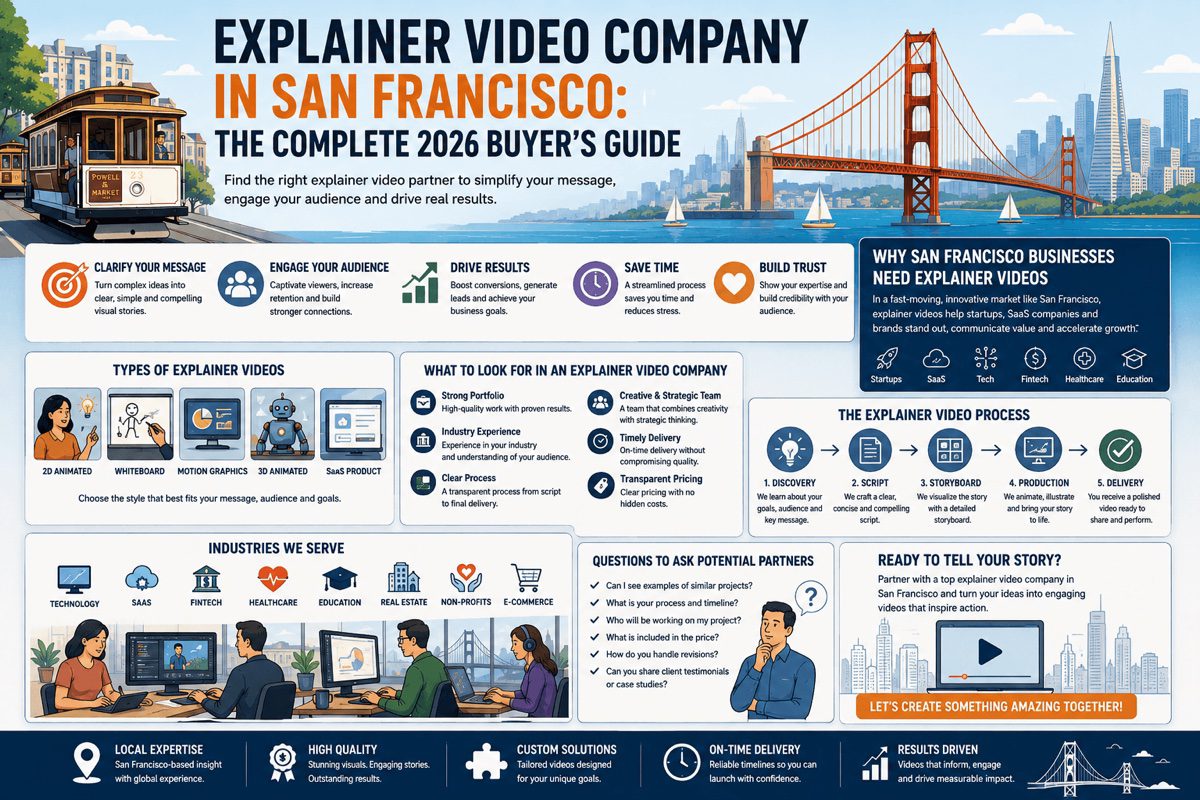
The best explainer video company in San Francisco produces animated videos that explain complex tech products clearly, converts viewers into buyers, and delivers finished files in a defined timeline with a structured revision process. Pricing for a professional 60 to 90-second animated explainer video in the SF market ranges from $5,000 to $15,000. This guide covers every format, verified pricing, the full production process, how to evaluate any studio, and the red flags that separate professional operations from expensive disappointments.
San Francisco's concentration of early-stage startups, Series A to C growth companies, enterprise software giants, biotech firms, and AI labs creates a market where animated explainer video is not a nice-to-have marketing asset. It is the default communication format for pitching investors, onboarding users, launching products, and explaining technology that resists simple description in plain language. Finding the right explainer video company in San Francisco is a high-stakes decision with a significant budget attached. This guide gives you the framework to make it correctly.
We cover what the best SF studios actually do, how to evaluate them before signing, which formats work for each major SF industry, what a realistic budget looks like in 2026, and the specific questions that reveal whether a studio has real process or just a good reel.
 explainer videos for AI SaaS fintech biotech and crypto startups in SoMa Mission Bay and the Financial District" width="1200" height="675" loading="lazy">
What Is an Explainer Video? (And Why It Is the Default Format for SF Tech)
An explainer video is a short animated or live-action video, typically 60 to 120 seconds, that communicates what a product is, who it is for, and why it matters. For most San Francisco technology companies, animated explainer video is the dominant format because it solves the central challenge that every SF company faces: explaining technology that does not physically exist in a way that an investor, customer, or recruit can understand in under 90 seconds.
Live-action video requires actors, sets, filming schedules, location permits, and post-production workflows that can take months to coordinate. It works well for testimonials, founder stories, and culture videos but struggles to communicate abstract software processes, AI decision-making, decentralized finance flows, or biotech mechanisms of action. Animation has no such constraints. A 2D animated character can demonstrate SaaS platform navigation, illustrate a blockchain transaction, visualize a drug's pathway through the bloodstream, and show an AI recommendation engine making a decision in real time, all within the same 90-second video.
For SF companies specifically, explainer video production sits at the intersection of three business-critical moments:
- Investor fundraising: A clear, professional animated video signals product maturity and communication sophistication to Series A, B, and C investors who review hundreds of pitches per month
- Product launches: New products need explanation before they can be evaluated. Animation creates that understanding faster than any other medium
- User onboarding: Complex SaaS platforms see activation rates improve significantly when users watch a 60-second animated overview before touching the product for the first time
Understanding what type of explainer video your specific company needs, what it should cost, and how to evaluate the studio you hire is the difference between a marketing asset that performs for years and one that sits on a staging server, never deployed because it missed the brief.
Why San Francisco Companies Commission More Explainer Videos Than Any Other City
No city in the world has a higher per-capita demand for professional animated explainer video than San Francisco. Understanding why makes it easier to understand what to expect from any explainer video company in San Francisco and what your video needs to accomplish.
Source: StartupBlink Global Ecosystem Rankings 2026; Startup Genome Silicon Valley data 2025; Visible.vc Bay Area VC metrics 2025.
The specific dynamics that drive explainer video demand in SF are worth understanding in detail:
The VC Fundraising Cycle
San Francisco companies raise money from investors who receive thousands of pitch decks per year. A professional animated explainer video embedded in a pitch deck or shared before a partner meeting does three things that slides cannot: it demonstrates that the founding team can communicate clearly, it proves production capability and organizational seriousness, and it makes a complex product category immediately legible to a partner who has not yet spent 20 minutes reading your one-pager. OpenAI's $40 billion raise in 2025, the largest single VC round in history, underscored how capital-dense and competitive the SF fundraising environment has become. In that environment, communication clarity is a competitive advantage.
The Y Combinator Demo Day Effect
Over 5,000 companies have gone through Y Combinator since 2005, the majority headquartered in San Francisco or the Bay Area. Each YC cohort creates a wave of companies simultaneously needing polished video assets for Demo Day, batch announcements, and immediate post-YC fundraising pushes. The Demo Day format, two-minute pitches to a room of investors, trains SF founders to value extreme communication efficiency. That instinct carries directly into how they brief animation studios: tight scripts, defined messages, and maximum impact per second of video.
Product Complexity That Requires Animation
The dominant SF industries. AI and machine learning, SaaS, fintech, biotech, crypto and Web3, and enterprise software, all share the same characteristic: their core value proposition is fundamentally invisible. You cannot film a machine learning model making a recommendation. You cannot photograph a DeFi protocol processing a transaction. You cannot shoot a video of a biotech company's drug binding to a receptor. Animation is the only format that can make these processes visible, and San Francisco's industry mix makes animation the default production format in a way that simply does not apply to cities with different economic bases.
The 5 Explainer Video Formats SF Companies Commission Most
Not all explainer videos are the same format, and the choice of format significantly affects price, timeline, and performance. Here are the five formats most commonly commissioned by San Francisco companies seeking an explainer video, with the verified pricing ranges and best-use context for each.
Animated shapes, text, icons, and data visualizations that communicate process and product logic without characters. The most common format for enterprise SaaS, AI platforms, fintech, and any product where precision and data communication matter more than brand personality. Performs strongly without audio, critical for LinkedIn auto-play and conference environments.
Custom illustrated characters in a clean, modern flat design style. The standard format for Series A and B companies building a first professional brand presence. Combines emotional storytelling with clear product communication. Shared brand assets and characters are reusable across multiple videos, making the first production the most expensive and subsequent videos significantly more cost-effective.
Animated UI walkthrough combining real product screen recordings with motion graphics overlays, callouts, annotations, and voiceover. Most cost-effective format for demonstrating a software product that already has a visual interface. Updates well when product UI changes, only the screen capture portion needs re-recording, not the entire production. The go-to format for product-led growth companies and PLG onboarding flows.
Simulated hand-drawing on a clean white background. The neutral, authoritative visual tone works best for educational content, regulatory compliance explanations, healthcare patient education, and technical documentation that requires maximum clarity without brand personality distractions. Less commonly used by early-stage SF startups but standard in biotech and healthcare investor communications.
Text as the primary visual element, choreographed to voiceover or music. The fastest and most affordable professional animated format. Used heavily for conference presentations, LinkedIn campaign content, brand manifesto videos, and event-specific social content where the message itself is the creative. Strong performer in muted social environments. Not a replacement for a full explainer but highly effective as a campaign supplement.
Explainer Video Pricing in San Francisco: What a Realistic Budget Looks Like in 2026
Pricing transparency is rare in the SF video production market. Most studios require a discovery call before sharing any numbers, a process that wastes time for both parties and creates information asymmetry that benefits the studio. Here is a verified breakdown of what explainer video production in San Francisco actually costs in 2026, by format and by studio tier.
| Format | SF Market Price Range (per min) | 60-sec Project Budget | Timeline |
|---|---|---|---|
| Kinetic Typography | $1,500 – $4,000 | $2,500 – $6,000 | 1 – 2 weeks |
| Screen-Capture Hybrid | $2,500 – $6,000 | $3,500 – $8,000 | 2 – 3 weeks |
| Whiteboard Animation | $2,000 – $5,000 | $3,000 – $7,000 | 2 – 3 weeks |
| Motion Graphics | $3,000 – $8,000 | $5,000 – $12,000 | 2 – 4 weeks |
| Flat 2D Character Animation | $5,000 – $12,000 | $7,000 – $18,000 | 3 – 6 weeks |
| Live-Action (SF location) | $8,000 – $25,000+ | $12,000 – $35,000+ | 6 – 12 weeks |
Source: Vidico 2026 pricing guide, LV Productions SF corporate video cost research, 175 Productions SF Bay Area rates. Highlighted rows represent the most commonly commissioned formats by SF B2B tech companies.
Why SF Pricing Is Higher Than the National Average
San Francisco production costs carry a premium over national averages for several compounding reasons:
- Talent cost: SF creative talent commands among the highest rates in the US market, reflecting the Bay Area's general cost of living premium
- Location overhead: Live-action production in SF specifically adds location access fees, certificate of insurance requirements for office buildings, union crew costs, and permit requirements that can add $3,000 to $8,000 to a production before a camera rolls
- Market sophistication: SF buyers have seen more professional video than buyers in most other markets, raising the quality bar for what gets approved and what gets shelved
- Turnaround pressure: SF's funding cycle creates genuine urgency around delivery dates. Demo Days, board meetings, and product launches happen on fixed calendars. Studios that can reliably hit tight timelines command a premium
Remote-First Studios Serving the SF Market
The most important pricing insight for SF companies is that physical proximity to your studio does not affect animated explainer video quality at all. Script, storyboard, voiceover, animation, and final delivery all happen digitally. A professional remote-first studio serving the SF market with SF-caliber creative standards but without SF overhead delivers the same output at significantly lower total cost. All reviews happen on shared cloud platforms. Communication happens in your time zone. For animated video production specifically, the best explainer video company for SF tech companies may not have a SoMa office address and does not need one. For complete pricing, see Magic Motion Studio's published pricing guide.
The Full Production Process: From Brief to Final File
Every professional explainer video company follows the same core production sequence. Understanding each phase and its timeline helps you plan revision rounds, align internal stakeholders, and avoid the scope creep that pushes projects past deadline and budget. Here is the standard seven-phase process for an animated explainer video.
Target audience, core message, desired action, tone of voice, animation style, distribution platform, and competitive context. The brief is the foundation. Vague briefs produce vague scripts, which produce vague animations. For SF companies, the brief should specify whether the video is for investors (prioritize clarity and market size), customers (prioritize problem-solution narrative), or users (prioritize product confidence and feature clarity). A professional studio asks for all of this before any creative work begins.
Professional scriptwriting calibrated to voiceover pacing: 130 to 150 words per 60 seconds at a natural speaking pace. Scripts for SF tech companies require a writer who understands product-market fit framing, can simplify technical product descriptions without oversimplification, and knows how to write for conversion rather than information delivery. Script approval is the most important creative gate in the entire production, changes made at script stage are free; changes made after animation starts are expensive.
Visual mapping of every scene, character position, on-screen text, and transition before any artwork is created. The storyboard is the blueprint, approving it carefully saves significant time and money later. For SF companies with multiple internal stakeholders (product, marketing, CEO, legal), storyboard review is the right moment to align all parties, not the animation review stage.
Voice talent selection from a curated roster. For SF tech companies, voiceover talent selection matters more than most clients realize: the voice should match the product category and target audience. An AI platform selling to enterprise IT buyers needs a different voice than a consumer fintech app targeting millennials. The animation is timed to the approved voiceover, so this stage must be locked before animation begins.
Static illustrations of 2 to 3 key scenes showing the full visual language: color palette, character design, typography, and motion graphic element style. Style frames are the final visual checkpoint before full illustration and animation begin. Approving style frames carefully locks the aesthetic for the entire production. Changes to visual direction after this stage are the most expensive and time-consuming revisions in the production process.
Full asset production: every background, character, icon, and on-screen element is illustrated and animated in sequence, synchronized to the voiceover track. A rough cut is delivered for review before final sound design begins. Licensed background music selected to match brand tone and pacing. Sound effects added to key visual moments. Final audio mix balancing voiceover, music, and effects. For SF tech companies, the rough cut review is the highest-stakes approval in the animation phase, address structural issues here, not in the final delivery review.
Delivery in MP4 (web-optimized for landing pages and social), MOV (broadcast quality for presentations and TV), plus 1:1 and 9:16 social-format cuts. Source files and full commercial rights included in professional packages. For SF companies planning to use video assets across investor materials, websites, LinkedIn campaigns, and product onboarding, confirm file format deliverables with your explainer video company in San Francisco before signing any contract.
Need an explainer video for your San Francisco company?
Magic Motion Studio delivers animated explainer videos for SF tech companies in 14 business days. Script to final file. Pricing published upfront, no discovery call required.
View Our San Francisco WorkHow San Francisco's Key Industries Use Explainer Videos
San Francisco's industry landscape is unlike any other US city. The specific use cases for explainer video production in SF reflect the particular communication challenges each sector faces. Here is how the six dominant SF sectors use animated video and which formats perform best in each. When briefing any explainer video company in San Francisco, share your sector and audience type upfront so the studio can recommend the right format from the first brief.
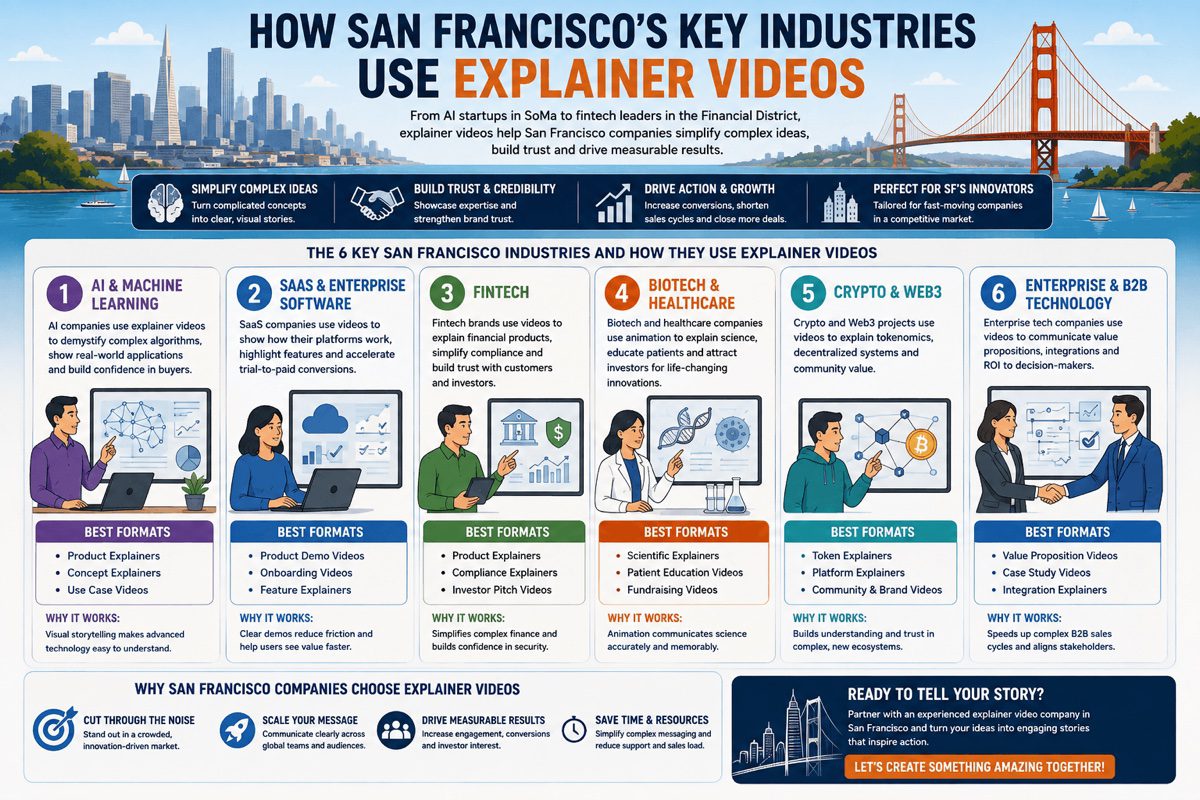
The Bay Area captured $122 billion in AI investment in 2025, more than 75% of all US AI funding. Mission Bay's office market logged among the largest occupancy gains in SF in 2026, driven by AI firms. AI companies face a universal explainer challenge: the value is invisible by definition. Motion graphics communicates how models train, how predictions surface, and how recommendations generate without requiring audiences to understand the mathematics. For AI companies raising Series A or B, a polished animated overview that explains the product in plain language is typically the first professional marketing asset produced.
SF SaaS is the densest sector in the ecosystem, from seed-stage developer tools to enterprise platforms serving Fortune 500 customers. SaaS companies use explainer video for three distinct purposes: homepage conversion (flat 2D overview, 60 to 90 seconds), product onboarding (screen-capture hybrid, 90 to 120 seconds), and investor fundraising (motion graphics overview, 60 seconds). A well-produced flat 2D explainer built at Series A serves all three purposes simultaneously when structured around the problem-solution-call-to-action narrative framework. See our dedicated guide on explainer video production in San Francisco for the full SaaS breakdown.
San Francisco's Financial District hosts Visa, Wells Fargo, Charles Schwab, and hundreds of fintech startups building the next generation of payment infrastructure, lending technology, and wealth management platforms. Fintech products carry regulatory complexity and trust requirements that live-action communication cannot simplify without compliance risk. Motion graphics communicates how funds move, how risk models calculate, and how compliance workflows execute with the precision that both regulators and customers need. For consumer fintech, flat 2D character animation adds emotional warmth that drives app download and onboarding completion rates.
Mission Bay anchors one of the world's leading biotech corridors, stretching south to South San Francisco where Genentech pioneered the industry. Biotech companies use animated explainer video for three distinct audiences: investors (mechanism of action and market opportunity), partners and collaborators (platform technology and pipeline), and patients (clinical trial information and treatment explanations). Whiteboard animation works for clinical and scientific communication where an authoritative, educational tone is appropriate. Motion graphics and 3D molecular visualization work for investor-facing content where visual sophistication signals research quality.
San Francisco's crypto sector is concentrated around Coinbase's founding address and extends through the broader SoMa startup network. Web3 and blockchain companies face the most acute explainer challenge in the SF ecosystem: their products are abstract, their technology is counterintuitive, and mainstream audiences carry significant skepticism about the category. Motion graphics is the primary format because it can visualize distributed consensus, tokenomics, and smart contract execution in ways that slides and whitepapers never achieve. For Web3 products targeting mainstream consumer adoption, flat 2D character animation bridges the technical-to-human communication gap that blockchain brands consistently struggle with.
SF's enterprise software sector includes Salesforce, Okta, Splunk, and hundreds of companies selling complex multi-stakeholder SaaS products to large organizations. Enterprise explainer videos serve a different communication function than startup-stage videos: they need to satisfy a buying committee rather than a single decision-maker. That means clearer ROI framing, more explicit use case specificity, and professional production quality that signals vendor stability. The best enterprise explainer videos in SF are modular: a 90-second overview with 30-second industry-specific variants cut from the same asset base, deployed differently for IT, finance, and executive buyer personas.
8 Questions to Ask Before Hiring an Explainer Video Company in San Francisco
The quality gap between the best and worst explainer video companies in San Francisco is enormous, and a polished demo reel does not reliably predict production quality, communication, or on-time delivery. These eight questions reveal the operational reality behind any studio's public-facing portfolio before you commit budget.
Any studio can curate a reel of their best work. Asking for recent projects regardless of quality reveals consistency. If the last five projects are noticeably weaker than the hero reel, the reel was assembled from outliers. Consistent quality across recent work is a stronger signal than one exceptional piece from three years ago.
Script strategy, copywriting, and animation are three distinct disciplines. A motion designer who also writes scripts is not a scriptwriter. Ask for the specific person who will write your script and request examples of scripts they wrote, not just finished videos. For SF tech companies, the script must demonstrate understanding of your product category, target audience psychology, and conversion-oriented narrative structure.
A professional studio has a written revision policy that defines how many rounds are included at script, storyboard, and animation stages, and what qualifies as an additional round. Vague revision policies create contract disputes and blown timelines. "Unlimited revisions" is not a policy, it is a liability that typically results in a studio deprioritizing your project when revisions extend indefinitely.
A professional studio can provide a milestone schedule, script delivery date, storyboard delivery date, voiceover recording date, animation rough cut date, and final delivery date, before the contract is signed. A studio that can only say "6 to 8 weeks" without milestone dates has no production accountability structure. For SF companies with board meetings, fundraising timelines, and launch dates, milestone specificity is not optional.
Explainer videos for AI companies require different scripting instincts than videos for biotech companies, which require different visual approaches than videos for consumer fintech. A studio that claims experience across all verticals but cannot produce specific, verifiable examples from your sector is generalizing. Ask for a reference contact from a client in your industry, not just a video link.
IP ownership in animated video production is more complex than most clients realize. Source files, character designs, background assets, voiceover recordings, and background music tracks all carry separate ownership and licensing considerations. A professional studio delivers full commercial rights to all produced assets. Stock music requires a license that covers the intended usage scope. Confirming ownership of all elements before signing prevents costly licensing disputes when the video is deployed at scale.
Communication friction during production is the most common source of delayed deliveries and unhappy clients. A professional studio assigns a dedicated project manager, specifies a communication channel (email, Slack, project management platform), and commits to a response time SLA during business hours. If a studio's pre-sales communication is slow or vague, their production communication will be worse.
A professional studio can tell you the price range for your project type before a 45-minute sales call. Pricing transparency is the simplest signal of organizational confidence in the product being offered. If a studio gates all pricing behind a consultation, they either do not have a standard production process or they are sizing the quote to the budget they think you have, not the budget the project should cost. Both outcomes benefit the studio, not the buyer.
7 Red Flags When Hiring an Explainer Video Company in San Francisco
Beyond the questions above, certain patterns in how a studio presents and operates are reliable predictors of a disappointing production experience. These are the seven most common red flags when evaluating any explainer video company in San Francisco.
A curated reel of five standout videos with no other portfolio evidence suggests the studio produced those videos over several years at variable quality. Ask for recent work, not highlight work. Consistent quality across the last ten projects is the benchmark.
Some studios offer "free sample scripts" or "concept frames" before signing. This is either a sales tactic that produces something superficial, or a request for unpaid creative labor from the client's own brief. A professional studio demonstrates capability through verified portfolio work and references, not through spec deliverables produced without a signed agreement and deposit.
If a studio will not give you a price range for a 60-second flat 2D animated explainer video before a 30-minute call, the pricing process is built around budget discovery, not transparent value. That dynamic typically continues through the production relationship, scope additions and revision charges will be more numerous and more expensive than expected.
No professional studio operating at quality offers unlimited revisions without scope constraints. This policy signals either that the studio has no defined creative process, that revision costs are buried elsewhere in the contract structure, or that the studio expects to deprioritize unlimited-revision projects when workload increases. A numbered revision policy per production stage is the only professional standard.
Animated explainer video production requires at minimum separate script, illustration, animation, voiceover direction, and sound design roles. A studio where one person handles all of these is a freelancer operating under a company name. That is not inherently a problem for simple projects, but for SF tech companies with multiple stakeholders, complex products, and real launch timelines, a solo operator cannot absorb scope changes, revision requests, and communication demands without timeline slippage.
A studio's responsiveness during the sales and contracting phase is the strongest available predictor of their responsiveness during production. If emails go unanswered for more than 24 hours before you have signed a contract, they will go unanswered for longer during production when the project is already in progress and your leverage is reduced.
A 60-second video optimized for a homepage hero section has different technical requirements than the same video optimized for a LinkedIn ad, a pitch deck, or a conference presentation. A professional studio asks where the video will be used before writing the script, because format, aspect ratio, muted performance, and call-to-action structure all change based on the deployment platform. If a studio proceeds to script without asking, the final video will likely underperform on at least one of its intended platforms.
Does Explainer Video Actually Deliver ROI for SF Companies? The 2026 Data
Commissioning an explainer video in San Francisco is a real budget decision. For early-stage companies managing runway carefully, and for growth-stage companies tracking cost per acquisition, the question of ROI is not abstract. Here is what verified 2026 research shows about animated explainer video performance across B2B and tech categories.
For SF companies at the seed and Series A stage, the highest-ROI use of an animated explainer video is typically not the homepage hero section. It is the fundraising email. A 60-second animated overview attached to or embedded in a cold investor email increases response rates significantly compared to text-plus-deck outreach, because it reduces the cognitive load on the investor and demonstrates communication quality before a single slide is read. The compounding value is that a video produced for fundraising can be repurposed immediately for the homepage, product onboarding, LinkedIn campaigns, and conference materials without additional production cost.
For growth-stage and enterprise SF companies working with an explainer video company in San Francisco or a remote specialist, the ROI calculation shifts toward attribution in paid channels. LinkedIn video ad campaigns consistently outperform static image campaigns for B2B SaaS at the awareness stage. A 30-second cut of a professionally produced animated explainer deployed as a LinkedIn InMail attachment or carousel ad generates significantly higher CPL than equivalent spend on non-video formats.
Frequently Asked Questions About Explainer Video Companies in San Francisco
How much does an explainer video company in San Francisco charge?
Explainer video pricing in San Francisco ranges from $3,000 to $20,000 for a finished 60 to 90-second animated video, depending on format and studio tier. Motion graphics runs $3,000 to $8,000 per finished minute. Flat vector 2D character animation runs $5,000 to $12,000 per minute. Live-action production in SF adds location, crew, and permit costs that push the budget above $15,000 for a 60-second piece. Remote-first studios serving the SF market produce animated explainer videos at comparable quality with lower overhead. See Magic Motion Studio's full pricing guide for published package details.
How long does explainer video production take in San Francisco?
A professional 60 to 90-second animated explainer video takes 3 to 8 weeks from a full-service studio, covering scripting, storyboard, voiceover, animation, and sound design. The fastest professional studios deliver in 14 business days without cutting corners on revision rounds. Rush timelines under 10 business days carry a 20 to 30 percent premium. Live-action production in San Francisco typically takes 6 to 12 weeks due to location scheduling, permitting, and post-production lead times.
What is the difference between an explainer video and a product demo video?
An explainer video communicates what your product is, who it is for, and why it matters, for audiences who do not yet understand your product category. It works at the top of the funnel. A product demo video shows how the product works in practice through screen recordings or walkthroughs, it serves buyers who already understand the category and need to see execution. For most SF SaaS and tech companies, an animated explainer is the first video asset produced, followed by product demos as part of a broader video content strategy.
Which animation style is best for a San Francisco SaaS company?
Flat vector 2D animation and motion graphics are the two most effective formats for SF SaaS companies. Motion graphics is right for platform-level explanations, data-driven content, and feature walkthroughs where precision is the primary objective. Flat vector 2D is right when brand personality drives conversion alongside technical explanation. For Series A companies building their first marketing asset, flat vector 2D with a single brand character delivers the highest recall and sharing rates. For enterprise SaaS targeting IT buyers, motion graphics and screen-capture hybrid perform strongest.
Can I work with a San Francisco explainer video company remotely?
Yes. The majority of professional animated explainer video production for SF companies already happens fully remotely. Script approval, storyboard review, voiceover selection, animation reviews, and final delivery all occur digitally. For animated production specifically, there is no physical component requiring in-person meetings. A remote-first explainer video company in San Francisco operates in the same time zone with the same quality standards and at lower overhead cost than a SoMa-address studio.
What should I prepare before briefing an explainer video company?
Before briefing any explainer video company, prepare: a one-paragraph product and problem description, your target audience by role and company size, the single action you want viewers to take, brand guidelines including logo and color palette, visual style references showing the direction you prefer, and the intended distribution platform. Companies that arrive with this brief get significantly better scripts and visual directions from the first pass, reducing revision rounds and total timeline.
How many revision rounds should a professional SF studio include?
A professional explainer video company in San Francisco should include at minimum two revision rounds at each production stage: script, storyboard, and animation. That means six total revision touchpoints. Unlimited revisions is not a professional policy and typically signals a studio without a structured creative process. Always confirm the revision policy in writing, with additional rounds specified at a published per-round rate, before signing any contract.
What is the typical turnaround time for a 60-second explainer video from an SF studio?
The industry average turnaround time for a 60-second animated explainer video from a professional studio serving San Francisco is 4 to 8 weeks. The fastest professional animated explainer studios deliver a complete 60 to 90-second video in 14 business days without reducing revision rounds or output quality. Rush delivery under 10 business days is possible at most studios but typically carries a significant premium and may compress revision windows.
More Explainer Video Company Guides by City
Magic Motion Studio produces animated explainer videos for tech companies across the United States. Whether you are evaluating us as your explainer video company in San Francisco or benchmarking our process against other studios, these city guides cover the same evaluation framework across other major US markets:
- Explainer Video Company in Los Angeles: The Complete 2026 Guide
- Explainer Video Company in Chicago: The Complete 2026 Guide
- Explainer Video Company in Miami: The Complete 2026 Guide
For Magic Motion Studio's full San Francisco service page and portfolio of SF tech client work, visit our dedicated San Francisco explainer video production page. For animated 2D production specifically, see our 2D animation studio overview.
Related guides for San Francisco businesses comparing every explainer video company in San Francisco or remote production option:
- 2D Animation Services in San Francisco: The Complete 2026 Buyer's Guide
- Explainer Video Examples That Convert: 12 Real-World Results
- What Is an Explainer Video? Types, Styles and Examples
- How to Measure Explainer Video ROI
- 2D Animation Styles: Flat Design, Frame-by-Frame, Cutout and More
Ready to commission your SF explainer video?
Custom animated explainer videos for San Francisco's AI, SaaS, fintech, and biotech companies. Delivered in 14 business days. Pricing published upfront. No discovery call required before you see numbers.
View Our San Francisco Work