
When businesses brief a video studio, one of the most common points of confusion is the motion graphics vs animation question. A client asks for "an animation." The studio asks back whether they want character animation or motion graphics. The client is not sure there is a difference. This confusion costs time and money when it results in the wrong style being commissioned, scripts written for the wrong format, or a video that does not perform because the style does not match the message.
This guide explains the difference clearly, from a production perspective. By the end, you will know exactly what each format is, when each one performs best, how they are produced and priced differently, and which one your next project actually needs.
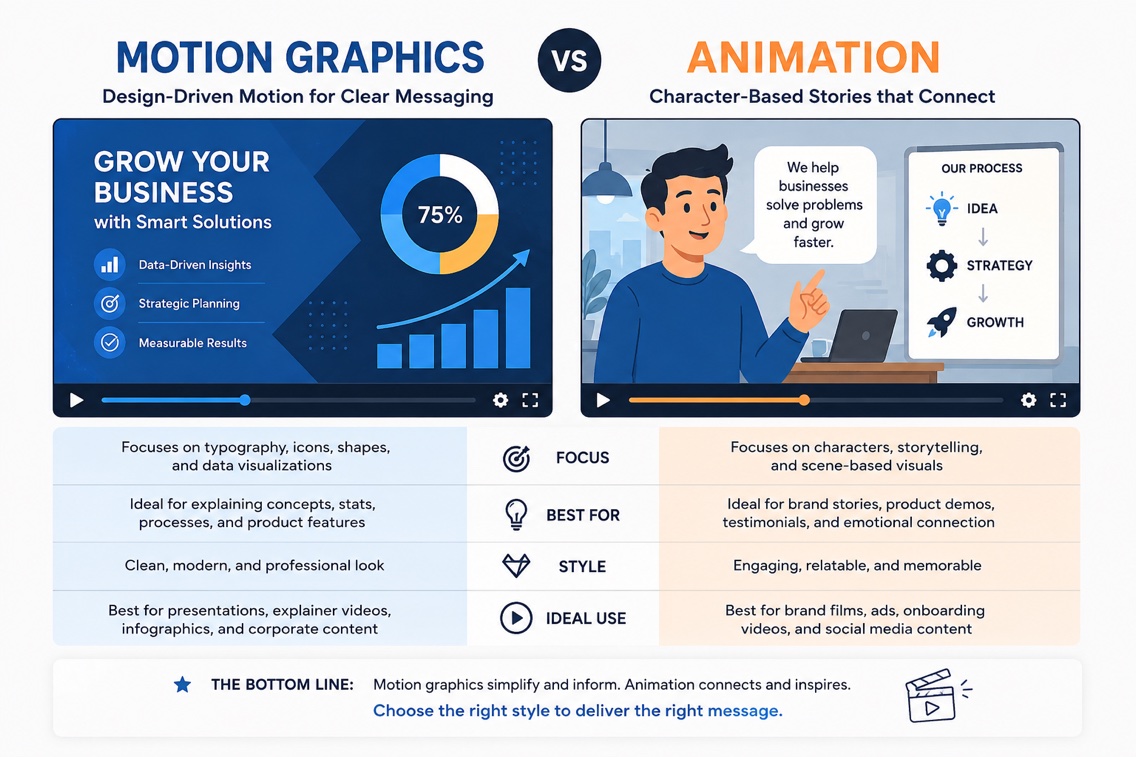
In the motion graphics vs animation comparison, motion graphics is a subset of animation, not a separate discipline. All motion graphics are animated, but not all animation is motion graphics. The distinction is what moves and why. Motion graphics moves graphic design elements (text, shapes, icons, data) to communicate information. Animation uses characters and narrative to tell a story. Most high-performing business videos combine both: animation for emotional engagement, motion graphics for information clarity.
The Relationship Between Motion Graphics and Animation
The first thing to understand about motion graphics vs animation is the hierarchy. Animation is the umbrella term that covers all forms of moving imagery created from static assets. Motion graphics is one specific style within that umbrella. To say motion graphics and animation are different things is technically incorrect. Motion graphics is a type of animation. What makes it distinct from other animation types is not that it moves differently, but that different things move and for different reasons.
Most people picture characters and stories when they think of animation. A cartoon character walks across the screen. A branded mascot explains a product. A protagonist faces a problem and finds a solution. This is character animation: movement in service of narrative and emotional storytelling. Motion graphics, by contrast, applies movement to graphic design elements. A title slides into position. A bar chart animates to its final value. An icon morphs from one state to another. There are no characters. There is no plot. The movement serves the information, not a story.
Understanding this hierarchy makes the briefing process significantly clearer. When you brief a studio for a video, you are not choosing between animation and motion graphics as if they were competing alternatives. You are choosing which style of animation best fits your content goal. And in many cases, the best answer is a combination of both.
Motion graphics is one style within the animation family. All motion graphics are animated. Not all animation is motion graphics.
What Is Motion Graphics?
In the motion graphics vs animation distinction, motion graphics is the practice of applying movement and timing to graphic design elements. Text, shapes, icons, logos, and data visualisations are the raw materials. What motion graphics does is add the time dimension to design: a static infographic becomes an animated sequence, a title card slides into position, a bar chart builds to its final value, a product feature name morphs into the next feature name.
The key characteristic of motion graphics is that it communicates through design rather than through narrative. There are no characters experiencing a problem. There is no story arc. There is a message, and there are designed elements moving in service of communicating that message as clearly and effectively as possible. This is why motion graphics is the default choice for data-heavy content, process explanations, SaaS product demos, and B2B communication where information clarity is the primary goal.
Production for motion graphics is primarily based in Adobe After Effects, combined with design work in Adobe Illustrator or Figma. A motion graphics video does not require character illustration or rigging, which means the production pipeline is shorter and generally less expensive than character animation. It also makes updates easier: changing a statistic, a price, a product name, or a feature label is often a matter of editing text in the source file and re-exporting, not redrawing an illustrated scene.
Design in motion, information-first
Animated text, shapes, icons, logos, and data. No characters. No narrative arc. Goal: communicate information clearly. Tools: After Effects, Figma, Illustrator. Best for: SaaS demos, fintech, B2B, data visualisation, social ads, process explanations, title sequences.
Characters in motion, story-first
Illustrated characters, environments, and narrative. Emotional engagement and audience identification. Goal: tell a story that moves the viewer. Tools: professional 2D animation software, After Effects. Best for: explainer videos, brand films, healthcare, startup pitches, consumer products, education.
What motion graphics looks like in practice
A motion graphics video for a fintech product might open with an animated headline counting up to a key statistic. A sequence of icons illustrates the three steps of onboarding, each fading in as the voiceover describes it. A simplified diagram of how the product processes a transaction animates from left to right. The video closes with the brand logo animating into position above a call-to-action button. No characters appear. No one experiences a problem or finds a solution. The information is communicated directly through movement and design.
This is why motion graphics is the right format for content that is informational by nature. The viewer needs to understand something specific, quickly, and the motion design serves that goal without the emotional overhead of character storytelling.
What Is Animation?
On the animation side of the motion graphics vs animation comparison, character animation uses illustrated or modelled figures within environments and narrative structure to create an emotional experience. The character is the vehicle. The viewer projects themselves onto the character, experiences the character's problem as their own, and arrives at the solution alongside the character. This emotional identification is the mechanism that makes character animation more persuasive than motion graphics for consumer-facing content, healthcare, and any scenario where trust is the primary conversion driver.
2D animation is the most common form of character animation used in commercial video production. Digital illustrators design characters and environments. Animators rig the characters with puppet controls that allow them to move naturally. The animation is then produced frame by frame or through interpolation between keyframe positions. The result is a flat, illustrated world populated by characters who carry the story.
3D animation follows the same storytelling principles but builds characters and environments in three-dimensional digital space, where they can be lit, rendered, and viewed from any camera angle. The production pipeline is longer and more expensive than 2D, but for content that requires physical depth or photorealistic rendering, it is the appropriate format.
What character animation looks like in practice
A character animation explainer for a healthcare app might open with an illustrated character who looks like the target audience: a parent managing a family's health records. They experience the frustration of losing track of appointments and prescriptions. The app appears in the scene and the character's experience changes as they use it. By the end of the video, the character's problem is solved and the viewer understands both what the app does and why it matters to someone like them. The emotion is the engine. The information is delivered inside the story. For a full range of styles within this format, see our 2D animation styles guide.
Motion Graphics vs Animation: Core Differences
The motion graphics vs animation comparison comes down to nine practical factors that affect briefing, production, cost, timeline, and performance. Here is the full comparison in one table.
| Factor | Motion Graphics | Character Animation |
|---|---|---|
| Primary purpose | Communicate information clearly | Create emotional connection through story |
| What moves | Text, shapes, icons, data, logos | Characters, expressions, environments |
| Narrative | None — sequential information delivery | Problem, solution, outcome arc |
| Characters | No characters | Central to the format |
| Primary production tool | Adobe After Effects + Figma/Illustrator | Professional 2D animation software + After Effects |
| Production timeline | Shorter — no illustration or character rigging | Longer — character design, rigging, animation passes |
| Cost relative to length | Lower — design-led, faster to produce | Higher — custom illustration and character work required |
| Ease of updating | High — text and data updated in source files | Lower — changes often require re-illustrating scenes |
| Works without sound | Yes — text overlays carry the message | Partially — narrative context is lost without voiceover |
| Best audience | B2B, professional, data-driven, SaaS | Consumer, healthcare, startup, emotional purchase |
| Best platform | LinkedIn, paid social, SaaS landing pages, email | Homepage hero, YouTube, investor pitch, healthcare |
When to Use Motion Graphics
Resolving the motion graphics vs animation question in favour of motion graphics makes sense when the goal is to communicate information quickly, professionally, and clearly to an audience that is not primarily driven by emotional engagement. Here are the six scenarios where motion graphics consistently outperforms character animation.
SaaS product demos and feature explanations
Software products live in screens, dashboards, and interfaces. Showing a software product through motion graphics, animating the UI, highlighting workflows, and labelling features in sequence, communicates the product clearly without the overhead of character storytelling. The viewer sees the product itself, not a character using it, which is more direct and often more convincing for professional buyers evaluating a tool.
Data visualisation and statistics
When the message centres on numbers, percentages, comparisons, or research findings, motion graphics is the only viable format. Charts building to their final values, percentages counting up, comparative bars animating side by side: these are motion graphic techniques that have no natural equivalent in character animation. Data-heavy content requires design thinking, not storytelling.
B2B and enterprise communication
Enterprise and corporate audiences expect a professional visual register. Character animation can feel casual or playful in a board-level presentation or a regulated industry pitch. Motion graphics matches the visual language that decision-makers already consume in professional contexts, communicating authority and clarity without the tonal risk of character-driven content.
Social media ads watched without sound
The majority of social media video is watched on mute. Motion graphics, with bold text overlays and icon-driven sequences, communicates the core message in silence. Character animation typically loses most of its narrative impact without voiceover and sound design. For paid social campaigns where silent viewing is the norm, motion graphics is the structurally superior format.
Process and workflow explanations
How a payment flows through a system, how a compliance process works, how a product integrates with existing tools: these are sequential, logical processes that motion graphics communicates more efficiently than character storytelling. Step-by-step flows with animated arrows, icon transitions, and labelled stages are a motion graphics speciality that character animation cannot replicate as cleanly.
Content that will be updated regularly
If your product changes every quarter, your pricing updates annually, or your statistics need refreshing, motion graphics is the lower-risk production format. Updating a feature name, swapping a statistic, or changing a price in a motion graphics project typically takes hours. The equivalent change in a character animation scene may require re-drawing or re-compositing elements, which adds days of production time. For evolving products and messages, motion graphics has a significantly lower total cost of ownership.
When to Use Character Animation
The motion graphics vs animation decision shifts toward character animation when emotional connection, audience identification, or trust-building is the primary conversion mechanism. These are the six scenarios where character animation consistently outperforms motion graphics.
Consumer-facing brand storytelling
When you are selling to a person rather than a procurement team, emotional resonance determines whether the viewer converts. A character who looks like the viewer, experiences the viewer's problem, and finds the solution the product provides creates identification. This emotional mechanism is what makes character animation the standard format for consumer-facing explainer videos and brand films. Motion graphics cannot replicate this effect.
Healthcare patient education and trust-building
Trust is the primary driver of engagement in healthcare. A patient evaluating a treatment option, a health app, or a medical service responds to warmth and relatability. A character who mirrors the viewer's situation creates identification that clinical motion graphics cannot achieve. Healthcare explainer videos that use character animation consistently outperform motion graphics equivalents in patient engagement and comprehension.
Startup investor pitch videos
An investor pitch video communicates product vision: a future state that does not yet exist, made to feel real and investable. Character animation can show a product being used by the target customer in a context the investor recognises, making the use case tangible before a line of code has shipped. Motion graphics can communicate data and process but cannot carry this kind of forward-looking narrative. See our guide to explainer videos for startups and investors.
Homepage hero videos for conversion
The primary job of a homepage hero video is to make a visitor feel understood before they read a single word of copy. A character experiencing the visitor's problem is a more powerful opening than an animated icon sequence. For conversion-focused landing pages where the audience is emotionally invested in the problem being solved, character animation generates stronger results than motion graphics in most commercial A/B tests.
YouTube long-form content marketing
Audiences on YouTube choose what to watch and give their full attention. A narrative-driven animated video holds attention for two to three minutes in ways that motion graphic sequences cannot sustain at length. Character-led storytelling with a coherent beginning, middle, and end translates directly to watch time and subscriber engagement, which are the primary metrics for YouTube content marketing success.
Education, e-learning, and onboarding
Learning content benefits from the engagement and emotional anchoring that character guides provide. A character walking a learner through a process creates a memorable mental model that a sequence of animated labels does not. For corporate training, employee onboarding, and e-learning, character animation produces better knowledge retention because the narrative structure gives the information emotional context. For the full range of animation in marketing contexts, see our dedicated guide.
Motion Graphics vs Animation by Industry
Industry context shapes the motion graphics vs animation decision as strongly as content type and budget. Different industries have different audience expectations and different visual conventions that influence which format feels credible and appropriate. Here is how the choice maps across the sectors Magic Motion Studio works with most frequently.
| Industry | Recommended | Primary reason |
|---|---|---|
| SaaS and B2B Technology | Motion Graphics | Product is software; UI and workflow shown through motion design. Professional B2B audience. |
| Fintech and Financial Services | Motion Graphics | Abstract financial concepts, data, and compliance messaging require clarity over character. |
| Healthcare (Patient-Facing) | Character Animation | Trust and emotional identification drive engagement. Character mirrors the patient's situation. |
| Healthcare (Clinical / MedTech) | Motion Graphics | Mechanism of action, device demonstration, and clinical process require technical precision. |
| Consumer Apps and DTC Brands | Character Animation | Emotional resonance and brand personality drive consumer conversion. |
| Startups and Investor Pitches | Character Animation | Narrative-driven vision communication. Investor pitch requires storytelling, not data sequences. |
| Enterprise and Corporate | Motion Graphics | Professional tone, internal communications, data-heavy stakeholder content. |
| Education and E-learning | Character Animation | Character guides, learning retention, narrative-anchored information delivery. |
| Government and Public Sector | Motion Graphics | Plain language process communication, accessible formats, regulated messaging. |
| Real Estate Development | Depends on goal | Lifestyle and brand: character animation. Development process and timeline: motion graphics. |
| Nonprofit and Cause Marketing | Character Animation | Emotional fundraising appeals and awareness campaigns require audience empathy. |
| Pharmaceutical and Biotech | Motion Graphics | Scientific mechanism, clinical data, and regulatory communication require precision. |
Not sure which style fits your project?
Submit a brief to Magic Motion Studio and we will recommend the right format based on your message, audience, and timeline. No calls required.
The Hybrid Approach: When the Answer Is Both
The motion graphics vs animation question often presents a false binary. The most effective commercial videos combine both styles within a single production, using each format for the type of content it handles best. This is not a compromise. It is the industry standard for high-performing business video.
How a hybrid video is structured in practice
A hybrid video uses character animation for the narrative and emotional arc, while motion graphics overlays handle data, product UI, title cards, and transitions. The two styles share the same colour palette and visual identity, so the video feels cohesive rather than assembled from two separate productions.
A typical structure: the video opens with a 2D animated character experiencing the target audience's problem (character animation). As the solution is introduced, the product's key statistics animate onto screen as motion graphic overlays. The character responds to the outcome (character animation). The video closes with a motion graphic call-to-action screen with the brand logo and tagline animating into position. The viewer gets emotional engagement from the narrative and information clarity from the motion graphic elements.
The Dropbox original launch video, one of the most studied commercial animation examples, used exactly this hybrid approach: simple illustrated characters combined with clean motion graphic product demonstrations. The emotional hook came from the character. The product understanding came from the motion graphics. Neither format alone would have achieved the same result.
For a detailed comparison of just the 2D animation and motion graphics styles specifically, see our dedicated guide to 2D animation vs motion graphics, which covers how to choose between the two at the style level within a single production decision.
Motion Graphics vs Animation: Cost and Timeline
The motion graphics vs animation cost difference is significant and rooted in production pipeline length. Motion graphics is generally less expensive and faster to produce than character animation at equivalent video length, for structural reasons that are worth understanding.
Motion graphics does not require custom character illustration, character rigging, or the multiple animation passes required to make a character move convincingly. A motion graphics production workflow typically involves: concept and script, storyboard, design (creating the graphic elements in Illustrator or Figma), animation in After Effects, voiceover and sound design, and delivery. Each stage is relatively streamlined because the elements being animated are design assets rather than illustrated characters.
Character animation production adds stages that motion graphics does not have: character design and illustration, environment design, character rigging (building the puppet control structure that allows the character to move), animation of the rigged character across scenes, and often multiple rounds of animation review before the final render. These additional stages require specialist illustrators and animators working in sequence, which extends the timeline and increases the cost.
The practical implication: for a given production budget, a motion graphics video will typically be longer, more detailed, or both, compared to what a character animation can deliver for the same investment. For businesses choosing between the two formats, this cost difference is a real factor when both styles would otherwise serve the content goal equally well.
For a full breakdown of 2D animation pricing by style and video length, see our 2D animation cost guide. Magic Motion Studio publishes transparent pricing at explainer-video-pricing with no discovery call required to get started.
Who Do You Actually Hire? Motion Designer vs Animator
Practically speaking, the motion graphics vs animation decision also determines who you hire. Motion graphics and character animation require different specialist skills, different software proficiency, and different creative backgrounds. Briefing the wrong person for the wrong job is one of the most common and avoidable production mistakes.
For motion graphics, you need a motion designer
- Background in graphic design, not illustration
- Expert in Adobe After Effects and Illustrator or Figma
- Thinks in terms of information hierarchy, timing, and visual design
- Portfolio shows: title sequences, data visualisations, product demos, brand animations
- Does not typically design characters or handle character rigging
- Can often complete projects faster than a character animator at the same length
For character animation, you need an animator (or a studio)
- Background in illustration and character design
- Skilled in 2D animation software and character rigging
- Thinks in terms of performance, emotion, and timing relative to a character's body
- Portfolio shows: character movement, facial expression, scene staging, narrative sequencing
- A full character animation production usually requires a team: illustrator, rigger, animator, compositor
- Studios that specialise in animation handle the full team coordination
For most business video projects, commissioning a studio rather than a freelance individual is the more reliable path. A studio manages the full pipeline for either style, which means you are briefing one point of contact rather than coordinating a team of specialists yourself. Magic Motion Studio produces both motion graphics and character animation across all major industry verticals. View our video examples to see both styles in practice, or read our guide to what motion graphics are for a deeper dive into the format.
Motion Graphics vs Animation: How to Choose
The motion graphics vs animation decision becomes straightforward when you work through five questions about your specific project. These are the questions Magic Motion Studio asks at the start of every brief to recommend the right format.
Is the primary goal to inform or to connect emotionally?
If the video needs to explain a process, demonstrate a product, or communicate data, lean toward motion graphics. If the video needs to make the viewer feel understood, build trust, or tell a brand story, lean toward character animation. The goal determines the mechanism, and the mechanism determines the format.
What is the audience's professional and emotional context?
A procurement manager evaluating a SaaS tool expects clarity and professionalism. Motion graphics matches that expectation. A parent choosing a health app for their child expects warmth and relatability. Character animation meets that need. Audience tone expectations are a strong guide to format choice.
Will this video be watched with or without sound?
Silent social environment (LinkedIn feed, Meta feed, TikTok): motion graphics with text overlays. Landing page or YouTube where the viewer is intentional and audio is on: either format is appropriate, with the decision driven by the emotional vs informational goal. Investor presentation with audio: character animation if the content is narrative-driven.
How frequently will the content need updating?
Content that changes seasonally, tracks product releases, or updates statistics belongs in motion graphics. Content that communicates an evergreen brand story or an investor vision that will remain stable belongs in either format, with the choice made on other criteria. Never commission character animation for content you know will be out of date in six months.
What is the budget and timeline?
Motion graphics is faster and generally less expensive than character animation at equivalent quality and length. If budget is constrained and the content goal can be served by either format, motion graphics delivers more production value per unit of investment. If the content specifically requires character-driven emotional engagement and the budget does not allow for it, a shorter character animation is a better choice than a longer motion graphics video that does not serve the communication goal.
Frequently Asked Questions
Ready to commission motion graphics or animation?
View Magic Motion Studio's published pricing for both styles. Fixed timelines, transparent packages, no discovery call required.
Related Guides
- What Are Motion Graphics? Guide for Businesses
- 2D Animation vs Motion Graphics: How to Choose the Right Style
- What Is 2D Animation? Complete Guide for Businesses
- 2D Animation Styles: Which Style Fits Your Brand?
- 2D Animation for Marketing: Does It Still Work in 2026?
- What Is an Explainer Video? Types, Styles and Examples
- Explainer Video Examples That Convert
- 2D Animation Cost: Complete Pricing Guide
- How to Measure Explainer Video ROI