
Anime Production Guide
How to Make an Anime Pilot:
The Complete Production Guide
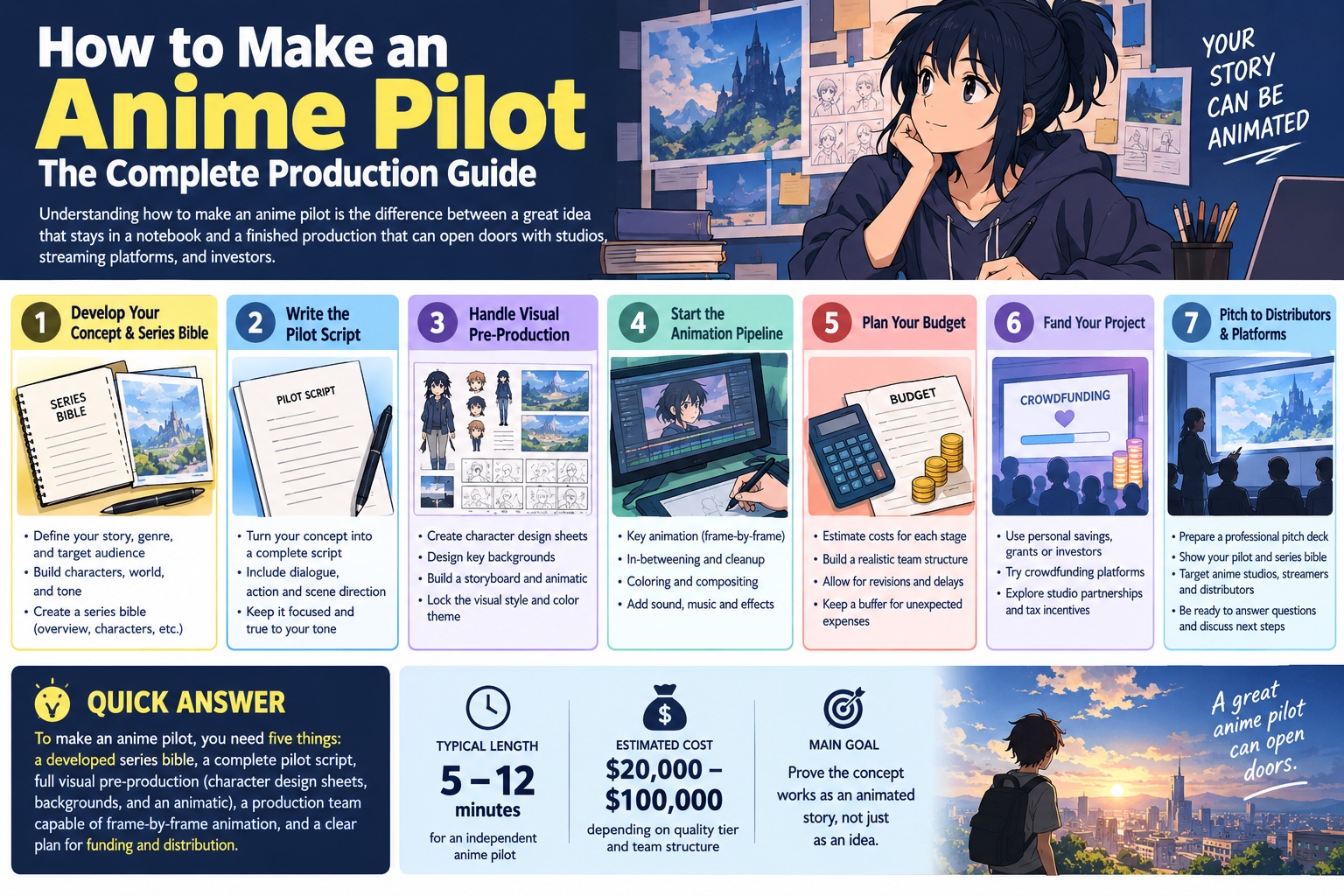
Understanding how to make an anime pilot is the difference between a great idea that stays in a notebook and a finished production that can open doors with studios, streaming platforms, and investors. This guide covers every stage of the process, from concept and series bible to animation pipeline, budget planning, crowdfunding, and pitching to distributors.
Quick Answer
To make an anime pilot, you need five things: a developed series bible, a complete pilot script, full visual pre-production (character design sheets, backgrounds, and an animatic), a production team capable of frame-by-frame animation, and a clear plan for funding and distribution. A standard independent anime pilot runs 5 to 12 minutes and costs between $20,000 and $100,000 depending on quality tier and team structure. The pilot's job is to prove the concept works as an animated story, not just as an idea. Every major step in learning how to make an anime pilot is covered in the sections below.
Foundations
What an Anime Pilot Actually Is (and Why It Is Not Just Episode 1)
Before you can understand how to make an anime pilot, you need to be precise about what a pilot is and what it is not. The word gets used loosely by independent creators, and that looseness causes real production problems later.
According to the Television pilot definition, a pilot is a standalone episode produced to demonstrate the premise, tone, characters, and production quality of a proposed series to broadcasters, distributors, and investors. Its purpose is proof of concept. It has to answer one central question: does this idea work as an animated story, not just as a pitch document?
That distinction matters. A pilot is not simply the first episode of a series you have already decided to produce. It is the episode that earns the right to produce the rest of the series. Every creative and production decision you make while learning how to make an anime pilot should be filtered through that question.
Three Types of Anime Pilot
Proof-of-Concept Clip
A short clip of one to three minutes that demonstrates visual style and character design in motion. Not a complete story. Used to attract investors, test crowdfunding response, or secure a studio co-production partner before committing to a full pilot budget. This is what gets posted to YouTube or shown at conventions to build an audience before the real production begins.
Independent Pilot Episode
A self-contained episode of 5 to 12 minutes that tells a complete story, establishes the world and main characters, and ends on a note that makes a viewer want to see more. This is the format most independent creators should target. It is long enough to demonstrate narrative competence but short enough to be produced without a broadcast budget. This is the primary format this guide is built around.
Broadcast Pilot
A full-length episode of 23 to 26 minutes produced to broadcast or streaming quality. This format is only practical when you already have a distribution deal in place or a production company committed to the project. The budget required is significant, the production timeline extends to 18 to 24 months minimum, and the team needs to be staffed at near-professional series level. This is the goal, not the starting point.
Pilot vs Series Bible
The pilot is the animated episode. The series bible is the written document that accompanies it. The bible explains what the show is, where it goes across multiple episodes and seasons, who the characters are in depth, and how the world is built. For an acquisition pitch, you need both. The pilot proves execution quality. The bible proves that the world extends beyond one episode. Neither is sufficient alone.
For the purposes of this guide on how to make an anime pilot, we focus on the independent pilot episode format: 5 to 12 minutes, authentic anime animation production, built with a professional pipeline. This is the format that has launched careers and secured distribution deals for independent creators.
Phase 1
Concept Development and the Series Bible
The first phase in how to make an anime pilot happens entirely on paper, before any frame is drawn. This is where creators consistently underinvest their time, and where most pilot projects eventually fail. A weak concept document leads to production that drifts, characters that feel interchangeable, and a pilot that impresses technically but leaves no one with a reason to care.
The Core Concept Document
The concept document is a one to three page brief that answers six questions precisely. What is the show about? Who is it for? What is the tone? What is the episode structure? What makes it visually distinct? What is the central conflict across the series? Every word in the concept document should be doing work. Vague premise descriptions like "a young hero discovers they have powers" are not concepts. They are genre placeholders. A strong concept document names something specific about this particular world and this particular set of characters that cannot be replicated by describing any other show.
Series Bible Components
The series bible is the expanded version of the concept document. It is written for two audiences: the production team, who uses it as the north star for creative decisions throughout production, and potential distributors and investors, who use it to evaluate whether the series can sustain beyond a single episode. A complete series bible for an anime pilot project includes the following sections:
Premise and Logline
A one-sentence logline and a two to three paragraph premise expansion. The logline states the central dramatic question of the series. The premise expansion covers the world, the inciting event that starts the series, and the overarching conflict that sustains it across multiple episodes.
Character Profiles
One to three paragraphs per main character covering appearance, personality, motivation, internal conflict, and how they change across the series. Character profiles for a pilot bible should also include on-screen dynamic notes, meaning how each character relates to and changes in the presence of the others. Secondary characters and antagonists receive shorter profiles.
World-Building and Visual Direction
A description of the world's rules, geography, history, and visual identity. This section should be specific enough to guide the art director but not so rigid that it blocks creative problem-solving during production. Include reference images or mood boards for the visual direction. State the color palette approach, the animation style influences, and any visual motifs that carry meaning within the world.
Episode Outlines (3 to 5 Episodes)
Synopses of the pilot episode plus three to five additional episodes. These do not need to be fully developed scripts, but they need to demonstrate that the series has a narrative engine. Platforms and investors want to see that the pilot's events set up a larger story, not that the pilot is a self-contained short film with a series name attached.
Production Insight
Nerdbot's August 2026 analysis of independent animated pilot production noted that the most common cause of project collapse is not budget or team quality. It is the absence of a completed pitch bible before production begins. Without a bible, every creative decision becomes a negotiation between the director's instincts and the team's interpretations, and those negotiations accumulate into months of lost production time.
Phase 2
Writing the Pilot Script and Building the Animatic
Knowing how to make an anime pilot means knowing that the script and the animatic together form the production blueprint. Nothing else in pre-production has more influence over the final quality of the animation than locking these two elements before a single frame of finished animation is produced.
Writing the Pilot Script
The pilot script has a specific and demanding job. It has to introduce the world, establish the main characters' voices, deliver a complete story with a beginning, middle, and end, and leave the viewer with a genuine desire to see the next episode. For a 7 to 10 minute pilot, that translates to roughly 7 to 10 pages of script. Animation scripts run approximately one page per minute of screen time.
Every scene in the pilot script should be doing at least two things simultaneously: advancing the plot and revealing character. A scene that only advances plot is functional but forgettable. A scene that only reveals character tends to feel static in animation. The pilot's opening two minutes are particularly critical. The inciting incident, the first major event that disrupts the world and sets the story in motion, should occur within the first two minutes of screen time. Anime pilots that spend the opening minutes on world-building exposition before anything happens lose audiences immediately.
The script for an anime pilot should also be written with production constraints in mind. Every new location requires background art. Every new speaking character requires a character design and a voice performance. Every action sequence that goes beyond what the storyboard and animatic can support in budget becomes a production problem during Phase 4. Write to your production capacity, not to an imagined Hollywood budget.
Storyboarding the Pilot
The storyboard translates the script into a visual sequence of shots. In professional anime production, individual episode directors typically draw their own storyboards under the guidance of the series director. For an independent pilot, the director is usually also the primary storyboard artist, at least for the first draft. The storyboard does not need to be finished illustration. It needs to be clear enough that every member of the production team understands exactly what happens in every shot: camera angle, character positions, movement direction, expression, and staging.
A complete storyboard for a 7 to 10 minute pilot typically runs 200 to 400 panels. Each panel represents a meaningful change in shot composition or action. Panel density is higher during action sequences and lower during dialogue-heavy scenes.
Building the Animatic (Leica Reel)
The animatic, also known as the leica reel in professional production, is the first moving version of the anime pilot. It is assembled from the storyboard panels timed to a scratch audio track, which typically includes temp music, sound effects, and a voice performance placeholder if casting has not yet occurred. The animatic is not animation. It is the storyboard frames changing over time, but it is the most important tool in the entire pre-production phase of how to make an anime pilot.
The animatic serves three functions. First, it shows you the rhythm of the pilot before any animation budget has been spent. Pacing problems, scenes that are too long, moments that do not land the way they were written, all of these are visible in the animatic and correctable before production. Second, it gives the frame-by-frame animation team a precise timing reference. Animators working from a locked animatic know exactly how many frames each shot occupies and can plan their key animation accordingly. Third, it is a fundraising tool. A compelling animatic is far more effective for a crowdfunding campaign or investor pitch than a static storyboard. It demonstrates that the pilot exists in motion, even if only in rough form.
The animatic should be locked before production begins. Changes made to timing and staging after animation has started are expensive in time and money.
Phase 3
Visual Pre-Production: Character Design, Backgrounds, and Art Direction
Visual pre-production is the phase that locks the look of the anime pilot before any animation begins. Every design decision made here either saves or costs production hours during Phase 4. The more thoroughly this phase is completed, the fewer surprises arise during animation.
Character Design Sheets (Settei)
Character design sheets, known in the Japanese anime production pipeline as settei, are the technical specification documents for every character in the pilot. Each character sheet includes a front, side, and back orthographic turnaround, a range of facial expressions, size comparison charts showing how characters relate to each other in height and proportion, and notes on hair, clothing, and any specific features that need to be consistent across all animators' work.
Settei are not concept art. Concept art explores possibilities. Settei locks choices. Once settei is approved, animators draw from it as a reference standard for the entire production. If your settei is incomplete or inconsistent, your character will look slightly different in every scene, and fixing that inconsistency in cleanup is one of the most time-consuming problems an anime pilot can encounter.
Background Art Concepts and Color Palette
Background art in anime is not painted in real time during production. Every background is a finished illustration created by a dedicated background artist working from the art director's layout instructions. For an independent anime pilot, the number of unique background paintings required is directly tied to the number of distinct locations in your script. A 7 to 10 minute pilot with 4 to 6 distinct locations requires 4 to 6 finished background paintings, plus secondary backgrounds for variations like day and night versions or different weather states.
The color palette for the anime pilot should be defined during visual pre-production and locked before background art begins. The palette covers character color sheets (the exact colors used for each character's design in full light, shadow, and highlight states), the environmental palette for each major location, and the palette for special effects like magic, fire, or energy attacks if your pilot includes them.
Key Visual and Art Direction Sign-Off
The key visual is the finished, publication-quality illustration of the main characters in the world of the series. It is the first piece of final art produced for the pilot, and it functions as the aesthetic north star for everything that follows. Every animation frame, every background painting, and every special effect sequence should feel like it belongs in the same visual world as the key visual. The art director's formal sign-off on the key visual marks the transition from visual development to locked production art.
Ready to Produce Your Anime Pilot?
Magic Motion Studio produces authentic frame-by-frame anime pilots for independent creators, brands, and production companies. From series bible to final delivery.
Phase 4
Phase 4: The Animation Production Pipeline
Phase 4 is where the anime pilot becomes animated. For anyone learning how to make an anime pilot with authentic production values, this is the most complex phase and the one that demands the most from your team and your production management. The anime animation pipeline is sequential: each step depends on the completion of the previous one, which means delays cascade.
Core Production Roles
Director
The director is responsible for the visual and narrative execution of the pilot. They approve all key animation, direct the voice performers, and make the final call on any creative decision that affects the finished episode. On an independent pilot, the director often also functions as the series creator and lead storyboard artist.
Key Animator
Key animators draw the principal poses of every shot. These are the most critical frames in any action: the starting position, the extreme pose, and the ending position of each movement. Key animation defines the timing, weight, and performance of every character on screen. The quality of your key animators determines the quality of your pilot.
In-Between Animator
In-between animators fill the frames between each key drawing, completing the motion arcs. The density of in-betweens determines the smoothness and speed of each action. Standard anime television production uses a limited animation approach, animating on twos (12 unique drawings per second) rather than ones (24 per second), which manages drawing volume without sacrificing perceived quality for most shot types.
Voice Cast
Voice recording typically happens before animation in the English-language production pipeline (prelay method), meaning the animators time character mouth movements and physical performances to the actual recorded dialogue. In the traditional Japanese anime pipeline, animation is completed first and voice recording follows (post-sync), but for independent English-language pilots, prelay gives you better sync results without the technical complexity of lip-sync matching in post.
Background Artist
Background artists produce the finished painted environments that appear behind the character animation in every scene. These are detailed, fully rendered illustrations in the established color palette. The background artist works from the art director's layout reference and the key visual to ensure consistency with the overall aesthetic of the pilot.
Cleanup and Color
Cleanup artists produce the final clean line art by tracing the key animation drawings with consistent line weights that match the character's settei. The shiage (cleanup and color) stage applies flat color fills to each character frame using the locked color sheets from visual pre-production. This stage is time-intensive but non-negotiable for a production-quality anime pilot.
Compositing and Digital Effects
Compositing is the final step in the animation phase. Cleaned-up, colored character animation layers are combined with background paintings, special effects layers, and any digital enhancements such as camera movement, depth-of-field blur, or particle effects. Professional anime studios use Toon Boom Harmony for compositing because it handles the full pipeline from key animation through to output. Independent pilots frequently use Adobe After Effects or DaVinci Resolve for compositing if the key animation was produced in a different application.
The composited output for each scene is rendered as a lossless image sequence or a high-quality intermediate codec. These files go into the editing timeline to be assembled into the final cut of the pilot.
Timeline Benchmark
A professional anime animation pipeline requires approximately four to eight weeks to produce one finished minute of output, including all pipeline stages from key animation through compositing. For a 10 minute anime pilot, that means 10 to 20 months of production time at a professional pace with a small team. This timeline is the primary reason why the animatic must be locked before production begins: late creative changes at this stage are proportionally very expensive.
For more detail on how the frame-by-frame production method works at the drawing level, see our guide to frame-by-frame animation.
Phase 5
Post-Production and Delivery
Post-production is where the assembled anime pilot becomes a finished, deliverable episode. The composited scenes are edited into the final cut, sound design and music are added, color grading is applied, and the pilot is exported in the formats required for its intended distribution path.
Final Edit and Picture Lock
The final edit assembles all composited scenes into the complete pilot episode and locks the picture. Picture lock is the point after which no further visual changes are made. Any edits after picture lock require redelivery of all audio elements, which adds significant time to the post-production schedule. Lock the picture before beginning any serious sound work.
Sound Design and Music
Sound design covers all non-dialogue audio: ambient sound, sound effects for character actions, environmental audio, and any procedural sound elements unique to your pilot's world. A music score is either commissioned from a composer or licensed from a library. For an independent anime pilot, a dedicated composer is the more powerful option for pitch purposes, since original music is an additional creative demonstration of the series' identity.
Color Grading
Color grading is the final visual pass that unifies the look of the pilot. Different scenes produced by different artists at different times can have subtle color inconsistencies that grading corrects. Grading also establishes the overall mood and atmosphere of the pilot through controlled manipulation of contrast, saturation, shadow depth, and highlight temperature. For an anime pilot, this is often done in DaVinci Resolve.
Export and Delivery Formats
Standard delivery formats for streaming platforms and festival submission are H.264 or H.265 in a 1080p or 4K resolution, with stereo or 5.1 audio. If you are submitting to animation festivals, check specific technical requirements in advance, as they vary. For direct streaming upload to Crunchyroll or Netflix acquisition review, 4K ProRes or DNxHR intermediate files may be requested for quality evaluation before final encoding.
Budget and Funding
Budget, Team Structure, and Funding Your Anime Pilot
Budget is the most common barrier when creators are learning how to make an anime pilot, and it is also one of the most frequently misunderstood. Independent creators often either dramatically underestimate the real cost of professional production or assume the only path is a full broadcast budget. Neither is correct.
Realistic Budget Ranges
| Format | Runtime | Team | Typical Budget | Suitable For |
|---|---|---|---|---|
| Proof of Concept Clip | 1 to 3 min | 2 to 4 people | $8,000 to $20,000 | Crowdfunding launch, investor interest, convention showing |
| Short Independent Pilot | 5 to 7 min | 4 to 8 people | $20,000 to $50,000 | Festival submission, streaming pitch, series bible accompaniment |
| Full Independent Pilot | 8 to 12 min | 6 to 12 people | $50,000 to $100,000 | Serious acquisition pitches, co-production proposals, full series development |
| Broadcast Pilot | 23 to 26 min | 20+ people | $200,000+ | Projects with distribution deal already confirmed |
Cost ranges reflect authentic anime animation production using frame-by-frame pipelines with professional team rates. Budget can vary significantly based on animation complexity, number of unique locations, action sequence density, and whether voice casting is included. For cost context specific to shorter format anime content, see our guide to anime opening costs.
Team Structure Options
Commission a Dedicated Studio
Commissioning an anime pilot production studio gives you a complete pipeline, experienced team, and production management under one roof. The studio handles scheduling, quality control, and pipeline management. You direct creatively from the series bible and script. This is the most efficient path for creators who have secured funding and want professional output without building a team from scratch. See how to approach this in our guide to commissioning anime animation.
Assemble a Freelance Team
Assembling a dedicated freelance team gives you more control over individual hiring but significantly more management overhead. You function as the producer as well as the director, managing schedules, revisions, payments, and pipeline handoffs across 6 to 12 individual contractors. This is viable but demanding. The most common failure mode is not budget, it is schedule management: freelance pipelines require more buffer time than studio pipelines at every handoff point.
Funding Routes for Independent Anime Pilots
Kickstarter is the primary platform for anime pilot crowdfunding. A successful animation campaign on Kickstarter requires three things before launch: a compelling proof-of-concept clip or animatic, a clear and detailed budget breakdown that backers can trust, and an existing audience or community that can drive the campaign's first 48 hours of momentum. Campaigns that launch to an empty following rarely fund. Campaigns launched to an audience that has been watching the project develop over months routinely exceed their goals.
JETRO, Japan's External Trade Organization, partnered with Kickstarter to support five independent Japanese studios including Studio 4 degrees C in producing pilot films through crowdfunding. This institutional validation demonstrates that crowdfunding for anime pilots is a recognized and legitimate production route, not an amateur shortcut.
Alternative funding routes include animation grants (Sundance, GKIDS, and national arts councils in the US and Australia), production company co-development deals, and brand partnerships for pilots that have a commercial application. For a deeper look at which studios you are competing with for attention and funding, our guide to the best anime animation studios in the USA provides useful competitive context.
Distribution
Pitching Your Anime Pilot to Streaming Platforms
Completing an anime pilot is step one of the distribution process, not the end of it. Understanding how streaming platforms acquire anime content is essential to building a pilot that is actually pitchable, as opposed to one that is technically accomplished but positioned for an audience that does not exist at a platform that is not acquiring in your format.
How Netflix and Crunchyroll Acquire Anime
Netflix and Crunchyroll operate fundamentally different acquisition models. Netflix acquires original anime content through two routes: co-production deals with established Japanese studios, and direct commissions for non-Japanese anime produced to Netflix Original standards. Netflix has the highest per-title budgets in the space and offers global exclusivity, which means your pilot needs to be produced to a quality level that justifies global exclusivity from a platform that has already committed resources at that level. Netflix has surpassed Crunchyroll as the primary anime streaming destination in the United States, according to recent platform viewership reporting.
Crunchyroll operates primarily as a simulcast platform for Japanese broadcast anime, meaning it licenses existing content rather than commissioning independent non-Japanese originals in most cases. However, Crunchyroll does run acquisition programs for non-Japanese anime that meets its community and genre criteria. Anime News Network covers acquisitions across both platforms regularly and is the most reliable source for tracking what is and is not being acquired at any given period.
What a Pitch Package Includes
- The finished anime pilot (or completed animatic for a pre-production pitch)
- The series bible including character profiles, world-building, and visual direction
- Episode outlines for at least 3 to 5 additional episodes beyond the pilot
- A look book or visual development package showing the aesthetic in detail
- A proposed season structure (typically 12 or 24 episodes for anime television)
- A production capability statement demonstrating the team can deliver the full series
- Any existing audience data: social following, YouTube subscribers, crowdfunding backers
The series bible is not sent ahead of the pitch meeting. Standard practice is that a platform or production company requests the bible after an initial expression of interest has been established. The pilot itself, and a short one to two page treatment, are what open the door. The bible is what keeps it open.
Realistic Expectation
Direct acquisition by Netflix or Crunchyroll is a long-odds outcome for a first independent anime pilot. The more practical near-term goals are: successful crowdfunding that funds the full pilot, festival selection that builds industry visibility, and co-production interest from a production company that can provide the resources for a broadcast pilot. Most successful independent anime that reached streaming platforms went through multiple intermediary steps. Cannon Busters was crowdfunded, then co-produced with a Japanese studio, then acquired by Netflix. That is the realistic path, not a direct pitch from first pilot to global streaming deal.
Your Production Route
Working With a Studio vs Building Your Own Team
The final major decision in how to make an anime pilot is choosing your production route. This choice is not purely creative. It is primarily a question of what your time, management capacity, and budget can realistically support.
| Factor | Commission a Studio | Build Your Own Team |
|---|---|---|
| Creative Control | High: you direct from script and bible, studio executes | Very high: every decision is yours |
| Production Management | Handled by the studio | Entirely on you |
| Quality Consistency | High: established pipeline and quality control | Variable: depends on individual freelancer quality |
| Timeline Risk | Lower: studio has production schedule management | Higher: freelance handoffs create delay risk |
| Best For | Creators with funding secured and a clear brief | Creators building a long-term in-house team |
For most independent creators learning how to make an anime pilot for the first time, commissioning a dedicated studio is the lower-risk path. The creative control is still entirely with the creator: you own the concept, the series bible, the script, and every creative decision. The studio's role is to execute the pipeline professionally, hit the quality level the pilot requires, and deliver on schedule. Attempting to build and manage a freelance pipeline on a first production while also developing the creative material is a significant management challenge that has derailed many anime pilot projects that were otherwise well-funded and well-conceived.
If a studio-commissioned route is the right fit for your project, the anime pilot production studio at Magic Motion Studio works directly with independent creators and production companies to produce frame-by-frame anime pilots from concept through to final delivery. Every production is built from the creator's own series bible and script.
Common Questions
FAQ: How to Make an Anime Pilot
Produce Your Anime Pilot With Magic Motion Studio
Magic Motion Studio specializes in authentic frame-by-frame anime pilot production for independent creators, brands, and production companies. We work from your series bible and script and manage the full pipeline through to final delivery.
Start Your Pilot Project