
Anime Production Guide
How to Brief an Anime Studio:
Everything the Studio Needs Before Production Starts
Knowing how to brief an anime studio correctly is the single most important thing a client can do before a project begins. The brief is not a formality. It is the document that determines whether your production runs on schedule or goes through six rounds of revisions trying to recover what should have been decided before work started.
Quick Answer
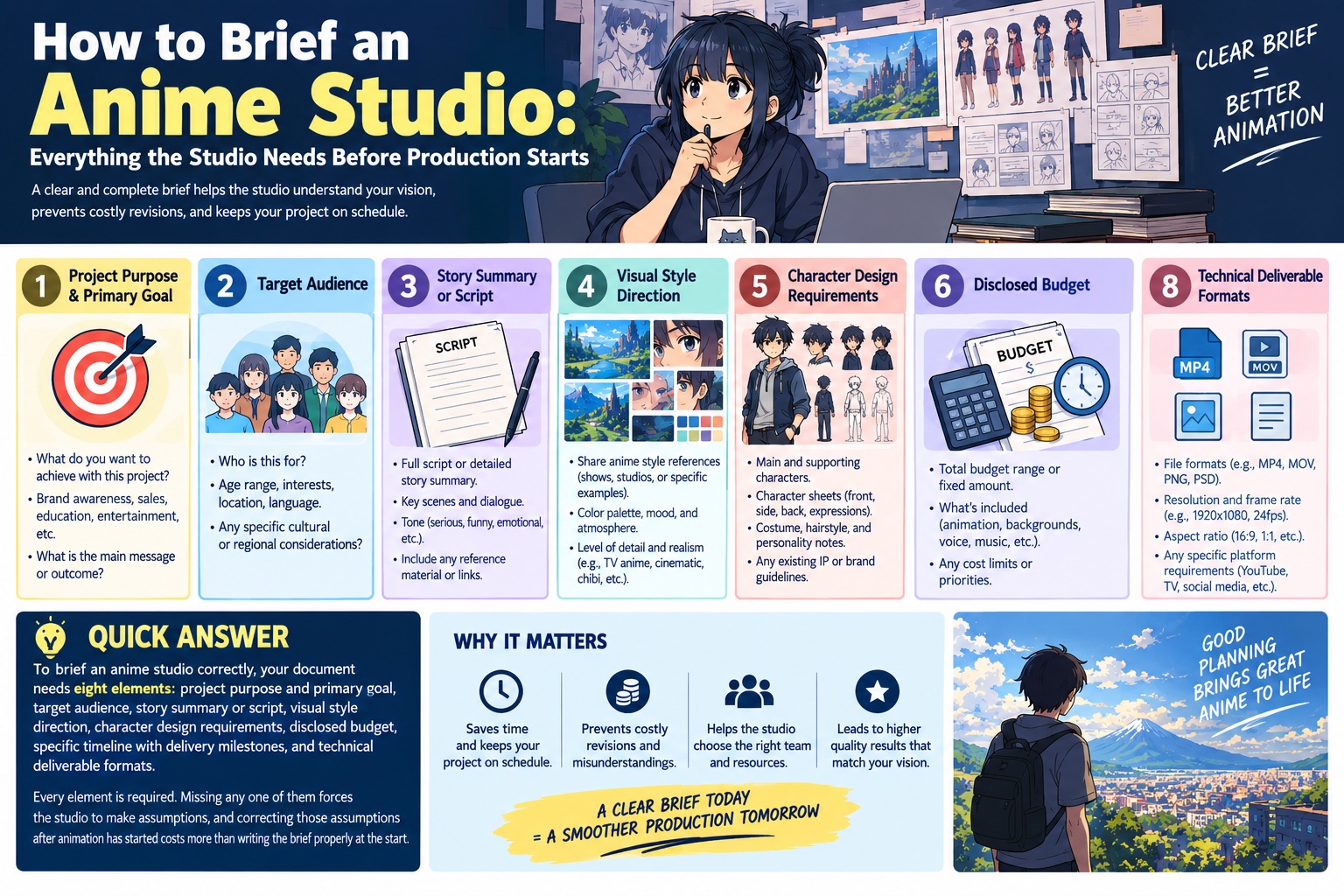
To brief an anime studio correctly, your document needs eight elements: project purpose and primary goal, target audience, story summary or script, visual style direction using anime-specific references, character design requirements, disclosed budget, specific timeline with delivery milestones, and technical deliverable formats. Every element on that list is required. Missing any one of them forces the studio to make assumptions during production, and correcting those assumptions after animation has started costs more than writing the brief properly at the start. This guide covers how to brief an anime studio on each element, what makes anime briefs different from general animation briefs, and what to expect from the studio after the brief is sent.
Foundations
Why Anime Briefs Are Different from General Animation Briefs
Most guides on how to brief an animation studio are written for general commercial animation: explainer videos, motion graphics, 3D product renders. That content is not useless, but it misses the specific requirements of anime production. When you need to know how to brief an anime studio specifically, you are entering a frame-by-frame animation pipeline with very different production parameters, and a brief that works for a motion graphics studio will leave an anime studio with critical gaps.
The Frame-by-Frame Production Difference
In a frame-by-frame anime pipeline, work is sequential and irreversible in a way that rig-based or motion graphics production is not. Character designs must be locked before key animation begins. Key animation must be approved before in-betweening begins. In-betweening must be completed before cleanup and color begins. A change request that reaches back two stages costs every hour of work done since the change point. This makes the brief more critical in anime than in other animation formats because the cost of a late decision is directly proportional to how far through the pipeline the project has already moved.
Artstyle Direction Requires Anime-Specific Language
A general animation brief typically asks for a mood board or a reference reel. In anime production, that approach produces ambiguous results because the word "anime" covers dozens of distinct visual traditions. The brief needs to point at specific studios, directors, series, or eras rather than the broad category. A client who says "make it look like anime" has told the studio almost nothing. A client who says "the colour palette approach of Kyoto Animation with the linework weight of Studio Trigger" has communicated a precise and actionable direction.
Character Design Is a Deliverable, Not a Preference
In general commercial animation, character design is often handled as part of the studio's creative development. In anime production, character design sheets (settei) are production-critical documents that every animator on the project references throughout. A brief that does not clearly define what character design information is being provided, what is being commissioned, and what proportion and style parameters apply forces the studio to develop these specifications independently, then revise them once the client sees the output. The brief should eliminate that cycle before it starts.
Industry Reality
Multiple studio producers cite the same root cause for most problem productions: "Most animation projects that go wrong do not go wrong in production. They go wrong in the brief." A clear, complete brief is not administrative overhead. It is the single most cost-effective thing a client can produce before the first invoice is paid.
The Core Brief
The 8 Elements Every Anime Studio Brief Must Include
When you brief an anime studio for the first time or the tenth, these eight elements are not optional. A brief that omits any one of them is an incomplete brief, regardless of how long or detailed the rest of it is. Each element is listed here with a description of what it must contain and why it matters to the production.
Project Purpose and Primary Goal
State what the animation is for and establish one primary goal. The project may have secondary goals, but the brief must name a single primary outcome. Is this a brand awareness video for social media? A pilot episode intended for streaming platform acquisition? A product explainer for a SaaS onboarding sequence? An internal training video? The primary goal informs every creative decision the studio makes, including tone, pacing, level of animation detail, and the structure of the call to action at the end. A brief with three equally weighted goals is a brief with no goal.
Target Audience
Define the audience with specificity: age range, platform context (the person watching at home on a streaming platform versus the person watching at their desk in a software product have different attention spans and visual expectations), existing familiarity with anime as a format, and any demographic detail relevant to the message. Audience definition informs animation style, pacing, dialogue density, and visual complexity. A 90-second anime-style brand video aimed at 25 to 34 year old tech professionals is produced differently from a 10-minute anime pilot aimed at 16 to 22 year old genre enthusiasts.
Story Summary or Script
The brief must include at minimum a clear story summary covering premise, key characters, tone, and the intended arc of the animation. If you have a complete script, include it. If the script is still in development, include the most detailed summary you have and note the script's expected completion date. The studio needs this to scope the project accurately: number of scenes, character count, location count, action complexity, and dialogue volume all feed directly into production timeline and cost estimates. A brief without any story information cannot produce an accurate proposal.
Visual Style Direction
This is the element most clients get wrong. Visual style direction for an anime brief must be specific to anime production. Include named studio or director references, specific series that represent the aesthetic you are targeting, and annotations on each reference explaining what quality you want from it. See the full section on artstyle direction below for exactly how to do this. Submitting a general mood board of live-action cinematography, illustration, or photography without any anime-specific reference leaves the studio with too much interpretive latitude and too little creative guidance.
Character Design Requirements
State the number of main characters and secondary characters, their age range and gender presentation, personality archetype, and any specific physical descriptors (hair colour and length, build, signature accessories, clothing style). If characters already exist as concept art or finished designs, include those files. If the studio is designing from scratch, note whether existing character art from a different artist is being used as a starting point. State the proportion and style target: realistic, shonen, josei, moe, chibi, or a specific series as reference. See the full section on character design requirements below.
Budget (Disclosed)
Share your budget. Withholding it on the assumption that it gives you negotiating advantage is the most common brief mistake clients make, and it costs time on both sides. A studio that knows your budget can immediately tell you whether your goals are achievable within it, where tradeoffs would need to be made if they are not, and what the production would look like at the budget you have. A studio working from an undisclosed budget has to present a proposal that may be completely misaligned with your financial reality, then renegotiate from scratch. That process costs weeks and produces frustration rather than production.
Timeline and Delivery Milestones
"As soon as possible" is not a timeline. Professional anime studios require four to six weeks from script sign-off as a minimum for a short-format production, and 12 to 24 months for a full pilot episode. Your brief must include a specific delivery date and any fixed milestones, such as a product launch date, a conference, a streaming release window, or a crowdfunding campaign launch. If the deadline is fixed, state it clearly so the studio can tell you whether it is achievable. If the deadline is flexible, state that too, because it may allow for a phased approach that produces better creative output than a compressed timeline.
Deliverables and Technical Formats
State the final deliverable formats required for your intended distribution path. Social media platforms, streaming services, television broadcast, cinema, web embedding, and app integration all have different technical specifications. Include aspect ratio (16:9, 9:16, 1:1), resolution (1080p, 4K), frame rate, audio specification (stereo, 5.1), subtitle or caption requirements, and whether you need multiple aspect ratio versions of the same production. Missing deliverable specifications discovered after production is complete require re-render and re-export work that adds time and cost to the project close-out.
Artstyle Guidance
How to Give Artstyle Direction That Actually Works
Artstyle direction is the element where most clients who need to brief an anime studio for the first time underperform. Getting this right is what separates a brief that produces one concept round from one that produces six. The problem is not a lack of vision. It is a lack of shared vocabulary. The brief needs to use reference points the studio can act on, and in anime production, the most actionable references are specific studios, directors, series, and eras rather than general descriptors like "clean" or "dynamic."
The anime tradition spans decades and dozens of distinct visual signatures. Understanding which one applies to your project is the core task of artstyle direction. Below are the most commonly referenced production signatures and what they communicate to an anime studio.
Cinematic Compositing and Particle Effects
Ufotable productions such as Demon Slayer and Fate/Zero are defined by seamless blending of 2D character art with dynamic 3D environments, digital particle effects, cinematic lighting, and high-contrast shadow volumes. Referencing Ufotable tells a studio you want a visually dense, effects-heavy aesthetic with a cinematic colour grade.
Best used for: action sequences, fantasy properties, brand content targeting mature anime audiences
Bold Linework, Dynamic Staging, Speed
Studio Trigger productions such as Gurren Lagann and Kill la Kill are defined by exaggerated proportions, thick bold outlines, extreme action poses, speed lines, and a deliberately graphic quality. Trigger animation prizes kinetic energy over anatomical realism. Referencing Trigger tells a studio you want expressiveness and impact over polish.
Best used for: action trailers, game marketing, high-energy brand videos, youth-targeted content
Soft Palettes, Detail, Expressive Face Acting
Kyoto Animation productions such as A Silent Voice and Violet Evergarden are defined by gentle colour palettes with high internal detail, exceptionally expressive facial animation, smooth fluid movement, and carefully composed backgrounds with natural lighting. Referencing KyoAni tells a studio you want emotional depth and visual refinement over spectacle.
Best used for: character-driven stories, emotional brand narratives, healthcare and education content
Watercolour Backgrounds, Natural Warmth
Studio Ghibli productions such as Spirited Away and My Neighbour Totoro are defined by hand-painted watercolour backgrounds, naturalistic environmental detail, warm colour temperatures, and gentle, observational character movement. Ghibli animation prioritises atmosphere and emotional honesty over technical complexity. Referencing Ghibli tells a studio you want warmth, craft, and naturalism.
Best used for: children's content, environmental messaging, lifestyle brands, food and travel
How to Annotate Style References in the Brief
Including reference images or series names without annotation produces ambiguous results. The studio cannot know which specific quality in a reference you want them to draw from. Add a short note to each reference that states precisely what you want from it. The format that works is: "Reference: [Series name or studio]. I want: [specific quality]. I do not want: [adjacent quality to avoid]."
For example: "Reference: Kyoto Animation, A Silent Voice. I want the soft colour palette and the detail level of the background art. I do not want the same emotional register or the watercolour wash technique. We need a more graphic, contemporary look at the same quality level." That annotation takes thirty seconds to write and eliminates two rounds of concept revisions.
For further context on what authentic anime animation production looks like across different styles and formats, our guide to anime animation covers the major production categories in detail.
Character Requirements
Character Design Requirements in the Anime Brief
Character design is the most production-critical visual element when you brief an anime studio. It is the element that most directly determines production timeline and cost after the budget itself. Every animator on the project works from the character design sheets (settei) throughout production. Incomplete character design information in the brief means the studio either commissions full character development without knowing your expectations, or begins production on a character design that does not match what you had in mind and must be revised mid-pipeline.
What Character Information the Brief Needs
Character Inventory
State the total number of main characters, supporting characters, and background or incidental characters that appear in the animation. Each unique character requires a design pass. More characters means more pre-production time and a higher cost for the design phase. If characters are already designed, specify whether you are providing finalized turnaround sheets (settei) or concept art that still requires production-standard model sheet development.
Proportion and Style Target
Specify the proportion style: realistic (closer to 7 to 8 head heights), shonen or action (5 to 6 head heights, muscular), josei or drama (slim proportions, detailed facial features), moe (large eyes, small features, 4 to 5 head heights), or chibi (2 to 3 head heights, exaggerated cuteness). Each requires a different design approach. Reference a specific series or character type if the terminology is unfamiliar, such as "proportions similar to Naruto characters" or "more realistic, like Vinland Saga."
Physical Descriptors
For each main character, include the essential physical details the designer needs to begin work: age range, gender presentation, approximate height or build, hair colour and length, eye colour, distinguishing features (scars, accessories, unusual physical traits), and clothing style. These do not need to be exhaustive. They need to be specific enough that two designers given the same brief would produce designs that share the same character identity.
Existing Assets and IP Considerations
If characters originate from an existing IP, manga, game, or prior production, include all available reference art and note what degree of faithfulness to the original design is required. If the brief is for an original character with no prior visual development, note that clearly. If brand characters or mascots are being adapted into anime style, include the original brand guidelines and state whether the character's proportions or colour palette can be adjusted to suit the anime aesthetic.
For context on how studios in the US approach original anime character development and what standards they hold character design work to, see our analysis of the best anime animation studios in the USA.
Brief Structure
The Brief Information Hierarchy: Critical, Helpful, and Harmful
Not all information in a brief carries equal value. Knowing how to brief an anime studio means knowing what the studio cannot work without, what makes their job easier when you include it, and what actually impedes the creative process when over-specified. The hierarchy below separates these three categories.
Production cannot start without these
- Project purpose and single primary goal
- Target audience with platform context
- Story summary or locked script
- Visual style direction with anime references
- Character count and core descriptors
- Disclosed budget range
- Delivery date and fixed milestones
- Final deliverable formats and specs
Reduces revision rounds when included
- Annotated mood board with anime references
- Existing brand guidelines or colour palette
- Voice direction notes (tone, accent, energy)
- Music direction (tempo, genre, mood)
- Competitor or comparable productions to avoid
- Intended distribution platform (YouTube, streaming, social)
- Series bible if this is a pilot project
- Internal stakeholder approval chain
Over-specification that slows production
- Shot-by-shot direction before storyboard phase
- Prescriptive colour codes before concept art
- Mandated software or toolchain requirements
- Scene-level timing locked before animatic
- Dialogue scripted to exact frame timing
- Style references with zero annotation
- Multiple conflicting internal visions in one document
- Brand guidelines that override creative judgment entirely
The "Harmful" category requires context. None of those items is wrong to think about or discuss with the studio once the relationship is established. They become a problem specifically in the initial brief document. The reason to understand how to brief an anime studio at this level of precision is to avoid spending production budget on misalignments that a better brief would have prevented. They become harmful when they arrive in the brief as locked requirements before the studio has had the opportunity to apply their creative judgment. The brief describes the what and the why. It leaves the how to the studio. Over-specifying the how produces a video that was always going to look exactly like the brief, with all of the brief's limitations built in.
What Goes Wrong
5 Brief Mistakes That Slow Every Anime Production Down
These five mistakes appear repeatedly across anime commissions of all sizes. Each one is preventable when you know how to brief an anime studio using the structured approach in this guide. Each one, when it occurs, adds weeks to the production timeline and cost to the final invoice. Each one, when it occurs, adds weeks to the production timeline and cost to the final invoice.
"Make It Look Like Anime" as the Entire Style Direction
This is the most common mistake in anime briefs from clients who are commissioning anime animation for the first time. Anime is not a single aesthetic. It encompasses several decades of distinct visual traditions across hundreds of studios and directors. A studio that receives this direction must either ask for clarification (adding time) or make an assumption (adding revision risk). Replace this phrase with a named studio reference and an annotation. One specific reference with a short note is more actionable than three pages of general adjectives.
Withholding the Budget
Clients sometimes believe that not disclosing a budget gives them negotiating leverage. In practice, it forces the studio to guess at a budget tier and produce a proposal that may be completely misaligned with what the project actually needs or what the client can afford. When the misalignment surfaces, the proposal process restarts. Sharing the budget does not mean you accept the first price offered. It means you get a proposal that reflects your actual financial parameters, and any negotiation starts from a realistic baseline rather than a mismatch.
"As Soon as Possible" as the Deadline
Anime production has physical time minimums driven by the number of frames that must be hand-drawn, reviewed, revised, cleaned up, coloured, and composited. Those minimums exist regardless of budget. A 60-second anime piece with four characters and three locations cannot be produced in two weeks by any professional studio without compromising quality visibly. When you brief an anime studio with an ASAP timeline, you are either going to receive a lower-quality output or you are going to receive a quote that assumes night-shift rates and rush fees. A specific, realistic deadline produces neither of those outcomes.
Script Changes After Storyboard Approval
The storyboard is the visual adaptation of the script. Every shot in the storyboard is designed around the scripted content of that scene. A script change after storyboard approval invalidates some or all of that work. In a frame-by-frame pipeline, if key animation has already begun based on the approved storyboard, a script change can invalidate completed animation drawings. Most studios issue change orders for script changes after storyboard approval, with costs reflecting the rework required. Lock the script before the storyboard phase begins, not after.
Multiple Stakeholders Providing Contradictory Feedback
A brief is a document that represents a decision already made, not a document that helps you make a decision. When the brief goes out before internal alignment has been reached, the studio becomes the venue for resolving the client's internal disagreements. This is the most expensive way to resolve those disagreements, because it happens during production time. The brief should be signed off by the final decision-maker before it goes to the studio. Designate one named contact person with authority to approve revisions at each stage of production. Studios that receive conflicting feedback from multiple contacts simultaneously cannot progress efficiently.
Ready to Use
Anime Studio Brief Template
Use the template below as the structure for your brief every time you need to brief an anime studio. Each field is labelled with a prompt that explains what the studio needs in that section. Copy, complete, and send this alongside your reference folder as a separate attachment.
01 · Project Overview
Project title
The working title of the project. Can be changed later.
Primary goal (one sentence)
State the single outcome this animation must achieve. e.g. "Drive sign-ups to our platform during the product launch window" or "Prove the series concept to Crunchyroll acquisition."
Format and runtime
e.g. "60-second social video, 16:9 and 9:16 versions" or "10-minute anime pilot episode, broadcast format."
02 · Audience
Target audience
Age range, platform context (streaming at home, watching on mobile, in-product onboarding), existing familiarity with anime, and any demographic detail relevant to the message.
Distribution platform
Where the animation will appear: YouTube, Instagram Reels, TikTok, a streaming platform, a conference, inside a software product, or broadcast television.
03 · Story and Script
Story summary or full script
At minimum: a paragraph-length summary of premise, characters, tone, and arc. Attach the full script as a separate file if available. Note the script's lock date if it is still in development.
Core message (one sentence)
What should a viewer think, feel, or do immediately after watching? This is not the tagline. It is the internal brief for the script's emotional outcome.
04 · Visual Style
Style references (anime-specific)
Name at least one studio or series. Add an annotation explaining what specific quality you want from each reference. e.g. "Studio Trigger: linework weight and action pose energy. Not the exaggerated proportions." Attach a reference folder with screenshots separately.
Style to avoid
Name any aesthetic directions the studio should not go. Avoiding bad directions saves as much time as providing good ones.
Brand assets
If applicable, attach brand colour palette, typography, logo files, and any existing moving image guidelines.
05 · Characters
Character list
Main characters (named, with key physical descriptors and personality note). Supporting characters (count and brief description). Background characters (count only). Attach any existing character art, concept sketches, or reference images.
Proportion and design style
e.g. "Shonen proportions, similar to My Hero Academia" or "Realistic, adult proportions closer to Vinland Saga." This tells the character designer where to begin.
06 · Budget and Timeline
Budget
State your budget range. This is required for an accurate proposal. Include whether the budget covers all phases (design through delivery) or whether separate budgets are allocated to pre-production and production.
Delivery date
The specific date by which you need the final delivery. Note any intermediate milestones (script lock, character design approval, animatic review, rough animation review) if known.
Fixed vs flexible deadline
State whether the delivery date is tied to an external event (product launch, conference, release window) or whether it has flexibility if the studio requires more time for quality.
07 · Deliverables
Final formats required
Aspect ratios, resolution (1080p or 4K), frame rate, audio specification (stereo or 5.1), subtitle files, and whether multiple versions are required (e.g. with and without voiceover, different language captions).
Approval contact
One named person with decision-making authority to approve revisions at each stage of production. This is the contact the studio will come to for sign-offs. Multiple approvers slow production significantly.
Ready to Brief Magic Motion Studio?
Send us your brief using the template above and we will respond with a production proposal and timeline within five business days.
Next Steps
What Happens After You Send the Brief
Knowing how to brief an anime studio means knowing what to expect once the brief lands. The days after a brief is sent are often a source of confusion for first-time clients unfamiliar with the studio intake process. Here is what a professional studio's typical response cycle looks like after you brief an anime studio using the template and guidance in this guide.
Days 1 to 3
Brief Review and Acknowledgement
The studio's producer reviews the brief for completeness. If any required element is missing (typically budget disclosure, artstyle reference, or character information), they will contact you to fill the gap before the proposal process begins. A brief that arrives with all eight required elements skips this round of back-and-forth and moves directly to proposal development.
Days 3 to 7
Discovery Call or Written Clarification
Most studios request a 30 to 60 minute discovery call to clarify ambiguities in the brief before producing a proposal. This is not a sales call. It is a production conversation. The studio will ask specific questions about the brief elements that require more detail. Having a named decision-maker available for this call reduces the back-and-forth significantly. If a call is not possible, the studio will submit written questions.
Days 5 to 10
Production Proposal and Timeline
The studio produces a written proposal covering their understanding of the project scope, a production timeline with named milestones, a fee structure, and a description of what each phase includes and who is responsible for what. Evaluate whether the proposal reflects the brief accurately. A proposal that omits elements you specified, or that reinterprets your goals significantly, is a sign of a poor brief read. This is the time to clarify, not after the contract is signed.
Contract to Production Start
Contract, Deposit, and Pre-Production
Once the proposal is agreed, the studio issues a contract that covers scope, payment schedule, revision allowances, IP ownership, and delivery terms. Pre-production typically begins after an initial deposit is received. The first pre-production deliverable is usually a style concept or character design sketch that confirms the visual direction before the full character sheet development begins. This is the final checkpoint before production commits to a direction.
How to Evaluate Whether a Studio Understood Your Brief
The quality of a studio's response to your brief tells you a great deal about how they will handle your project throughout production. This is one of the most useful filters when you learn how to brief an anime studio and compare responses from multiple studios at once. A strong brief response directly references the specific elements you provided, asks precise and informed questions about anything that needs clarification, and produces a proposal that reflects your stated goals rather than a generic scope of work template.
A weak brief response treats your project as a category (anime video) rather than a specific commission (your project with your characters and your goals), asks questions that are already answered in the brief, or produces a timeline that does not account for the complexity stated in your story summary. Use the brief response as a quality indicator before committing to a contract.
Using this guide to brief an anime studio correctly means you arrive at every production stage with the decisions already made and the studio focused on execution rather than clarification. For more detail on the full commissioning process from brief to final delivery, see our guide to commissioning anime animation. If your brief is for a pilot episode specifically, see our complete guide to how to make an anime pilot, which covers the series bible and pre-production requirements in full detail.
Common Questions
FAQ: How to Brief an Anime Studio Correctly
Brief Magic Motion Studio on Your Next Anime Project
When you are ready to brief an anime studio, use the template in this guide and send it directly to the Magic Motion Studio anime animation team. We review every brief within two business days and respond with a production proposal and timeline.
Send Your Brief