
Cost Guide 2026
How Much Does an Anime Opening Cost?
An anime opening is the most animation-dense format in the entire anime production catalogue. Ninety seconds. Hundreds of cuts. Thousands of drawings. Understanding anime opening cost means understanding why every second of that sequence costs more to produce than almost any other animation format of equivalent length, and what decisions determine where your production lands on the price spectrum.
Quick Answer
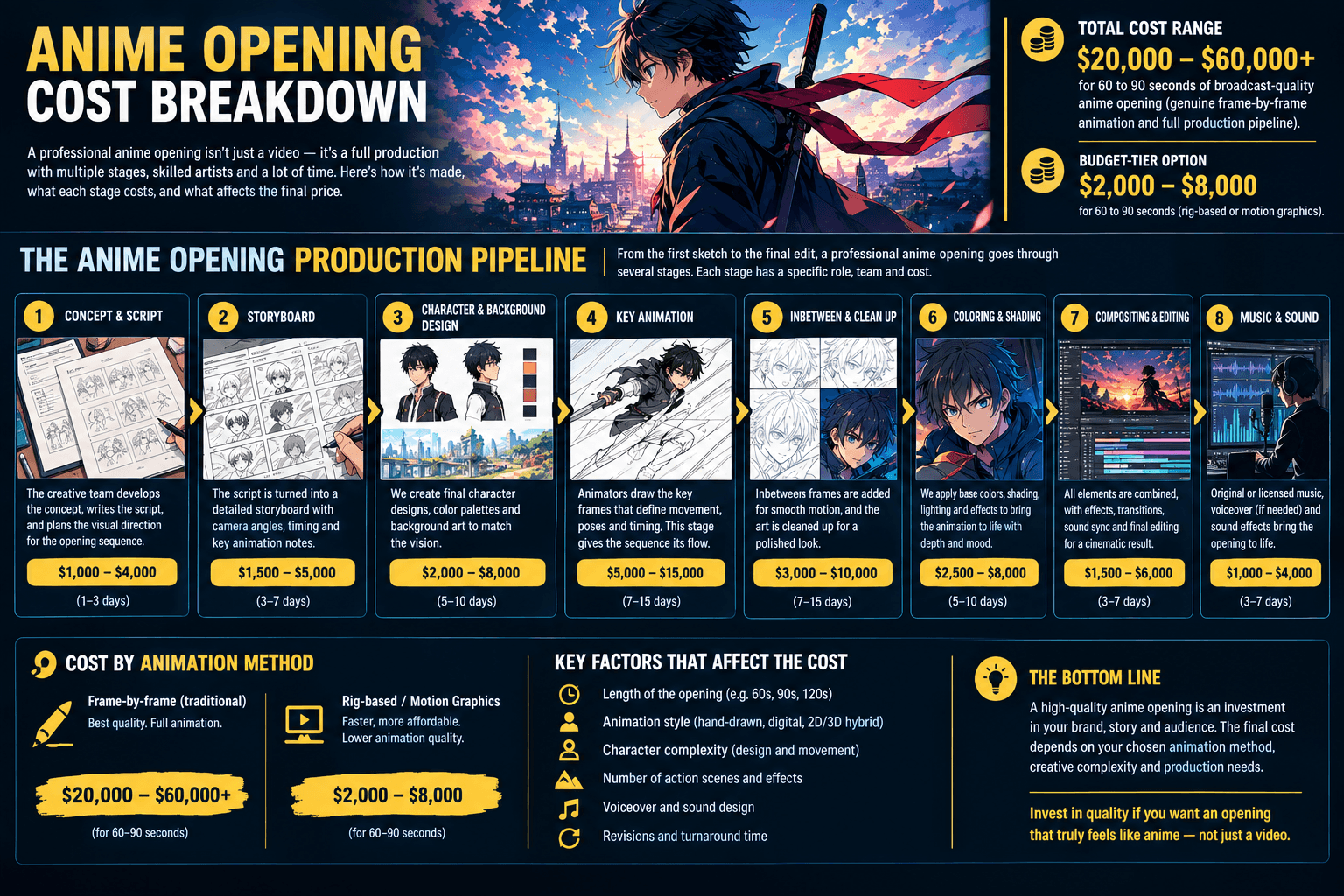
An anime opening produced with genuine frame-by-frame animation and the full Japanese production pipeline typically costs $20,000 to $60,000 or more for 60 to 90 seconds of broadcast-quality content. Budget-tier openings produced with rig-based or motion-graphics methods can be produced for $2,000 to $8,000, but the animation quality is immediately recognizable as lower to any anime-native audience. The final anime opening cost is determined by animation method, character complexity, cut count, background art volume, music production, and the studio's production pipeline. This guide breaks down every factor in detail.
Context First
Why an Anime Opening Costs More Than a Trailer of the Same Length
Most people searching for anime opening cost information start from a general sense of animation pricing and assume an opening sequence is simply a short animation project. That framing understates the actual production demands by a significant margin. An anime opening sequence is the highest animation-density format in the entire anime production catalogue, measured in drawings per second of finished content.
Compare it to an anime trailer of the same length. A well-produced anime trailer can use motion manga sections (panning over static artwork), slow reveals of key art, text-driven sequences, and a handful of high-quality action cuts to create impact without sustaining continuous character animation throughout. These techniques are accepted and effective in the trailer format because a trailer's job is to create intrigue and demonstrate quality in concentrated moments.
An anime opening has a different mandate entirely. It must introduce the series' principal characters in motion, establish the visual world, build emotional resonance with the theme song, and hold the animation quality at or near its peak from the first frame to the last. There are no slow-pan relief moments. There are no title cards that pause the drawing requirement. Every cut requires fully animated character performance synchronized precisely to a music track that was itself produced to a specific tempo and emotional arc.
This sustained requirement for high-quality character animation across the full 60 to 90 second runtime is what drives anime opening cost above other formats of equivalent length. Understanding this is essential before evaluating any quote or cost estimate. When a studio quotes an anime opening cost that seems surprisingly low, the question to ask is not "how did they achieve this price?" but "what did they remove from the production to reach it?"
Industry Benchmark
Japanese broadcast TV anime openings are typically produced by the main production studio's key animation team, sometimes with specialist opening directors brought in for flagship productions. In major Japanese productions, the opening sequence alone receives a dedicated director, a hand-picked team of senior animators, and a production schedule that runs in parallel with main episode production. The cultural and commercial weight of an anime opening in Japan is enormous. For an international production targeting the same audience, that standard sets the quality expectation.
What Moves the Price
6 Factors That Determine Anime Opening Cost
No two anime openings cost the same amount because no two anime openings make the same production demands. These are the six variables that move the price most significantly, and understanding them lets you scope your project accurately before you approach any studio.
Animation Method
This single factor has the largest effect on anime opening cost of any other variable. Genuine frame-by-frame hand-drawn animation, where every significant pose is drawn by a skilled animator, is fundamentally more expensive than rig-based digital animation or motion graphics production. A frame-by-frame opening requires 10 to 20 times the skilled labor hours of a rig-based production of the same length. The quality gap is equally large, and anime-native audiences perceive it immediately.
Cut Count and Runtime
Cut count, the total number of individual scene transitions in the opening, is a direct driver of anime opening cost because each cut requires its own key animation, background art, and compositing work. A 90-second opening with 80 cuts demands significantly more production resources than one with 40 cuts of the same duration. Long sustained action sequences and rapid montage sequences have very different cost profiles despite potentially covering the same number of seconds.
Character Count and Complexity
Every character appearing in an anime opening requires a full settei package (character design sheets from multiple angles with expression references) before key animation begins. Each additional character with significant screen time adds not just drawing volume but design cost. Characters with complex costumes, distinctive silhouettes, or high-detail features require more drawing time per frame than simple character designs. An ensemble cast opening with eight fully animated characters costs substantially more than a lead-character-focused opening.
Background Art Volume and Detail
Background art is one of the most underestimated cost drivers in an anime opening. Atmospheric, detailed painted environments are a defining quality signal of professional anime, and an opening typically requires a higher density of background art per second than a standard episode because of the rapid scene transitions. Complex architectural environments, distinct natural settings, and elaborate fantasy world designs each require significant specialist background artist time to produce at a quality level consistent with the character animation.
Music Production and Licensing
The music is not a line item that exists outside the anime opening cost calculation, even though many clients budget it separately or ignore it entirely until late in production. Commissioning an original theme song with professional composition, recording, mixing, and mastering adds significant cost. Licensing an existing track for use in an indie or commercial production involves sync rights negotiations that can range from manageable to prohibitive depending on the track's rights holder. Music production and licensing typically represent 15 to 25 percent of total anime opening cost at professional scale.
Typography and Title Treatment
Every anime opening ends with the series title card: the animated typography treatment that reveals the show's title in sync with the music's emotional peak. This is a specialist motion design discipline distinct from character animation, and a memorable, high-quality title treatment requires dedicated attention and iteration. Multilingual title treatments (Japanese kanji with romaji or English subtitles) increase the complexity further. A studio that treats this as an afterthought will produce an opening that looks finished until the last five seconds, then underdelivers on the most memorable moment.
2026 Market Pricing
Anime Opening Cost Tiers: What Each Budget Level Gets You
The anime opening market in 2026 spans a wide range of price points, production methods, and quality outcomes. Here are the three principal tiers you will encounter when commissioning an anime opening, with an honest assessment of what each delivers and who it is right for.
Budget Tier
$2,000 to $8,000 / 60-90 seconds
- Motion graphics or rig-based character animation
- Pre-made or asset-library background elements
- Limited or no character design sheet package
- Royalty-free music or client-supplied track
- Short turnaround (2 to 6 weeks)
- Suitable as a demo or concept placeholder
Best for: First pitch decks, internal demos, concept tests
Mid-Range Tier
$8,000 to $20,000 / 60-90 seconds
- Partial frame-by-frame animation on hero moments
- Custom character designs with limited settei
- Mix of original and asset backgrounds
- Professionally sourced music track
- 6 to 12 weeks production time
- Acceptable for indie releases and smaller platforms
Best for: Indie series launch, crowdfunding, small platform
Recommended
Professional Tier
$20,000 to $60,000+ / 60-90 seconds
- Full frame-by-frame pipeline: settei, genga, douga, shiage
- 1,500 to 2,200+ individual hand-drawn frames
- Original painted background art for all environments
- Original music composition and full audio production
- 10 to 20 weeks production time
- Broadcast, streaming platform, and Kickstarter campaigns
Best for: Platform pitches, broadcast series, high-expectation fanbases
Why the Gap Is So Wide
The 10x price difference between budget and professional tier is not markup. It reflects a 10 to 20 times difference in skilled labor hours. A frame-by-frame anime opening requires 1,500 to 2,200 individual drawings, each passing through key animation, in-betweening, and cleanup stages performed by trained animators. A rig-based opening generates the same finished length of video with a fraction of the drawing volume, using software interpolation to fill the frames between manually positioned rig poses. The motion quality is fundamentally different at a level any viewer can perceive.
The Numbers Behind the Cost
The Drawing Math: Why 90 Seconds Costs What It Does
The clearest way to understand anime opening cost at the professional tier is to work through the drawing mathematics. Every drawing in a frame-by-frame anime opening must be created by hand, reviewed for model accuracy, approved for timing, in-betweened to complete the motion arc, cleaned up to broadcast line quality, and digitally colored. There is no shortcut in this pipeline that does not degrade the finished quality.
At the standard anime production rate of animating on twos, a 90-second opening requires approximately 1,080 drawings to fill every frame. Professional openings do not animate entirely on twos. Action sequences, especially character movement during the music's energy peaks, are animated on ones for maximum fluidity, adding several hundred additional drawings to the total count. A professional broadcast-quality anime opening realistically requires 1,500 to 2,200 individual drawings, and in highly ambitious productions that number can exceed 2,500.
Each of those drawings passes through three distinct production stages. Key animation (genga) is the most skilled stage, where senior animators draw the principal poses that carry the character's performance. In-betweening (douga) fills the transition frames between key poses, completing the motion arcs. Cleanup and color (shiage) produces final broadcast-quality line art from the rough animation drawings and applies the digital color. These are three separate skilled roles with separate labor costs, and all three must be completed on every drawing before a single cut is finished.
When you divide the total production cost of a professional anime opening by the drawing count, the per-drawing cost including all pipeline stages typically runs between $15 and $40 depending on the studio, the animator experience level, and the complexity of the character designs being animated. This is not a number that can be compressed significantly without using less experienced animators or skipping pipeline stages, both of which directly degrade the visible quality of the finished animation.
Stage-by-Stage Breakdown
The 6-Stage Anime Opening Production Pipeline
A professional anime opening passes through six distinct production stages. Each stage contributes a defined portion of the total anime opening cost and has its own timeline, skilled roles, and quality checkpoints. Understanding this pipeline helps you evaluate any studio's quote and understand where budget compromises will show up in the finished work.
Stage 01
Pre-Production: Storyboard and Animatic
The director creates a storyboard mapping every cut, character action, camera movement, and scene transition in the opening, synchronized to the music track. The storyboard is then produced as an animatic: a timed rough cut using still or sketch drawings to confirm pacing, energy flow, and musical sync before any full animation begins. Pre-production mistakes fixed at this stage cost a fraction of what the same mistakes would cost to fix after key animation has been completed.
Cost weight: 8-12%Stage 02
Character Design Sheets (Settei)
Every character appearing in the opening requires a full settei package: front, side, three-quarter, and rear views at consistent scale, accompanied by expression sheets covering the emotional range the character will display. Settei are the production's law. Animators working on different cuts of the same opening must each produce drawings that match the settei exactly. Without a complete settei package, character consistency across cuts becomes impossible and the opening looks inconsistent even when individual cuts are well animated.
Cost weight: 6-10%Stage 03
Key Animation (Genga)
Key animation is the most expensive and most creatively demanding stage of anime opening production. Senior animators draw the principal poses for every action in every cut, establishing the character's performance, the timing of movements, and the weight and energy of each sequence. Key animation quality is the primary determinant of an opening's visual appeal. A skilled genga-ka produces expressive, character-specific, physically convincing motion that no in-betweener or cleanup artist can improve upon if it is not present in the key drawings.
Cost weight: 30-40%Stage 04
In-Betweening (Douga)
In-betweeners draw the transitional frames between the key poses established in genga, completing the motion arcs that make character movement feel fluid and continuous. The number of in-between drawings per cut depends on the animation timing instructions set by the key animator: a cut animated on twos requires roughly one in-between drawing per key drawing, while on-ones sequences require more. In-betweening quality directly affects the smoothness and weight of the finished animation. Rushed or inaccurate douga creates stuttering, off-model motion that undermines strong genga.
Cost weight: 15-20%Stage 05
Cleanup and Color (Shiage)
Cleanup artists trace over the rough animation drawings to produce clean, consistent, model-accurate line art at the final broadcast line weight. Digital colorists then apply the character's color palette, including shadow and highlight colors, per-frame for the finished animation sequence. Shiage quality is what separates rough animation that looks like an animatic from finished animation that looks broadcast-ready. Cleanup errors in line weight, model accuracy, or color application are visible in every frame of the finished opening and cannot be corrected without redrawing the affected frames.
Cost weight: 15-20%Stage 06
Background Art and Compositing
Background artists produce the detailed painted environments for every distinct location in the opening. These are composited with the character animation layers, visual effects elements, and the title typography treatment, then synced to the final music mix. Compositing also applies camera movements, depth-of-field effects, color grading, and the lighting integration between characters and their environments. The final composite is the version of the anime opening that will be seen by its audience, and the quality of this stage determines whether the individual elements read as parts of a unified, atmospheric world or as disconnected layers laid on top of each other.
Cost weight: 15-20%What You're Actually Buying
Three Production Methods, Three Quality Ceilings
When evaluating anime opening cost quotes, the most important question to ask is what production method the studio uses. The three common methods produce fundamentally different results, and the price difference between them directly reflects the labor and quality difference, not studio margin.
Method One
Motion Graphics Opening
A motion graphics anime opening uses static or semi-static character illustrations with animated camera movements, zoom effects, particle systems, and typographic elements to simulate the energy of a genuine anime opening without producing actual character animation. Characters do not move in the way hand-drawn animation moves. They slide, zoom, fade, and transform between illustrated poses. The visual result can be striking and is the appropriate choice for projects where budget is severely constrained, but any anime-native viewer will identify it as a motion graphics production rather than an animated opening within seconds.
The quality ceiling for this method is aesthetic, not technical. No amount of production polish can produce the organic, weight-driven, expression-rich character movement that frame-by-frame animation delivers.
Quality ceiling: ModerateMethod Two
Rig-Based Anime Opening
A rig-based anime opening uses digitally rigged character puppets that are posed and animated using software. Characters have articulated joints and can move more dynamically than in a motion graphics production. The animation can include walk cycles, running, fighting, and emotional expressions. However, rig-based movement has a characteristic mechanical quality that comes from software interpolation between manually placed poses. Limb movement lacks the weight and organic fluidity of hand-drawn animation. The "rubber hose" feel of rig-based motion is particularly apparent in fast action sequences, which are a defining feature of most anime openings.
For an audience that grew up watching frame-by-frame anime, rig-based animation in an opening is a clear signal of reduced production quality regardless of the visual style applied to the character design.
Quality ceiling: Good for non-anime audiencesMethod Three
Frame-by-Frame Anime Opening
A frame-by-frame anime opening uses genuine hand-drawn animation where every significant character pose is drawn by a skilled animator. The motion quality achievable with this method has no upper ceiling except animator skill and budget. Character weight, momentum, expressive gesture, and the characteristic visual language of anime that audiences have spent decades training their perception on, all of these are only possible with frame-by-frame production. The frame-by-frame anime animation pipeline is the only method that produces output indistinguishable in quality from Japanese broadcast anime.
For any project targeting an anime-native audience, whether an indie series, a brand activation, or a platform pitch, frame-by-frame is the only method that meets audience expectations.
Quality ceiling: Broadcast / Streaming QualityCommission Guide
Which Tier Fits Your Project?
Different projects have different audience expectations, commercial goals, and budgetary constraints. Here is a practical guide to matching your project type to the right anime opening production tier and studio. For full production details and to get a quote from Magic Motion Studio's anime opening animation service, see their service page.
Platform Pitch or Distribution Deal
If the opening is being produced to accompany a pitch to a streaming platform, broadcaster, or distributor, it will be evaluated by industry professionals who watch hundreds of pitches and have a precise eye for production quality. Budget or mid-range openings are immediately identifiable as non-broadcast quality and undermine the credibility of the pitch. For a platform pitch, professional-tier frame-by-frame production is not optional. The opening is your strongest argument that the series can be produced at the quality level the platform requires.
Recommended tier: Professional (frame-by-frame)
Crowdfunding Campaign (Kickstarter / Indiegogo)
An anime opening produced for a crowdfunding campaign serves two functions: demonstrating the series' quality to potential backers, and providing a viral asset that spreads the campaign reach. The anime community evaluates crowdfunding campaigns with acute attention to animation quality. An impressive professional-tier opening generates social sharing, comment discussion, and trust that a budget-tier production cannot. If the campaign funding target is significant and the audience is anime-native, professional-tier production pays for itself in campaign performance.
Recommended tier: Professional or mid-range depending on campaign target
Indie Series Launch (YouTube / Streaming)
For an independent series launching on YouTube or a smaller streaming platform with an established community following, a mid-range frame-by-frame opening is often the right balance of quality and budget. A fully professional-tier opening may not be necessary if the series has an established audience that already trusts the creator's output. However, for a series launch where the opening is one of the first impressions for new viewers, production quality communicates the series' ambition more clearly than any other asset.
Recommended tier: Mid-range to professional based on audience size
Brand or Marketing Campaign
A brand commissioning an anime opening as part of a campaign targeting the anime-native demographic faces the highest credibility threshold. This audience is extremely resistant to brands that approximate anime aesthetics without matching anime production quality. An anime opening produced at budget or mid-range tier for a brand activation or product launch will generate the opposite of the intended effect with an anime-literate audience. For anime-style marketing video that earns credibility with this demographic, frame-by-frame professional production is the only viable approach.
Recommended tier: Professional (frame-by-frame, no exceptions)
Series Concept Demo
A concept demo or proof-of-concept opening produced to test a series idea, gather audience feedback, or build a creative team around a project before committing to full production is a different use case from a finished series opening. For a demo, a mid-range production approach may be appropriate as a cost-effective placeholder that communicates the series' visual direction without committing the budget of a full professional-tier production. The demo opening should be replaced with professional-tier work before any significant public or commercial launch.
Recommended tier: Mid-range (upgrade before launch)
Manga or Webtoon Adaptation Announcement
An anime opening produced to announce the animation adaptation of an existing manga or webtoon property needs to match the quality expectations of the property's existing fanbase. If that fanbase is large and the property is commercially successful, the announcement opening will be directly compared against the production quality they have seen from professional anime adaptations of similar properties. Professional-tier frame-by-frame production is the baseline expectation for an adaptation announcement that will reach an existing fanbase rather than building one from scratch.
Recommended tier: Professional (existing audience has quality expectations)
Getting an Accurate Quote
The best way to get an accurate anime opening cost quote is to brief the studio with specifics: the number of characters appearing in the opening, whether music is already in place or needs to be produced, the intended platform and delivery specifications, your timeline, and any visual reference for the style and quality level you are targeting. A studio that can provide a detailed line-item quote rather than a single lump sum gives you much better visibility into where the budget is going and where it can be adjusted if needed. Magic Motion Studio's anime opening service includes a free project consultation to scope your production before any commitment.
For a full breakdown of anime animation pricing across all project types including trailers, pilots, and series, see our anime animation cost guide. For information about commissioning a complete series pilot alongside the opening sequence, see our anime trailer production service.
Ready to commission your anime opening?
Magic Motion Studio produces professional frame-by-frame anime openings for series, brands, and platforms. Tell us your project and we'll scope the production for you.
Frequently Asked Questions
Anime Opening Cost: FAQ
Commission Your Anime Opening with Magic Motion Studio
Professional frame-by-frame anime openings for series, platforms, and brand productions. Full pipeline from settei through compositing, with direct client management and a free consultation to scope your project.
Start Your Anime Opening Project