
2D Animation for Marketing: The Complete Strategy Guide
2D animation for marketing works because it removes the two biggest obstacles in video content: production constraints and communication limits. It can visualise anything a script describes, including software workflows, abstract concepts, and future products that do not yet exist, without a camera, location, cast, or reshoot budget. It also works across every stage of the marketing funnel and every major platform, making it one of the most versatile content investments a marketing team can make. This guide covers where it fits in the funnel, the 10 highest-value use cases, platform-specific guidance, and a framework for measuring actual ROI.
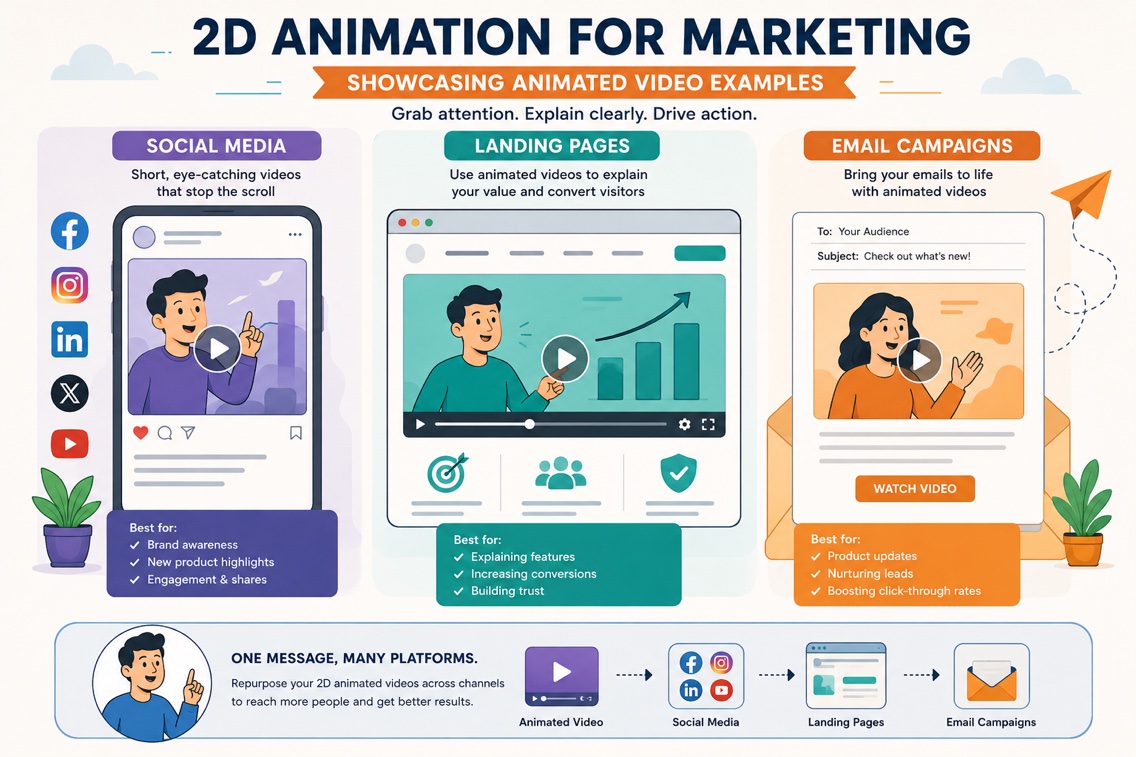 motion graphics used across digital marketing channels" loading="lazy">
The case for using 2D animation in marketing is not primarily about aesthetics. It is about communication efficiency. The human brain processes visual information 60,000 times faster than text, and the combination of moving imagery with audio, the format animation naturally produces, creates the strongest encoding conditions for memory retention of any content format. When a marketing team commits to 2D animation, they are not choosing a style. They are choosing a communication format with a structural advantage over every alternative.
That advantage is most visible in contexts where the subject being marketed cannot be easily shown through live video: a software platform's internal workflow, a financial service's risk model, a healthcare company's clinical process, a logistics network's routing algorithm. These subjects resist conventional video but lend themselves perfectly to 2D animation for marketing. The animation can render anything the script describes at the same cost regardless of the complexity of the visual.
Why 2D Animation for Marketing Works
Most marketers know 2D animation performs well. Fewer understand specifically why, which limits their ability to deploy it strategically rather than as a default creative choice. There are four distinct mechanisms through which 2D animation for marketing outperforms other content formats.
Movement captures and holds attention
The human visual system is hardwired to detect movement. This is an evolutionary response: movement in the peripheral field historically indicated a threat or an opportunity, both of which required immediate attention. In a digital environment where static content competes for the same visual space, animation's inherent movement gives it an attention capture advantage that no static format can match. On a social feed where a viewer is scrolling through a mix of text posts and static images, an animated element stops the scroll by triggering the same attentional response at far lower stimulus intensity than a sudden sound or flash.
Simplification through visualisation
Complex ideas that require paragraphs of text to explain can often be communicated in seconds through well-designed 2D animation for marketing. This is not because animation dumb things down. It is because the visual channel carries information in parallel with the audio channel, and the brain integrates both simultaneously. A diagram that takes three sentences to describe in text can be shown in two seconds of animation. A process that requires a numbered list of seven steps in a written guide can be demonstrated in 30 seconds of animation without the viewer needing to hold the whole list in working memory while they read.
Emotional engagement through character and story
2D character animation creates emotional connection that information design alone cannot. When a viewer identifies with a character in an animated marketing video, recognising their own frustration in the character's situation, or feeling the resolution when the character finds the product's solution, that emotional engagement encodes the brand message more durably than a purely informational presentation. This is the mechanism behind the most successful explainer videos: Dropbox's whiteboard character, Headspace's abstract figures, and Slack's animated office workers all earned viewer identification that made the brand message stick.
Production flexibility across channels and audiences
A single 2D animation for marketing marketing video can be repurposed across multiple formats with relatively low incremental cost. The 90-second hero video becomes a 30-second social cut, a 15-second pre-roll ad, a looping GIF for email headers, and a series of still frames for presentation slides. The same animation can be adapted for different languages by swapping the voiceover and any on-screen text, without reshooting. For global marketing teams or campaigns that need to run across multiple regions, this adaptability is a significant practical advantage over live-action production.
Live-action marketing video ages visibly. Fashion changes, hairstyles date, office environments look dated, and the humans in the video get older. A well-produced 2D animation for marketing does not visually date in the same way. A character animation style that was considered modern in 2020 still looks intentional in 2026. This extended shelf life means the cost of a 2D animation for marketing marketing video is amortised over a longer period than a comparable live-action production, which improves its effective ROI significantly.
Where 2D Animation for Marketing Fits the Funnel
One of the strongest arguments for 2D animation for marketing as a marketing investment is that it is one of the few content formats that performs across all three funnel stages rather than specialising in one. Understanding which animation approach serves which funnel stage prevents the common mistake of producing the wrong type of video for the wrong audience context.
Get noticed, be remembered
At the top of the funnel, the viewer does not know you yet. The animation's job is to communicate the brand's personality and the category it operates in quickly enough to earn a second look. Emotional resonance and visual memorability matter more than product detail at this stage.
Explain and differentiate
The viewer is comparing options. The animation's job is to make the product's value proposition clear, specific, and differentiated from alternatives. Explainer videos, product demos, and comparison content all serve this stage. Information clarity and specificity matter most.
Remove doubt, drive action
The viewer is close to deciding. The animation's job is to remove the last objection and make the next step feel obvious. Homepage hero videos, pricing page videos, and onboarding animations all serve this stage. Specificity and a single clear CTA are essential.
10 Use Cases for 2D Animation for Marketing
These are the ten contexts where 2D animation for marketing consistently delivers the strongest return. Each entry includes the funnel stage it serves and the platforms where it performs best.
Explainer videos for products and services
The highest-impact single application of 2D animation for marketing. An explainer video reduces your product's value proposition to a clear, visual story that a cold visitor can understand in 60 to 90 seconds. It does the work that a homepage's above-the-fold copy cannot: it shows the product solving a recognisable problem rather than describing it.
Landing pages with an embedded explainer video convert up to 80 percent higher than text-only equivalents. The Crazy Egg explainer video lifted their homepage conversion rate by 64 percent and generated $21,000 in additional monthly recurring revenue. Placement matters as much as production quality: the video needs to be above the fold where cold traffic lands, not buried below the page fold.
Social media content and paid social ads
Animated content stops the scroll because movement triggers the brain's attentional response before the viewer has consciously decided to engage. On a feed of static images and text posts, a 2D animation for marketing marketing video with a strong visual hook in the first two frames creates a category-level advantage over non-animated competitors.
For paid social, the 15-second and 30-second formats are optimised for completion rate on Instagram, TikTok, and YouTube pre-roll. The animation style needs to work without sound in the first three seconds, because most social video is watched muted until the viewer actively chooses to listen. On-screen text combined with expressive animation covers both sound-on and sound-off viewing without compromising either experience.
Brand storytelling and company culture
An animated brand story video communicates values, origin, and personality in a way that is more controllable than live-action and more durable than text. For brands that want to establish a clear personality rather than compete solely on product features, a character-driven 2D animation for marketing that shows the brand's founding story, its values in action, or its vision for the category creates an emotional foundation that product marketing can build on.
This format works particularly well for B2B companies whose product categories are undifferentiated on features, where brand personality is the primary purchase differentiator. It also works for recruitment-facing content, where the goal is communicating what it is like to work at a company rather than what the company sells.
Product demonstration videos
For software products, SaaS platforms, and any product where the user interface or process is central to the value proposition, 2D animation for marketing is consistently more effective than screen recordings. A raw screen recording shows what the product looks like. An animated product demo shows what it feels like to use the product and what becomes possible as a result.
The animated demo can simplify a complex UI to show only the relevant workflow without distracting navigation elements. It can highlight the moments of value delivery, the moment a task completes, the moment a report generates, the moment a notification fires, with visual emphasis that a real screen recording cannot produce without appearing manipulated.
Website hero videos
An animated hero video on the homepage above the fold communicates the brand's category, personality, and core value proposition to a cold visitor before they have read a single word of copy. It functions as a visual elevator pitch: a 15 to 30 second loop (or an autoplay 60 second video) that answers "what is this company and why should I care" without the visitor having to work for the answer.
The animation style of the hero video sets the visual tone for the entire site experience. A consistent design language between the animation and the site's static design elements creates a cohesive first impression that signals production quality and brand investment to the visitor.
Email marketing campaigns
Including the word "video" in an email subject line increases open rates by approximately 19 percent across documented email marketing benchmarks. Embedding an animated GIF or a video thumbnail that links to a 2D animation for marketing marketing video significantly increases click-through rates compared to a text-and-image email format.
The most effective email animation format is a short GIF loop of two to four seconds that shows a key moment from the full video, enough to create intrigue and motion in the email without requiring video autoplay support (which most email clients still do not provide). The GIF acts as an animated call to action rather than a static button, and its movement draws the eye in the same way an animated social post stops the scroll.
Customer onboarding and educational content
Post-purchase 2D animation for marketing serves a different goal from acquisition content, but the stakes are equally high. Onboarding videos that help a new customer understand how to use a product reduce time-to-value, decrease support ticket volume, and increase the likelihood of the customer becoming a long-term retained user rather than churning after the first week.
Educational animation is particularly valuable in SaaS products with complex setup flows, in regulated industries where compliance training is required, and in any context where a manual would be the alternative. A three-minute animated onboarding video replaces 20 pages of written documentation, has a fraction of the support cost, and has a measurably better completion rate than any text equivalent.
Data visualisation and report animation
Annual reports, market research publications, and data-heavy content briefs present a specific communication challenge: the data is credible but dry, and most readers skim or ignore it. Animated data visualisation transforms static statistics into visual stories that communicate both the number and the narrative surrounding it.
An animated infographic video showing market growth, user behaviour trends, or product performance data can be shared on social media, embedded in press releases, and distributed via email in a way that a static chart PDF cannot match. The animation also allows the producer to control the sequence in which data is revealed, building a narrative argument rather than presenting all information simultaneously for the viewer to interpret without guidance.
Recruitment and employer branding
Employer brand content competes with every other company trying to attract the same talent pool. An animated culture video communicates values, team personality, and working environment in a format that is more controllable and scalable than a live video production that requires real employees on camera and a film crew on site.
Animation is particularly useful for global talent acquisition, where a single animated employer brand video can be localised for multiple languages without reshooting. It also avoids the common live-action challenge where employees are uncomfortable on camera, producing content that reads as forced or performative rather than authentic.
Trade show and event display content
2D animation for marketing in a trade show environment solves a problem that no printed material can: it creates continuous visual motion that draws attention from across a crowded exhibition floor. A looping animated display running on a monitor or LED wall communicates the brand and product story to passing visitors even when no sales representative is available to present.
The animation needs to work without audio (trade show floors are loud), communicate the core value proposition in a single loop of 30 to 60 seconds, and be visually distinctive enough to stand out from competitors' displays. On-screen text that labels each sequence allows the content to be self-explanatory without requiring any prior knowledge of the brand.
Ready to add 2D animation for marketing to your marketing stack?
Magic Motion Studio produces 2D animation for marketing teams across Australia and the USA, from explainers to social content to full brand campaigns.
Platform Guide for 2D Animation for Marketing
The same 2D animation content does not perform equally across all platforms. Each channel has different technical requirements, different audience behaviours, and a different definition of "good" engagement. Understanding these differences before production begins allows the marketing team to brief the studio correctly rather than trying to adapt a single master cut to formats it was not designed for.
YouTube
Viewers on YouTube self-select into content. They are already interested in the topic before they click. This means longer, more educational 2D animation for marketing performs well here. Two to three minute explainers, product deep-dives, and how-it-works content have the highest watch-through rate of any platform because the viewer's intent to learn is already established. Optimise for strong first 15 seconds (skip button appears after five), clear audio, and closed captions for accessibility and search indexing.
LinkedIn's audience is in a professional context and has a higher tolerance for information-dense content than a consumer social platform. 2D animation for B2B marketing performs particularly well on LinkedIn: explainer content, thought leadership data visualisations, and product demos all match the platform's professional intent. Square (1:1) and vertical (4:5) formats outperform widescreen. Native video upload is favoured by the algorithm over external links. Captions are essential as most LinkedIn video is watched without sound in a workplace environment.
Instagram and TikTok
Short-form, vertical (9:16), and visually punchy. The first frame must deliver a visual hook strong enough to stop an actively scrolling thumb. No logos in the first two seconds. On-screen text must carry the story independently of sound because 70 to 80 percent of short-form video is watched muted. High-energy editing, bright colour contrasts, and fast visual rhythm outperform measured, corporate pacing on these platforms. The animation style needs to match the energy register of the platform's native content rather than standing out as an ad.
Website landing pages
The highest-conversion deployment for 2D animation for marketing in marketing. Place the video above the fold as the primary homepage or landing page element, not below. Autoplay with muted video on loop works well as a background element; click-to-play with a strong thumbnail works better as a standalone player. For more detail on the placement, thumbnail, and CTA alignment strategy that maximises landing page conversion from an animation, the guide on using explainer videos on a landing page covers the conversion mechanics in depth.
Email marketing
Direct video embedding is not widely supported in email clients. Use an animated GIF that shows a key moment from the full video, with a play button overlay and a CTA link to the hosted video. The GIF provides the motion that draws the eye while keeping file size manageable. Including the word "video" in the subject line increases open rates across benchmarked studies. The email video CTA should go to a dedicated landing page with the video as the primary element, not to a general website page where the viewer might miss it.
Paid advertising (display and pre-roll)
Pre-roll YouTube ads need to deliver the brand message and value hook in the first five seconds (before the skip button). Display ads need to communicate in a looping GIF format of two to six seconds. 2D animation excels at both: it can compress a brand story into five seconds of visual storytelling in ways that live-action cannot. The six-second bumper ad format on YouTube is one of the most challenging video formats to use effectively, 2D animation's ability to carry narrative with compressed visual language makes it the best tool for the format.
Briefing a Studio for 2D Animation for Marketing
The most common reason 2D animation for marketing underperforms its potential is an incomplete brief at the start of production. When a studio does not have answers to the five questions below, they make assumptions, and those assumptions create revision cycles that extend the timeline and add cost. Answering these questions before the first production meeting is worth more than any creative direction or style reference.
- 1
Who is the primary viewer and what do they already know?
The viewer's existing knowledge level determines how much the script needs to explain versus assume. A video for a cold social media audience needs to earn attention before it explains anything. A video for a mid-funnel prospect who has already visited the pricing page can skip the category education and go straight to differentiation. Specify the audience context, not just the demographic.
- 2
What is the single most important thing the viewer should do after watching?
One CTA, not three. Every animation in this brief that has multiple CTAs ("visit our website, follow us on LinkedIn, download our guide") performs worse than a single, specific next step. Decide before production begins what the ideal viewer action is and build the animation's closing beat around that action exclusively.
- 3
Where will the video live and at what dimensions?
Platform determines aspect ratio, safe zones for on-screen text, audio assumptions, and length. A video brief that does not specify platform forces the studio to choose the most common format and then adapt, which is always less effective than designing for the specific context from the start. If the video needs to work across multiple platforms, specify that as a brief requirement, a multi-format brief, so the studio can plan the master asset accordingly.
- 4
What is the animation style reference?
Link to three examples of 2D animation for marketing that match the tone, energy, and visual language you want. References are not instructions. The studio will interpret them through your brand guidelines, but they are the most efficient way to calibrate aesthetic expectations before a single frame is produced. Without a reference, "modern and clean" means something different to every person in the briefing room.
- 5
What is the one belief the viewer should hold after watching that they did not hold before?
This is the belief brief, different from the action brief. The action brief says what you want the viewer to do. The belief brief says what you want the viewer to think or feel. "Our product is the simplest solution in this category." "This company understands our specific problem." "This brand is trustworthy with sensitive data." Naming this belief before production begins ensures the script is built to install it, rather than building a script that describes the product and hoping the belief follows.
The 2D animation for marketing studio page covers Magic Motion Studio's production process from brief to delivery, including how the script brief translates into storyboard, animation style, and final delivery format. For cost context across different 2D animation for marketing production tiers, the 2D animation for marketing cost guide breaks down investment by style, length, and scope.
Measuring ROI on 2D Animation for Marketing
Most marketing teams produce 2D animation for marketing content without a pre-defined success metric. The video goes live, view counts are collected, someone declares success or failure based on gut feeling, and the next production brief is written without any data from the previous one. This cycle produces content that gets more expensive over time but does not necessarily get more effective.
Setting the primary success metric before production begins solves this. The metric should be tied to the funnel stage the video is designed to serve.
| Funnel Stage | Primary Metric | Secondary Metrics | Benchmark to Beat |
|---|---|---|---|
| Awareness | Top View count + completion rate | Brand search lift, social shares, reach | 25% video completion rate for 60-second social content |
| Consideration | Mid Click-through rate on CTA | Time on page, lead form completion, return visits | 5 to 8% CTR from video CTA to next step |
| Conversion | Bottom Conversion rate lift on page | Direct form completions, demo bookings, free trial starts | 20 to 64% conversion lift vs pre-video baseline |
| Post-conversion | Feature adoption rate after onboarding video | Support ticket volume reduction, 30-day retention | 30% reduction in onboarding-related support tickets |
For a landing page or homepage video, measure the conversion rate on the page before the video was added and after. A controlled A/B test (50% of visitors see the page with the video, 50% without) is the most rigorous approach. If a full A/B test is not feasible, compare conversion rate in the four weeks before the video launch against the four weeks after, controlling for traffic source mix. A meaningful difference in either direction is the real ROI signal, not view count alone.
For 2D animation for marketing that will be used in a broader content strategy, understanding how the animation style relates to other video formats helps with planning the full asset suite. The 2D animation for marketing styles guide covers the range of visual approaches available. The comparison between 2D and 3D animation covers the production differences for teams considering both formats. For motion graphics applications within marketing, the motion graphics services page covers the use cases where motion graphics outperforms full character animation.
For production cost context in each region, the Australia cost guide and USA cost guide break down investment by style and scope. For the full scope of what 2D animation is as a format, the what is 2D animation for marketing guide covers the technical and creative foundations. And for the full range of explainer video production services, including 2D animation, motion graphics, and hybrid approaches, Magic Motion Studio's production page covers the complete offering.
Frequently Asked Questions
2D animation for marketing works because it combines movement, colour, sound, and narrative in a format the brain processes more readily than text or static images. Viewers retain 95 percent of a message from video versus 10 percent from reading text. Animation adds a further advantage over live-action: it can visualise things that cannot be filmed, software workflows, abstract concepts, internal processes, at the same cost regardless of visual complexity.
2D animation for marketing is used across the full range of marketing video formats: explainer videos, social media content, paid advertising, website hero videos, email campaigns, product demos, onboarding content, brand storytelling, data visualisation, trade show displays, and recruitment videos. The versatility of 2D animation for marketing makes it one of the few formats that performs across all channels and funnel stages without a separate production approach for each.
Platform determines length. Paid social ads: 15 to 30 seconds. Organic Instagram and TikTok: 30 to 60 seconds. LinkedIn: 60 to 90 seconds. Homepage and landing page hero videos: 60 to 90 seconds. YouTube educational content: two to three minutes. Onboarding and tutorial videos: three to five minutes when the viewer has committed to learning the product.
Neither is universally better. 2D animation outperforms live-action when the subject cannot be filmed, when the budget needs to stretch further, when multiple language versions are required, and when the shelf life of the asset needs to be long. Live-action outperforms 2D animation for marketing for testimonials and authentic human stories where real people are more credible than animated figures, and for products where physical texture and photorealism are central to the purchase decision.
Set the primary success metric before production begins, tied to the funnel stage the video serves. For awareness content, track completion rate and reach. For consideration content, track click-through rate and lead form completion. For conversion content, track conversion rate on the page before and after the video was added. The Crazy Egg benchmark, a 64 percent conversion lift from a single homepage 2D animation, is a useful reference point for what well-placed marketing animation can achieve.
Add 2D animation to your marketing
Magic Motion Studio produces 2D animation for marketing teams across Australia and the USA, from 60-second explainers to full social media content suites.
See Our 2D Animation Work