
Explainer Videos for Fintech and Financial Services: The Complete Guide
Explainer videos for fintech and financial services work by making invisible, trust-sensitive products visible and understandable without requiring a viewer to read a product disclosure statement or sit through a sales call. Animation is the dominant format in this category because it can show how a payment flow works, how a robo-advisor rebalances a portfolio, or how an API connects two financial systems, all without needing a physical product, a filming location, or on-screen talent. This guide covers the eight main fintech verticals that use them, which animation styles work for each, real-world examples from both Australia and the United States, and how to brief a studio on a financial services project that needs compliance sign-off built into the workflow.
Financial products share one communication challenge that makes them fundamentally different from almost every other product category: the thing being sold is invisible. A neobank account is a set of database entries and software permissions. A robo-advisor is an algorithm. A BNPL checkout option is a credit decision made in milliseconds. A B2B payments API is a set of HTTP calls. None of these can be photographed, demonstrated in a showroom, or sampled before purchase. And all of them require a customer to trust a company with something they care deeply about: their money.
This combination of invisibility and high-stakes trust is precisely why explainer videos for fintech and financial services have grown from a niche production category into one of the most in-demand formats in the video industry. According to Vidico's video marketing report, 91% of businesses now use video as a marketing tool, and the financial services sector has seen the sharpest increase in adoption of any industry category over the past three years. Landing pages with embedded video convert at 86% higher rates than text-only equivalents, a figure that carries even more weight in an industry where the average consumer visits four to six competitor pages before making a product decision.
The challenge is that most fintech marketing teams approach video production the same way they approach written content: start with features, list the benefits, add a call to action. The videos that actually move fintech audiences do the opposite. They open with a financial pain the viewer already feels, introduce the product as the resolution, show the product in action through animation or interface walkthrough, and close with a low-friction next step. The production discipline required to execute that four-beat structure well, inside 90 seconds, is what separates a video that builds conversions from one that fills a YouTube channel nobody watches.
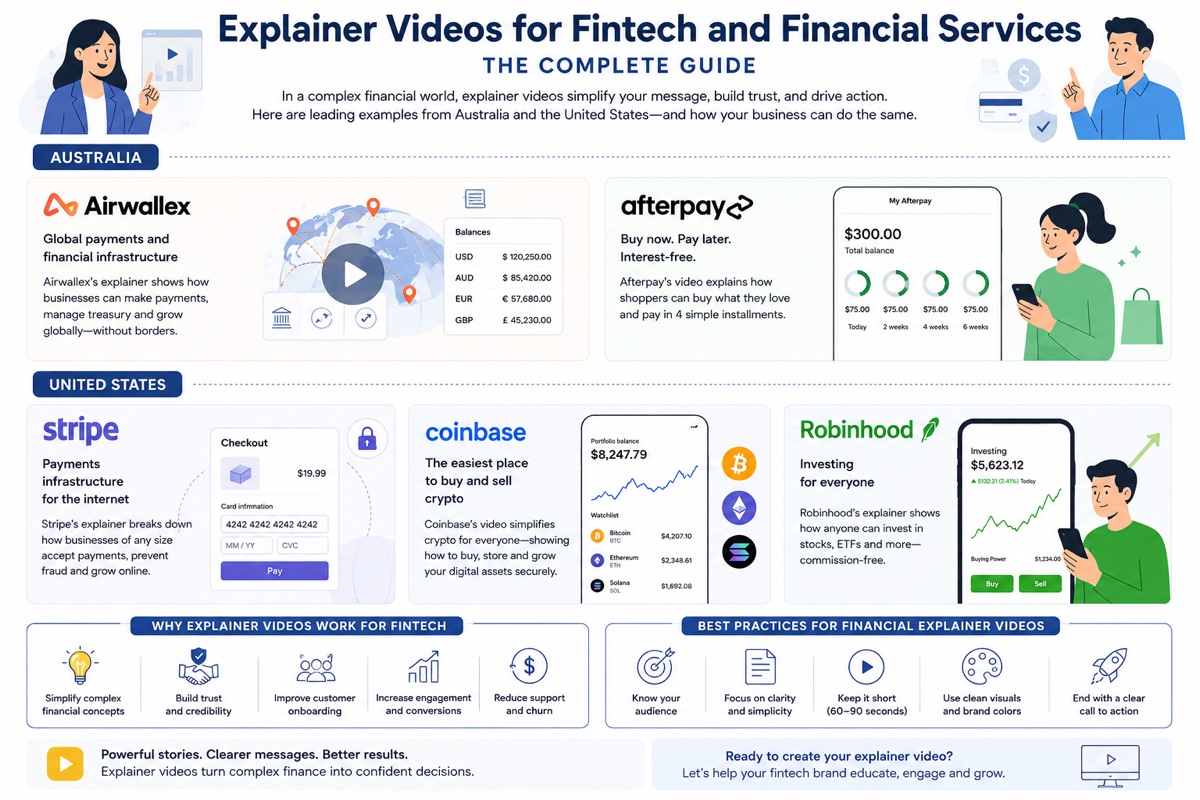 motion graphics of payment flows, neobank app interfaces, crypto wallets and financial dashboard UI" width="1200" height="800" loading="lazy">
Sources: Vidico; Digital Applied; FetchFunnel 2025; Lambda Finance.
Why Explainer Videos for Fintech and Financial Services Work
Every fintech product faces two overlapping problems that written content alone cannot solve. The first is complexity: the underlying technology is genuinely difficult to explain without visual support, and dense product copy consistently fails to convert audiences who do not already understand what they are being asked to adopt.
The second is trust. Customers asked to hand over their banking credentials, investment capital, or credit history to a company they may have discovered three minutes ago on a social media ad are making a high-stakes decision under significant uncertainty. A well-executed animated explainer video collapses the trust gap by showing exactly what happens with that data, exactly how the product works, and exactly what the viewer gets in return, before they click sign up.
The trust deficit is particularly acute for fintech companies competing against established banks and financial institutions that have decades of brand recognition behind them. A new neobank, robo-advisor, or BNPL platform is asking customers to defect from a provider they already know to one that may have been founded eighteen months ago. The product needs to earn trust faster than a television advertisement and more credibly than a landing page full of feature bullet points. Animation does this by showing the product working, rather than claiming it works. A payment flow animated in 45 seconds demonstrates more about how a product functions than three paragraphs of feature copy, and does it in a format that 91% of consumers say they prefer for understanding a new product or service.
For B2B fintech products, the trust challenge is different but equally real. A CFO evaluating a treasury management platform or a CTO assessing a payments API is not going to buy based on a social media video. But the right animated explainer on a product page or in a sales deck can compress a lengthy discovery process by pre-answering the technical and commercial questions a buying committee would otherwise ask across three to five calls.
Explainer Videos by Fintech Vertical
Fintech is not a single product category. The communication challenge, the audience, and the ideal video format differ significantly across the main sub-verticals. The eight cards below map specific production approaches to each sector.
Neobanks and Digital Banking
Neobank explainers cover account opening flows, debit card features, fee comparisons with traditional banks, and savings tools. The "why switch" narrative is central: the video must make a familiar product category feel meaningfully different in under 90 seconds.
60 to 90-second 2D character animation with app UI overlay, placed on homepage and paid social.
BNPL and Consumer Credit
Buy-now-pay-later videos show the checkout experience in real time, explain the repayment structure, and address the questions that cause cart abandonment: how approval works, what happens if a payment is missed, and whether it affects a credit score.
45 to 60-second motion graphics with animated checkout UI, deployed in merchant partner onboarding and consumer-facing social ads.
Crypto and DeFi
Crypto explainers face the hardest trust gap in financial services. Animation is well-suited here because blockchain mechanics, wallet custody, and DeFi liquidity pools are genuinely abstract concepts that have no physical equivalent. Dark, technical visual styles work for developer audiences; cleaner motion graphics convert better for retail investors.
60 to 90-second motion graphics or 3D animation depending on audience, with minimal on-screen text for international reach.
Robo-Advisors and Wealthtech
Wealthtech videos must simultaneously communicate sophistication and accessibility. The product audience includes first-time investors who need reassurance alongside experienced investors evaluating algorithmic credibility. The animation must demonstrate the rebalancing logic, tax optimisation, and portfolio construction process without overwhelming either segment.
90-second hybrid motion graphics with 2D character entry point, targeting both consumer and adviser channels.
Insurtech
Insurance is the most trust-resistant category in financial services. Insurtech videos focus on claims flow simplicity: showing exactly what happens when a claim is lodged, how fast it is processed, and what documentation is required. Usage-based insurance models and embedded insurance within apps both require short product explainers targeted at the moment of purchase.
60-second 2D animation focused on the claims moment, embedded in the product onboarding flow and app store listings.
B2B Fintech APIs and Embedded Finance
B2B fintech products are sold to technical buyers who evaluate documentation and integration complexity before making a purchasing decision. An API explainer video that shows data flowing between systems in a clean isometric diagram, combined with a voiceover that explains the business outcome rather than the HTTP method, closes the gap between what a developer understands and what a CFO needs to approve the purchase.
90 to 120-second motion graphics with system architecture animation, used in sales decks, conference booths, and product pages.
Payments and Wallets
Payment and digital wallet explainers need to communicate speed, security, and simplicity in a market where the primary competitor is a habit the viewer has already formed. The most effective payment explainers show a before-and-after scenario where the friction of the old method is made visible before the new product removes it.
45 to 60-second motion graphics with tap-and-pay or checkout animation, optimised for 9:16 social and 16:9 web placement.
Regtech and Compliance
Regtech products are sold to compliance officers, risk managers, and legal teams who need to understand how a system monitors transactions, flags anomalies, or produces audit-ready reporting. Animation makes invisible compliance logic visible: showing a transaction being screened, a rule being triggered, and a report being generated in a way that no live screenshot can match.
90 to 120-second motion graphics with dashboard animation, used in RFP responses, compliance team demos, and LinkedIn campaigns.
Best Animation Styles for Fintech
The animation style decision in fintech production is not primarily aesthetic. It is a strategic choice about what the audience needs to feel in order to take the intended action. The table below maps the four main animation formats to the fintech use cases where each performs best.
| Style | Best Fintech Use Case | Audience Fit | Key Strength |
|---|---|---|---|
| Motion Graphics | BNPL checkout, payments, B2B API, regtech, crypto data | Technical buyers, retail investors, B2B procurement | Handles abstract data flows and UI animations with precision; no character design required |
| 2D Character Animation | Neobanks, consumer credit, wealthtech onboarding, insurtech claims | Retail consumers, first-time investors, broad demographics | Audience sees themselves in the story; highest emotional engagement and behaviour change |
| 3D / Isometric Animation | Crypto infrastructure, blockchain, embedded finance architecture, premium wealthtech | Tech-forward audiences, enterprise buyers, investor relations | Communicates technical sophistication; works well for system-level diagrams and DeFi infrastructure |
| Hybrid Screencast | App walkthroughs, API documentation, platform onboarding, EdTech fintech | Users evaluating a product mid-funnel, developers, support | Shows the real interface; builds confidence for digital adoption at the moment of decision |
The most common production mistake in fintech video is choosing 2D character animation because it looks friendly, for a product where the buyer is a technical evaluator who finds characters unconvincing. The inverse also happens: a consumer-facing neobank choosing motion graphics because they look polished, losing the emotional connection their audience needed to decide. The brief should define the viewer's primary purchase driver before the style is selected, not after.
For fintech products operating across both Australian and US markets, the style decision carries an additional consideration: cultural tone. Australian consumer finance audiences tend to respond better to understated, confident animation than high-energy motion graphics common in US fintech advertising. The same core animation can be adapted for both markets through voiceover and on-screen text adjustments, provided the visual style is neutral enough to work in both contexts. This is a specific area where an experienced production studio brings value beyond pure animation skill.
Producing a Fintech Explainer Video?
Magic Motion Studio specialises in compliance-safe fintech animation for AU and US markets. Fixed-price packages, 14-business-day delivery, source files included.
Real-World Examples: Australia
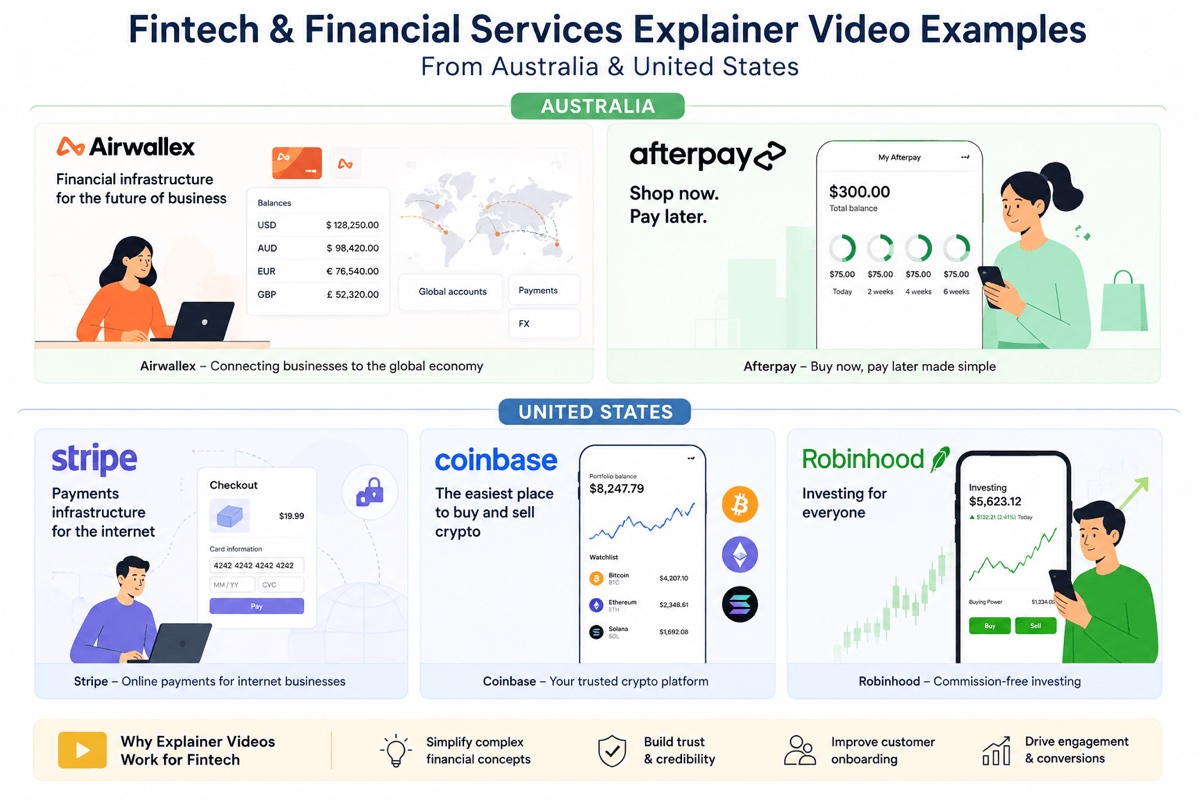
Australian fintech has produced some of the most compelling examples of animated financial services communication in recent years, driven by a regulatory environment that demands clarity and a consumer market with unusually high digital banking adoption rates relative to comparable markets.
Airwallex
Airwallex, founded in Melbourne and now valued as one of Australia's most prominent global fintech companies, used animated explainer videos extensively during its international expansion phase to communicate a genuinely complex product: multi-currency business accounts, FX conversion, and cross-border payment infrastructure, to an audience that ranged from Australian SMEs to enterprise finance teams in the United States, United Kingdom, and Southeast Asia.
The production approach combined clean motion graphics with animated UI walkthroughs, allowing a non-technical viewer to understand how a global payment moved through the Airwallex system without requiring them to understand the underlying API infrastructure. Vidico produced a widely cited animated explainer for Airwallex's Airi checkout solution, demonstrating how the same studio-quality production approach can serve both consumer-facing and enterprise-facing fintech audiences from the same visual design system.
Afterpay
Afterpay's rise from Melbourne startup to a global BNPL leader was supported by consistent use of short, clear animated video to explain the payment model to merchant partners, consumer audiences, and regulatory stakeholders simultaneously. The challenge was significant: BNPL as a category required consumer education before it could drive adoption, because the product required shoppers to adopt a new checkout behaviour they had never encountered before.
Afterpay's animated explainers broke the checkout flow into visible steps, addressed the "does this affect my credit score" question that drove consumer hesitation, and were adapted for multiple markets including Australia, the United States, and the United Kingdom with voiceover and on-screen text localisation, without requiring a re-animation for each market.
Zip Co
Zip Co, one of Australia's largest consumer credit platforms, used animated explainer videos to differentiate its product from Afterpay in a market where the two were frequently compared. The videos focused on Zip's broader product range, including Zip Pay for everyday purchases and Zip Money for larger purchases, with clear animated breakdowns of credit limits, repayment flexibility, and the application process.
The production approach used 2D character animation rather than pure motion graphics, a deliberate choice to create emotional connection with a consumer audience that was being asked to establish an ongoing credit relationship rather than make a one-off payment decision.
Commonwealth Bank and ANZ
Australia's major banks have used animated explainers extensively to communicate digital banking features to customers who might otherwise be reluctant to engage with new technology. CommBank's animated videos covering NetBank security features, international money transfers, and the CommBank app's money management tools demonstrate that traditional financial institutions face the same communication challenge as fintech startups: digital products that cannot be demonstrated physically require animation to show how they work.
ANZ's animated video communications around its Plus digital bank launch illustrated how an incumbent could use the same animation format that fintech challengers rely on to compete on clarity and accessibility rather than brand familiarity alone.
Real-World Examples: United States
The United States fintech market is the largest and most competitive in the world, which has produced some of the most refined examples of financial services animation. The examples below cover both consumer-facing and B2B fintech products.
Stripe
Stripe's animated explainer content walks viewers through how its infrastructure connects businesses and customers globally, combining clean motion graphics with technical accuracy in a way that serves both developers evaluating an API and executives approving a platform switch. Stripe's visual language, all flat illustration, dark backgrounds, and smooth motion, has influenced the visual direction of B2B fintech animation more broadly, with dozens of payment companies producing content in a similar aesthetic.
What makes Stripe's approach notable is the restraint applied to technical jargon. The animation shows data flowing between systems without ever requiring the viewer to understand the underlying request format, a discipline that most technical B2B fintech teams struggle to maintain in their own video briefs.
Robinhood
Robinhood's explainer videos center on accessibility, using energetic motion graphics and a direct voiceover to show how anyone can start investing with a few taps. The videos address the primary objection driving non-investor hesitation: that investing is too complicated, too risky, or only for people with significant capital to start. By showing the account opening flow, identity verification, and first trade placement in a clean animated walkthrough, Robinhood collapsed a process that previously required a phone call with a broker into something a viewer could visualise completing in minutes.
Coinbase
Coinbase's animated video for its One Card product used a dark, cinematic animation style with smooth transitions and controlled pacing to convey the premium and security positioning the brand needed to establish in a market where crypto custodianship is highly trust-sensitive. The visual restraint of the animation, minimal on-screen text, slow reveals, dark backgrounds, communicated security through the style of the production rather than through explicit claims, which is a significantly more credible communication strategy for a compliance-regulated financial product.
Plaid
Plaid's "How Plaid Works" animated explainer addressed one of the most significant trust barriers in consumer fintech: the question of what happens when a third-party app requests access to your bank account data. The animation showed the data handshake between a consumer app and a bank in a way that was simultaneously accurate and reassuring, demonstrating that the data accessed is limited, the connection is secure, and the user retains control at every step.
This video is widely cited in the fintech marketing community as an example of how animation can address a security concern more credibly than a written disclosure, because the visual walkthrough makes the invisible data flow tangible rather than simply asserting that it is safe.
Affirm
Affirm's merchant-facing explainer video used motion graphics to show how flexible payment options at checkout increase order values and conversion for retail partners, visually breaking down installment payment flows and customer choice touchpoints. The video targeted a B2B2C audience: merchants evaluating whether to integrate Affirm, with the consumer experience animated to show what their own customers would see.
Chime
Chime's animated explainer for its Credit Builder Secured Visa demonstrated how a consumer with no credit history or a damaged credit score could use the product to build credit without the risk of accumulating high-interest debt. The 2D character animation used relatable scenarios and a conversational voiceover to address the anxiety that surrounds credit products for underserved audiences, making it one of the more emotionally resonant fintech videos produced in the US market in recent years.
Compliance and Regulation: What to Know Before Production
All explainer videos for fintech and financial services operate in a regulated advertising environment that most other product categories do not face. In Australia, the Australian Securities and Investments Commission (ASIC) enforces advertising standards for financial product communications, including video, under the Corporations Act and the ASIC Act. In the United States, the Securities and Exchange Commission (SEC) and the Financial Industry Regulatory Authority (FINRA) govern investment-related advertising, while the Consumer Financial Protection Bureau (CFPB) covers consumer credit and payment products.
Compliance review must happen at the script stage, not after animation is complete. Any claim about investment returns, interest rates, risk levels, or product performance requires accurate disclosure language that must be reviewed by a compliance officer or legal team before the script is locked. A revision at the animation stage costs three to five times more than the same change at the script stage, and can delay delivery by weeks if a compliance-flagged claim requires structural changes to the video.
A production studio with genuine financial services experience builds compliance checkpoints into the workflow as a standard production stage, not as an optional add-on requested after the first draft is delivered. This is one of the most significant differentiators between studios that specialise in fintech and studios that treat it as a generic production category. Magic Motion Studio's fintech production process includes compliance review as a standard scripting stage for all financial services projects.
Beyond regulatory compliance, financial services videos must also navigate accuracy requirements that do not apply to most product categories. A claim that a robo-advisor "beats the market" is not just a poor creative choice: it is a potential regulatory violation. A BNPL video that implies there is "no cost" to the consumer may require a disclaimer that the cost is borne by the merchant. An insurtech video that shows a claim "paid in 24 hours" may need to specify the conditions under which that timeline applies. These are not creative decisions. They are legal ones, and they need to be made before a frame of animation is produced.
How to Brief Your Studio on a Fintech Project
A brief for explainer videos for fintech and financial services that is well-prepared before production begins is the single most reliable predictor of a project that delivers on time, within budget, and without the late-stage revisions that compliance requirements and multi-stakeholder approval processes typically generate. The checklist below covers what a fintech brief needs to contain before a production studio can begin script development.
- Define the one thing the video must make the viewer believe. Not the three features you want to communicate, not the brand values you want to reinforce. The single belief that needs to change in the viewer's mind between pressing play and clicking the call-to-action button. Every other creative decision in the video should serve that one objective.
- Identify and map your compliance approval chain before the script is written. List every stakeholder who needs to review and approve the script and storyboard before animation begins. Include your legal team, your compliance officer, your product lead, and any external regulatory consultant. A stakeholder who surfaces a compliance requirement after animation has started is the most expensive possible point of discovery.
- Specify all claims that require disclosure language. Any performance claim, rate claim, risk statement, or comparative claim must be identified in the brief so that the scriptwriter can build in accurate disclosure language from the first draft rather than retrofitting it after review. A disclaimer that appears as a legal afterthought at the end of a video damages the trust the preceding 60 seconds built. Disclosure language integrated into the narrative reads as transparency rather than fine print.
- Confirm which markets the video will be used in before the script is finalised. A video produced for the Australian market under ASIC guidelines may require different disclosure language or different claim framing to be compliant in the United States under SEC or CFPB guidelines. If a multilingual or multi-market version is planned, confirm this before the English script is locked so the source file architecture and visual design can support adaptation.
- Agree on the visual style before providing access to brand assets. Share a visual brief that includes competitor videos you want to reference, a description of the emotional tone you want the viewer to leave with, and any brand restrictions around colour, typography, or character design. The more specific the visual brief, the fewer design revision rounds are required before animation begins.
- Confirm source file delivery and update rights before signing a production agreement. Financial regulations change. Product features change. Interest rates change. A fintech video that cannot be updated without a full re-production becomes a liability the moment its underlying content needs revision. Ensure the production agreement specifies that source files are delivered with the final video and that the studio can be commissioned for targeted updates without restarting the full production process.
Where to Place Fintech Explainer Videos for Maximum Impact
Producing explainer videos for fintech and financial services and placing them only on a YouTube channel is one of the most common distribution mistakes in the category. The placement strategy should be determined during the brief stage, not after the video is delivered.
For consumer-facing fintech products, the highest-priority placement is the product landing page, above the fold, with the video set to autoplay muted. Research consistently shows that landing pages with embedded video convert at significantly higher rates than text-only equivalents, and the effect is strongest for complex financial products where a viewer cannot evaluate the product without first understanding how it works. The second-highest-priority placement is onboarding: a welcome video triggered at the first login or after account creation reduces the volume of support queries a new user generates and improves the activation rate for key product features.
For B2B fintech products, the highest-priority placements are the sales deck, the product page, and the conference or tradeshow booth. A 90-second animated overview of a B2B payment platform or regtech solution running on a screen behind a booth conversation gives a sales team a reference point for the most common product questions without requiring the salesperson to interrupt their conversation to pull up a demo environment.
For both consumer and B2B contexts, LinkedIn has consistently outperformed other social platforms for fintech video distribution in the Australian and US markets. Short-form versions of product explainers, 30 to 45 seconds, perform well as paid LinkedIn video ads targeting specific job titles in financial services, with click-through rates in the finance vertical averaging 6.35% against a cross-industry average of 5.1% according to Softjourn's fintech statistics report.
For startups preparing an investor pitch or Series A raise, a 60 to 90-second product explainer video placed at the top of an investor deck outperforms the alternative of asking an investor to read a product description before the demo. For a deeper look at how animation supports fundraising, see our guide to explainer videos for startups and investors.
Frequently Asked Questions
Fintech companies use explainer videos because their products are digital, invisible, and trust-sensitive. A neobank account, a robo-advisor algorithm, or a B2B payments API cannot be demonstrated physically. Animation gives production teams full control over visualising how the product works, what problem it solves, and why a user should trust it with their money. Explainer videos also address the trust deficit every fintech faces when competing against established financial institutions with decades of brand recognition. Research from Vidico shows 91% of businesses now use video as a marketing tool, with financial services among the fastest-growing adopters.
Motion graphics is the most widely used animation style in fintech because it handles data flows, UI animations, and abstract financial concepts without requiring character design. Clean motion graphics with app interface animation works for payment platforms, BNPL checkouts, and B2B API explainers. 2D character animation works better for consumer-facing products, particularly neobanks and consumer credit products, where emotional engagement drives the adoption decision. For premium positioning in crypto, wealthtech, and enterprise fintech, a 3D or isometric animation style communicates technical credibility in a format that motion graphics and 2D do not replicate easily.
Consumer-facing fintech explainer videos perform best at 60 to 90 seconds. Videos under 60 seconds generate 2.5 times more engagement per impression than longer formats, making that length ideal for social media and paid advertising. B2B fintech videos aimed at enterprise buyers can run 90 to 120 seconds when technical detail justifies the additional length. Onboarding and tutorial videos inside a product can run up to 3 minutes for multi-step processes that users are actively working through. Prioritise the shortest length that fully answers the viewer's primary question, as completion rates drop significantly beyond the 90-second mark in all fintech contexts.
Yes, and the compliance review must happen at the script stage, not after animation is complete. Financial services video content is subject to advertising standards and disclosure requirements enforced by ASIC in Australia and the SEC and FINRA in the United States. Any claim about investment returns, risk levels, or product performance requires accurate disclosure language reviewed by a compliance officer before the script is locked. Requesting compliance review after animation has begun is one of the most common causes of budget overruns and delivery delays in fintech video production. Magic Motion Studio builds compliance checkpoints into the scripting stage as a standard workflow stage for all fintech video projects.
The highest-priority placements for consumer fintech are the product landing page above the fold, the post-signup onboarding sequence, and paid social advertising on Meta and LinkedIn. For B2B fintech, the sales deck, the product page, and conference displays are the primary placements. Landing pages with embedded video convert at 86% higher rates than text-only equivalents, making homepage placement the first priority for any new fintech explainer video. YouTube functions as a long-term organic discovery channel rather than a primary conversion placement for most fintech products.
An animated fintech video can be adapted for multiple markets more efficiently than a live-action equivalent because the visual layer remains unchanged between language and locale versions. Voiceover is re-recorded, subtitles are swapped, and any on-screen text referencing region-specific regulators, currency symbols, or product names is updated in the source file. This makes animation the most cost-effective format for fintech companies operating across Australia, the United States, and other markets simultaneously. Magic Motion Studio serves clients in both markets with local account management in Melbourne and project team coverage in New York.
Fintech explainer video cost depends on animation style, video length, revision rounds included, and whether compliance review, multilingual adaptation, or multiple format exports are required. Magic Motion Studio publishes fixed-price packages for all production tiers. See our explainer video pricing page for full package details. Most clients receive a scoped production estimate within 24 hours of submitting a brief.
Choosing the Right Production Partner for Fintech
The market for explainer videos for fintech and financial services has matured significantly since 2020, and the distinction between studios that genuinely understand financial services and studios that treat it as a generic product category is now visible in the output. The most reliable differentiator is not the quality of the studio's showreel, but the structure of their production process: whether compliance review is built into the workflow as a standard stage, whether they have experience coordinating multi-stakeholder approval across legal, product, and marketing teams, and whether they deliver source files that allow a financial institution to commission targeted updates when product features or regulatory requirements change.
For companies in both the Australian and US markets, the additional consideration is whether the studio has production experience in both regulatory environments. An Australian studio that understands ASIC disclosure requirements but has no experience with SEC and FINRA standards will produce a video that works in one market and requires significant rework for the other. The most efficient path for a fintech company with a dual-market presence is a studio that has produced compliance-reviewed animated content for both markets and can manage the regulatory nuances of each without briefing from the client's legal team at every stage.
If you are comparing options, our guide to the best explainer video companies in Australia covers what to look for in a production partner specifically for the Australian fintech market. For healthcare financial services and SaaS products with similar trust and compliance considerations, the production principles covered in our guides to explainer videos for healthcare and explainer videos for SaaS companies apply directly to fintech contexts as well.
Fintech Animation Built for Trust and Conversion
Compliance-safe explainer videos for fintech and financial services companies across Australia and the United States. Fixed pricing, 14-business-day delivery, source files included as standard.
Related Guides
Further reading for teams producing explainer videos for fintech and financial services or adjacent regulated product categories:
- What Is an Explainer Video? Types, Styles and Examples
- What Is 2D Animation? Complete Guide for Businesses
- 2D Animation Studio: Character Animation & Motion Graphics
- Explainer Video Examples That Convert: 12 Real-World Results
- How to Measure Explainer Video ROI
- How Much Does an Explainer Video Cost in Australia?
- Explainer Videos for SaaS Companies
- Explainer Video Storyboard: What to Expect