
Explainer Videos for Startups and Investors: The Complete Guide (2026)
Explainer videos for startups and investors are frequently treated as one asset, but they serve two different audiences with two different jobs. A startup explainer video is customer-facing and needs to make a product clear enough to drive signups or sales. An investor pitch video is fundraising-facing and needs to cover the problem, market, business model, traction, team, and ask, calibrated to a specific funding stage. Data from DocSend shows investors spend an average of 3 minutes and 44 seconds reviewing a full pitch deck, so a pitch video needs to earn attention fast. This guide covers both tracks in full, plus fundraising-stage differences, distribution, and how to brief a studio for either type of video.
Search results for explainer videos for startups and investors reveal a consistent pattern: most guides pick one audience and ignore the other. A page written for customer-facing explainer videos will mention investors once in the title and never again in the body. A page written for fundraising pitch videos will cover problem-solution-traction and stop there, with no acknowledgement that a startup often needs a completely separate video for its actual customers. Founders searching this exact phrase are usually trying to solve both problems at once, and no single page in the search results currently does that.
This guide is built to cover both. The first half addresses the customer-facing explainer video, the asset that sits on a homepage, a Demo Day landing page, or an app store listing. The second half addresses the investor pitch video specifically, including a timestamped structure, fundraising-stage differences, and exactly where and how investors actually encounter these videos in practice.
The stakes for getting this right are higher than founders often assume before their first raise. Research from HubSpot's video marketing research consistently finds that businesses using video communicate complex ideas faster and retain more audience attention than those relying on text or static slides alone, which matters enormously in a fundraising process where an investor's attention is the scarcest resource in the room. A founder who treats video as an afterthought is competing against founders who do not.
Sources: Wyzowl Video Marketing Statistics 2026; DocSend investor engagement data; Crowdcube campaign data.
Two Audiences, One Common Mistake
Most founders searching for explainer videos for startups and investors are quietly trying to solve two different problems with one video. A customer does not care about your total addressable market. An investor does not care about your onboarding flow.
Treating these as the same script produces a video that half-satisfies both audiences and fully satisfies neither.
The two tracks differ in almost every dimension that matters for a script: audience, goal, length, and what "success" looks like at the end of the video. A founder who understands this split before briefing a studio saves an entire revision round, since a script written without a clear audience in mind almost always needs to be rebuilt once the confusion surfaces in the first draft.
| Dimension | Startup Explainer Video (Customers) | Investor Pitch Video (Fundraising) |
|---|---|---|
| Audience | Prospective users or buyers | VCs, angels, or crowdfunding backers |
| Core question answered | "What does this do and why should I use it?" | "Is this a business worth funding?" |
| Typical length | 30 – 90 seconds | 90 seconds – 5 minutes |
| Required content | Problem, product, one clear CTA | Problem, market, product, business model, traction, team, ask |
| Success metric | Signup, purchase, or engagement | A follow-up meeting or a term sheet |
Track 1: Explainer Videos for Startup Customers
Explainer videos for startups aimed at customers follow the same fundamentals as any product explainer video, with one added constraint: a startup usually has no brand recognition to lean on, so the video is doing more persuasive work per second than an established company's video needs to.
Homepage / Landing Page
The most common placement. Needs to establish what the product does and why it matters within the first five seconds, before a visitor with no prior context decides whether to keep reading.
45 to 90 seconds, problem-first opening, one clear CTA.
Launch / Demo Day
Built for a specific launch moment, a Product Hunt debut, an accelerator Demo Day, or an app store listing. Needs to work with zero context and often with sound off, since these platforms are usually browsed silently.
30 to 60 seconds, captioned, built to stand alone with no surrounding explanation.
Social and Paid Acquisition
Shorter cuts of the core explainer used for LinkedIn, paid social, or early-stage growth experiments where budget and audience patience are both limited.
15 to 30 seconds, hook in the first three seconds, sound-off design.
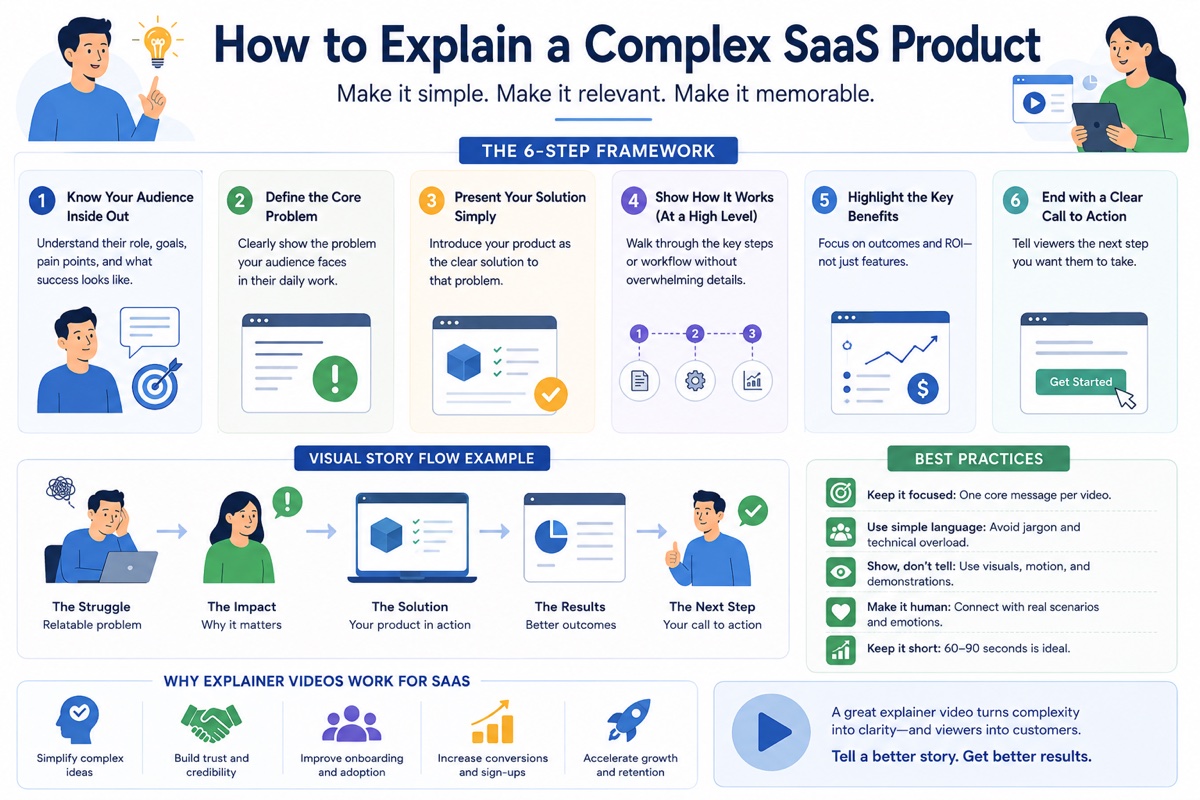
The scripting discipline covered in our guide on what an explainer video actually is applies directly here: open with the problem, not the company name, and give the video exactly one job rather than trying to cover every feature in a single 60-second cut.
A Worked Example
Using the same hypothetical logistics startup from the pitch video example later in this guide, here is how the customer-facing version of the story changes for a retailer evaluating the product directly, rather than an investor evaluating the business:
- Hook (0 to 4 seconds): "You know that feeling when a customer asks where their order is, and you have no real answer." Visual shows a support inbox filling with the same question from different customers.
- Problem (4 to 15 seconds): The cost of not knowing: refund requests, lost repeat customers, and support hours spent on a question the retailer cannot actually answer.
- Solution (15 to 45 seconds): A single dashboard resolves the exact question, live shipment status a retailer can check or forward to a customer in seconds, shown as an actual workflow rather than a feature list.
- CTA (45 to 55 seconds): "Start tracking your shipments today," matched to the funnel stage the video serves, a homepage placement asking for a signup rather than a generic "learn more."
Compare this to the investor version of the same underlying business, covered next: the market size, business model, and traction that matter enormously to an investor are entirely absent here, because a retailer deciding whether to sign up does not need any of them. The same company, the same product, but two scripts built around what each specific viewer actually needs to know.
Track 2: Pitch Videos for Investors
An investor pitch video is a different deliverable entirely, and it needs to survive a much harsher attention environment than a customer-facing video does. Per DocSend's investor engagement data, the average full pitch deck gets roughly 3 minutes and 44 seconds of an investor's attention, spread across every slide, which means a pitch video competing for a slice of that same window has to justify every second it uses.
A Timestamped Framework
The strongest investor pitch videos follow a consistent structure, adapted here into a clear timestamped framework for a 3-minute video, long enough to cover every required element without losing the investor's attention before the ask.
| Timestamp | Section | What It Covers |
|---|---|---|
| 0:00 – 0:20 | Hook | The specific problem, stated with urgency, before the company name appears |
| 0:20 – 0:50 | Market | Market size and why now is the right moment for this solution |
| 0:50 – 1:30 | Product | What the product does, shown rather than described wherever possible |
| 1:30 – 2:00 | Business model | How the company makes money, stated simply and directly |
| 2:00 – 2:30 | Traction and team | Metrics, milestones, and the credibility of the people executing |
| 2:30 – 3:00 | The ask | What is being raised and what it will be used for, stated plainly |
Every section above should be scripted with the assumption that an investor may stop watching at any point, which is why traction and team sit before the ask rather than after it: an investor who has seen credible numbers and a credible team is far more receptive to the ask than one who reaches it cold.
A Worked Example
To make the framework concrete, here is how it plays out for a hypothetical seed-stage logistics startup raising a round:
- Hook (0:00 to 0:20): "Every year, small retailers lose a combined nine figures in revenue to shipping delays they have no visibility into." Visual shows a delayed package and a retailer refreshing a tracking page with no update.
- Market (0:20 to 0:50): A simple animated chart establishes the size of the small-retailer shipping market and why current tracking tools fail them, without dwelling on the number for longer than the point requires.
- Product (0:50 to 1:30): Real product footage or a close animated recreation shows the dashboard resolving the exact problem named in the hook, one specific workflow, not a full feature tour.
- Business model (1:30 to 2:00): A single sentence on how revenue is generated, stated plainly enough that a non-technical investor understands it on first hearing.
- Traction and team (2:00 to 2:30): Specific, real numbers, not vague growth language, paired with a brief note on why this founding team is positioned to execute.
- The ask (2:30 to 3:00): The exact amount being raised and the two or three specific things it funds, stated directly with no hedging.
Notice that the product beat does not attempt a full walkthrough. It shows one workflow tied directly to the problem named in the hook, the same discipline that applies to customer-facing explainer videos, just recalibrated for an audience evaluating a business rather than a purchase.
Need Explainer Videos for Your Startup and Your Next Raise?
Magic Motion Studio produces both customer-facing and investor-facing videos, scripted separately for each audience. Get a scoped quote in 24 hours.
Pitch Videos by Fundraising Stage
A pitch video script needs to change as a company moves from an idea to a business with real metrics. Reusing the same video across every round under-sells whatever progress has been made since the last raise, and investors evaluating a Series A round from a founder still pitching pre-seed vision language will read it as a gap in self-awareness about how far the company has actually come.
Pre-Seed
The product may not exist in a demonstrable form yet, so the video leans on the size and urgency of the problem and the founder's personal credibility to work on it.
Problem, founder-market fit, and vision, since traction data is usually thin or absent.
Seed
Early traction exists, and the video should show it directly: user growth, early revenue, or engagement signals that prove the problem-solution fit is real.
Early metrics and product demonstration, balanced with continued market-size framing.
Series A / B
Investors at this stage are evaluating whether the business model works at scale, not whether the idea is worth trying. Traction and unit economics carry the video.
Metrics, growth trajectory, and a credible plan for what the new capital scales.
Where Investors Actually See the Video
A well-produced pitch video only works if it reaches the investor at the moment they are actually paying attention. These are the placements that matter most, in order of how much control a founder has over them.
- Embedded in a data room. Tools such as DocSend let a founder track exactly how long an investor spends on each slide, including a video slide, which turns the pitch video into a measurable asset rather than a one-way send. This tracking data is also useful after the fact: if investors consistently drop off at the same slide, that slide is the one to revise before the next round of outreach.
- Linked from the cover slide of the deck. Placing the video link on the very first slide means it is the first thing an investor sees, before they have formed any impression from the slides that follow. A QR code on a printed or PDF version serves the same purpose for in-person pitch events.
- Embedded directly in the warm-intro email. A video embedded in the email itself gets watched far more often than one attached as a separate file the recipient has to download and open. Keep the embedded thumbnail specific to the pitch, not a generic company logo, since a compelling thumbnail measurably increases play rate.
- Public platforms for visibility. AngelList and Crunchbase profiles benefit from an embedded pitch video for inbound interest, though these placements typically produce lower-intent attention than a direct warm introduction.
Common Mistakes With Explainer Videos for Startups and Investors
These are the mistakes that show up most often in explainer videos for startups and investors, whether the video is aimed at customers or at fundraising audiences.
One video trying to serve both audiences
A video that opens with market size for investors and then pivots to a feature walkthrough for customers satisfies neither. Each audience needs a script built around what they specifically came to learn. This mistake usually happens because a single video feels more budget-efficient than two, but the lost persuasive power on both ends costs far more than the second script would have.
Script and produce these as two separate deliverables, even if they share visual style, characters, and brand identity from the same production round. The shared visual identity keeps costs reasonable while the separate scripts keep each video sharp.
Burying the ask
Pitch videos that end with vague language like "we'd love to talk more" instead of a specific funding amount and use of funds leave investors unclear on what is actually being requested.
State the raise amount and what it funds directly and plainly in the final section, after traction and team have already built credibility.
Leading with the team before the problem
Founder bios matter, but opening with them before establishing why the problem matters gives an investor no reason yet to care who is solving it.
Establish the problem and its urgency first. Team credibility lands harder once the investor already understands what is at stake.
No captions on either video type
Investors reviewing decks in a data room frequently do so without sound, and Demo Day or app store viewers are often browsing silently as well. An uncaptioned video loses its message in both contexts.
Burn in captions on every version of both video types, so the core message survives regardless of sound settings.
Reusing a pre-seed pitch video at a later stage
A pitch video built when the company had no traction stops being credible once real metrics exist. Continuing to use it under-represents the actual progress made, and an investor who researches the company beforehand may notice the video predates numbers the company now has.
Re-script around the same visual identity at each new raise, shifting emphasis from vision toward traction as the company matures, so the video always reflects the strongest version of the current story rather than an outdated one.
Skipping a script draft and going straight to filming
Founders comfortable speaking about their company sometimes skip the script stage entirely, assuming they can improvise a clear pitch on camera. The result is usually a video that runs long, wanders off the core points, and buries the ask somewhere in an unstructured monologue.
Write and time the script before any filming or animation begins, even for a founder-led video. A tightly written 90-second script almost always outperforms an unscripted three-minute recording, regardless of how comfortable the founder is on camera.
How to Brief Your Studio on Either Video Type
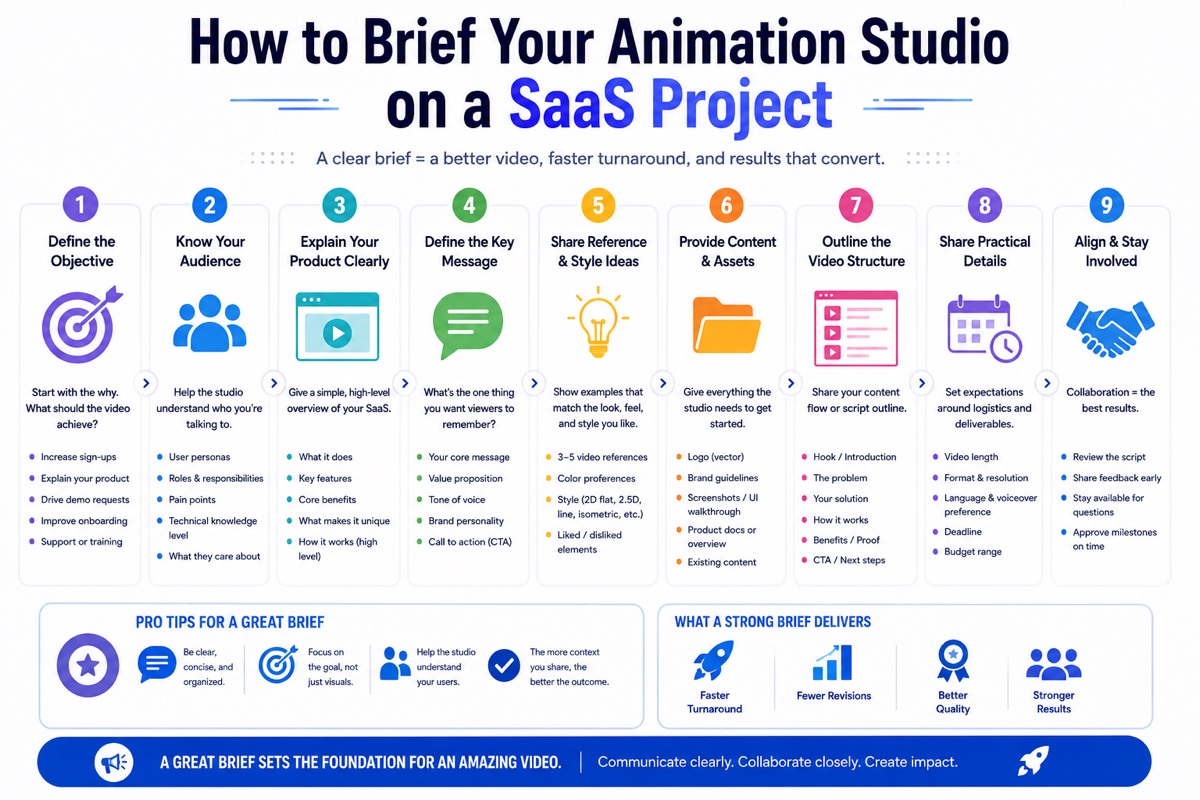
The brief looks different depending on which track you are commissioning, but both benefit from the same underlying discipline: clarity on audience and goal before any visual concept is discussed.
Name the Audience Explicitly
Tell the studio whether this video is for customers, investors, or both as separate deliverables. This single decision shapes the entire script structure.
Share Your Actual Metrics and Fundraising Stage
For a pitch video, give the studio your real traction numbers and current round, so the script emphasises what genuinely matters at your stage rather than a generic template.
Decide the Length Per Placement
A data room cut, an email-embedded cut, and a social cut of the same pitch video often need different lengths. Plan these cutdowns before production starts.
Approve the Script Before Storyboarding
Every structural decision should be locked at the script stage. Our guide on the explainer video storyboard process covers what happens between script approval and the first frame of animation, in a pipeline built on a Toon Boom Harmony studio workflow.
The single most useful thing a founder can hand a studio before kickoff is not a mood board, it is a clear answer to who this video is for and what decision it needs to move. To understand the full path from brief to final delivery, our explainer video production guide walks through the entire process.
Frequently Asked Questions
A startup explainer video is built for customers and users, and its job is to make a product or service easy to understand so someone signs up, buys, or engages. An investor pitch video is built for a completely different audience evaluating a completely different decision: whether to write a check. It needs to cover the problem, the market, the business model, traction, the team, and the ask, none of which belong in a customer-facing explainer video. Explainer videos for startups and investors are frequently treated as the same asset, but the strongest fundraising results come from treating them as two distinct deliverables with two distinct scripts.
Most effective investor pitch videos run between 2 and 5 minutes. Data from DocSend shows the average investor spends only 3 minutes and 44 seconds reviewing a full pitch deck, with roughly 15 to 22 seconds per slide, so a video significantly longer than that window will lose attention before the ask is reached. A 90-second to 2-minute cut works best for a cold email or a data room landing page, while a fuller 5-minute version suits a scheduled call where the investor has already committed time.
Video is not a substitute for a strong business, a real market, and clear traction, but it does measurably improve how a pitch is received. Crowdcube, the equity crowdfunding platform, has reported that campaigns with video raise more than twice the average of those without one. A well-produced video also helps a deck travel further: partners forward decks with video attached more readily than static PDFs, because video communicates founder credibility and product clarity faster than slides and bullet points alone.
No. A pre-seed pitch video should focus on the size and urgency of the problem, since the product may not exist yet in a demonstrable form, and the founder's credibility carries a larger share of the persuasion. A Series A or B pitch video should lead with traction and metrics, since by that stage investors are evaluating whether the business model works at scale rather than whether the idea is worth trying. Reusing a pre-seed script at a later stage under-sells the progress a company has actually made.
The most effective placements are inside a data room or deck-sharing tool such as DocSend, embedded directly in a warm-intro email rather than attached as a separate file, and linked from the cover slide of the pitch deck itself so it is the first thing an investor sees. Public platforms such as AngelList and Crunchbase are useful for visibility and inbound interest, but the highest-intent placements remain the ones a founder controls directly: the data room and the introduction email.
Cost depends on length, animation style, and how much of the video relies on custom illustration versus founder-recorded footage. Rather than a single fixed figure, most studios scope a quote based on the specific brief, including script development, storyboard revisions, voiceover, and delivery formats. You can request a custom quote for a startup pitch or explainer video project and receive a scoped estimate within 24 hours.
Two Videos, One Production Partner
Most content on this topic collapses two distinct problems into one page and leaves founders to figure out the difference themselves. Explainer videos for startups and investors deserve separate scripts, separate structures, and often separate lengths, even when they are produced in the same round and share the same visual identity. Getting this distinction right before a studio starts writing is the difference between a video that half-works for two audiences and two videos that each do their job completely.
At Magic Motion Studio, every project starts with a direct answer to one question: who is this video actually for. If you are planning your first startup explainer video, preparing a pitch video ahead of a raise, or need both as separate deliverables from the same production round, our team can walk you through what that looks like before you commit to a scope.
Once the customer-facing video is live, do not stop at publishing it. Track whether it is actually converting visitors, since a video that looks polished but does not move a landing page's conversion rate needs revision before more budget goes toward promoting it. Our guide on how to measure explainer video ROI covers the exact tracking setup for that half of the equation. The pitch video's success metric is simpler to observe but harder to control: whether it earns a follow-up call, which is precisely why the DocSend tracking data covered earlier in this guide matters, it turns an untracked pitch video into one with a measurable read rate.
Built for Customers and Capital
Explainer videos for startups and investors, scripted separately for each audience. Custom production for founders across Australia and the US.
Related Guides
Further reading for founders and fundraising teams producing explainer videos for startups and investors:
- What Is 2D Animation? Complete Guide for Businesses
- 2D Animation Studio: Character Animation & Motion Graphics
- Explainer Video Examples That Convert: 12 Real-World Results
- Explainer Videos for Pitch Decks
- How to Measure Explainer Video ROI
- How Much Does an Explainer Video Cost in Australia?
- Explainer Video Storyboard: What to Expect