
2D Animation Services in Austin: The Complete 2026 Guide
Professional 2D animation services in Austin cover six core styles, motion graphics, flat vector character animation, screen-capture hybrid, whiteboard, kinetic typography, and frame-by-frame, at price points below San Francisco and New York with comparable quality. A professionally produced 60-second animated video for an Austin tech company costs between $3,500 and $15,000. Austin's unique position as the US capital of Physical AI, where software companies and hardware manufacturers operate side by side, creates animation demands that no other major US market shares. This guide covers every style, verified Austin pricing, the full production process, and how Austin's six key industries use 2D animation differently.
Austin is unlike every other US tech city. It is simultaneously a world-class software and SaaS ecosystem, a major semiconductor and hardware manufacturing hub, a clean energy center, and the fastest-growing major metropolitan area in the country. That combination creates demand for 2D animation services that spans a broader range of industries and technical communication challenges than any comparable market.
Whether you are a Series A SaaS startup preparing for Demo Day, a semiconductor company explaining chip architecture to investors, a clean energy firm visualising grid infrastructure, or a defense tech company communicating systems capability to government partners, 2D animation is the format that makes invisible technology visible and complex processes clear. This guide gives you the complete framework for commissioning it in Austin.
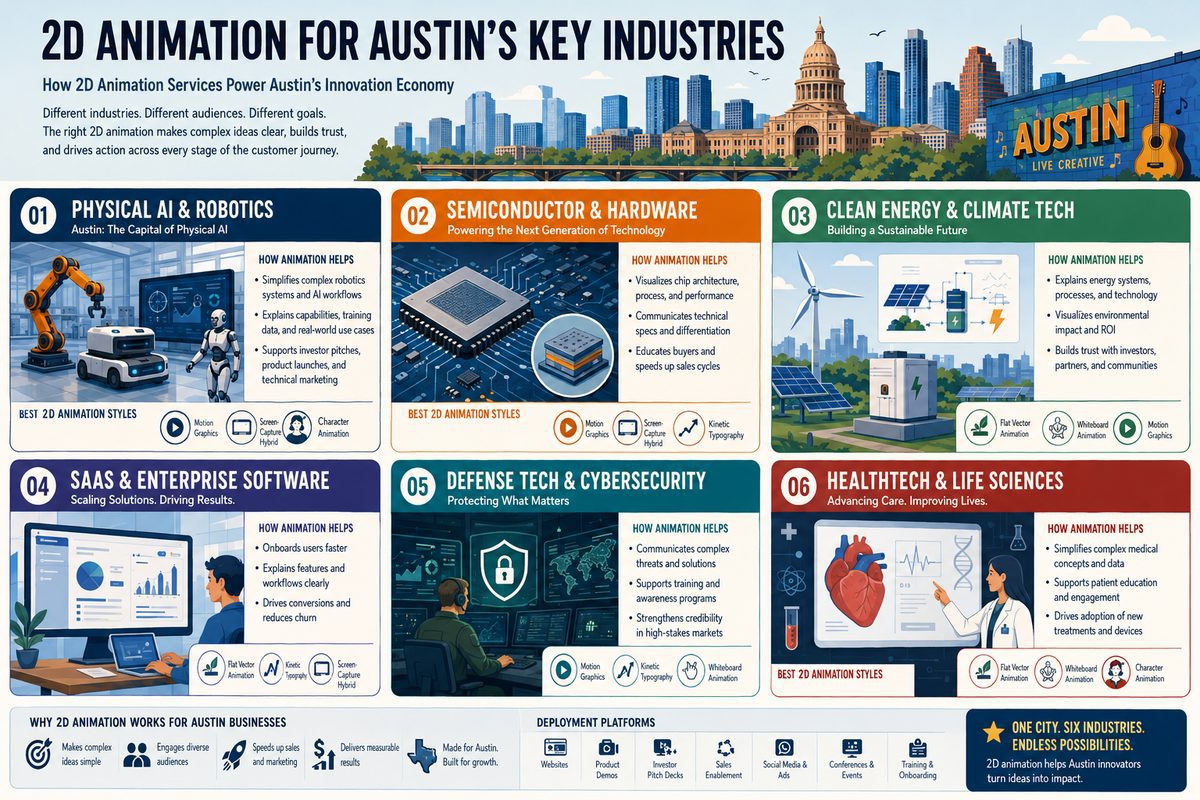
What Is 2D Animation? (And Why It Works for Austin's Mix of Software and Hardware Companies)
2D animation creates movement in a two-dimensional flat plane using illustrated characters, backgrounds, icons, and text. Unlike 3D animation, which builds dimensional models in virtual space, 2D animation exists on a flat canvas, giving it a distinctive visual clarity, faster production timelines, and significantly lower cost at comparable creative quality.
The term covers a wide range of formats, from simple motion graphics to full custom character animation, and the right choice depends heavily on what you are trying to communicate. For Austin companies specifically, this choice is shaped by a factor that does not exist at the same scale in San Francisco, Miami, or Chicago: the coexistence of software intelligence and physical hardware manufacturing in the same metro economy.
Why Austin Companies Choose 2D Animation Over Live-Action
Live-action video requires physical locations, actors, filming crews, scheduling coordination, and post-production workflows that can take months. More importantly for Austin's dominant industries, live-action cannot show what these products actually do:
- You cannot film a machine learning model making a real-time decision
- You cannot photograph a semiconductor chip communicating its processing advantage
- You cannot shoot a solar grid managing distributed energy loads during a peak demand event
- You cannot record a cybersecurity system detecting and responding to a threat vector
2D animation has no such constraints. Motion graphics and flat 2D illustration make all of these processes visible, accurate, and immediately understandable to the audience that needs to act on that understanding. For Austin's blend of software-first startups and hardware-first manufacturers, 2D animation services are not a creative preference. They are the technically correct communication format.
Austin's Unique Animation Demand: Where Software Meets Physical AI
No major US city has Austin's specific combination of software intelligence and physical hardware scale operating simultaneously in the same metropolitan economy. Understanding this context is essential for understanding what 2D animation in Austin needs to accomplish and why the brief for an Austin animation project differs from a brief for a San Francisco or Miami company.
Source: Austin Today: Austin startup funding surges to record $7.19B in 2025; American Growth Project 2025; McCombs School of Business / UT Austin 2025.
Austin Is the US Capital of Physical AI in 2026
In 2026, Austin has cemented its position as the world's premier destination for Physical AI, the point where high-level software intelligence meets massive hardware manufacturing at scale. Tesla's Gigafactory Texas operates alongside the Cortex AI supercluster, one of the world's most powerful AI training facilities. Samsung's $17 billion semiconductor plant in nearby Taylor produces chips for 5G and AI applications. ARM has expanded its Austin presence twice in 2025 and 2026. Dell employs approximately 14,000 people in the metro. Apple, Amazon, IBM, and Google maintain thousands of employees each.
This convergence creates animation communication challenges that do not exist at scale anywhere else: companies need to explain both the software intelligence and the physical hardware in the same communication environment, often to the same audience. A pure motion graphics studio that specialises in SaaS explainers may not be equipped to handle semiconductor process visualisation. A 3D studio that handles hardware product renders may not produce the sharp, fast-paced motion graphics that AI platforms need for investor communication.
Austin's startup funding by sector in 2025 reflects this breadth: AI and ML attracted 32% of all capital, HealthTech captured 24%, Fintech drew 18%, and Robotics and advanced manufacturing took 15%. No other major US city generates animation briefs across all six of these categories simultaneously at significant volume. Understanding your sector's specific animation needs, and finding a studio that has produced credibly in that sector, is more important in Austin than in any comparable market.
The 6 Types of 2D Animation Services Austin Companies Commission Most
The choice of animation style determines the budget, timeline, and performance of any production. Here are the six 2D animation styles most commonly commissioned by Austin companies, with verified pricing and the specific Austin industry use cases where each performs best.
Animated shapes, text, data, and icons in motion without characters or narrative. The single most versatile format in Austin's diverse market, equally effective for explaining AI model architecture, semiconductor supply chain logistics, SaaS platform features, and clean energy grid management. Performs strongly without audio, which matters for LinkedIn auto-play and conference display environments where Austin companies are frequently active.
Custom-illustrated characters with expressive movement in a clean, modern flat design aesthetic. The standard format for Austin's Series A and B companies building their first major brand investment. Characters and visual assets built for the first video become reusable brand infrastructure across all subsequent productions at 30 to 50% lower per-video cost. The highest-recall format for B2B SaaS and consumer tech brands seeking emotional connection alongside technical explanation.
Real product UI screen recordings combined with motion graphics overlays, animated callouts, and professional voiceover. The most cost-effective format for software products with an existing visual interface. Particularly well-suited to Austin's enterprise software sector: Dell Technologies, IBM, and the broader enterprise SaaS companies headquartered or operating from Austin produce significant volumes of screen-capture hybrid content for internal training, product updates, and customer onboarding.
Simulated hand-drawing on a clean white background. The educational, authoritative visual tone performs well for compliance explanations, clinical trial information, regulatory submissions, and technical training content. Austin's HealthTech and life sciences sector uses whiteboard animation for patient education videos, clinical pathway explanations, and medical device regulatory communication, contexts where the academic register of whiteboard animation adds credibility that character-driven styles do not.
Text as the primary visual element, choreographed to voiceover or music. The most affordable professional animation format and the strongest performer without audio. Widely used for SXSW conference content, Austin startup event presentations, brand manifesto videos, and LinkedIn campaign ads where the message itself carries the creative. For early-stage Austin startups managing tight budgets while preparing for Demo Day or investor meetings, kinetic typography delivers high-impact professional output at the lowest cost.
Every frame individually illustrated, the most labor-intensive and highest-quality 2D format. Produces fluid, organic movement with a hand-crafted aesthetic that signals premium brand investment. Rarely the right choice for standard B2B technology communication, but appropriate for entertainment IP, premium consumer campaigns, and brand films where production quality itself communicates brand values. Austin's entertainment and music industry, the Live Music Capital of the World, generates the most demand for this format locally.
2D Animation Pricing in Austin: What to Budget in 2026
Austin's 2D animation market is priced meaningfully below San Francisco and New York for equivalent quality output. The primary driver is studio overhead: Austin studios do not carry coastal commercial real estate premiums or the talent cost inflation that SF and NYC markets generate. Austin's creative talent pool, supported by UT Austin's fine arts, design, and computer science programs and the city's deep entertainment and music industry history, is competitive with any US market. For companies comparing providers across cities, Austin represents one of the best-value professional animation markets in the country.
| Style | Austin Market Price (per min) | 60-sec Project Estimate | Timeline |
|---|---|---|---|
| Kinetic Typography | $1,000 – $3,500 | $1,800 – $5,000 | 1 – 2 weeks |
| Whiteboard Animation | $1,500 – $4,000 | $2,500 – $6,000 | 1 – 3 weeks |
| Screen-Capture Hybrid | $1,800 – $5,000 | $2,800 – $7,000 | 2 – 3 weeks |
| Motion Graphics | $1,200 – $5,000 | $2,500 – $8,000 | 2 – 4 weeks |
| Flat / Vector 2D Character | $3,000 – $10,000 | $5,000 – $15,000 | 3 – 6 weeks |
| Frame-by-Frame Traditional 2D | $7,000 – $18,000+ | $12,000 – $28,000+ | 6 – 14 weeks |
Source: Pixune Animation Cost Guide 2026; Austin Visuals pricing benchmarks; Vidico 2026 animation pricing data. Highlighted rows represent the most commonly commissioned formats for Austin B2B tech companies.
What Drives 2D Animation Cost Up or Down in Austin
- Technical accuracy requirements: For semiconductor and hardware companies requiring engineering approval of animation accuracy, add one production review stage that typically adds 3 to 5 business days and 10 to 15% to total cost
- Number of animated characters: each additional character adds 15 to 25% to flat 2D production cost
- Background complexity: animated parallax environments add 30 to 50% over static illustrated backgrounds
- Multiple language versions: English plus Spanish (relevant for Austin's significant Hispanic business community) adds approximately 30 to 40% over single-language production
- Revision scope: revisions beyond included rounds add 10 to 20% per additional round, agree on revision counts in writing before signing
- Rush delivery: expedited timelines under 10 business days typically carry a 20 to 30% premium
The 8-Step Production Process: From Brief to Final Delivery
Every professional 2D animation studio follows the same core production sequence. Knowing what happens at each phase and what decisions must be locked before the next phase starts protects your timeline, prevents costly late revisions, and ensures all internal stakeholders are aligned before production money is committed.
Target audience, core message, desired viewer action, animation style direction, brand guidelines, distribution platform, and any technical accuracy requirements. For Austin hardware and semiconductor companies, the brief must specify whether animation content requires engineering sign-off, because this adds a review stage that must be built into the production timeline from day one, not retrofitted after animation is already produced.
Professional scriptwriting at 130 to 150 words per 60 seconds at natural voiceover pacing. For Austin's technically complex industries, the script must explain accurately without oversimplifying, a semiconductor process, an AI decision pathway, or a clean energy grid management system each requires a writer who can handle technical source material and translate it into audience-appropriate language. Approving the script carefully is the most important revision decision in the production. Script revisions are free. Post-animation revisions are expensive.
Visual mapping of every scene, character position, on-screen text, and transition before any artwork begins. The storyboard is the highest-leverage revision point in the production, changes here take hours; the same changes after animation is produced take days. For Austin companies with multiple internal stakeholders including technical, marketing, and executive reviewers, the storyboard review is the correct alignment moment. All parties should approve the storyboard before illustration begins.
Voice talent selection from a curated roster matched to product category, target audience, and brand tone. The animation is timed and synchronised to the approved voiceover, so this stage must be locked before animation begins. For Austin companies addressing both technical and non-technical audiences simultaneously, voiceover tone is a critical decision: an AI platform selling to enterprise CISOs needs a different voice register than a consumer HealthTech app targeting individual patients.
Static illustrations of 2 to 3 key scenes establishing the complete visual language: color palette, character design, typography, background style, and motion graphic elements. Style frames are the final creative checkpoint before full illustration production begins. Approving style frames carefully locks the visual direction for the entire video. Changes to visual direction after this stage are the most time-consuming and expensive revisions in the process.
Every background, character, icon, and on-screen element is built as a production asset. For flat 2D character animation, this includes character expression sheets, body position libraries, and rig construction. For motion graphics, this covers icon design, data element creation, and scene composition. All assets are built as reusable components, a first production creates the visual brand infrastructure that every subsequent video draws from at significantly lower incremental cost.
Assets animated in sequence and synchronised to the voiceover. For motion graphics, transitions, text reveals, and data animations are choreographed. For character animation, movement, expression, and timing are refined against the voiceover track. A rough cut is delivered for review before sound design begins. Structural issues should be raised at rough cut, once sound design is complete, structural revisions extend the timeline and add cost.
Licensed background music selected to match brand tone and pacing. Sound effects added to key visual moments. Final audio mix balancing voiceover, music, and effects. Delivery in MP4 (web-optimised), MOV (broadcast quality), 1:1 and 9:16 social cuts. Source files and full commercial rights included in professional packages. Confirm all format deliverables and rights scope before signing. Austin companies deploying video across investor materials, trade shows, government pitches, and LinkedIn simultaneously need the full asset suite.
Ready to commission 2D animation for your Austin company?
Magic Motion Studio delivers custom 2D animation for Austin's AI, SaaS, semiconductor, clean energy, and HealthTech companies in 14 business days. Pricing published upfront.
View Our 2D Animation Work2D Animation for Austin's Key Industries
Austin's industry mix is unlike any other US city. The six sectors below each create distinct animation demands, different styles, different audiences, different technical requirements, and different deployment platforms. Here is how 2D animation services serve each of Austin's dominant industries and what makes animation the right format in each case.
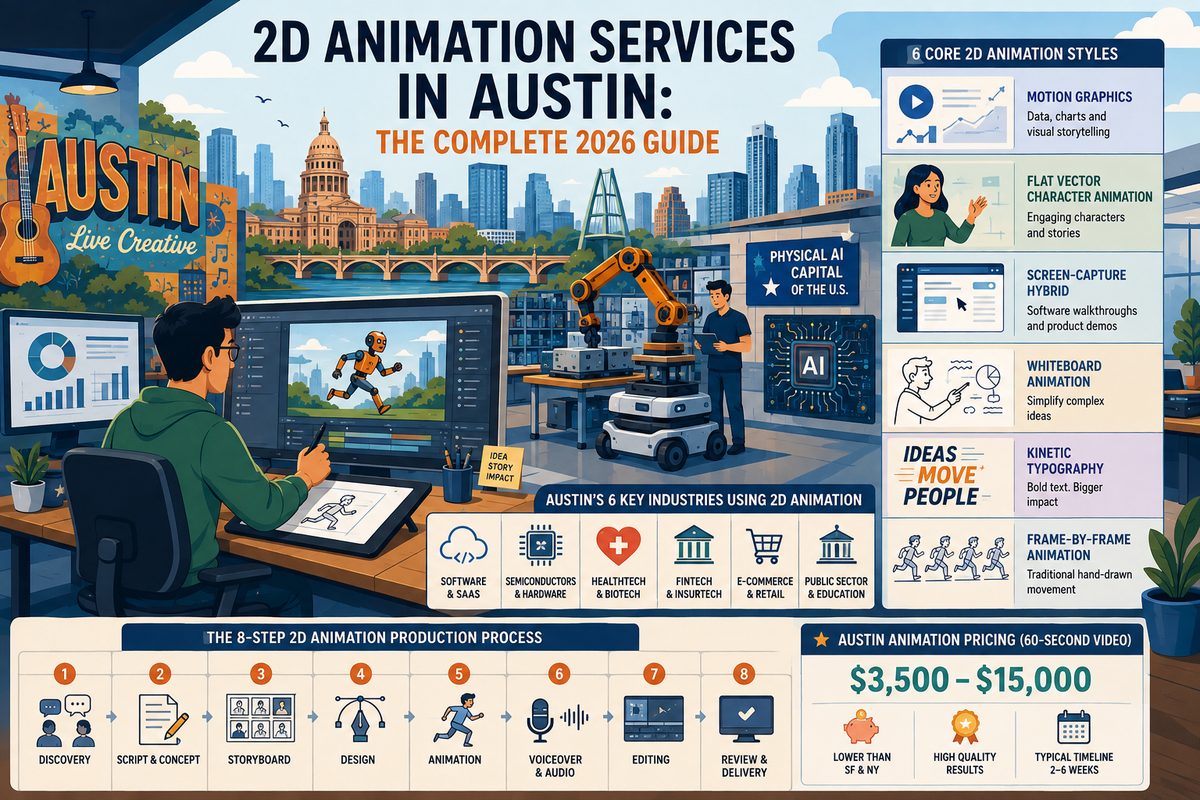
AI attracted 32% of all Austin startup funding in 2025. Tesla's Gigafactory Texas and Cortex AI supercluster have cemented Austin's position as the Physical AI capital of the US. Apptronik, the humanoid robotics company, raised $431.8 million in Austin. Physical AI companies face a dual communication challenge: they must explain both the software intelligence and the physical hardware simultaneously. Motion graphics is the format that handles this best, it can show a neural network making a decision, a robot arm responding, and the system's business outcome in a single cohesive animated sequence that live-action or 3D alone cannot match for clarity and speed.
Samsung's $17 billion semiconductor plant in Taylor is the largest foreign direct investment in Texas history. ARM has expanded Austin twice in 2025 and 2026. Dell employs approximately 14,000 people in the metro. Semiconductor and hardware companies use 2D animation for investor relations (explaining chip architecture and market position), customer education (communicating processing advantages to OEM partners), supply chain partner communication, and government regulatory submissions. Motion graphics handles chip-level process visualization, signal pathway animation, and manufacturing workflow communication with the technical accuracy these audiences require. This is an animation category that no other major US city generates at Austin's volume.
Austin is home to more than 200 clean technology companies employing approximately 30,000 people, according to Opportunity Austin. Clean energy infrastructure, solar farms, wind power grids, battery storage systems, demand response platforms, is physically vast and operationally complex. The core communication challenge for clean energy companies is explaining how systems that span hundreds of square miles work in a way that utility partners, investors, regulators, and consumers can all understand. Motion graphics is the primary format for grid-level explanations and infrastructure overviews. Flat 2D character animation works well for consumer-facing clean energy brands where emotional connection and values alignment drive adoption decisions.
Austin's SaaS sector spans the full spectrum from Capital Factory seed-stage companies to enterprise platforms serving Fortune 500 customers globally. NinjaOne, valued at $5 billion, is headquartered in Austin. Tricentis and dozens of other enterprise software companies maintain significant Austin presences. SaaS companies in Austin use flat 2D animation for homepage conversion, investor communication, and user onboarding. Screen-capture hybrid animation works for product update announcements, feature walkthroughs, and training content where showing the actual product interface accelerates user understanding. For Austin SaaS companies planning a video content series, a well-built flat 2D brand system at Series A reduces per-video production cost across every subsequent production by 30 to 50%.
HealthTech attracted 24% of Austin's startup funding in 2025, approximately $1.7 billion. Iodine Software reached unicorn status changing how healthcare operates nationwide. Colossal Biosciences is valued at $10 billion. Austin's HealthTech sector uses 2D animation for investor-facing platform overviews, patient education videos, clinical trial explanations, medical device demonstrations, and telemedicine onboarding. Whiteboard animation works well for clinical and academic-facing content where educational authority matters most. Character animation works best for patient-facing content where emotional reassurance and human connection drive engagement and compliance with medical guidance.
Austin's defense technology sector has grown significantly around the city's concentration of engineering talent and government agency relationships. Defense tech and cybersecurity companies use 2D animation for capability demonstrations to government and military procurement committees, internal training and security awareness programs, and recruiting communications that explain mission-critical work to engineering talent. Motion graphics communicates threat detection systems, network security architectures, and defense platform capabilities with the precision and authority these audiences require. For defense tech companies, technical accuracy in animation content is not optional, engineering review of animated content is a standard production step that must be built into every timeline.
How to Choose a 2D Animation Studio in Austin: 6 Things to Check
Austin's animation market ranges from established studios with genuine production capability to individual freelancers operating under a company name. The quality gap between these tiers is significant, and a polished website does not reliably predict production quality, timeline reliability, or technical accuracy capability. Here is a six-point checklist for evaluating any 2D animation studio in Austin before signing.
- Portfolio work in your specific industry, not just your general sector. A studio that has produced animation for SaaS companies may not have the technical vocabulary to handle semiconductor process visualisation or clean energy infrastructure animation. Ask for specific examples from your industry. If the studio cannot produce three relevant examples, they are likely learning on your project budget.
- Technical accuracy review as a defined production stage. For Austin's semiconductor, hardware, clean energy, and defense tech companies, animation content must be technically accurate. Ask whether the studio includes an engineering-review stage in their production timeline and whether they have experience incorporating technical feedback without blowing the production schedule. Studios without this process typically deliver technically inaccurate animation that cannot be deployed without costly revisions.
- A written revision policy with numbered rounds per stage. Professional studios specify how many revision rounds are included at script, storyboard, and animation stages, and what the per-round rate is for additional revisions. "Unlimited revisions" is not a revision policy, it signals a studio without structured production process, and typically results in timeline slippage when revisions extend indefinitely. Get the full revision policy in writing before signing.
- A milestone production schedule with specific dates provided before signing. A professional studio provides a milestone schedule: script delivery, storyboard delivery, rough cut, and final delivery dates. For Austin companies working against SXSW appearances, investor meetings, or product launches, "3 to 6 weeks" without specific milestone dates means no production accountability. Milestone specificity before signing is the clearest indicator of a studio with a real production system.
- Full IP ownership and deliverable format confirmation before signing. Confirm in writing that you receive full commercial rights to all produced assets, that source files are included, that background music is fully licensed for your intended usage (website, paid ads, government presentations, broadcast), and that voiceover talent rights cover all distribution platforms. For Austin companies presenting animation at government procurement reviews or industry conferences, broad usage rights are not optional.
- Pricing transparency before any discovery call. A professional 2D animation studio can give you a price range for your project type without a 45-minute sales conversation. Pricing gated behind a consultation typically means the quote will be calibrated to the budget they think you have rather than the budget the project should cost. See Magic Motion Studio's published pricing for a direct comparison benchmark.
Does 2D Animation Deliver ROI for Austin Companies? The 2026 Data
Commissioning 2D animation services is a real budget decision for every Austin company at every stage. Here is what verified 2026 research shows about animated video performance across the B2B and tech categories that dominate Austin's economy.
For Austin startups specifically, the highest-ROI use case for a first 2D animation investment is often not the homepage. It is investor communication. A 60-second animated overview embedded in a fundraising email or shared before a partner meeting demonstrates communication sophistication, product clarity, and organisational capability in a competitive funding environment where Austin's record $7.19 billion in 2025 VC activity means investors are reviewing more pitches than ever before. The compounding value: a video produced for investor outreach deploys immediately on the homepage, in product onboarding, across LinkedIn campaigns, and at SXSW and other Austin events without additional production cost.
Frequently Asked Questions About 2D Animation Services in Austin
How much do 2D animation services cost in Austin?
2D animation services in Austin are priced below coastal markets at comparable quality. Motion graphics and kinetic typography run $1,200 to $5,000 per finished minute. Flat vector 2D character animation costs $3,000 to $10,000 per minute. A professionally produced 60 to 90-second animated explainer video for an Austin tech company typically costs between $3,500 and $15,000. Austin studios carry lower overhead than SF or NYC equivalents, making the market one of the best-value professional animation locations in the US. See Magic Motion Studio's full pricing guide for published package details.
How long does 2D animation production take in Austin?
Motion graphics takes 1 to 3 weeks per 60 seconds. Flat vector 2D character animation takes 2 to 5 weeks. Frame-by-frame traditional 2D takes 6 to 14 weeks. The fastest professional studios serving Austin deliver a complete 60 to 90-second animated video in 14 business days covering all eight production phases with included revision rounds. For Austin companies working against SXSW appearances, investor meetings, or launch dates, 14-day delivery is achievable at full professional quality.
Can 2D animation work for semiconductor or hardware product companies in Austin?
Yes. 2D animation is one of the most effective formats for semiconductor and hardware communication because physical products at the chip and circuit level cannot be filmed in a way that communicates their value to a non-technical audience. Motion graphics visualises chip architecture, manufacturing process flows, signal processing pathways, and supply chain logistics with the accuracy and clarity that live-action cannot achieve. Austin's Samsung semiconductor corridor and hardware manufacturing sector use 2D motion graphics for investor relations, customer education, supply chain partner communication, and government submissions.
Which 2D animation style works best for an Austin SaaS or AI startup?
Motion graphics and flat vector 2D are the dominant formats for Austin SaaS and AI startups. Motion graphics is right for explaining AI model logic, visualising data flows, and demonstrating platform features where precision matters most. Flat vector 2D with brand characters is right when the startup is investing in brand identity at Series A or B and wants visual assets that scale across 10 or more future productions. For seed-stage Austin companies under budget pressure, motion graphics delivers the fastest high-quality output. For Series A companies, flat vector 2D delivers the highest long-term asset value.
Is Austin more affordable for 2D animation than San Francisco or New York?
Yes. Austin's 2D animation market operates at 20 to 35% lower price points than San Francisco for equivalent quality output. The primary driver is studio overhead: Austin studios do not carry SF's commercial real estate premium or NYC's operating costs. Talent quality in Austin's animation market is competitive with both coastal cities. For companies comparing providers across markets, Austin-based and remote-first studios serving Austin consistently deliver lower total project cost at the same quality tier.
What should I prepare before briefing a 2D animation studio in Austin?
Prepare: a one-paragraph product and problem description, your target audience by role and company size, the single action you want viewers to take, brand guidelines including logo and color palette, three to five visual style references, and the primary deployment platform. For Austin hardware and semiconductor companies, also specify whether animation requires engineering sign-off, this adds a review stage that needs to be built into the production schedule from the start.
What is the difference between 2D animation and 3D animation for Austin hardware companies?
For hardware companies, the choice depends on what needs to be communicated. 3D animation is justified when physical dimensional accuracy is required: a chip with visible die layers, a mechanical assembly with moving tolerances, or a product form factor that must be shown from multiple angles. 2D motion graphics is the right choice when the goal is to explain a process, data flow, or value proposition that exists in the logic of the hardware rather than its physical form. Most Austin hardware company productions use both: 3D for physical product visualization and 2D motion graphics for surrounding process and benefit communication.
Does 2D animation deliver ROI for Austin B2B companies?
Yes. 83% of marketers say video directly increased sales (Wyzowl 2026). Landing pages with embedded animated video convert at up to 86% higher rates than text-only pages. For Austin B2B companies with high customer acquisition costs across SaaS, semiconductor, and HealthTech, a well-produced animated video that improves homepage conversion, investor pitch response rates, and paid ad performance simultaneously pays for itself quickly. Brand assets built for a first video redeploy across investor materials, onboarding, conference content, and LinkedIn campaigns at no additional production cost.
More 2D Animation Services Guides by City
Magic Motion Studio produces custom 2D animation for tech companies across the United States. For guides covering other major markets:
- 2D Animation Services in San Francisco: The Complete 2026 Guide
- 2D Animation Services in Los Angeles: The Complete 2026 Guide
- 2D Animation Services in Chicago: The Complete 2026 Guide
- 2D Animation Services in Miami: The Complete 2026 Guide
For the full Austin explainer video buying guide covering how to hire, questions to ask, red flags, and pricing, see our companion piece: Explainer Video Company in Austin: The Complete 2026 Buyer's Guide. For our full Austin service overview, visit our Austin explainer video production page. For anime-style and frame-by-frame 2D, see our anime animation studio page.
Further reading for Austin businesses:
- What Is 2D Animation? Complete Guide for Businesses
- 2D Animation Styles: Flat Design, Frame-by-Frame, Cutout and More
- How Long Does 2D Animation Take to Produce?
- 2D Animation Cost: Complete Pricing Guide for Businesses
- Explainer Video Examples That Convert: 12 Real-World Results
Ready to start your Austin animation project?
Custom 2D animation for Austin's AI, SaaS, semiconductor, clean energy, HealthTech, and defense tech companies. Delivered in 14 business days. Pricing published upfront, no discovery call required.
View Our 2D Animation Work