
2D Animation Services in Chicago: The Complete 2026 Guide
Chicago runs on complex products, long B2B sales cycles, and institutional buyers who evaluate vendors through research before ever speaking to a salesperson. The city's fintech platforms, enterprise SaaS companies, healthcare systems, manufacturing technology firms, and professional services organizations all share one communication challenge: what they sell is difficult to explain with text and images alone. That is why demand for 2D animation services in Chicago has grown steadily across every major industry segment in the city. This guide covers every dimension of the market: what makes Chicago a distinct environment for 2D animation production, which styles work for which buyers, how pricing is structured, how to choose the right studio, and exactly what to ask before you commit budget to any production.
Why Chicago Businesses Choose 2D Animation
Chicago is the third-largest economy in the United States with a gross metropolitan product exceeding $770 billion, home to more than 35 Fortune 500 company headquarters and one of the most concentrated enterprise B2B markets in the world. The city's businesses invest in 2D animation services in Chicago for the same fundamental reason organizations in every major market do: animation communicates complexity in a format that live-action video and static design cannot match, and does so at a production cost and turnaround speed that scales with business output rather than requiring a film crew for every deliverable.
For Chicago's enterprise B2B market specifically, 2D animation solves a communication problem that most content formats ignore: B2B buyers in 2026 are conducting most of their vendor evaluation independently, before any sales contact occurs. According to Gartner research, 67% of B2B buyers now prefer a rep-free research experience when evaluating vendors. A professionally produced animated video is the asset that bridges the gap between a buyer's first search and their decision to request a quote. According to Wyzowl's State of Video Marketing Report, 96% of people have watched a video to understand a product or service, and 89% say a brand's video convinced them to take action.
Beyond the strategic case, 2D animation offers practical advantages over live-action production that matter directly to Chicago businesses managing production budgets and timelines. There are no actors to cast, no locations to book, no weather delays, and no re-shoot costs when the product or message changes. Revisions happen in the file, not on a set. International and bilingual versions require only a new voiceover track, not a full re-production. For Chicago organizations serving the city's 29% Spanish-speaking population or distributing content across multiple regions, this flexibility makes 2D animation services a strategic production investment rather than a single-use marketing spend.
2D Animation Styles Chicago Companies Use
Not all 2D animation is the same format. Chicago businesses commission six distinct styles, each suited to a specific audience type, content category, and stage of the buyer journey. Choosing the right style for your objective is the first production decision and the one with the most downstream impact on how your content performs.
| Style | Best For | Timeline | Chicago Use Case | Complexity |
|---|---|---|---|---|
| Motion Graphics | Data, process, compliance, B2B precision | 7–14 days | Fintech, financial exchanges, enterprise SaaS | Moderate |
| 2D Character Animation | Brand storytelling, explainer video, awareness | 10–20 days | Healthcare, EdTech, consumer brands, DTC | Moderate–High |
| Cutout / Rigged Animation | Series content, training, recurring formats | 8–16 days | HR and L&D, compliance training, e-learning | Moderate |
| Whiteboard Animation | Concept explanation, internal training | 7–12 days | Manufacturing, professional services, onboarding | Low–Moderate |
| Frame-by-Frame Animation | Premium brand, broadcast, entertainment | 20–45 days | Consumer CPG, broadcast advertising, entertainment | Very High |
| Live-Action Hybrid | Enterprise trust-building, professional services | 14–28 days | Consulting, legal, financial advisory firms | High |
Chicago's enterprise buyers respond most strongly to motion graphics and clean product-focused 2D animation. The city's institutional culture favors precise, evidence-based communication over narrative-heavy character animation, and this preference shows consistently in what performs well in financial services, SaaS procurement, and professional services content. Character-driven storytelling is most effective in consumer-facing content, healthcare patient education, and EdTech, where emotional engagement drives the response. Matching the animation style to the decision-making context of your specific buyer is what separates 2D animation services in Chicago that produce business results from those that produce attractive videos that do not convert.
Chicago Industries That Commission 2D Animation Services
Chicago's economy spans a broader range of enterprise B2B sectors than almost any other US city. Each of the following industries uses 2D animation services in Chicago in ways specific to their buyer type, content requirements, and distribution context. Understanding where your sector fits shapes both the style decision and the brief you bring to a studio.
Chicago is home to five of the world's most important financial exchanges, including the Chicago Mercantile Exchange and the Chicago Board Options Exchange, alongside a dense cluster of proprietary trading firms, payment platforms, wealth management tools, compliance software companies, and financial data providers. The products these organizations sell are technically complex and heavily regulated, and the audiences evaluating them range from institutional traders to regulatory bodies to retail investors.
Motion graphics is the standard 2D animation format for Chicago's financial services companies because it communicates abstract financial concepts with precision. A compliance platform explaining a regulatory workflow, a trading technology company communicating order routing logic, or a risk management tool explaining a portfolio model all use motion graphics to make technical content legible to the specific audience without oversimplifying it in ways that undermine credibility with a sophisticated institutional buyer.
Compliance explainers · Trading tech · Payment platforms · Regulatory contentChicago's technology sector, concentrated across Fulton Market, River North, and the West Loop, has produced a significant cluster of enterprise SaaS companies, insurtech platforms, logistics technology providers, and B2B software businesses whose products serve large institutional clients with procurement processes, evaluation committees, and multi-month buying cycles. The tech community centered in this part of the city is frequently called Silicon Prairie, reflecting both the scale of the ecosystem and its distinction from Silicon Beach and Silicon Alley in style and buyer culture.
2D animation services for Silicon Prairie companies must solve a multi-stakeholder communication problem. The same 90-second video will be watched by a technical evaluator, an operational lead, and an executive sponsor who each need to take away different information. A product walkthrough animation combining screen-level product demonstration with animated callouts and professional voiceover consistently performs best for enterprise SaaS procurement content, because it communicates technical depth to the evaluator while making the operational benefit immediately legible to the decision-maker.
Product walkthroughs · Sales enablement · Procurement assets · OnboardingChicago sits at the center of the United States freight network and remains one of the most economically significant manufacturing cities in the country. The technology companies serving Chicago's manufacturing and logistics sector, including warehouse management systems, supply chain optimization platforms, industrial IoT providers, and procurement automation tools, sell to operations leaders who evaluate software on operational metrics rather than brand appeal: throughput, cycle time reduction, inventory accuracy, and fill rate improvement.
2D animation for Chicago manufacturing and logistics technology companies requires a visual language distinct from consumer or SaaS content. Process flow diagrams, system integration maps, warehouse floor visualizations, and before-and-after operational comparisons communicate more effectively to this buyer than character-driven narrative. Studios without experience in industrial or supply chain content consistently misread this and produce videos that look polished but fail to connect with the operational priorities of a plant manager or VP of Supply Chain evaluating software.
Supply chain tech · Industrial IoT · Warehouse management · Procurement automationChicago is home to major healthcare systems including Northwestern Medicine, Rush University Medical Center, Advocate Health, and the University of Chicago Medical Center. The HealthTech companies serving these systems, from clinical decision support platforms and telehealth providers to medical device companies and digital therapeutics brands, operate in a regulatory environment where communication accuracy is not just a quality standard but a clinical and legal requirement.
Clean flat 2D character animation is the most commonly used format for Chicago healthcare and HealthTech content because it achieves the balance that regulated clinical communication demands. It is precise enough to satisfy a clinical audience that will immediately identify imprecision, while remaining accessible to patient and administrative audiences who need the same information without the clinical vocabulary. The same animated video can communicate patient intake instructions, insurance coverage explanations, and clinical protocol walkthroughs in a format that works across every healthcare stakeholder audience without a separate production for each.
Patient education · Clinical platform demos · Medical device mechanism · Provider trainingChicago's professional services sector spans major consulting firms, legal practices, accounting and audit organizations, and management advisory companies whose services are intangible, relationship-driven, and difficult to differentiate through standard marketing content. For professional services firms commissioning 2D animation services in Chicago, the communication challenge is demonstrating expertise and process clarity without either oversimplifying the complexity that justifies their fees or overwhelming the buyer with it.
Live-action hybrid formats are commonly used by Chicago professional services organizations that need to maintain the human credibility the market expects while achieving the message clarity that animation delivers independently. For firms where individual partner reputation is central to the brand, a hybrid format that combines presenter footage with supporting animated graphics maintains the relational signal of a real person while giving the underlying content the structure and visual clarity that pure talking-head video does not provide.
Consulting methodology · Legal process · Audit and advisory · Executive recruitmentChicago is the headquarters city for some of the world's most recognized food and consumer goods organizations. Kraft Heinz, Mondelez International (the Oreo and Cadbury brand owner), and McDonald's Corporation all maintain significant Chicago presences, and the city has a growing cluster of DTC food, wellness, and consumer goods brands building audiences through digital channels. These organizations use 2D animation services in Chicago for product launches, ingredient transparency content, retail channel education, and paid social advertising campaigns where animated content outperforms static creative on every major engagement metric.
For Chicago consumer brands targeting the city's bilingual audience, Spanish-language 2D animated video produced from the same brief as the English version extends distribution into a large and underserved market segment at a fraction of the cost of a separate production. Frame-by-frame and premium character animation styles are used most by Chicago's consumer CPG and entertainment brands where emotional resonance and brand personality are primary drivers of the content's effectiveness.
Product launches · Ingredient transparency · Paid social · Bilingual content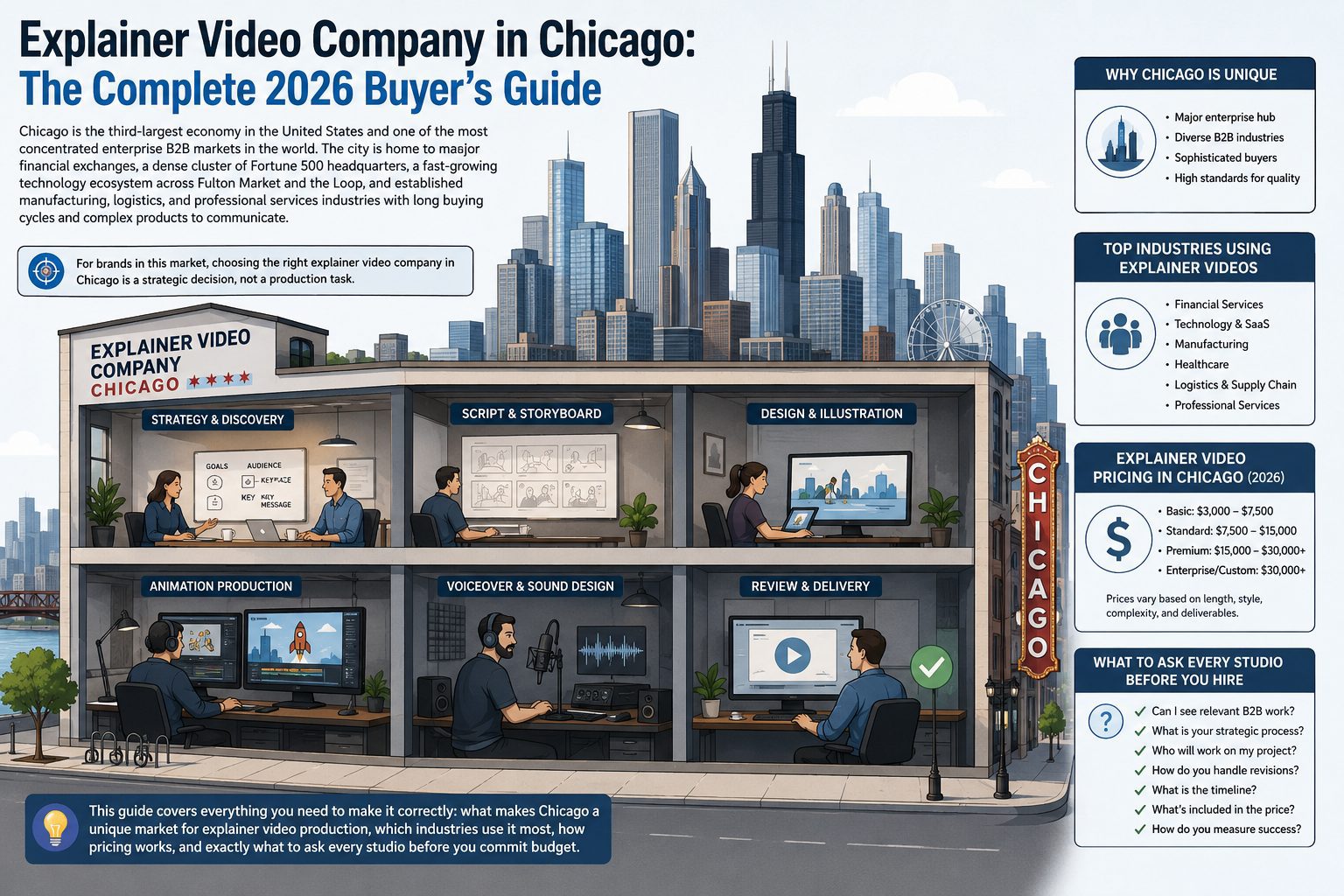
How to Choose a 2D Animation Studio in Chicago
Chicago's 2D animation market includes experienced B2B production studios, generalist agencies with animation added to a broader service menu, offshore operations with Chicago phone numbers and local-facing websites, and freelance animators operating independently. These five criteria cut through the marketing positioning and reveal which option can actually serve a Chicago enterprise buyer at the production quality and timeline reliability the project requires.
Ask for portfolio samples from your industry, not a general showreel of their most visually impressive work. A fintech explainer requires a different scripting approach, visual register, and credibility standard than a consumer product video. A manufacturing technology animation requires operational vocabulary and process visualization that generalist studios consistently get wrong because they have never briefed a studio on throughput optimization or inventory cycle time. General showreels disguise this gap. Sector-specific samples reveal it immediately.
Every effective 2D animated video starts with a locked message: the problem it addresses, the mechanism of the solution, the primary benefit, and the single call to action. Ask each studio how their production process begins. The answer that produces results every time is with the brief and the script, reviewed and approved before any storyboard or style frame is created. Studios that open with mood boards, color palettes, or visual references before the message is agreed are prioritizing their creative workflow over your communication outcome. This creates expensive rework at the animation stage when the message turns out to be wrong.
Every deliverable from your 2D animation project, including the script, voiceover recording, character designs, background illustrations, and animation source files, should transfer to you with full commercial rights at the point of final delivery. Some studios retain licensing rights over character designs or animation elements, which means you cannot modify, repurpose, or adapt your own video without returning to them and paying again. For Chicago enterprise clients who may need to update product content in response to a compliance change, product revision, or rebrand, this is a material operational constraint. Confirm IP ownership transfer in writing before production begins.
Ask for the revision policy at each production stage separately: how many rounds are included at script, storyboard, and animation? This forces the studio to commit to a policy before they have your deposit, and ensures you are scoping the project accurately for your internal review process. For Chicago enterprise clients with legal sign-off, compliance review, or multi-stakeholder approval cycles, the number of revision rounds is not a minor detail. It is a budget variable that can double the effective cost of the project if not agreed before production begins.
Chicago enterprise clients plan 2D animation content around product launches, board presentations, trade shows, and quarterly sales cycles. A production estimate that says "six to eight weeks" is a range, not a commitment. A professional 2D animation studio gives you a production schedule with specific dates for script approval, storyboard completion, animation delivery, and final output at the point of signing, not after production begins. Studios that cannot commit to a milestone schedule before they start are telling you how they will manage your timeline once you have paid the deposit.
- No portfolio work from your specific industry or a comparable B2B sector
- Visual-first briefing process, mood boards or style frames before message strategy
- No revision policy stated at each stage before you sign or deposit
- Pricing only available after a discovery call or behind a "get a quote" wall
- Chicago-positioned studio with no verifiable local team or clients
- Testimonials with no named clients, industries, or verifiable project details
- No mention of IP ownership or source file transfer in the contract
Freelancer vs. Studio vs. Agency: Which to Choose for Chicago 2D Animation
Chicago businesses sourcing 2D animation services have three distinct engagement models available. Each has a different cost profile, production structure, and risk profile. The right choice depends on your project complexity, internal capacity to manage the production, timeline requirements, and the degree of strategic input you need from the production partner.
Questions to Ask Before Signing with a Chicago 2D Animation Company
These six questions reveal more about what a 2D animation company in Chicago can actually deliver than any portfolio presentation or agency pitch. Ask them before committing budget and evaluate not just the answer but the confidence, specificity, and speed of the response.
A showreel is built to impress across all possible clients. Industry-specific samples reveal whether the studio understands your buyer's communication context, vocabulary, and the competitive environment your video will live in. A motion graphics piece built for a Chicago fintech platform is a fundamentally different production from a character animation for a consumer DTC brand. Studios that cannot show you relevant sector experience are asking you to fund their learning curve at your project's expense.
Red flag: "We adapt our style to any industry" with no specific examples from your sector.The script is the single highest-leverage deliverable in any 2D animation production. A script written by someone who understands your specific buyer's objections, decision criteria, and vocabulary will outperform a generic product description formatted into a template. Ask specifically who writes it, what their background is in your sector, and whether it is included in the quoted fee or billed separately. Some studios require you to provide the script. Others include it but assign it to a generalist writer with no relevant experience. A full-service 2D animation studio includes scripting from a writer briefed on your buyer, not your product.
Good answer: "Script writing is included. Our writer will send a detailed questionnaire about your buyer, their objections, and the single outcome the video must drive."Ask this for script, storyboard, and animation separately. This forces the studio to commit to a revision policy at each stage before you have signed or deposited. For Chicago enterprise clients with internal legal, compliance, or multi-stakeholder review processes, revision rounds per stage are a budget variable, not a minor detail. A studio that gives you vague answers about "working until you are happy" has no accountability structure for scope. That answer means unlimited revisions at your timeline's expense.
Red flag: "We'll work until you're happy" with no defined revision count or change-order policy.For Chicago businesses in regulated industries, those commissioning content tied to a product that will evolve, or any brand planning to repurpose animation assets across formats, IP ownership at delivery is a material contract issue. Some studios retain licensing rights over character designs and animation elements, which means updating or adapting your video later requires going back to them. Confirm that full commercial rights and all source files transfer to you on final delivery, and that this is written into the contract before you sign, not referenced verbally during a sales call.
Good answer: "Full commercial rights and all source files transfer to you at final delivery. That's written into every contract before production starts."In larger Chicago agencies, projects are sold by a senior producer and handed off to a junior coordinator managing fifteen to twenty simultaneous accounts. For enterprise clients with approval cycles involving multiple stakeholders, this handoff is where timeline reliability breaks down. Ask who your named daily contact is from brief to delivery, what their direct communication channel is, and how many other active projects they run. A studio that cannot answer the last question confidently is telling you something important about their project management infrastructure.
For Chicago enterprise brands with product launches, board presentations, or trade shows tied to a delivery date, a missed deadline is a business problem, not an inconvenience. Ask this question directly and evaluate the specificity of the answer. A studio with a clear policy has dealt with the situation and structured their operations around timeline accountability. A studio that gives vague reassurances has no accountability structure for the scenario, and will rely on those reassurances again when it happens during your project.
Red flag: Any answer that is not a specific policy statement, "we'll do our best" means there is no timeline commitment structure.What 2D Animation Services in Chicago Actually Cost
Pricing for 2D animation services varies significantly based on animation style, character complexity, background detail, script length, revision rounds, voiceover language requirements, and final delivery format count. The table below reflects market rates sourced from Pixune's 2026 animation cost research and the Clutch Chicago 2D animation directory, covering both per-minute production rates and common project types.
| Animation Tier | Per Minute Rate | 60-Second Project | Typical Style | Chicago Use Case |
|---|---|---|---|---|
| Basic | $2,000–$7,000 | $2,000–$7,000 | Motion graphics, kinetic type, simplified character | Internal training, e-learning, social content |
| Commercial | $7,000–$20,000 | $5,000–$15,000 | Custom character animation, illustrated environments | B2B explainer, product launch, brand video |
| Premium | $20,000–$60,000+ | $20,000+ | Frame-by-frame, broadcast-quality, high character detail | Broadcast advertising, CPG brand, entertainment |
Source: Pixune 2D Animation Cost Guide 2026; Clutch Chicago 2D Animation Directory (Clutch-verified studios: Demo Duck $200–$300/hr, $10k+ min; Bottle Rocket Media $150–$199/hr, $10k+ min). Market rates vary by studio location, team structure, and project complexity.
The most significant cost drivers in 2D animation production are: animation style (motion graphics is faster and less expensive to produce than character animation at the same runtime); character count and design complexity (each unique character requires design, rigging, and expression work); number of unique background scenes; revision rounds included at each stage; voiceover language count; and final delivery format requirements. A 60-second motion graphics piece with no characters, two background scenes, and delivery in one format will come in at the lower end of the commercial tier. A 90-second piece with three custom character rigs, ten background environments, multiple revision rounds, bilingual voiceover, and delivery in six formats across aspect ratios will come in at the upper end. Chicago agencies with physical studio overhead in the Loop or River North operate at higher base rates than remote-first studios with equivalent or superior animation talent and no real estate cost in the price.
The 2D Animation Production Process: What Chicago Clients Should Expect
A professional 2D animation production follows a structured sequence of stages. Understanding this sequence before you begin helps you plan internal approvals, align stakeholders early, and avoid the scope changes and delayed feedback that are the most common source of timeline overrun in enterprise animation projects.
The production begins with a structured brief covering target audience, the problem addressed, the solution mechanism, primary benefit, single call to action, tone of voice, animation style direction, and delivery deadline. For Chicago enterprise clients, the brief should also specify which stakeholder the video is optimized for, the stage of the buyer journey where it deploys, and any compliance or legal review requirements that will affect the approval timeline. The brief is the foundation of every subsequent decision. A strong brief produces a strong video. A vague brief produces expensive revision cycles.
Days 1–2A 60-second animated video runs approximately 150 words of narration. Every word is allocated a second of screen time, which means every word must earn its place. For enterprise B2B content, the script must communicate the problem accurately, present the solution mechanism credibly, and deliver a specific call to action in a register that matches the sophistication of the buyer. Script approval locks the message before any visual work begins. Chicago enterprise clients who complete internal review cycles at the script stage, before storyboard and animation, avoid the most expensive revision scenarios that occur when message changes happen after visual production has started.
Days 2–4With an approved script, the animation team builds a scene-by-scene storyboard and full-color style frames for two to three key scenes. The storyboard establishes the visual flow, character design direction (if applicable), color palette, and animation style before any production work begins. Style frame approval is the point at which brand guidelines, compliance visual requirements, and multi-stakeholder visual preferences are resolved. Changes made after storyboard approval that require structural rework to the animation sequence are the most common source of cost overrun in complex 2D animation projects.
Days 4–7Professional voiceover is recorded to the approved script in a studio-quality environment. For Chicago's enterprise B2B market, voiceover register matters significantly: financial services and compliance content requires a different tone and pacing than consumer product animation. For Chicago brands serving bilingual audiences, Spanish-language voiceover is recorded in parallel from the same source brief, maintaining consistent timing and messaging without the cost of a separate full production. The voiceover track is what the animation team synchronizes to frame by frame in the production stage that follows.
Days 7–8Animation is produced against the approved storyboard and voiceover track using professional production tools, including Toon Boom Harmony for character-driven work and After Effects for motion graphics and compositing. Every scene is built to the timing of the voiceover. Motion graphics projects animate data visualizations, process flows, UI elements, and graphic transitions. Character animation projects build character rigs and animate expressions, movements, and interactions synchronized precisely to the audio. Client feedback that stays within the agreed revision scope at this stage produces the sharpest final output. Late structural changes, such as new scenes added after animation has begun, generate the largest cost and timeline variances.
Days 8–12Background music, sound effects, and audio mix are layered onto the completed animation sequence. The finished video goes through a final quality review covering visual accuracy against the approved storyboard, audio sync, color consistency, and export quality before delivery. Final output is provided in all required formats: 16:9 for website, YouTube, and LinkedIn; 1:1 square for social media; and 9:16 vertical for Reels, Shorts, and TikTok. Additional formats including broadcast-quality MOV, alpha channel exports, and captioned versions are available. Full commercial rights and all source files transfer to you on final delivery as written in the contract.
Days 12–14Common Mistakes Chicago Brands Make When Commissioning 2D Animation
The most common mistake Chicago brands make when commissioning 2D animation services is coming to a studio with a style decision already made before the message has been defined. "We want a character animation" is a production format decision. It does not answer what the video must communicate, who it is communicating to, or what it must get the viewer to do next. An animation style chosen without reference to the buyer, the content, and the distribution context produces a video that looks exactly as requested and performs nothing like expected. Define the message first. The right format for that message is a derivable answer.
A visually impressive showreel is not evidence that a studio can produce a video that converts a Chicago enterprise procurement committee. It is evidence that the studio has produced visually impressive work. For most Chicago B2B applications, the content strategy, message architecture, and script writing are more important to the video's business performance than the visual style. A beautifully animated video with the wrong message, or a message aimed at the wrong buyer, will not move an enterprise evaluation. Ask studios about case studies where a video they produced drove a measurable business outcome, not just which of their videos looked the best.
Chicago enterprise brands frequently commission 2D animation production before their internal teams have agreed on the single message the video must deliver. Marketing has one version of the message. Product has a different version. The executive sponsor has a third priority. Legal has compliance constraints on the first two. When each of these stakeholders provides independent feedback at different production stages, revision costs multiply and timelines extend well beyond any initial estimate. The single most cost-efficient step before briefing any 2D animation studio is one internal alignment meeting that produces consensus on the one thing the video must communicate and the one action it must drive. Every internal disagreement resolved before the brief is infinitely cheaper than the same disagreement resolved after animation has started.
A 90-second 2D animated video produced for a website homepage is simultaneously a 30-second paid LinkedIn ad, a 15-second trade show teaser, a product page asset, a sales email attachment, a presentation background loop, and a YouTube pre-roll cut. Chicago brands that plan all required format variants at the time of initial production, and brief the studio to deliver them from the same source file, spend a small fraction of what separate subsequent productions cost. Organizations that discover they need a LinkedIn-formatted cut or a Spanish-language version six months after delivery pay nearly full production rates for a deliverable that could have been a simple export at the time of initial delivery. Plan the full distribution system before the brief, not after the video launches.
Why Chicago Brands Work with Magic Motion Studio
Magic Motion Studio is a professional 2D animation studio with over 1,000 videos delivered for enterprise SaaS companies, fintech brands, healthcare platforms, manufacturing technology firms, and consumer brands across the United States. We are a Toon Boom Harmony studio, producing character-driven 2D animation alongside motion graphics, motion graphics production, and explainer video production for clients including organizations headquartered in and serving the Chicago market.
Our production process is fully remote and structured around enterprise client requirements: milestone-based approval checkpoints, named delivery dates from brief to final output, and dedicated project management from a single named contact through every production stage. Brief intake, script review, storyboard approval, animation feedback, and final delivery all happen through dedicated project management platforms and scheduled video calls, with no handoffs between the sales team and the production team.
Standard delivery for a 60-second animated video is 14 business days from an approved brief, covering every stage from script writing through sound design and final format delivery. Voiceover in 20+ languages is available from the same brief at no full re-production cost. Full commercial rights and all source files transfer to you on final delivery, written into every contract before production begins. See how we serve other major US markets in our guides to 2D animation services in Los Angeles and 2D animation services in New York.
Frequently Asked Questions About 2D Animation Services in Chicago
How much do 2D animation services in Chicago cost?
According to Pixune's 2026 animation cost research, 2D animation ranges from $2,000 to $7,000 per minute for basic motion graphics and simplified animation, $7,000 to $20,000 per minute for commercially polished character animation with custom environments, and $20,000 to $60,000 or more per minute for premium frame-by-frame production. A standard 60 to 90 second animated explainer video costs between $5,000 and $15,000 at the commercial tier.
Chicago-based agencies with physical studio space in the Loop or River North tend toward the upper end of these ranges. Remote-first studios serving Chicago clients deliver at competitive rates because their cost structure does not include Chicago commercial real estate. The primary cost drivers are animation style, character count, background scene complexity, revision rounds per stage, voiceover language count, and final delivery format requirements.
How long does a 2D animation project take in Chicago?
A professionally produced 60 to 90 second 2D animated video typically takes 4 to 8 weeks from brief to delivery with an established studio. This covers script writing, storyboard, character and background design, voiceover recording, animation production, sound design, and final format delivery. The most common source of timeline overrun is delayed client approvals at the script and storyboard stages, particularly in enterprise projects with multi-stakeholder review cycles.
Magic Motion Studio delivers standard 60-second animated videos in 14 business days from an approved brief, covering every production stage through final delivery in all required formats. For enterprise clients with legal sign-off or compliance review requirements, review checkpoints are built into the production schedule from day one.
What 2D animation style works best for Chicago B2B companies?
For most Chicago B2B companies, motion graphics or a clean 2D animated explainer combining motion graphics with one to two character elements delivers the strongest result with enterprise audiences. Fintech, financial services, and compliance platforms respond best to motion graphics because the format communicates technical precision without the ambiguity of character narrative. Enterprise SaaS companies perform best with product walkthrough animation combining screen elements with animated callouts. Healthcare and HealthTech brands typically perform well with clean flat 2D character animation that simplifies clinical processes without oversimplifying them.
The right style depends entirely on your specific buyer, content type, and the stage of the buying process where the video deploys. A style that converts a consumer buyer will not convert an enterprise procurement committee, and vice versa.
Should a Chicago business hire a freelancer or a 2D animation studio?
For single, lower-stakes projects with a flexible timeline and a client-side producer who can manage script, voiceover, and creative direction independently, a freelance 2D animator in Chicago can be a cost-effective option. For enterprise projects, B2B sales assets, product launches, or any video where message strategy, production quality, and on-time delivery are business-critical, a professional 2D animation studio provides the structured process, dedicated project management, and revision accountability that freelance engagements typically cannot match at scale.
Studios also handle script writing, voiceover casting, sound design, and format delivery as a single managed workflow, which removes the coordination overhead that falls on the client in a freelance arrangement and is the main source of timeline overrun in client-managed productions.
Does a 2D animation studio need to be physically located in Chicago?
No. Professional 2D animation production is a fully remote discipline. Brief intake, script review, storyboard approval, animation feedback, and final delivery all happen through project management platforms and scheduled video calls. Physical proximity to your Chicago office has no effect on animation quality, production speed, or day-to-day communication responsiveness.
Some studios that market as 2D animation services in Chicago are offshore operations using a local address or generalist agencies without specialist B2B production experience in Chicago's key sectors. Evaluate studios on their industry portfolio, production process, revision policy, IP ownership terms, and delivery record. None of those factors have any geographic relationship to the 60601 zip code.
Over 1,000 videos delivered. Toon Boom Harmony studio. 5.0 client rating. Full commercial rights. Voiceover in 20+ languages including Spanish.
Related Guides and Resources
Further reading for Chicago businesses commissioning 2D animation:
- Explainer Video Company in Chicago: The Complete 2026 Buyer's Guide
- 2D Animation Services in New York: The Complete 2026 Guide
- 2D Animation Services in Los Angeles: The Complete 2026 Guide
- What Is 2D Animation? Complete Guide for Businesses
- 2D Animation Styles: Flat Design, Frame-by-Frame, Cutout and More
- How Long Does 2D Animation Take to Produce?
- 2D Animation Cost: Complete Pricing Guide for Businesses
- Explainer Video Examples That Convert: 12 Real-World Results