
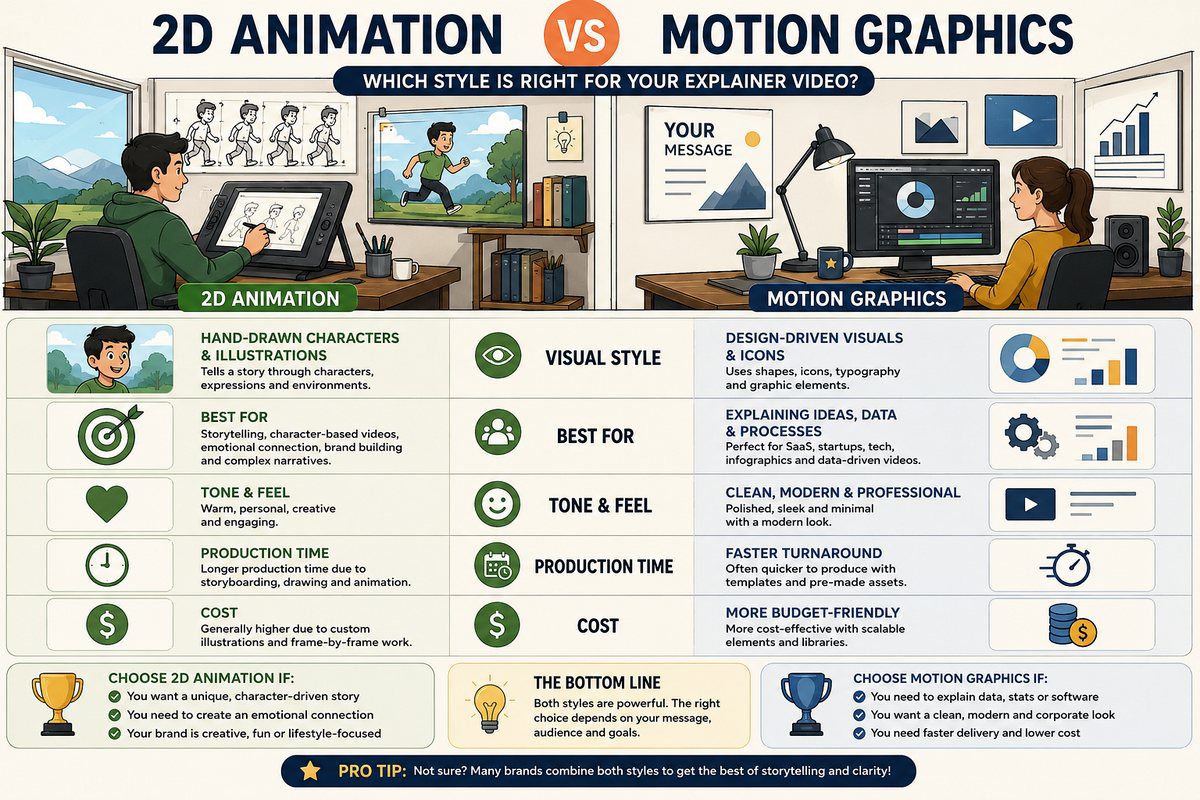
If you have ever asked a studio for an animated video and received a quote for both 2D animation and motion graphics, you are not alone. Most business owners do not know the difference between the two, and most studios do not explain it clearly. They just ask which one you want, then charge accordingly.
This guide breaks down the 2D animation vs motion graphics question from a production perspective, not a theoretical one. You will know exactly which style fits your product, your audience, and your goals by the end of it.
Motion graphics animate design elements (text, shapes, icons, data) to communicate information. 2D animation uses characters and narrative to tell a story. Motion graphics are information-first. 2D animation is emotion-first. Most high-performing business videos combine both. The right choice depends on your audience, your message, and whether your goal is to explain or to connect.
What Is 2D Animation?
2D animation is the craft of creating movement within a two-dimensional plane using characters, environments, and narrative. It is what most people picture when they think of classic cartoons, but the format has evolved significantly for business use. Modern 2D animation for brands typically uses rigged digital characters (built in Toon Boom Harmony, Adobe Animate, or After Effects with puppet tools) rather than the labour-intensive frame-by-frame approach used in film production.
In a business context, 2D animation is used to build emotional connection. The character, whether a branded mascot or a representative figure that mirrors the viewer, carries the story. The viewer follows that character through a problem and a resolution. That structure triggers the same psychological engagement as any narrative, whether it is a film or a case study. The viewer does not just understand the product. They feel something about it.
What defines 2D animation for business:
- Character-driven: a person, mascot, or illustrated figure carries the story
- Narrative structure: problem, solution, outcome
- Custom illustration: scenes, environments, and characters are drawn for the brand
- Higher emotional range: can convey trust, urgency, empathy, delight
- Longer production timeline due to illustration and rigging requirements
- Best formats: homepage hero, investor pitch, onboarding, brand campaigns
What Are Motion Graphics?
Motion graphics are animated design elements. Text that flies in, icons that morph, data that builds on screen, shapes that transition between states. There are no characters. There is no plot. The goal is to make information easier to absorb by putting it in motion.
The term "motion graphics" technically falls under the broader umbrella of animation, since all motion graphics are animated. But in production practice and in client briefs, the two terms refer to distinct styles with different costs, timelines, and conversion behaviours. When someone says "motion graphics," they mean design-driven animation. When they say "2D animation," they mean character-driven storytelling.
What defines motion graphics for business:
- Design-element driven: shapes, text, icons, logos, and data visualisations
- Information-first: the goal is clarity, not emotional connection
- No characters or narrative arc
- Faster to produce than 2D character animation
- Easier to update when product features or data change
- Best formats: SaaS demos, B2B explainers, data presentations, social ads
2D Animation vs Motion Graphics: The Core Difference
The simplest way to separate 2D animation vs motion graphics is this: motion graphics moves information, 2D animation moves people. Both use the same production software. Both appear on the same platforms. But the purpose, the emotional mechanism, and the production process are fundamentally different.
| Factor | 2D Animation | Motion Graphics |
|---|---|---|
| Primary goal | Emotional connection, storytelling | Information clarity, data communication |
| What moves | Characters, expressions, environments | Text, icons, shapes, charts, logos |
| Narrative | Problem, solution, outcome arc | No narrative, sequential information |
| Production time | Longer (illustration, rigging, animation) | Shorter (no character design or rigging) |
| Cost tier | Higher (custom illustration required) | Lower (design-element based) |
| Ease of updating | Harder (characters must be redrawn or re-rigged) | Easier (text and data swap quickly in After Effects) |
| Best audience | Consumer, B2C, emotional products | B2B, SaaS, data-heavy, enterprise |
| Works without sound? | Partially (context is lost without voiceover) | Yes (text and icons communicate standalone) |
| See our work | 2D animation studio | Motion graphics services |
Not sure which style fits your project?
Submit a brief and we will recommend the right format based on your audience, goal, and budget. No calls required.
When to Use Motion Graphics
Motion graphics is the right choice for 2D animation vs motion graphics decisions when the goal is to explain a process, visualise data, or communicate a complex idea to a professional audience quickly. Here are the specific scenarios where motion graphics wins.
SaaS product demos and feature explainers
Software UI, dashboards, and feature workflows are best shown through animated interfaces, not characters acting out their use. Motion graphics can demonstrate a product flow in 60 seconds without a single character appearing on screen. The viewer sees the product, not a proxy for it.
Data visualisation and statistics
When your message centres on numbers, motion graphics is the only viable format. Charts building, percentages counting up, comparative bars animating side by side. This type of content cannot be rendered effectively through character animation. It requires design thinking, not storytelling.
B2B and enterprise communication
Corporate and enterprise audiences expect a professional tone. Character animation can feel out of place in a regulated industry pitch or a board-level presentation. Motion graphics communicate authority and clarity, matching the visual language decision-makers already consume.
Social media ads designed to work without sound
Most social media video is watched on mute. Motion graphics, with their text overlays and icon-driven design, communicate the core message even when the audio is off. Character-driven 2D animation typically loses most of its impact without voiceover and sound design.
Tight timelines or content that will be updated frequently
If your product changes every quarter, motion graphics is the lower-risk investment. Updating a price, swapping a feature name, or changing a statistic in a motion graphics file takes hours. Doing the same in a character animation requires re-drawing or re-rigging elements, which can mean days of production time and additional cost.
Process and workflow explanations
How your product works, how a payment flows through your system, how your service is delivered: these are sequential, logical processes that motion graphics communicates more efficiently than character storytelling. Step-by-step flows with icon transitions are a motion graphics strength.
When to Use 2D Animation
In the 2D animation vs motion graphics decision, 2D animation wins when the goal is emotional engagement, brand personality, or storytelling that moves a viewer from scepticism to trust. These are the scenarios where character animation consistently outperforms motion graphics.
Consumer-facing brands that need emotional connection
When you are selling to a person, not a procurement team, emotional resonance determines whether the viewer converts. A character who looks like the viewer, experiences the viewer's problem, and reaches the viewer's desired outcome creates identification. Motion graphics cannot replicate this effect.
Startup investor pitch videos
Investor decks communicate the team and the market. An explainer video for investors communicates the product vision. 2D animation can show a product that does not exist yet, place it in a world the investor recognises, and make the use case tangible before a single line of code has shipped. Motion graphics cannot carry a narrative of this kind.
Healthcare and patient education
Trust is the primary purchase driver in healthcare. A patient or carer deciding on a treatment option, a device, or a service responds to warmth and relatability. A character who looks like them, experiencing their situation, creates that trust. Healthcare explainer videos that use 2D animation consistently outperform clinical motion graphics equivalents in patient engagement.
Homepage hero videos for conversion-focused landing pages
The primary job of a homepage hero video is to make a visitor feel understood before they read a single word of copy. A character experiencing the visitor's problem is a more powerful opening than an animated icon. For conversion-focused landing pages where the audience is emotionally invested in the problem being solved, 2D animation generates stronger results.
YouTube and long-form content marketing
Audiences on YouTube are there voluntarily, with attention to spare. A narrative-driven 2D animated video can hold attention for 2 to 3 minutes in ways that motion graphics cannot. Character-led storytelling with a beginning, middle, and end translates directly to watch time and subscriber engagement.
Brand mascot and character-driven campaigns
If your brand strategy includes a recurring character, mascot, or illustrated identity, 2D animation is the only format that builds that asset. Motion graphics has no mechanism for character development or visual brand personality of this kind.
The Hybrid Approach: Why Most High-Performing Videos Use Both
The 2D animation vs motion graphics debate is often a false choice
The most effective explainer videos combine both styles within a single production. A character-driven 2D animated narrative carries the story and emotional arc. Motion graphic overlays handle the data, product UI, titles, and transitions. The two styles complement each other because they solve different problems within the same video.
A typical hybrid structure: the video opens with a character experiencing the target audience's problem (2D animation). As the solution is introduced, the product's interface or key data appears as motion graphics overlaid on the scene. The character responds to the information (2D). The video closes with a motion graphic call-to-action screen. The viewer gets emotional engagement and information clarity in a single piece.
Dropbox's original growth-driving explainer video used exactly this approach: simple illustrated characters combined with clean motion graphic product demonstrations. The emotional hook came from the character. The product understanding came from the motion graphics. Neither style alone would have achieved the same result.
2D Animation vs Motion Graphics: Cost and Timeline
In the 2D animation vs motion graphics cost comparison, motion graphics consistently sits at a lower price point and shorter production timeline. The reason is structural: motion graphics does not require custom character design, character rigging, or the additional animation passes needed to make a character move believably.
2D character animation requires an illustrator to design the characters and environments, a rigger to build the puppet structure, and an animator to bring it to life. Each stage adds time and cost that motion graphics does not have. A motion graphics video of equivalent length uses pre-built or rapidly-designed shape elements and focuses production time on composition and timing rather than character construction.
For full AUD and USD pricing broken down by animation style, video length, and studio tier, see our complete explainer video cost guide, our Australia pricing guide, and our USA pricing guide. Magic Motion Studio delivers both styles in 14 days from brief to delivery, with no rush fee.
The scalability point is worth emphasising separately. If your product is a SaaS platform that ships updates every quarter, the ease of updating a motion graphics video is a genuine financial consideration. A feature rename or pricing change can be applied to a motion graphics master file in a few hours. The same change in a character animation may require re-recording voiceover, re-animating the scene, and re-exporting the entire file. For businesses with evolving products, motion graphics represents a lower total cost of ownership over the life of the video.
Which Style Fits Your Industry?
The 2D animation vs motion graphics decision is heavily influenced by industry norms and audience expectations. Here is how that decision maps across the sectors Magic Motion Studio works with most.
| Industry | Recommended Style | Reason |
|---|---|---|
| SaaS and B2B Tech | Motion Graphics | Product UI demonstration, feature-led content, professional B2B audience |
| Fintech and Financial Services | Motion Graphics | Data visualisation, compliance-safe messaging, process flows, enterprise tone |
| Healthcare (Clinical / MedTech) | Motion Graphics | Clinical process, mechanism of action, device demonstration |
| Healthcare (Patient Facing) | 2D Animation | Trust-building, emotional connection, patient identification |
| Consumer Apps and DTC | 2D Animation | Brand personality, emotional engagement, consumer-to-consumer tone |
| Startup and Venture-Backed | Depends on product | B2B product: motion graphics. Consumer product: 2D animation. Investor pitch: 2D animation |
| Enterprise and Corporate | Motion Graphics | Professional tone, internal comms, data-heavy content, multiple stakeholder audiences |
| Education and E-learning | 2D Animation | Engagement, character guides, long-form attention retention |
| Government and Public Sector | Motion Graphics | Accessibility, plain language compliance, process communication |
| Real Estate | Depends on goal | Lifestyle and brand: 2D animation. Process and timeline explanation: motion graphics |
How Each Style Performs by Platform
The 2D animation vs motion graphics performance difference is most visible when you look at specific distribution channels. Where your video will live should influence which style you commission.
LinkedIn and B2B Social
Professional audiences, often on mute, scrolling quickly. Motion graphics with text overlays communicates the message in the first 3 seconds without sound. Character animation loses most of its impact in this context.
Landing Pages
Visitors on landing pages are intentional and receptive. 2D animation with full voiceover and sound design converts better for emotional or consumer products. The visitor has time and willingness to watch.
YouTube
Long-form 2D animation thrives here for brand and content marketing. Motion graphics performs well for educational or how-to content. Platform supports both with audio on, giving voiceover its full impact.
Paid Social Ads
Short-form ads (6-30 seconds) on Meta, TikTok, and YouTube pre-roll depend on immediate visual impact. Motion graphics with fast-cut transitions and bold text hooks outperforms character animation in most paid media tests.
Investor Decks and Pitch Presentations
An embedded 2D animated video in a pitch deck communicates product vision faster than 10 slides. The narrative structure of character animation is precisely what a pitch needs: a problem, a solution, and a future state.
Product Onboarding Flows
In-app onboarding videos need to demonstrate the product quickly and update when features change. Motion graphics is the practical choice here, both for production speed and for the ease of future edits.
Our Work: Both Styles in Practice
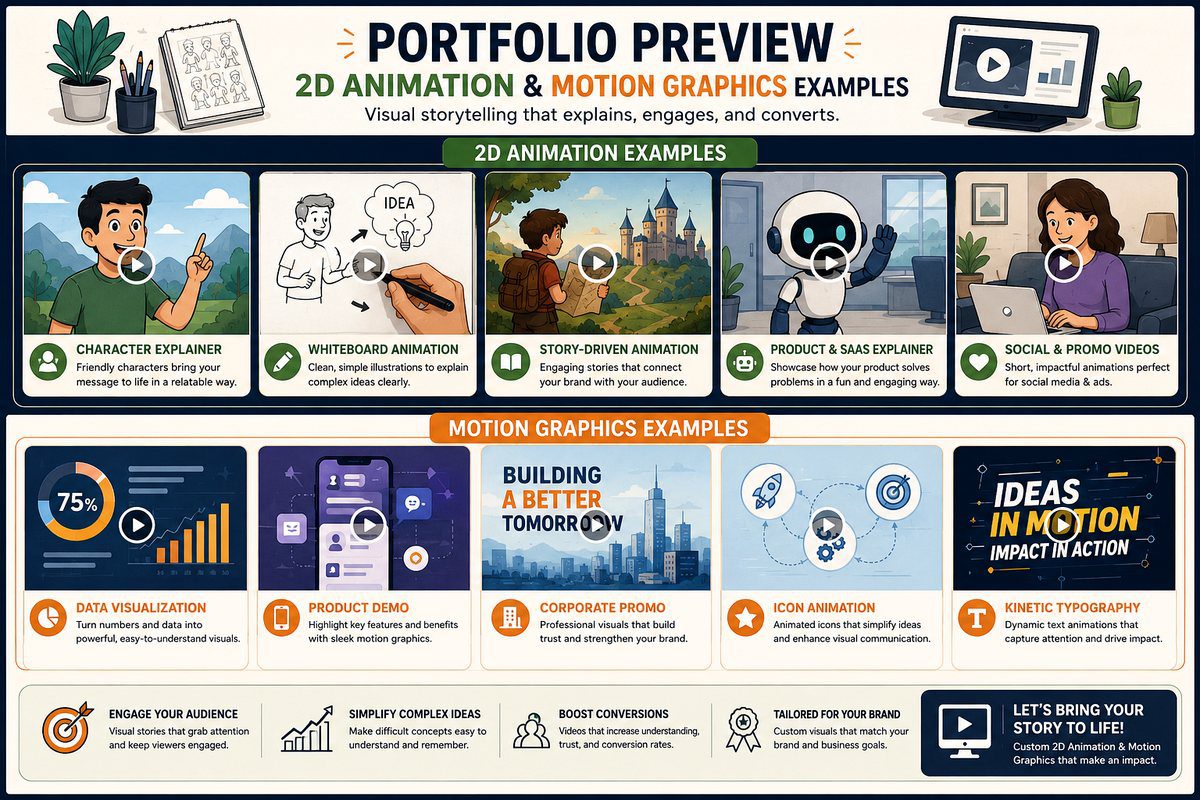
Magic Motion Studio has produced both 2D character animation and motion graphics across more than 1,000 projects for SaaS companies, healthcare brands, startups, and enterprise clients. The full portfolio spans both styles across every major industry vertical.
View the full Magic Motion Studio portfolio to see both styles in production, including examples from fintech, healthcare, consumer apps, and B2B tech.
How to Brief Your Studio: 5 Questions to Answer Before You Choose
The 2D animation vs motion graphics decision becomes straightforward once you can answer these five questions. Bring your answers to any studio brief and they will be able to recommend the right format immediately.
What is the primary goal of this video?
If the goal is to explain a process or show a product, lean toward motion graphics. If the goal is to build emotional connection or tell a brand story, lean toward 2D animation.
Who is the audience and what tone do they expect?
A procurement manager at a FTSE 100 company expects a professional tone. Motion graphics. A parent choosing a health app for their child expects warmth and trust. 2D animation.
Where will this video live and will it be watched with sound?
Silent social media environment: motion graphics. Landing page with deliberate viewers: either style. Investor presentation: 2D animation.
Will the content need updating in the next 12 months?
Evolving SaaS product, changing pricing, updating statistics: motion graphics. Evergreen brand story or investor narrative: either style is appropriate.
Is there a character or brand mascot involved?
If yes, the answer is 2D animation. Motion graphics has no mechanism for character-based brand identity. If the brand relies on a character or mascot, that character needs to live in 2D animation.
Frequently Asked Questions: 2D Animation vs Motion Graphics
Ready to commission the right style for your project?
View all Magic Motion Studio packages for both 2D animation and motion graphics. Published pricing, 14-day delivery, no discovery call required.
Video marketing statistics sourced from Wyzowl State of Video Marketing 2026. Last updated July 2026.
Related Guides
- What Is 2D Animation? Complete Guide for Businesses
- What Are Motion Graphics? Guide for Businesses
- What Is an Explainer Video? Types, Styles and Examples
- 2D Animation Styles: Flat Design, Frame-by-Frame, Cutout and More
- How Long Does 2D Animation Take to Produce?
- Explainer Video Examples That Convert: 12 Real-World Results
- 2D Animation Cost: Complete Pricing Guide for Businesses