
Internal Comms Video: Animated vs Talking Head
The research does not establish that either format is generally better, which is awkward for the many animation studios who publish guides saying otherwise. A 2025 study of 358 participants found no statistically significant difference between the two on knowledge transfer. A 2022 study found something more interesting: the talking head reduced factual recall while increasing viewer satisfaction. Viewers liked it more, believed they had learned more, and remembered less. So the useful question for an internal comms video is not which format performs better. It is whether your message needs a sender or a subject.
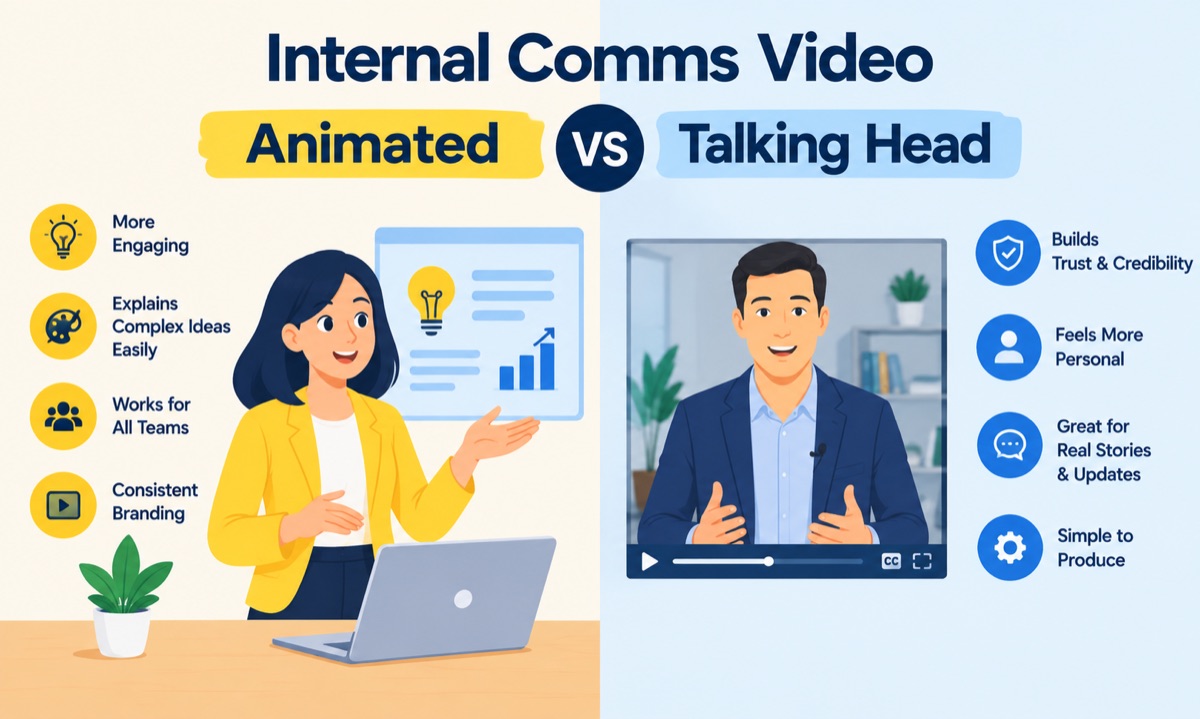 motion graphics alongside a talking head leadership message for employee communication" loading="lazy">
Neither format wins outright. The best available evidence finds them equally effective for knowledge transfer, with competing advantages that cancel out.
Liking is not learning. One controlled study found the talking head improved satisfaction and perceived learning while reducing actual recall.
Stop surveying employees on format preference. It measures enjoyment, not comprehension, and the two can move in opposite directions.
Ask whether the message needs a person attached. If who is saying it matters, film it. If what is being said matters, animate it.
Talking heads expire. The video is tied to one individual, and organisations are not.
Almost every published comparison of internal comms video formats is written by a studio that produces one of them, and each reaches the conclusion its business model requires. We produce animation, so the same warning applies here. What follows tries to be useful anyway by reporting what the research found, including where it does not support the conclusion our own industry prefers.
This guide sits under our broader overview of motion graphics for corporate communication, which covers audience segmentation, distribution channels and accessibility across internal communications. This piece goes deeper on the one question that guide does not resolve: which format to use.
What the Research on Internal Comms Video Actually Found
Two controlled studies bear directly on the internal comms video format question, and they do not say the same thing. Reporting both honestly is more useful than picking the one that suits a preferred conclusion.
No significant difference between formats
Published in the British Journal of Health Psychology, this study tested 358 participants representative of the German population, using a two by three between-subjects design across video format and topic.
It found no statistically significant difference between animated and talking head video on any primary measure.
Knowledge: F(2, 352) = 0.10, p = .749
Evaluation: F(1, 352) = 0.16, p = .898
Intention to share: F(1, 352) = 0.12, p = .727
The authors concluded that both formats can be considered equally effective for science communication.
The talking head reduced recall
Published in Computers and Education under the title Like it or learn from it, this experiment had 112 participants watch eight short narrated-slide videos, varying whether a talking head was present.
It used free recall questions rather than multiple choice, which is a harder test because the viewer must retrieve information rather than recognise it.
The presence of a talking head had a detrimental effect on recall of factual knowledge. It simultaneously raised satisfaction ratings and perceived learning.
Why both internal comms video studies can be right
The 2025 authors offered an explanation that reconciles the findings. Animation should theoretically reduce cognitive load, because there is less irrelevant visual information competing for attention. A talking head should theoretically strengthen engagement, because human faces carry social cues that support attention and connection.
In their data, those two advantages appeared to cancel each other out, producing comparable outcomes overall. The 2022 study, using a harder recall test and isolating the talking head as a variable, was able to detect the cognitive load cost that the broader comparison absorbed.
For anyone planning an internal comms video, the practical reading is that format choice is not a lever that reliably improves comprehension on its own. What it does change is where the effort goes and what the message signals.
The Paradox That Should Change How You Survey Staff
The 2022 finding deserves isolating, because it has a direct operational consequence for anyone commissioning an internal comms video.
Teams commissioning an internal comms video routinely ask employees which format they prefer, and routinely treat the answer as evidence about what works. The study above suggests that is precisely backwards for comprehension-driven content. Staff will tell you they preferred the video with the executive in it, report that they understood it well, and score worse on what it actually said.
Stop asking whether employees liked the internal comms video. Ask two or three specific questions about its content shortly after viewing.
This costs almost nothing, takes a minute of the viewer's time, and produces a number that means something. It also gives you evidence you can take to a budget holder that survives a challenge, which a satisfaction score does not.
If you genuinely want to compare formats in your own organisation, run the same message both ways to different groups and compare comprehension. That is the only method that gives an answer about your audience rather than about a research sample.
None of this means satisfaction is worthless. For culture, recognition and leadership content, how people feel about the message is a legitimate objective in its own right. The error is using a satisfaction measure to judge whether a policy explanation landed.
What the Internal Comms Video Research Does Not Tell You
Before applying either study to an internal comms video decision, it is worth being clear about what they do and do not cover, because overreading them is as unhelpful as ignoring them.
| Limitation | Why it matters for internal comms |
|---|---|
| Neither study tested workplace communication | Both examined science and educational communication. Employees receiving a message from their own employer have a relationship with the sender that a research participant watching a stranger does not |
| The presenters were not known to viewers | This is the crucial gap. The talking head advantage in an organisation comes largely from the viewer knowing who the person is. An unfamiliar presenter cannot generate that |
| Videos were short and single-topic | Findings may not extend to longer mandatory content such as compliance modules |
| Viewing was voluntary and attentive | Research participants watch properly. Employees watch between tasks, often on a phone, frequently muted |
| Recall was tested immediately | Neither study addresses retention weeks later, which is what most internal communication actually needs |
| Emotional and trust outcomes were not the focus | For leadership and culture content, the objective is not recall at all, so neither study speaks to it directly |
Limitations noted so the findings are applied at the right strength. Both remain the best controlled evidence available on this comparison.
Why the familiarity gap matters most for an internal comms video
Of everything above, the second row does most of the work for an internal comms video. In both studies the person on screen was a stranger to the viewer. In an organisation, the person on screen is frequently someone the employee knows, reports to, or has at least seen at an all-hands meeting.
That changes the social cue mechanism substantially. A familiar leader carries authority, accountability and context that an unknown presenter cannot, and it is reasonable to expect the talking head's advantage in an internal comms video to be larger than the research measured, while its cognitive load cost stays roughly the same.
The honest conclusion is therefore slightly more favourable to the talking head than the raw findings suggest, for the specific case where the viewer knows the speaker. It says nothing in favour of filming an unfamiliar presenter reading a policy update, which is the format's most common misuse.
The Real Internal Comms Video Question: Sender or Subject
If neither internal comms video format reliably wins on comprehension, the decision has to be made on something else. The most useful test is whether the identity of the person delivering the message is part of the message.
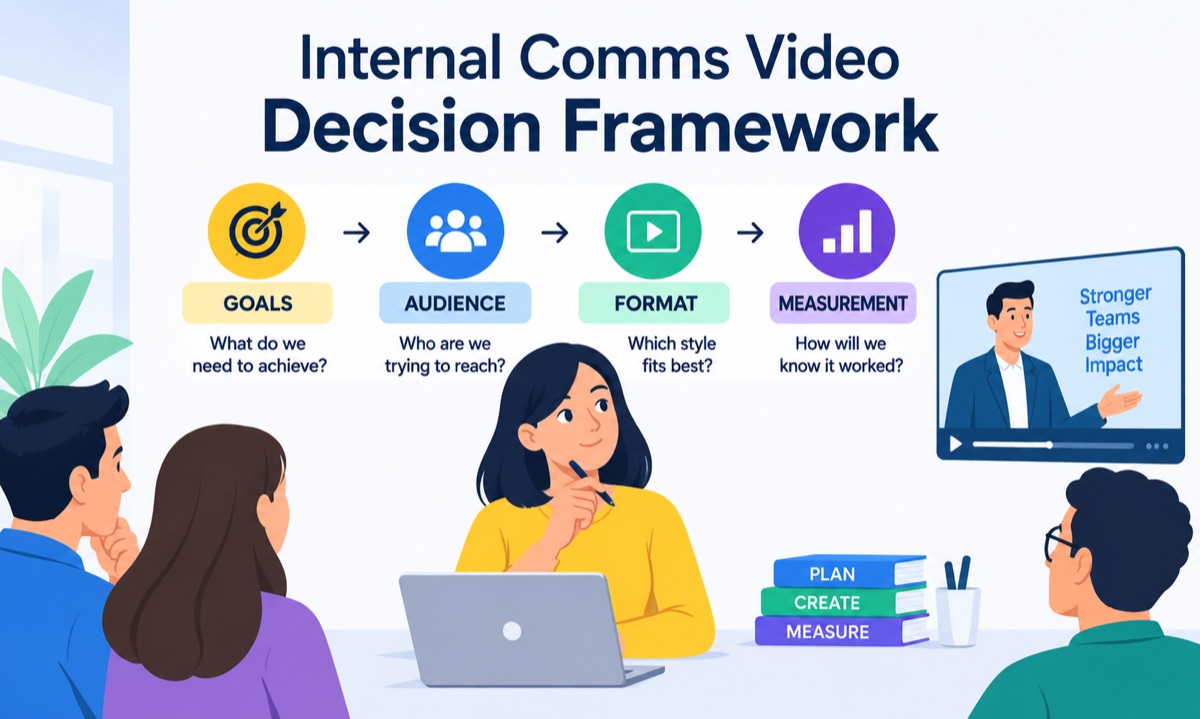
Film it
The message is inseparable from who is delivering it. Removing the person removes the point, and an animated treatment reads as the organisation declining to front up.
- Leadership messages during uncertainty
- Restructures, redundancies and difficult news
- Anything requiring visible accountability
- Apologies and responses to incidents
- Recognition and colleague stories
- Introducing a leader people will actually meet
Animate it
The information is the point and the speaker is incidental. These subjects frequently have no filmable form at all, and benefit from sequential visual explanation.
- Process and workflow changes
- Policy detail and compliance content
- Organisational structure changes
- Benefits, thresholds and calculations
- Systems training and adoption
- Safety procedures and data
Applying the test
Read your script and ask whether it would mean materially less if a different person delivered it. A message that says the organisation is restructuring and the chief executive takes responsibility for how that is handled means less from anyone else, and means least of all from an animated figure. A message explaining how the new expenses threshold works means exactly the same regardless of who speaks it.
The awkward cases are the ones where leadership wants visibility on content that is genuinely informational. A chief executive explaining a new payroll system is using their presence to signal importance while attaching it to material that would be clearer animated. The hybrid structure below exists precisely for that situation.
What a Talking Head Internal Comms Video Does That Animation Cannot
The 2026 Edelman Trust Barometer reported that "my employer" is the most trusted institution measured, at 78 percent, standing 14 points ahead of business generally at 64 percent and 25 points ahead of government at 53 percent.
For an internal comms video that is both a significant asset and a significant exposure. Employees extend more trust to their own organisation than to almost anything else, which means internal messages start from an unusually favourable position and also that mishandling one costs more.
Visible leadership is one of the mechanisms through which that trust is maintained. A leader who appears on camera during a difficult period is doing something an animated explanation cannot: accepting the discomfort of being seen. The social cues the research identifies as the talking head's theoretical advantage are exactly what that situation requires.
The absence signal
There is a version of this that is easy to miss when choosing an internal comms video format. When an organisation announces something difficult and chooses an animated internal comms video to do it, employees notice. The format itself communicates that nobody was willing to say it directly, and that reading is usually correct.
Animation has an intrinsic distancing quality. On a process explanation that is a feature, because it removes irrelevant personality from the information. On a redundancy announcement it is a liability, and no amount of production quality fixes it.
What Animation Does That a Talking Head Internal Comms Video Cannot
The case for animation in an internal comms video is strongest where the subject has no visible form, where the content must persist, and where it must travel.
| Requirement | Why animation wins |
|---|---|
| Invisible subjects | Organisational structures, process flows, benefit calculations and system logic have no filmable form. A person describing a shape is slower and less accurate than showing it |
| Sequential revelation | Information can be introduced one element at a time, with earlier elements retained on screen as context. A speaker delivers the same content linearly with nothing visible to anchor it |
| Multiple languages | Voiceover and on-screen text are replaced. A filmed presenter cannot be localised without dubbing over visible lip movement or reshooting |
| Frequent updating | Guidance changes are an asset and script revision. The filmed equivalent means recalling the presenter and matching the original setup |
| Long asset life | No dependency on any individual remaining with the organisation |
| Consistency at scale | A design system produces a library that looks like one organisation. Filmed content varies with location, lighting and who was available |
| Sensitive scenarios | Safety incidents, near misses and misconduct examples can be depicted without real people, at a controllable level of confrontation |
Format advantages, not effectiveness claims. The research does not support a general claim that animation improves comprehension.
Deciding between formats for a real campaign?
Magic Motion Studio produces internal comms video for organisations across Australia and the USA.
The Executive Turnover Problem
This is the internal comms video cost most consistently underestimated at commissioning, because it arrives years after the invoice.
A talking head internal comms video is tied to one individual. Organisations outlast individuals. When the person in the video leaves, the asset becomes dated at best and actively problematic at worst, particularly if the departure was contentious or the video concerned a strategy that has since been abandoned.
Onboarding libraries are the most exposed. A new starter in week one meeting a leader who left eighteen months ago receives a clear signal about how current the organisation's materials are, and it is not a good one. The same applies to compliance and policy content, where a presenter who has moved on undermines confidence that the policy itself is current.
Decide the intended lifespan at commissioning. Content expected to last years should not depend on one person's tenure. Content addressing a specific moment can, because it is meant to be of its moment.
Split hybrid pieces cleanly. Where a leader introduces informational content, keep the introduction as a discrete segment that can be replaced without rebuilding the rest.
Prefer role to individual where possible. A message delivered by whoever holds a role, framed around the role rather than the personality, survives a change of occupant more gracefully.
Set a review trigger. Departure of anyone appearing in published internal content should prompt a review, not a discovery months later.
The Hybrid Internal Comms Video Structure
Most substantial internal comms video projects need both formats, and the effective structure is not blending them but segmenting them by function.
The standard internal comms video pattern opens with the leader on camera, briefly, establishing that the organisation is fronting the message and why it matters. It then moves into animation for the substance, where the process, structure or calculation is explained. It returns to the leader to close, with the action required and an acknowledgement of what the change means for people.
This gives each format the job it is genuinely better at. The social cues and accountability come from the person. The sequential explanation and retained visual context come from the animation. It also solves the awkward case identified earlier, where leadership wants visibility on informational content.
Getting the internal comms video proportions right
- Keep the opening under thirty seconds. Its job is to establish who is speaking and why, not to deliver the content.
- Give animation the majority of the runtime where the message is informational, since that is the part the viewer needs to retain.
- Make the closing specific. One action, clearly stated, from the person who is accountable for it.
- Keep the segments technically separable so the filmed portions can be replaced without touching the animation.
Accessibility and Localisation in Internal Comms Video
The two internal comms video formats carry different obligations and different costs once accessibility is taken seriously, and this is where an internal comms video differs sharply from marketing content. Failing to make workplace information accessible can constitute a failure to provide equal access rather than a missed engagement opportunity.
| Consideration | Talking head | Animated |
|---|---|---|
| Captions | Required, straightforward to produce | Required, can be designed into the frame |
| Audio description | Rarely needed, little visual-only information | Needed if visuals carry information the narration omits |
| Caption placement | Constrained by the frame as shot | Composition can reserve space for captions |
| Colour contrast | Set by the location and lighting | Fully controllable at design stage |
| Additional languages | Dubbing over visible speech, or reshoot | Voiceover and text replacement |
| Sign language | Inset interpreter requires frame space planned in advance | Layout can accommodate an inset from the outset |
| Transcript | Direct from the spoken script | Must include information shown only visually |
Both formats can be made fully accessible. The difference is where the work falls and how cheaply it can be retrofitted.
The practical asymmetry is that an animated internal comms video lets accessibility be designed in, whereas filmed content largely inherits whatever the shoot produced. A talking head recorded without considering caption placement or an interpreter inset leaves limited options afterwards. The wider treatment of this sits in our guide to motion graphics for corporate communication.
Measuring Which Internal Comms Video Format Worked
| Measure | Use it? | Why |
|---|---|---|
| Format preference survey | No | Measures enjoyment. The research shows it can move opposite to recall |
| Satisfaction rating | Only for culture content | Legitimate where feeling is the objective, misleading for comprehension |
| Comprehension check | Primary | Two or three questions shortly after viewing. The only direct test |
| Action completion | Primary | Policy acknowledgement, enrolment, system login. Behaviour beats opinion |
| Query volume change | Strong | Fewer repeat questions on the topic indicates the message landed |
| Reach as share of population | Yes | The audience is fixed and known, so raw views mean little |
| Completion rate | Secondary | Useful for voluntary content, meaningless for mandatory |
For measurement design more broadly see our guide on measuring explainer video ROI.
If you want a defensible answer about internal comms video for your own organisation, the method is a split test on the same message. Send the animated version to one population and the filmed version to another, matched as closely as practical, then compare comprehension scores. That is more effort than a preference poll and it produces something a budget holder cannot dismiss.
Six Mistakes in Internal Comms Video Format Choice
1. Surveying staff on preference and calling it evidence
Asking which format employees liked, then using the answer to justify a format decision for comprehension-driven content. The research directly contradicts this approach.
Fix: ask two or three content questions instead, and report comprehension.
2. Animating a message that needed a person
Delivering a restructure, a redundancy programme or an incident response as an animated explainer. Employees read the absence of a person accurately.
Fix: apply the sender test. If the message would mean less from someone else, film it.
3. Filming a message that needed a diagram
An executive describing a new organisational structure or a benefit calculation in words. The information has a shape, and speech cannot show a shape.
Fix: keep the leader for the framing and animate the substance.
4. Ignoring lifespan at commissioning
Building a long-lived onboarding library around executives who will not all still be there in two years.
Fix: decide intended lifespan first, and animate anything expected to persist.
5. Treating accessibility as a post-production task
Filming without planning caption placement or an interpreter inset, then discovering the frame offers no room.
Fix: resolve accessibility requirements before the shoot or the storyboard.
6. Choosing a house format
Standardising on one approach for all internal communication because it simplifies procurement. It guarantees that half the content is in the wrong format.
Fix: standardise the visual system, not the format, so both look like one organisation.
Bringing It Together
The honest position on internal comms video format is that the evidence does not hand you an answer. Two controlled studies found either no meaningful difference between the formats or a trade-off in which the talking head improved how viewers felt while reducing what they retained. Anyone claiming one format is simply better is either unaware of that literature or selling something.
What the evidence does give you is a better internal comms video question. Decide whether the identity of the speaker is part of the message. If it is, film it, and accept a modest comprehension cost in exchange for accountability and social presence. If it is not, animate it, and put the effort into sequencing the information well.
And measure the right thing afterwards. The internal comms video that everyone enjoyed is not automatically the one that worked. The single most useful change most internal communications teams could make is to stop asking employees whether they liked a video and start asking them what it said.
For related guidance see our overview of motion graphics for corporate communication, the corporate explainer video page for external-facing work, what motion graphics are, what an explainer video is, and our production process.
Frequently Asked Questions
The research does not establish that either is generally better. A 2025 study in the British Journal of Health Psychology tested 358 participants and found no statistically significant difference between the formats on knowledge transfer, evaluation or intention to share, concluding both can be considered equally effective. A separate 2022 study in Computers and Education found the talking head reduced factual recall while increasing satisfaction. The useful question is not which format performs better but whether your message needs a person attached to it.
Because preference and effectiveness come apart. The 2022 study, titled Like it or learn from it, used free recall testing with 112 participants and found the presence of a talking head reduced recall of factual knowledge while raising satisfaction and perceived learning. Viewers enjoyed the format more, believed they had learned more, and actually remembered less. A team that surveys staff on preference and treats the answer as evidence of comprehension is measuring the wrong thing.
When the identity of the sender is part of the message: leadership messages during uncertainty, restructures and redundancies, anything requiring visible accountability, apologies and incident responses, and recognition or colleague stories. In these cases the absence of a person is itself a message, and an animated treatment reads as the organisation declining to front up. The social cues the research identifies as the talking head's advantage are exactly what these situations need.
When the subject matters more than the sender. Process explanation, policy detail, structure changes, benefit calculations, systems training, safety procedures and data all favour animation, because these subjects have no filmable form and benefit from sequential visual explanation. Animation is also stronger where content must run in several languages, will need updating as guidance changes, and must outlive the tenure of any particular executive.
It becomes a liability, and this is the most underestimated cost of the format. The video is tied to one individual while organisations outlast individuals. When that person leaves, the asset is dated at best and confusing at worst, especially if the departure was contentious. Onboarding libraries are most exposed, since a new starter meeting a leader who no longer works there learns something unflattering about how current the materials are. Animation carries no such dependency.
Test recall rather than preference, since the research shows the two can point in opposite directions. Ask two or three specific comprehension questions shortly after viewing rather than asking whether staff liked it. Where the objective is behavioural, measure the action the video was meant to produce, such as policy acknowledgement or reduced query volume. To compare formats properly, run the same message both ways to matched groups and compare comprehension, which is the only method that answers the question for your own audience.
Sources
- Marx et al. Comparing the effectiveness of animated videos and talking-head videos in science communication. British Journal of Health Psychology, 2025. PMC11840882
- Sondermann and Merkt. Like it or learn from it: Effects of talking heads in educational videos. Computers and Education, 2022.
- 2026 Edelman Trust Barometer. Trust in "my employer" reported at 78 percent, against business at 64 percent and government at 53 percent.
Internal comms video, matched to the message
Magic Motion Studio produces animated and hybrid internal comms video for organisations across Australia and the USA.