
Residential vs Commercial Real Estate Video: The Real Differences
The difference is not production budget or drone footage. It is that the two audiences are doing completely different jobs. A residential buyer is choosing where to live, a decision made largely on feeling and justified afterwards. A commercial buyer is underwriting an income stream, a decision made on numbers and then defended to other people. Everything else follows from that single divergence: pacing, length, music, what appears on screen, how many people approve it, where it is distributed, and how long it survives. A commercial real estate video built with residential technique does not merely underperform. It signals to a professional buyer that you do not understand the asset.
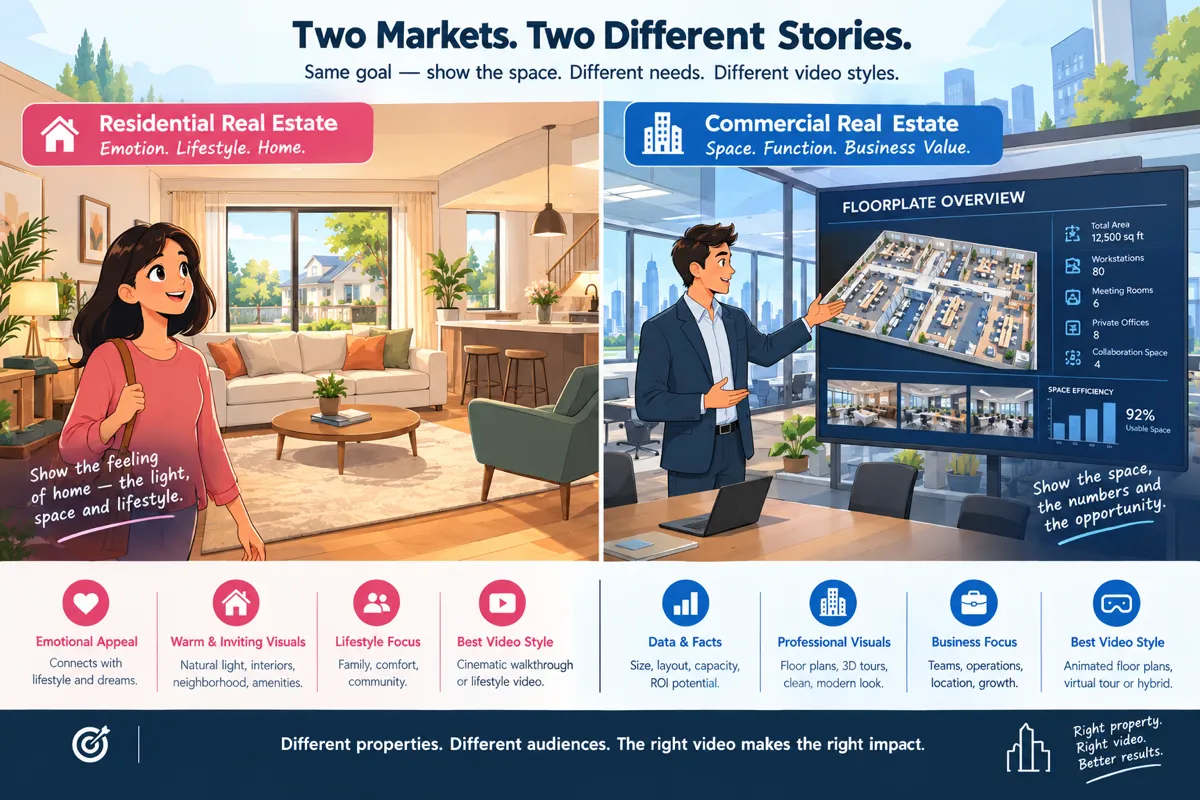
Feeling versus underwriting. One viewer imagines living somewhere. The other builds a case they will have to defend to an investment committee.
Length is structural, not stylistic. Residential works at 60 to 120 seconds. Commercial commonly needs three to five minutes, and judging it on completion rate is misleading.
The cap rate hides the risk. Two assets can show identical returns with completely different income security behind them. That gap is exactly what a commercial real estate video can make visible.
Approval chains differ enormously. Residential is vendor and agent. Commercial can involve asset management, leasing, ownership and fund compliance.
They disappear differently. Residential videos are removed on sale. Commercial video frequently never becomes public at all.
Most published guidance on commercial real estate video and its residential counterpart reduces the question to a style note: residential is warm and emotional, commercial is sharp and factual. That is true and nearly useless, because it describes the output without explaining the cause, which leaves anyone briefing the work guessing at where the line actually sits.
The cause is the buyer's task. Once that is clear, every other decision follows without needing a rule. For the format question underneath all of this, see our comparison of animated real estate video and property walkthroughs, and for development pre-sales specifically, how developers use explainer videos to pre-sell.
The Audience Gap Behind Every Commercial Real Estate Video
The audience for a commercial real estate video is not a scaled up version of a home buyer. A residential buyer is making a decision about their own life. They will live in the property, their children may go to school nearby, and they are imagining mornings in the kitchen. The decision is emotional first and rationalised afterwards, which is not a criticism but a well understood feature of how people buy homes. Nobody has to justify the purchase to a committee.
A commercial buyer is making a decision about capital. They will probably never occupy the building. What they are buying is a contracted income stream secured against a physical asset, and they will have to present the case to partners, a credit team, or an investment committee who will ask questions the video needs to have already answered.
That difference produces two almost opposite briefs. Residential video succeeds by reducing information and increasing feeling. A commercial real estate video succeeds by increasing information while keeping it navigable. Applying either approach to the other audience fails in a predictable direction: residential technique on commercial assets reads as unserious, and commercial technique on a family home reads as cold.
The viewer's question
Can I see myself living here? Does it feel right? Is it worth booking an inspection on a Saturday morning?
They are browsing, comparing on feel, and deciding in seconds whether to keep watching. They are not looking for specifications. They are looking for recognition.
The viewer's question
Does this income hold? What is the risk in the tenancy? Can I defend this acquisition to the people who have to approve it?
They have self selected, they are prepared to spend time, and they need detail they would otherwise have to request. Absent detail is a reason to move on.
Anatomy of a Residential Property Video
Unlike a commercial real estate video, a residential piece is a sequence of emotional beats, ordered roughly as a visitor would experience the property. The structure is conventional for good reason: it matches how someone imagines arriving.
The conventional structure
- Approach. Street, facade, first impression. Establishes the address.
- Entry. The threshold moment. Light, volume, the feeling of walking in.
- Living. The main gathering space, usually the emotional centre of the film.
- Kitchen. Frequently the deciding room. Shot slowly and generously.
- Primary suite. Privacy and retreat.
- Outdoor. Garden, terrace, pool. Lifestyle made literal.
- Neighbourhood. The street, the cafe, the walk. Buying a suburb as much as a house.
Why it looks the way it does
Slow camera movement. Drifting moves let the viewer's eye wander, which is what imagining feels like. Fast cutting prevents it.
Warm grading. Slightly warm colour reads as comfortable and inhabited. Neutral or cool reads as clinical.
Music over voiceover. Narration intrudes on a fantasy the viewer is constructing. Music supports it without directing it.
Minimal text. Specifications belong in the listing, not over the footage. On screen data breaks the spell.
Length of 60 to 120 seconds. The viewer is browsing many properties and has not committed to this one.
The most common residential failure is length. A four minute film of a family home is not thorough, it is a test of patience for someone comparing a dozen listings on a phone. The video's job is to earn an inspection booking, not to substitute for one.
Anatomy of a Commercial Real Estate Video
A commercial real estate video is not a tour. It is closer to a structured briefing, and the sequence follows the order a professional buyer assesses an asset rather than the order a visitor walks through it.
The assessment order
- Location and transport. Position within the market, access, infrastructure. Assessed first because it cannot be changed.
- Building presentation. Facade, entry, lobby. Quality signals to prospective tenants.
- Floorplate. Efficiency, configuration, column spacing, subdivisibility. The core of what is being sold.
- Services and structure. Ceiling heights, plant, power, connectivity, loading, parking.
- Tenancy. Who occupies it, the fitout condition, how the space is actually used.
- Amenity and end of trip. Increasingly material in office leasing decisions.
- The numbers. Area, income position, lease structure, delivered as on screen data.
Why it looks different
Steady, measured camera. The viewer is assessing, not dreaming. Movement serves orientation rather than mood.
Neutral grading. Accuracy matters more than warmth. A buyer will inspect, and a flattering grade that misrepresents the fitout damages credibility.
Text overlays throughout. Areas, heights, spans, distances. The viewer should not have to open the memorandum to follow along.
Voiceover is acceptable. Unlike residential, narration helps, because there is genuine information to convey.
Length of three to five minutes. The audience has self selected and will watch if the content earns it.
Marketing teams accustomed to consumer video often apply completion rate as the quality measure, and it produces the wrong conclusion on commercial assets.
A commercial real estate video is watched by a mixed audience: a small number of genuine prospects and a larger number of brokers, analysts and curious competitors. The genuine prospects watch to the end and then request the memorandum. Everyone else leaves early, which is correct behaviour and not a failure of the video.
Shortening a commercial video to lift completion rate typically strips out precisely the detail the real prospects were watching for.
What a Commercial Real Estate Video Must Show On Screen
This is the section that separates a commercial real estate video made by someone who understands the asset class from one made by a residential videographer working at larger scale.

Capitalisation rate, and what it conceals
The capitalisation rate is derived from net operating income divided by price, and it is usually the first question asked about an asset. It is also the number least able to be improved by video, because it is arithmetic.
What video can do is show what the cap rate does not. Two assets can present an identical cap rate while carrying entirely different risk: one leased to a strong national covenant with many years remaining, the other to a smaller operator with months left. The spreadsheet shows one number. The building, the fitout, the tenant's evident investment in the space and the quality of the occupancy tell the rest of the story.
Show: the tenancy as it actually operates, not an empty floor.
Lease expiry profile
Weighted average lease expiry, commonly abbreviated to WALE, has become a focal point in institutional due diligence, with longer profiles increasingly treated as an indicator of asset quality. Funds frequently target profiles of seven years or more, because a long runway buys time to refinance, re-lease vacancy and adapt the asset.
This is not a number a video can dramatise, but it is one the video should support. Footage that demonstrates a tenant is embedded, has invested in fitout, and is operating a real business in the space substantiates the expiry profile in a way a table cannot.
Show: evidence of commitment, not just occupancy.
Tenant covenant quality
Covenant and lease quality have become increasingly central to underwriting, because they determine how durable the contracted income actually is. With more expensive debt, buyers have less margin for error and weight secure cash flow more heavily.
Video's contribution is visible substantiation. A recognisable tenant, a substantial fitout, evident trading activity, and specialised infrastructure installed for that occupier all communicate that the tenant is not casually placed and is unlikely to leave easily.
Show: fitout investment and operational reality.
Floorplate efficiency and configuration
For office assets, how efficiently a floorplate converts to usable workspace directly determines what a tenant will pay. Column spacing, core position, depth from window to core and subdivisibility all matter, and none of them are conveyed by an attractive wide shot.
This is where a commercial real estate video benefits most from combining footage with animated floorplate diagrams, showing how a floor divides and how it configures for different occupier sizes.
Show: the floor as a diagram alongside the footage.
Physical specification
Ceiling height, clear span, floor loading, roller door access, hardstand, power supply and connectivity. For industrial and logistics assets these are frequently the entire decision, and they are trivially easy to show and surprisingly often omitted.
A measured shot with the specification on screen answers a question the buyer would otherwise have to ask, and every question removed from the process shortens it.
Show: the number over the thing the number describes.
Location as logistics, not lifestyle
Residential location content is about cafes and schools. Commercial property location content is about access: distance to motorway interchange, port or airport proximity, public transport for staff, and position relative to competing stock.
Aerial footage serves a genuinely different purpose in each. Residential aerials establish setting and privacy. Commercial aerials establish connectivity and context within a market.
Show: routes and distances, not scenery.
A Commercial Real Estate Video Is Not One Brief
Treating every commercial real estate video as a single brief is the second most common error after borrowing residential technique. A commercial real estate video for a logistics facility and one for a medical centre share almost nothing beyond a neutral colour grade, because the buyers are assessing entirely different sources of value.
| Asset class | What decides the purchase | What the video must show |
|---|---|---|
| Office | Floorplate efficiency, amenity, staff attraction, building services | Floor configuration and subdivisibility, lobby and end of trip, outlook, transport access for staff |
| Industrial and logistics | Physical specification and access, almost entirely | Clear height, column spacing, floor loading, roller doors, hardstand, truck turning, motorway proximity |
| Retail | Foot traffic, exposure, anchor tenancy, catchment | Passing trade, visibility from the street, anchor presence, car parking, surrounding activity |
| Healthcare and medical | Specialised fitout, compliance, tenant stickiness | Consulting suite configuration, services capacity, accessibility, the cost of the tenant relocating |
| Large format and showroom | Exposure, access, loading, zoning | Frontage, signage opportunity, parking ratio, delivery access |
Simplified. Individual assets and buyer types vary, and mixed use property blends several of these at once.
Why industrial gets the weakest commercial real estate video treatment
Industrial and logistics assets receive the weakest commercial real estate video treatment of any class, usually because the property photographs poorly and the brief defaults to making it look attractive. That is the wrong objective entirely. An industrial buyer is not assessing beauty, they are assessing whether their operation fits.
A commercial real estate video for a warehouse that shows clear height against a measurable reference, demonstrates truck access by following the route a vehicle actually takes, and displays floor loading and power supply on screen is doing more for the buyer than any amount of aerial footage at sunset. The specifications are the story, and they are easy to show.
Why healthcare rewards the tenant story
Medical and healthcare assets give a commercial real estate video an unusual advantage: the fitout cost of relocating a practice is high enough that tenants tend to stay. That stickiness is a significant part of the investment case and it is almost impossible to convey in a table.
This is where a commercial real estate video does something a memorandum cannot. Showing the specialised infrastructure, the consulting suite configuration and the evident capital a tenant has sunk into the space substantiates income durability in a way that a lease expiry date on its own does not.
Residential and Commercial Real Estate Video Side by Side
| Factor | Residential | Commercial |
|---|---|---|
| Buyer's task | Choosing where to live | Underwriting an income stream |
| Decision basis | Emotional, rationalised after | Analytical, defended to others |
| Typical length | 60 to 120 seconds | 3 to 5 minutes or more |
| Pacing | Slow, drifting | Measured, purposeful |
| Colour treatment | Warm, inviting | Neutral, accurate |
| Audio | Music led, rarely narrated | Voiceover common and useful |
| On screen text | Minimal, breaks immersion | Extensive, carries specification |
| Aerials | Setting and privacy | Connectivity and market context |
| Who approves | Vendor and listing agent | Asset manager, leasing, ownership, sometimes fund compliance |
| Approval timeframe | Days | Frequently weeks |
| Primary distribution | Portals, social, agent channels | Memoranda, broker portals, data rooms, direct outreach |
| Success measure | Inspection bookings | Qualified enquiry and memorandum requests |
| Shelf life | Until the property sells | Years, across multiple campaigns |
General patterns rather than rules. Mixed use assets and office leasing campaigns aimed at staff attraction legitimately blend the two approaches.
Producing for either side of the market?
Magic Motion Studio produces residential and commercial real estate video across Australia and the USA.
Why Commercial Real Estate Video Examples Are So Hard to Find
A note worth making about residential and commercial real estate video, because anyone researching the category runs into this immediately and it tells you something real about how the two markets work.
In preparing this comparison of residential and commercial real estate video we attempted to assemble a verified set of public examples, checking that each video resolved and that the publisher was who the source claimed. We abandoned the exercise. The examples that surfaced were dead links, vendor showreels, or content published by someone entirely unrelated to the property. We are not publishing a list of examples we could not verify.
The reasons are structural and they differ between residential and commercial real estate video.
Residential videos are transactional and get removed
A residential listing video markets one property for one campaign. When the property sells, the asset has served its purpose. Agencies routinely unlist or delete them, partly for housekeeping and partly because a channel full of sold stock is poor advertising. The video was never intended to persist.
There is also a practical consideration around vendor privacy. A video showing the inside of someone's home, now occupied by a new owner, is material many vendors prefer taken down once the transaction completes.
Commercial real estate video frequently never becomes public
A commercial real estate video is often distributed to a qualified audience rather than published. It sits inside an information memorandum, behind a confidentiality agreement, in a data room, or is sent directly to a shortlist of buyers the agent has identified. Public listing is sometimes actively undesirable, since a vendor may not want the market knowing the asset is being tested.
The result is that the highest quality commercial real estate video work is largely invisible, and what does surface publicly is skewed toward vendor showreels and smaller listings.
Residential: treat the video as consumable. It has a campaign life measured in weeks, so the production investment should be proportionate to the property's value and the likely campaign duration, not to how impressive the film could be.
Commercial: treat the video as an asset with years of life. The same building is remarketed as tenancies change, and a well made piece with modular sections can be updated rather than replaced. Budget accordingly, and make sure you own the project files so the next campaign can amend rather than rebuild.
Who Approves a Commercial Real Estate Video
Approval on a residential piece is simple: the vendor likes it or does not, the agent confirms, and it goes live. The cycle is days.
Commercial approval is a different exercise entirely. Depending on the ownership structure, a single video may need sign-off from the asset manager, the leasing team, the campaign agent, the property owner and, where the asset sits inside a fund, the fund manager and sometimes compliance.
The constraint on a commercial real estate video that surprises marketing teams most is consistency with the formal documents. Any figure appearing on screen has to reconcile with the information memorandum. An area quoted one way in the video and another way in the memorandum is not a design inconsistency, it is a discrepancy in material a buyer is relying on, and it will be raised in due diligence.
For any component depicting unbuilt space, whether a proposed fitout, a refurbishment or a development stage, the accuracy standards discussed in our guide to animated real estate video and property walkthroughs apply directly, including the Australian case law on misleading depictions of property that does not yet exist.
Budget approval time honestly in a commercial campaign. It is frequently longer than production, and a timeline that assumes a week for something that reliably takes a month is not a schedule.
It also argues for locking on screen figures early and treating them as a data set approved once, rather than as copy that can be tweaked in the edit. Every change to a number restarts a reconciliation.
Briefing a Residential and a Commercial Real Estate Video
Residential brief checklist
- Name the buyer you are targeting: downsizer, first home, family upgrader. They respond to different rooms.
- Identify the property's single strongest feature and build the film around it.
- Confirm styling and vacancy before scheduling. A cluttered house cannot be rescued in the grade.
- Set the length at 60 to 120 seconds and resist expanding it.
- Decide the neighbourhood content: which three local places genuinely matter.
- Plan the vertical cut at the same time, not afterwards.
- Agree what happens to the video once the property sells.
Commercial brief checklist
- State the asset class. Office, industrial, retail and healthcare each have different decisive factors.
- Name the buyer type: owner occupier, private investor, syndicate or institution.
- Supply the figures that will appear on screen, reconciled against the memorandum, before production.
- Confirm what may be disclosed publicly and what is memorandum only.
- Identify the tenancies that can be filmed and secure occupier permission early.
- List the specifications that matter for this asset class and plan a shot for each.
- Decide whether floorplate diagrams are needed alongside footage.
- Map the approval chain and put realistic durations in the schedule.
Measuring a Commercial Real Estate Video Correctly
| Measure | Residential | Commercial |
|---|---|---|
| Primary metric | Inspection bookings per listing view | Qualified enquiry and memorandum requests |
| Completion rate | Useful, audience is browsing | Misleading, most viewers are not prospects |
| View count | Weak but indicative of reach | Largely meaningless, audience is small by design |
| Watch time | Secondary | Strong signal, a long watch indicates genuine assessment |
| Enquiry quality | Matters less, volume helps | The whole point, one right buyer is the outcome |
| Campaign duration | Days on market | Time to qualified shortlist |
Set the measure before the campaign. For measurement design more broadly see our guide on measuring explainer video ROI.
The critical distinction is that a commercial real estate video with a small audience and one serious buyer has succeeded, while a residential campaign with the same numbers has failed. Applying a single reporting template across both categories guarantees that one of them is judged wrongly.
Six Mistakes in Residential and Commercial Real Estate Video
1. Residential technique on a commercial asset
Drifting camera moves, warm grading and emotive music on an industrial facility or office floor. To a professional buyer this signals that the agency does not understand what is being sold.
Fix: measured pacing, neutral grade, specification on screen.
2. Commercial technique on a family home
Specification overlays, clipped pacing and narration over a residential listing. It reads as a rental inspection rather than an invitation.
Fix: strip the data, slow the movement, let the music carry it.
3. Empty floors in commercial video
Filming vacant tenancies because they look cleaner. It removes the single most persuasive evidence available, which is a real occupier operating a real business in the space.
Fix: negotiate tenancy filming access early, and show the space working.
4. Figures that do not reconcile
An area or income figure on screen that differs from the memorandum. It surfaces in due diligence and damages credibility at the worst possible moment.
Fix: approve the on screen data set once, before production, and lock it.
5. Judging commercial video on completion rate
Cutting a commercial real estate video shorter to improve a metric that is measuring the wrong audience, and losing the detail the actual prospects wanted.
Fix: report qualified enquiry, and use watch time rather than completion.
6. Treating both as the same product line
Agencies running both sides of the market with one video template, one length and one reporting format.
Fix: maintain two separate specifications, briefs and measurement frameworks.
Bringing It Together
The distinction between residential and commercial real estate video is not aesthetic preference dressed up as strategy. It follows from the fact that one viewer is choosing a life and the other is assessing an income stream, and those tasks demand opposite things from a film.
Residential works by removing information so feeling has room. A commercial real estate video works the other way. Commercial works by adding information while keeping it followable. Get that the wrong way round and the failure is not subtle: the commercial buyer concludes you do not understand the asset, and the home buyer concludes the property is uninviting.
For related guidance see our real estate explainer video overview, how developers use explainer videos to pre-sell, what an explainer video is, examples that convert, and our production process.
Frequently Asked Questions
The audience is doing a fundamentally different job. A residential buyer is choosing where to live, a decision made largely on feeling and justified afterwards, so the video works by helping them imagine themselves in the space. A commercial buyer is underwriting an income stream, a decision made on numbers and defended to other people, so the video works by giving them the information to build a case. Pacing, length, music, on screen data, approvals and measurement all follow from that.
Longer than residential, for structural rather than stylistic reasons. Residential works best between 60 seconds and two minutes because the viewer is browsing. Commercial commonly runs three to five minutes or more because the viewer has self selected and needs floorplate detail, services, tenancy information and location logistics. A commercial viewer who stops at ninety seconds was probably never a prospect, so optimising for completion rate is actively misleading.
The detail that determines income durability: net lettable area and floorplate efficiency, ceiling heights and column spacing, services and building systems, parking and loading, transport proximity, tenancy profile and lease structure. Capitalisation rate follows from net operating income, but the cap rate alone does not reveal the risk behind it. Two assets can show identical cap rates while one is leased to a strong covenant with a long term remaining and the other to a weaker tenant with months left, and that is exactly the difference video can make visible.
The two categories disappear for different reasons. Residential listing videos are transactional and usually removed once the property sells, since they market a listing rather than a brand, and vendor privacy is a further consideration. Commercial video frequently never becomes public, because it is distributed inside information memoranda, broker portals and data rooms to a qualified audience. Agency content is also fragmented across hundreds of franchise channels. The practical consequence is that published example lists in this category are frequently full of dead links.
Considerably more people than a residential one. Residential is typically vendor and listing agent, which takes days. Commercial may involve the asset manager, leasing team, campaign agent, property owner and, where the asset sits in a fund, the fund manager and sometimes compliance. Any figure on screen also has to reconcile with the information memorandum, because a discrepancy between marketing material and formal disclosure creates a problem beyond marketing. Budget approval time honestly, as it is frequently longer than production.
No, and borrowing residential technique is the most common error in the category. Slow drifting moves, warm grading and emotive music signal lifestyle rather than investment, and to a professional buyer read as a lack of seriousness about the asset. Commercial work should be measured, well lit and information dense, with on screen text carrying specifications. The exception is amenity content for office leasing aimed at staff attraction, where lifestyle technique is legitimate because the eventual audience is employees rather than investors.
Two markets, two specifications, one studio
Magic Motion Studio produces residential and commercial real estate video across Australia and the USA.