
Anime Style Video for Brands
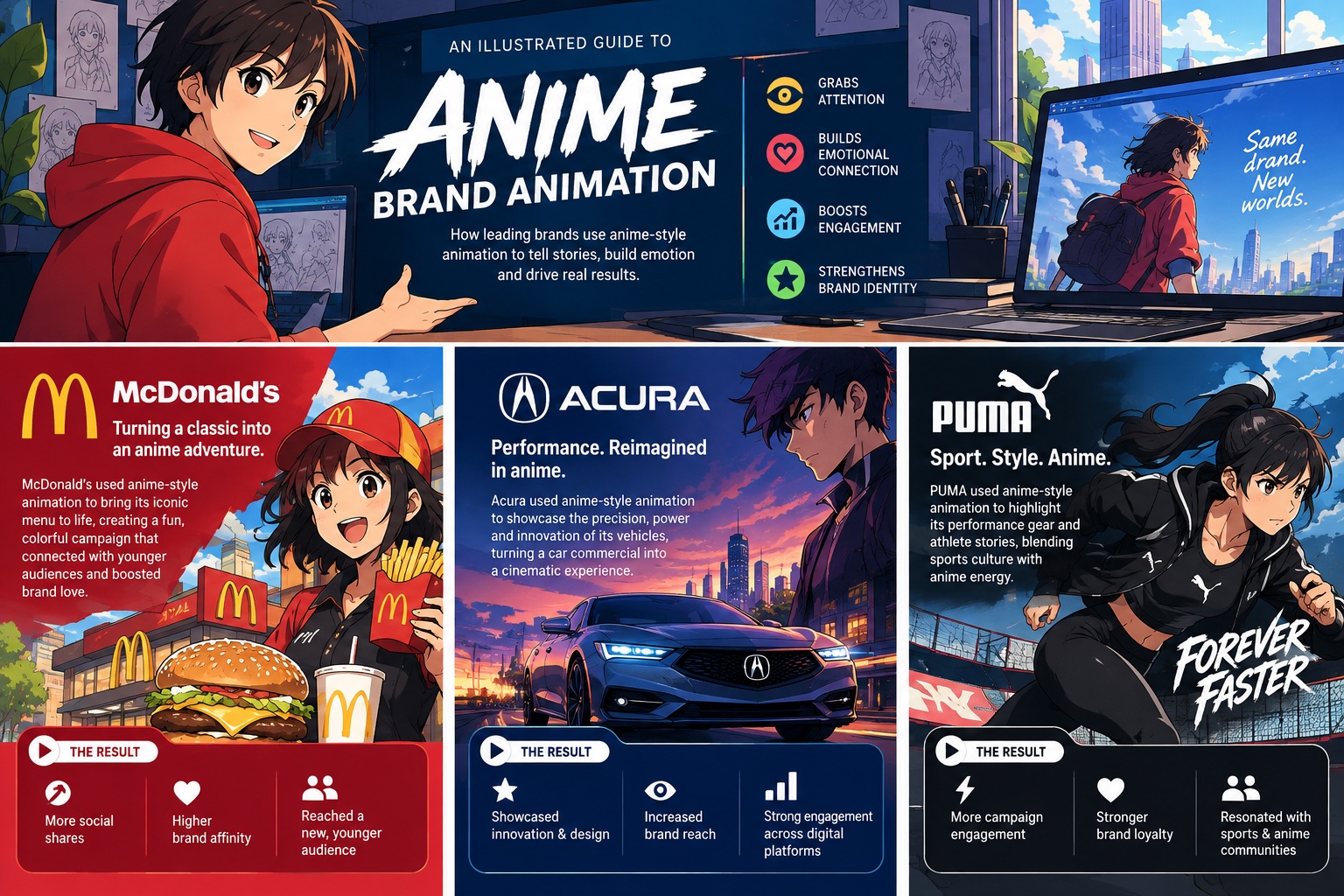
McDonald's ran it across 30 global markets. Acura built a multi-season series around it. PUMA used it to sell out a collaboration in days. Anime style video for brands is no longer a niche experiment. Here is what it takes, what it delivers, and how to commission it properly.
Why Anime Works for Brand Marketing Right Now
Most animation styles are visual choices. Anime is a cultural one. That distinction matters enormously for brand strategy. When a brand commissions anime style video for brands, it is not just selecting a look. It is choosing to speak directly to one of the most loyal, vocal, and share-driven fandoms on the internet.
Research by Getty Images VisualGPS found that anime fandom among Gen Alpha and Gen Z globally stands at 54%, nearly on par with Beyonce's fanbase at 56%. It is larger than the audiences for Formula 1 (52%), the Premier League (49%), and e-sports (43%). Crunchyroll subscriptions have tripled in recent years. Netflix has doubled down on its anime library. One in five Americans now watches anime according to a May 2026 Forbes report on global viewership data.
Nearly half of Gen Z and Millennials actively post anime-related content on social media. These are not passive consumers. They create, share, tag, and discuss anime content at a rate that most brand categories can only dream of achieving with paid media. When a brand produces something that credibly enters that aesthetic space, the organic amplification potential is substantial.
The engagement numbers reflect this. Anime-themed Instagram posts average a 4.2% engagement rate, more than double the platform average for general brand content. On TikTok, 155 million videos are tagged anime, making it one of the most populated content categories on the platform. Brands that produce content natively in that aesthetic, rather than borrowing superficially from it, earn meaningful shares from audiences who already love the style.
The key strategic insight: anime fandom is not a demographic. It is a psychographic. It crosses age groups, geographies, and income levels. The connecting thread is a deep emotional investment in the aesthetic, the storytelling style, and the community around it. Brands that respect that investment produce content that earns genuine audience loyalty. Brands that chase the surface aesthetic without that respect produce content that anime audiences recognise immediately and dismiss just as quickly.
This is why the brands doing this most successfully are not treating anime as a visual skin. McDonald's partnered with a Japanese manga artist and a professional anime studio. Acura built a multi-season narrative series with original characters. PUMA collaborated with an established anime IP. Each of those choices reflects a genuine engagement with what anime audiences value, not a shortcut to look culturally relevant.
Brands Already Doing It: Four Verified Campaigns
Before looking at formats and strategy, it is worth grounding this in what major brands have actually produced. These four campaigns are verified from primary and established news sources and represent different approaches to the same opportunity.
McDonald's launched "WcDonald's" in more than 30 global markets, activating around the fictional McDonald's stand-in that has appeared in anime since the 1980s. The campaign included manga-inspired packaging designed with artist Acky Bright and a four-episode original anime series produced with Studio Pierrot, one of Japan's most established animation studios. The campaign ran across social, digital, and in-store simultaneously, with the episodic content driving ongoing engagement across the run of the activation.
Acura produced a multi-season original anime series titled "Type S: Chiaki's Journey" built around the launch and positioning of the Acura Integra Type S. The series follows Chiaki, a young racing protege, and centres the vehicle as a narrative element rather than a product placement. Season two culminates at Pikes Peak, with the 2024 Integra Type S as the centrepiece of the story's climax. The series ran across Acura's owned channels and received coverage across automotive and anime media outlets simultaneously.
PUMA collaborated with the One Piece anime IP on a collection featuring four Suede designs inspired by the Four Emperors from the series: Straw Hat Luffy, Red-Haired Shanks, Blackbeard Teech, and Buggy the Genius Jester. The collaboration extended anime character aesthetics into product design rather than producing original animation, demonstrating that the anime visual language works across merchandise and brand identity as well as video content. The collection generated significant organic social traction within the One Piece fanbase before any paid media ran.
Kikkoman ran an anime-informed brand campaign specifically targeting Gen Z's growing affinity for Japanese culture and aesthetics, reported by Marketing Dive. The campaign positioned the brand's Japanese origins as a cultural asset rather than a background fact, using anime visual language to connect authentically with an audience already engaged with Japanese pop culture. This is a strong example of a heritage brand using anime aesthetics to refresh cultural relevance with a younger demographic without compromising the brand's existing identity.
The through-line across all four campaigns is authenticity of engagement with the aesthetic. None of these brands applied an anime filter to existing creative. Each made a deliberate production decision to engage with the style on its own terms, whether through professional anime studio partnerships, original character development, or IP collaboration with an established anime property.
Six Anime Video Formats That Work for Brands
The right anime style video for brands format depends on the campaign goal, the platform, and the story the brand needs to tell. These six formats cover the range from social media short-form through to long-form branded content.
A short video introducing an original anime-style character designed to represent the brand or product. The character becomes a recurring visual asset across multiple videos, social posts, and campaign materials, building recognition over time. Most effective for brands with a strong personality to express and a content calendar that can sustain the character across touchpoints.
A narrative-driven video telling the story behind a product, ingredient, or brand founding moment in anime visual style. The format borrows anime's strength in emotional storytelling and character journey to create brand content that communicates values without feeling like a product pitch. Kikkoman's use of Japanese cultural heritage is a real-world example of this approach at brand level.
A 15 to 30 second looping animation designed natively for Instagram Reels, TikTok, or YouTube Shorts. Vertical format, kinetic pacing, a single striking visual moment or character interaction at the centre. This is the format with the highest organic share potential given where anime content performs best on social platforms.
The Acura model: a series of two to six episodes with original characters, an ongoing narrative, and the brand's product or values woven into the story. Each episode is a content event that drives repeat platform visits and audience investment in the characters. The highest production commitment but also the highest potential for sustained brand engagement and press coverage.
A product reveal or launch video executed in anime visual style, using dynamic camera movement, expressive character reactions, and anime motion conventions to give the product announcement energy and personality. Works particularly well for tech, gaming, and consumer electronics where product specs alone do not create emotional connection.
A short anime-style cinematic opener designed to set the tone for a campaign, live event, or product experience. Uses anime's visual grammar of dramatic establishing shots, expressive character moments, and kinetic energy to create a memorable opening that audiences associate with the brand event.
Which Industries Have the Strongest Fit
Anime style does not work equally for every brand or sector. The aesthetic has a built-in cultural positioning that aligns strongly with certain industries and audience profiles. These six categories have produced the most consistent results.
Gaming audiences and anime audiences overlap heavily. Tech brands targeting developers, creators, or young consumers benefit from the aesthetic's association with skill, creativity, and digital culture.
The McDonald's WcDonald's and Kikkoman campaigns demonstrate that food brands can use anime style to build cultural relevance and Gen Z engagement that product-focused content cannot achieve.
Acura's multi-season anime series demonstrated that automotive brands can use anime narrative conventions to build emotional connection with vehicles in a way that traditional car advertising cannot replicate.
PUMA and Nike have both leveraged anime aesthetics for drops and collections that sell out rapidly within anime fan communities. The style signals cultural awareness and co-signs the brand with an influential taste community.
Financial products aimed at younger consumers face a memorability problem in a crowded category. Anime style transforms what would be a generic app walkthrough into content that earns organic views and shares.
Streaming platforms, events, and entertainment brands already operate in anime's cultural adjacency. Anime-style trailers, teasers, and promotional content feel native to entertainment audiences rather than trend-chasing.
What Makes a Brand Anime Video Actually Work
Producing anime style video for brands that earns genuine audience response requires getting five craft decisions right. These are the elements that separate credible anime-style brand content from surface-level imitation.
Every character needs proper model sheets produced before animation begins. This means front, side, back, and three-quarter views, plus expression sheets covering the emotional range the character will perform in the video. Inconsistent character proportions across scenes are the most visible sign of an underprepared production, and anime audiences notice immediately. This is not optional pre-production. It is the foundation everything else builds on.
Anime covers a vast range of visual styles from Ufotable's fluid photorealistic compositing to Trigger's bold linework to Ghibli's textured environmental painting. A brief that says "we want it to look like anime" gives a studio nothing to work with. A brief that says "we want the line quality of Demon Slayer but the colour palette of Your Name, with backgrounds that feel like early Studio Ghibli" gives the studio a precise target. The more specific the reference, the closer the output lands to what the brand imagined.
Integrating a brand's colour palette into an anime aesthetic requires deliberate art direction. Anime has specific colour conventions for skin tones, shadows (which typically use a different hue rather than a darker shade of the same colour), highlight placement, and background palette temperature. A brand's primary colours need to be mapped to those conventions, not simply applied on top of them. The result should feel like the brand belongs in the anime world, not like a logo was placed on an anime scene.
Traditional Japanese anime is animated on twos or threes (12 or 8 unique frames per second within a 24fps output), which creates the distinctive rhythmic quality of anime movement. Western animation typically targets 24 unique frames per second for smoother motion. The choice between these approaches significantly affects the final aesthetic. For brand work targeting the anime audience, animating on twos for action sequences and key character moments is part of what makes the result feel authentic rather than "anime-inspired."
Anime's emotional impact relies significantly on its audio layer. The interplay between orchestral scoring, silence, and sound effects in Japanese animation is studied and deliberate. Brand anime videos that use generic royalty-free music beneath their visuals undercut the emotional work of the animation. Commissioning original music or licensing composition that matches the aesthetic of the target style is not a luxury. It is what determines whether the video actually moves its audience.
If the video includes dialogue or voice acting, the casting and direction choices carry significant weight. Anime voice performance has a distinct energy and expressiveness that differs from Western animation. For brand videos targeting the anime community specifically, voice direction that matches the tone of the visual reference reinforces the work's credibility. Mismatched voice performance against strong visual anime style is an immediate break in the audience's immersion.
Ready to Build an Anime Brand Video?
Magic Motion Studio produces anime-style animation for brands, from 30-second social loops to full branded series. Tell us about your campaign.
What to Include in Your Brief
Commissioning anime style video for brands requires a more specific brief than most marketing teams are used to writing. The pre-production phase, specifically character design approval and style confirmation, is where most timelines slip and most budget revisions happen. A thorough brief prevents both.
- 1Target audience and primary platform. Who specifically is watching this and where. This determines aspect ratio, pacing, length, and the level of narrative complexity the audience will engage with. A 16:9 YouTube series and a 9:16 TikTok loop are different productions requiring different creative decisions from the first frame.
- 2Three specific anime style references. Name the shows, films, or specific scenes that represent the visual style you want. Be specific about what you like in each reference: the line weight, the colour palette, the background treatment, the movement style. A studio cannot match a vague direction, but it can match a precise one. See our guide on how to brief an anime studio for a full breakdown of style reference formats.
- 3The core message in one sentence. What is the single idea this video needs to leave the audience with? Not the list of product features. Not the brand values document. One sentence that captures the emotional or informational core of the piece. Every production decision should serve that sentence.
- 4Character requirements and existing brand assets. If the video features characters, specify who they are, what they represent, and whether they are new characters or an extension of an existing mascot or brand identity. Include your brand colour palette, logo files, and any existing visual guidelines so the studio can integrate brand identity into the anime aesthetic from the first concept stage.
- 5Delivery format and technical specifications. The platform's technical requirements determine the resolution, frame rate, codec, and aspect ratio the finished file needs to meet. Specify these upfront rather than discovering a format mismatch at delivery. If the video will run as paid media, your media buying partner can provide the exact specifications required.
For the complete brief process including the eight elements every professional anime studio needs before production can begin, see our guide on how to brief an anime studio. For a broader view of the commissioning process from enquiry through to delivery approval, see how to commission anime animation.
Four Mistakes Brands Make with Anime Style Video
Briefs that say "we want anime vibes" or "something that looks Japanese" give a studio nothing specific to work toward. Anime spans 70 years of distinct visual styles. Without specific show or film references, the studio will produce a generic interpretation that satisfies no one. The brands that produce the best anime video come in with scene-level references and articulate what specifically attracts them about each one.
Anime is a distinct production discipline. Frame-by-frame character animation, settei (model sheet) production, anime-specific colour convention, and the timing sensibility of Japanese animation are skills built through practice, not adapted from general motion graphics or 2D animation experience. A studio that primarily produces corporate explainer videos will approach the same brief differently to a studio whose core work is anime-style production. The output reflects that difference.
Animation production timelines and approval structures are different from live-action. The most expensive changes in animation happen after line art is approved and painting has started. Brands that treat the animatic stage as a rough cut they can substantially revise later are setting up budget overruns. Understanding where the production locks down and what flexibility exists at each phase is part of working effectively with an animation studio. See our guide on what is frame-by-frame animation for how the technical process works.
Music and sound effects are built into anime's emotional grammar from the earliest production stages. Leaving audio as a final step, selecting a track after the animation is complete, produces videos where the visual rhythm and the audio rhythm work against each other. The best anime brand videos have the music direction locked at brief stage, with composition or track selection happening in parallel with the animation, not after delivery.
Frequently Asked Questions
Why are brands using anime style video?
Anime commands exceptionally strong audience loyalty and cultural engagement, particularly among Gen Z and Millennials. Research by Getty Images VisualGPS found that anime fandom among Gen Alpha and Gen Z is nearly on par with Beyonce's fanbase globally, and larger than Formula 1, the Premier League, and e-sports audiences. For brands targeting those demographics, anime style video connects with an audience that is already primed to engage and share content in that aesthetic.
Which industries are best suited to anime style video for brands?
Gaming, tech, food and beverage, automotive, fashion and sportswear, and fintech brands targeting Gen Z have the strongest fit. McDonald's, Acura, PUMA, and Kikkoman have all run verified anime-style campaigns with measurable results. The style works best when the target audience has natural affinity for anime aesthetics, which skews strongly toward 18 to 35 year olds globally.
How long does it take to produce an anime style brand video?
A 60 to 90 second anime style brand video with full character design and frame-by-frame animation typically takes 8 to 14 weeks from brief to delivery. A shorter 15 to 30 second social media loop can be completed in 4 to 6 weeks. Timelines depend heavily on how quickly the brand can approve concept designs and style references, as the pre-production approval stage is where most delays occur.
Can anime style video work for B2B brands?
Yes, particularly for B2B brands in tech, SaaS, fintech, and cybersecurity whose buyer personas skew younger or whose products serve creative industries. Anime style adds personality and memorability to product explanation videos that would otherwise be generic screen-recording walkthroughs. The key is ensuring the anime aesthetic matches what the target buyer actually responds to, rather than imposing it on an audience with no existing anime affinity.
Do you need a character to make an anime style brand video?
Not necessarily. Anime style can be applied to environment design, kinetic typography, product animation, and abstract visual storytelling without a human character at the centre. That said, character-driven anime is significantly more emotionally engaging and shareable. A brand character designed in anime style gives brands a recurring visual asset they can use across multiple videos and campaigns.
What should a brand include in an anime video brief?
A strong brief for an anime style brand video should include: the target audience and platform, at least three anime visual style references, the core message in one sentence, any existing brand assets including colour palette and logo, character requirements if any, and the intended delivery format and aspect ratio. The clearer the style reference, the faster and more accurately a studio can produce the work.
For brands building their first anime-style video, understanding the production process from concept through delivery is the most effective way to protect timelines and budgets. Our guide on how to commission anime animation covers the full process. For a deeper look at what the animation technique involves, what is anime animation explains the production form and what distinguishes it from other styles.
For brands producing a longer-form anime project such as a branded series, our guide on how to make an anime pilot covers the production phases and what is required to build something at the scale of the Acura Chiaki's Journey model. To evaluate studios by location and capability, our overview of the best anime animation studios in the USA covers what separates production-capable studios from general animation providers. And for a complete picture of every tool in a professional anime production pipeline, see what software anime studios use.
Let's Build Your Anime Brand Video
Magic Motion Studio produces anime-style brand animation for campaigns, product launches, social media, and branded series. Talk to us about your project and we will tell you exactly what it takes to build it.
See Our Anime Animation Studio