
How Developers Use Explainer Videos to Pre-Sell
Explainer videos for property developers are usually discussed as marketing assets. In practice they are closer to financing instruments. Pre-sales exist primarily to satisfy a condition of construction finance, not simply to bring revenue forward, which means the objective is not selling apartments but generating pre-sales that qualify under the lender's criteria. Those criteria include concentration limits on overseas and single purchasers, so a campaign that sells strongly to the wrong buyer mix can leave a project unable to draw down its facility. Understanding that changes the brief, the audience, and the definition of success.

Note on scope. This article discusses construction finance conditions and regulatory proposals as general information for developers and marketing teams. It is not financial, legal or credit advice. Facility terms vary substantially between lenders and between deals, and the figures below describe common market ranges rather than any particular loan. Confirm your own requirements with your financier and advisers.
Pre-sales unlock finance. The facility usually cannot be drawn until a pre-sale threshold is met, so the video's real job is releasing construction funding.
Not every sale counts. A qualifying pre-sale is defined in the loan documents, and sales outside those definitions contribute nothing to the threshold.
Concentration caps shape the brief. Limits on overseas and single purchasers mean buyer mix matters as much as sales volume.
Stock spread matters. Selling only the best apartments can hit a revenue number while leaving the facility conditions unsatisfied.
The rules may be shifting. An APRA proposal with a target date of 1 April 2027 could materially reduce how long the pre-sale period needs to run.
Search for guidance on explainer videos for property developers and you will find advice about cinematic hero films, drone footage and lifestyle storytelling. Almost none of it mentions the reason developers commission this work in the first place, which is that a bank will not release construction funding until a defined volume of stock is under unconditional contract.
That omission is not trivial for anyone budgeting explainer videos for property developers. It is the difference between a campaign judged on enquiry volume and one judged on whether the project can start. This guide covers what pre-sales are actually for, what makes one count, and how that reshapes the brief for explainer videos for property developers. For the format decision underneath all of it, see our comparison of animated real estate video and property walkthroughs.
Why Explainer Videos for Property Developers Are a Financing Tool
Explainer videos for property developers sit in a different economic position from ordinary property marketing. For a completed property, marketing generates sales and sales generate money. For a development, the sequence is different and the marketing sits much earlier in a chain that ends in a loan drawdown.
Site and approval
Land secured, planning obtained, design documented, feasibility tested.
Pre-sale campaign
Where explainer videos for property developers do their work. Stock sold before anything is built.
Threshold met, facility drawn
Qualifying pre-sales reach the level the facility requires. Funding is released.
Build and settle
Construction proceeds, buyers settle on completion, debt is repaid.
Stage three is the point of the whole exercise, and the reason explainer videos for property developers exist at all. A lender uses committed pre-sales as evidence that the finished product has a real market and that the debt can be repaid on settlement. Until the threshold is satisfied, the facility generally cannot be drawn, and the project does not begin.
What pre-sale thresholds actually look like
Requirements vary considerably by lender type, and they set the workload for explainer videos for property developers more than any creative preference does. and the gap between them is one of the most consequential decisions a developer makes.
| Lender type | Common qualifying pre-sale requirement | Practical implication |
|---|---|---|
| Major bank, senior debt | Commonly 70% to 100% of the debt facility, with full debt cover a frequent apartment benchmark | A long pre-sale campaign before construction can start |
| Non-bank, senior debt | Commonly 30% to 50% or lower | Shorter pre-sale period, generally at a higher cost of funds |
| Market flexibility | Around 71% of lenders now accept pre-sales of 35% or less, and roughly 29% have removed pre-sale requirements for selected deals | Almost all of that flexibility sits with non-banks |
| Serviceability test | Projects commonly tested against a debt coverage ratio around 1.5x | Pre-sale value, not only unit count, determines whether the test is met |
Indicative market ranges as at September 2026, not the terms of any particular facility. Individual loan documents govern.
The practical consequence for a marketing team is that the length and intensity of the pre-sale campaign is set by the finance structure, not by preference. A project funded by a major bank at full debt cover needs a campaign that can sustain months of consistent conversion. That is a fundamentally different brief from one that needs a third of the stock away.
What Makes a Pre-Sale Qualify
This is the section that explains most of the strategic decisions in a development campaign, and it appears in essentially no published guidance on explainer videos for property developers.
A qualifying pre-sale is a defined term in the loan documents, and understanding it is the difference between explainer videos for property developers that release funding and ones that merely sell. A sale that does not meet the definition is real, produces a real deposit and a real buyer, and contributes nothing toward the threshold that releases funding. Common conditions include an unconditional contract, a deposit held in an approved form, a purchaser not related to the developer, and a settlement period falling inside the facility term.
Two conditions in particular have direct consequences for how explainer videos for property developers are built.
| Concentration limit | Common range | What it means in practice |
|---|---|---|
| Foreign buyer cap | Typically 25% to 35% of pre-sales by value | Overseas purchases beyond the cap do not count toward the threshold, however genuine the sale |
| Single buyer cap | Typically 15% to 20% of pre-sales by value | One investor taking a block of apartments cannot carry the pre-sale requirement |
Common market ranges. Caps are set facility by facility and expressed by value rather than by unit count.
Consider a campaign that performs extremely well with overseas investors. Enquiry is high, conversion is strong, and a substantial share of stock is under contract. On a conventional marketing dashboard this is a success.
If those purchasers exceed the foreign buyer cap by value, the sales above the cap do not count. The project may be most of the way to its revenue target and nowhere near its funding condition. Construction still cannot start.
The same logic applies to a single large investor. A bulk purchase that looks like a campaign-defining result can be largely inadmissible against a threshold once the single buyer cap is applied.
So the actual objective for explainer videos for property developers is not maximum sales. It is a diverse base of domestic buyers, weighted toward owner occupiers, spread across the full range of stock.
The creative consequences for explainer videos for property developers
Liveability beats yield. In explainer videos for property developers, investment Investment framing, rental return and depreciation appeal to exactly the buyer segment most likely to be constrained by concentration caps. Content built around how it feels to live somewhere attracts owner occupiers, who count without complication.
Unremarkable stock needs its own content. This is where explainer videos for property developers earn their keep. Every development has apartments that sell themselves and apartments that do not: south facing, lower floors, poorer outlook, awkward layouts. A campaign that only markets the building leaves those to sell last, which is precisely when the pre-sale clock is most pressured. Typology specific content lets the difficult stock be argued for on its own terms.
Local relevance matters more than aspiration. Domestic owner occupiers buy a suburb, a commute and a school catchment as much as a building. Content anchored in the actual location speaks to the buyers who count most.
The Pre-Sale Funnel for Explainer Videos for Property Developers
Explainer videos for property developers serve a longer and more structured funnel than resale marketing, and different assets belong at each stage.
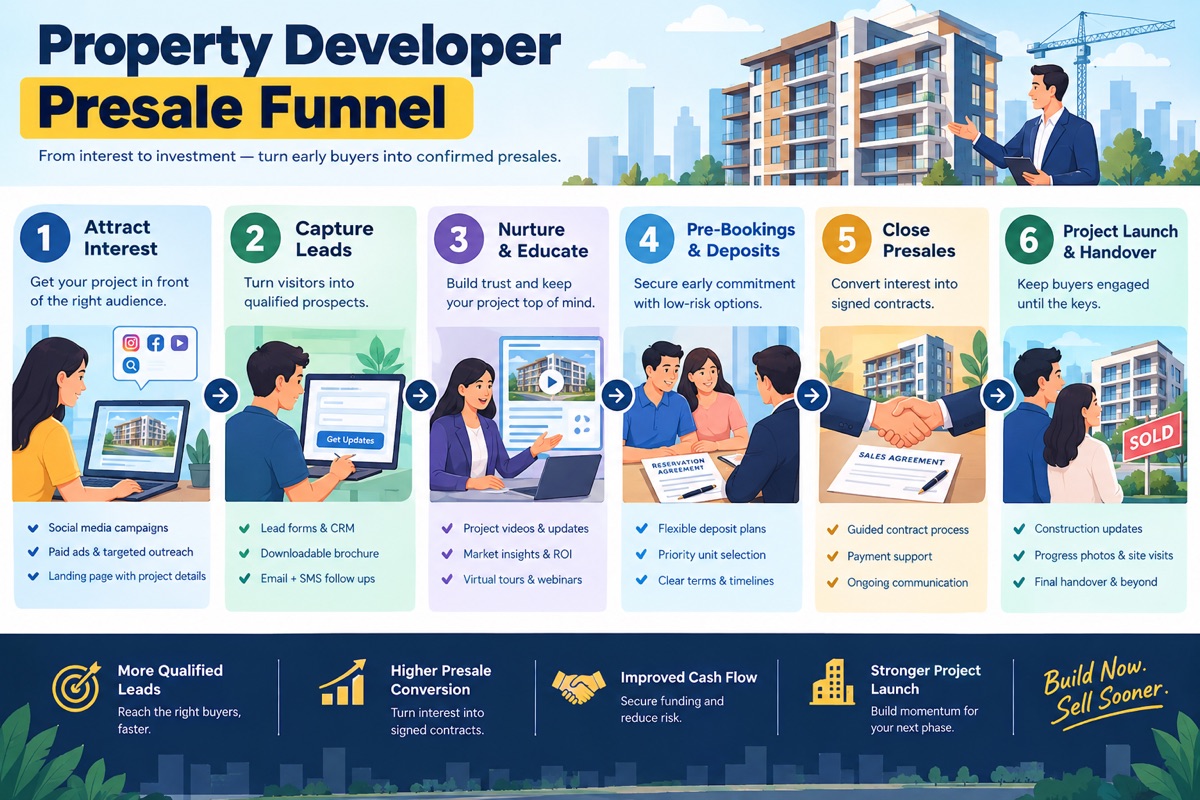
| Stage | Buyer state | Video job |
|---|---|---|
| Registration | Aware, curious, uncommitted | Generate enough interest to exchange contact details |
| Nurture | On the list, waiting for launch | Sustain interest across months without new stock to show |
| Display suite | Attending in person | Support the sales conversation, work silently on screen |
| Expression of interest | Considering a specific apartment | Answer questions about that apartment, not the building |
| Contract | Committing, seeking reassurance | Reduce anxiety about delivery and the developer's record |
| Construction | Committed, waiting years | Maintain confidence and prevent rescission attempts |
| Settlement | Completing | Support valuation and smooth the handover |
The nurture and construction stages are the ones most commonly under-resourced, and both run for the longest.
The stage most explainer videos for property developers neglect is construction. A buyer who signed a contract eighteen months ago, watched interest rates move, and has seen nothing since a brochure is a buyer looking for a reason to walk. Content showing genuine progress is retention work, and retention protects the very pre-sales the facility depends on.
The Five Explainer Videos for Property Developers Every Campaign Needs
Most developments commission one hero film and then improvise. A more effective approach treats explainer videos for property developers as a planned set. A more effective structure plans five distinct assets from a shared three dimensional model.
Campaign trailer
Short, atmospheric, built to generate registrations rather than explain anything. Its only job is to make someone give you their contact details before there is anything concrete to show them.
This is the asset that runs in paid social and on the registration landing page, so it has to work vertically, silently, and in under thirty seconds.
Full project explainer
The substantive piece: location, design intent, amenity, delivery timeline and who is building it. Sent to the registration list, embedded on the project site, and used as the core asset a sales team can send after a first conversation.
This is where credibility is established, which means the developer's track record and the builder's identity belong here rather than being left implicit.
Typology and apartment specific pieces
Short walkthroughs of individual apartment types rather than the building as a whole. This is the asset set that addresses the stock spread problem described earlier, because it allows a sales team to market a specific apartment rather than hoping the general film does the work.
Built from the same model as the hero piece, these are comparatively inexpensive to produce and are frequently the highest converting assets in the set.
Display suite loop
A silent, seamlessly looping piece for the screen in the display suite. It runs continuously while a consultant talks, so it cannot rely on audio and must not distract from the conversation happening in front of it.
Frequently treated as an afterthought and simply a muted version of the hero film, which has audio-dependent pacing and a beginning and end that make a poor loop.
Construction progress content
Recurring updates for contracted buyers across the build period. Cheap to produce relative to everything above, and the asset most directly tied to protecting pre-sales that have already been counted toward the facility.
The useful structure compares real site footage against the original animation, which reassures buyers that what they bought is what is being built.
Commissioning these explainer videos for property developers as one scope is markedly more efficient than commissioning them sequentially, because the three dimensional model is the expensive component and it serves all five. It is also worth settling ownership of that model at the outset, since a developer who owns it can commission later work from any supplier.
Planning a pre-sale campaign?
Magic Motion Studio produces explainer videos for property developers across Australia and the USA, scoped as a full asset set.
What Changes for Property Developers From April 2027
The pre-sale requirement that shapes all explainer videos for property developers is under active review in Australia, and the proposed change is material enough to affect campaign planning now.
The Australian Prudential Regulation Authority has been consulting on changes to bank risk weights intended to support lending and productivity. Among the proposals is an adjustment to the criteria for land acquisition, development and construction lending, so that more exposures qualify for the lower risk weight applied to residential property development. APRA has stated it intends to finalise credit risk capital changes in the second half of 2026, with a proposed effective date of 1 April 2027.
Industry analysis has interpreted the proposals as reducing the qualifying pre-sale requirement from full debt cover toward roughly half. We attribute that reading to industry commentary rather than to APRA directly, because APRA's own published material describes the change in terms of risk weight criteria rather than stating a new pre-sale percentage.
Shorter pre-sale campaigns. A lower threshold means fewer months of selling before construction can begin, which compresses the period the marketing has to sustain.
Front loaded intensity. Campaigns would shift from long endurance runs toward concentrated launches, which favours having the full asset set ready at launch rather than building it as the campaign runs.
Concentration caps still bite. A lower threshold does not remove the foreign buyer or single buyer limits. If anything it increases their relative importance, because a smaller pre-sale pool can breach a percentage cap more easily.
Bank and non-bank gap narrows. Part of the current appeal of non-bank funding is the lower pre-sale hurdle. If bank requirements fall, that trade-off shifts.
None of this is settled, and nothing here should be planned around as certain when budgeting explainer videos for property developers. It is worth tracking, because a developer whose next project launches in 2027 may be operating under a materially different pre-sale requirement than the one they are budgeting a campaign against today.
Accuracy in Explainer Videos for Property Developers Is a Financing Risk
Because pre-sales secure funding, an inaccuracy in explainer videos for property developers does not simply cost one sale. If rescission takes the project below its threshold, the facility condition is no longer satisfied.
This is why the accuracy of depictions matters more in development marketing than in almost any other category. In Ripani v Century Legend Pty Ltd [2022] FCA 242, the Federal Court considered an off the plan render showing a feature that was not architecturally achievable, found misleading or deceptive conduct under the Australian Consumer Law, and rescission of the contract was ordered along with damages, interest and costs. The court also held that labelling the image an artist impression did not qualify the representation it conveyed.
For a developer commissioning explainer videos for property developers, the exposure is therefore twofold. There is the direct cost of the individual claim, and there is the risk that rescissions erode the qualifying pre-sale position the facility depends on. Our guide to animated real estate video and property walkthroughs covers the case and the briefing practices that reduce this exposure in detail.
The short version for anyone commissioning explainer videos for property developers is that accuracy is a production decision made when the model is built, not a legal one made when the brochure is proofed.
The Approval Chain for Explainer Videos for Property Developers
Explainer videos for property developers pass through more approvers than almost any other category of marketing content, and underestimating that is the most common cause of a campaign launching late.
| Approver | What they are checking | When they must see it |
|---|---|---|
| Developer | Positioning, price point, brand | Script and storyboard |
| Architect | Whether the depiction can actually be built | Storyboard, before rendering |
| Project marketer | Buyer segment fit and campaign integration | Script |
| Sales agency | Whether the asset is usable in a real conversation | Script and rough cut |
| Legal | Representations, disclaimers, contract alignment | Script and final |
| Financier | Consistency with the approved scheme and feasibility | Where the facility requires it |
Not every project involves every approver, but most involve more than the marketing team initially plans for.
Why the architect gate matters most
Of all the approvals on explainer videos for property developers, the architect's is the one most frequently skipped and the one with the largest downstream consequence. Marketing teams reasonably assume the architect signed off the design, so the animation of that design must be fine. In practice the studio interprets drawings, makes choices about materials, light and sightlines, and can produce something the drawings do not support without anyone intending it.
In the Australian case discussed below, the developer's own architect had warned that the apartment could not reasonably resemble the marketing image. The warning existed. It simply did not stop the material going out. Building the architect into the approval chain as a formal gate, with the storyboard in front of them before rendering begins, converts that warning from an opinion into a checkpoint.
Sequencing explainer videos for property developers to survive review
The practical sequence that works is claims and depictions approved at script, buildability approved at storyboard, and only then production. Explainer videos for property developers reviewed for the first time at final cut generate the worst possible outcome, because a required change to a depiction means rebuilding the sequence it appears in rather than amending a line.
It is also worth being honest in the schedule about how long approvals on explainer videos for property developers take. A development involves parties with different priorities and different response times, and a timeline assuming a week for something that reliably takes a month is not a plan.
Measuring Explainer Videos for Property Developers
The standard marketing measures mislead badly when applied to explainer videos for property developers, because they count activity that may not advance the only outcome that matters.
| Measure | Use it? | Reasoning |
|---|---|---|
| Video views | No | Bears no relationship to a facility condition |
| Enquiry volume | Weak | Counts buyers who may not qualify against the caps |
| Registrations | Yes | The genuine top-of-funnel measure for a pre-sale campaign |
| Display suite attendance | Yes | The clearest indicator of real intent |
| Unconditional contract rate | Yes | Only unconditional contracts generally count |
| Domestic versus overseas mix | Critical | Tracks the foreign buyer cap in real time |
| Spread across stock types | Critical | Reveals whether difficult stock is moving |
| Cost per qualifying pre-sale | Primary | The only figure connecting spend to the funding outcome |
Buyer mix and stock spread should be reviewed against facility conditions throughout the campaign, not reconciled at the end.
The last point deserves emphasis for anyone reporting on explainer videos for property developers. A campaign reviewed only on cumulative sales can look healthy while quietly accumulating a buyer mix that will not satisfy the facility. Reviewing mix against the caps monthly turns that from a late discovery into a correctable trend. For measurement design more broadly, see our guide on measuring explainer video ROI.
Six Mistakes With Explainer Videos for Property Developers
1. Briefing the campaign without the facility conditions
Marketing teams are frequently never shown the loan conditions their work exists to satisfy, so they optimise for enquiry volume while the caps go unmanaged.
Fix: share the qualifying pre-sale definition and the concentration caps with whoever writes the brief.
2. Leading with investment returns
Yield and depreciation framing attracts precisely the buyer segment most likely to be constrained by the caps, while under-serving the owner occupiers who count without complication.
Fix: lead with liveability and location, and keep investment material as a separate, secondary asset.
3. One film for the whole building
A single hero piece markets the development but not any particular apartment, which leaves difficult stock unsupported exactly when the pre-sale deadline tightens.
Fix: commission typology pieces from the same model, prioritising the hardest stock first.
4. Nothing for the construction period
Buyers contracted years before completion hear nothing during the build, and doubt grows in the silence. Rescissions erode the pre-sale position the facility relies on.
Fix: budget recurring progress content as retention spend, not as optional extra marketing.
5. Animating ahead of the documentation
Production begins before the design is settled, the design then changes, and the campaign depicts a building that will not be delivered.
Fix: record which drawing set the model was built from, and have the architect approve the depiction.
6. Reporting sales without reporting mix
A cumulative sales figure presented to a board can conceal a buyer concentration that will not satisfy the facility.
Fix: report qualifying pre-sales against the caps, not gross sales.
Bringing It Together
Explainer videos for property developers are commissioned as marketing and judged, in the end, as finance. The campaign either produces enough qualifying pre-sales to release the facility or it does not, and everything else is commentary.
Three things follow from treating explainer videos for property developers that way. Share the facility conditions with the people writing the brief, because a campaign that does not know about the caps cannot manage them. Plan the full asset set at the outset rather than commissioning a hero film and improvising, since the model that makes the hero film expensive is the same one that makes everything after it cheap. And report on buyer mix and stock spread throughout, not at the end, because those are the variables that quietly determine whether strong sales translate into a drawdown.
For related guidance see our real estate explainer video page, what an explainer video is, examples that convert, our production process, and the Australian cost guide for the factors that shape a development scope.
Frequently Asked Questions
Because pre-sales are usually a condition of construction finance rather than simply early revenue. Lenders use committed pre-sales as evidence that the completed product has a market and that debt can be repaid on settlement. Major bank facilities commonly require qualifying pre-sales covering between 70 and 100 percent of the debt facility, with full debt cover a frequent apartment benchmark. Non-bank senior lenders typically require considerably less, often 30 to 50 percent or lower. Until the threshold is met the facility generally cannot be drawn, so construction does not start.
A qualifying pre-sale is defined in the loan documents, and not every sale counts. Typical conditions include an unconditional contract, a deposit held in an approved form, a buyer unrelated to the developer, and settlement inside the facility term. Two concentration limits matter most for marketing: foreign buyer caps commonly restrict overseas purchasers to 25 to 35 percent of pre-sales by value, and single buyer caps commonly restrict any one purchaser to 15 to 20 percent. Sales beyond those caps can be perfectly real and contribute nothing toward the threshold.
Fundamentally. If overseas purchasers are capped by value, a campaign optimised for offshore investor appeal can generate strong sales that do not move the project closer to drawing down finance. The brief becomes generating a diverse base of domestic buyers, weighted toward owner occupiers, across the full range of stock rather than concentrated in the most marketable apartments. Liveability content outperforms yield framing, and the less appealing stock needs its own content rather than being left to sell itself.
Most campaigns need five assets rather than one hero film. A short campaign trailer to generate registrations, a full project explainer covering location, design and delivery, apartment or typology specific pieces so individual stock can be marketed, a display suite loop that works silently on a screen, and construction progress content that maintains confidence between contract and settlement. Producing these as one scope from a shared three dimensional model is markedly more efficient than commissioning them separately.
There is a proposed change under consultation. APRA has consulted on adjusting criteria for land acquisition, development and construction lending so more exposures qualify for the lower risk weight applied to residential property development, and has stated it intends to finalise credit risk capital changes in the second half of 2026 with a proposed effective date of 1 April 2027. Industry analysis reads the proposals as reducing the qualifying pre-sale requirement from full debt cover toward roughly half, which if implemented would shorten the pre-sale period before construction can begin.
By cost per qualifying pre-sale rather than cost per lead. A campaign producing large volumes of enquiry from buyers who cannot count toward the threshold is expensive activity that does not advance the project. Track registration to display suite conversion, display suite to expression of interest, expression of interest to unconditional contract, the domestic versus overseas mix against the cap, and the spread of sales across stock types. The last matters because concentrated sales in the best apartments can meet a revenue target while leaving facility conditions unsatisfied.
Explainer videos for property developers, scoped as a full asset set
Magic Motion Studio produces development pre-sale campaigns across Australia and the USA, from campaign trailer to construction progress.