
Animated Real Estate Video vs Property Walkthroughs
This is usually framed as a question about which format engages buyers better. It is not. The decisive factor is whether the property physically exists, because you cannot point a camera at a building that has not been constructed. For off the plan apartments, pre construction developments and unbuilt later stages, an animated real estate video is not the better option, it is the only option. For a completed, accessible property, filming is almost always stronger, because a camera records what is actually there and buyers know the difference. The engagement statistics usually quoted in this debate turn out, on inspection, to be largely unverifiable.
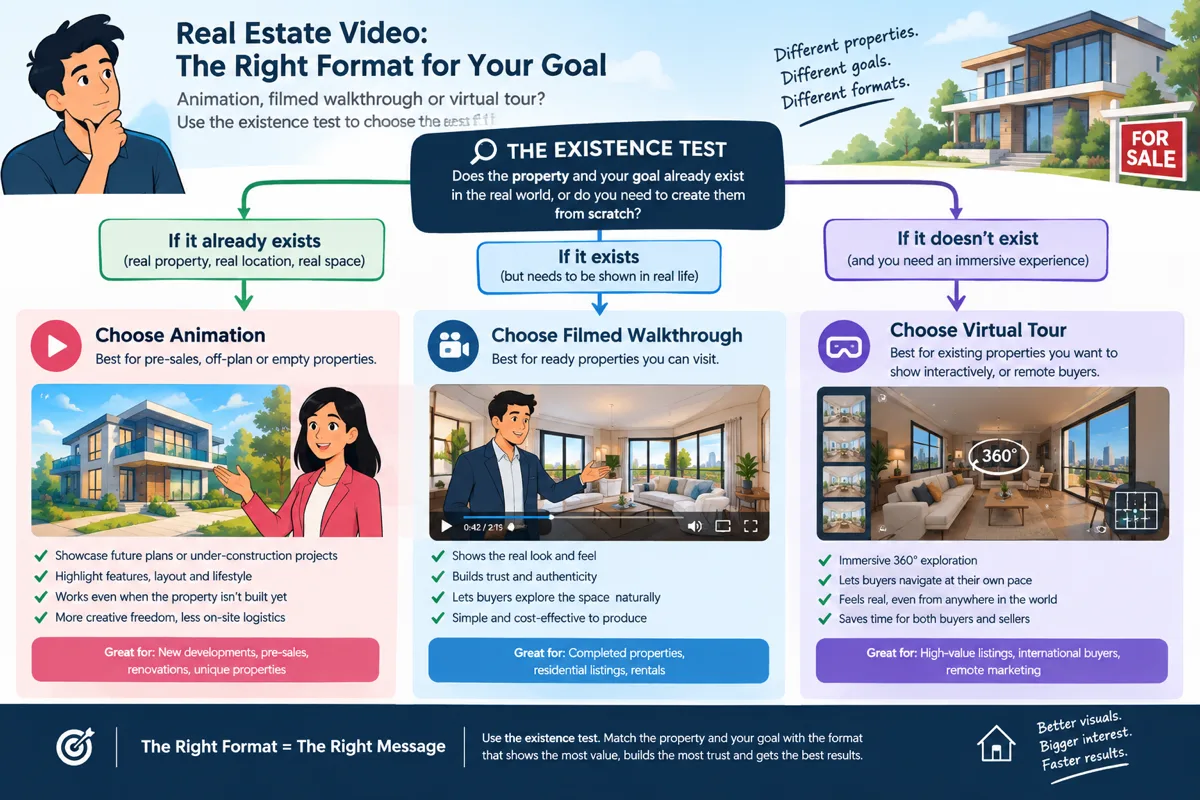
Existence decides, not engagement. An animated real estate video and a filmed walkthrough are rarely competing options for the same property, because one requires a building and the other does not.
There are three formats, not two. Animation, filmed walkthrough, and interactive virtual tour each do a different job.
The famous statistics do not hold up. The 403 percent figure quoted everywhere traces to a single self reported claim from 2012 with no methodology behind it.
Animating the unbuilt carries legal exposure. An Australian Federal Court decision found an inaccurate off the plan render to be misleading or deceptive conduct, with the contract rescinded.
Artist impression is not a shield. The same court held that label did not qualify the representation the image conveyed.
Note on scope. This article includes discussion of Australian case law and consumer protection principles as general information for marketing teams and developers. It is not legal advice. Case outcomes turn on their specific facts. Confirm any marketing approach for off the plan property with your own legal advisers before release.
Almost every published comparison of animated real estate video and its alternatives is written by a vendor selling one of them, and reaches the conclusion you would expect. The interactive tour companies explain why interactive tours win. The video production companies explain why video wins. Each supports the case with engagement figures, and those figures deserve more scrutiny than they usually get.
We produce animation, so the same caveat applies to us. What follows tries to be useful anyway, by separating the decision into the part that is genuinely determined by circumstance and the part that is a real judgement call. For the wider category see our real estate explainer video overview.
First, the Animated Real Estate Video Statistics Nobody Checks
Before comparing formats, it is worth dealing with the numbers that dominate this topic, because decisions are being made on them.
| Widely quoted claim | Usually attributed to | What it actually traces to |
|---|---|---|
| Listings with video receive 403% more inquiries | National Association of Realtors | Unverifiable A single agency's self reported claim from 2012, with no published study or methodology. The NAR attribution does not correspond to any located document |
| 73% of homeowners prefer agents who use video | National Association of Realtors | Unverifiable No corresponding NAR publication located |
| Video sells homes 32% to 68% faster | Various industry sources | Unverifiable Traced to unpublished or non existent studies |
| 91% of sellers used a real estate agent | National Association of Realtors | Verified NAR 2025 Profile of Home Buyers and Sellers |
Attribution checks conducted September 2026. We publish only the figures we could trace to a named, locatable source.
The 403 percent claim is the one worth dwelling on for anyone budgeting an animated real estate video, because it appears on a substantial majority of pages discussing property video, and it is presented as settled research. It is not. It began as a marketing claim by one agency, was repeated by trade press, and has since acquired retroactive attributions to bodies that never published it.
None of this means video does not work. It means the case for an animated real estate video or a filmed walkthrough should rest on what each format structurally can and cannot do, which is verifiable, rather than on percentages that dissolve when you follow them.
Animated Real Estate Video, Walkthrough, Virtual Tour: Three Formats
The comparison is usually posed as animated real estate video against walkthrough. In practice there are three distinct options, and conflating the second and third causes most of the confusion.
Animated real estate video
Built from architectural data and three dimensional models, then rendered. Nothing is captured, everything is authored. Includes exterior flythroughs, interior walkthroughs of unbuilt space, masterplan animations and 2D animated explainers of a development proposition.
Filmed property walkthrough
A camera moves through a real, completed property along a path the filmmaker chooses, usually with narration or music. The viewer follows. What appears on screen is a record of what was physically in front of the lens on the day.
Interactive 3D virtual tour
A real space is scanned and reconstructed so the viewer navigates it themselves, choosing where to go and how long to spend. Not a video at all, strictly speaking, since there is no fixed timeline and no authored sequence.
The second and third are frequently discussed as though interchangeable, and they are not. A filmed walkthrough tells a story with a beginning and an end, controlled by whoever made it. A virtual tour surrenders that control entirely in exchange for letting a serious buyer satisfy their own curiosity. One persuades, the other verifies, and a listing at different stages of buyer interest needs both.
The first is categorically different from both, because it is the only one that does not require the property to exist.
The Existence Test for Animated Real Estate Video
Before weighing engagement, style or budget, one question settles most of the animated real estate video decision.

Film it
Default to a filmed walkthrough, adding an interactive tour for serious buyers. Animation should only enter where the camera genuinely cannot reach, such as cutaways, future streetscape context, or proposed changes to the space.
Animate it
An animated real estate video is the only available format. The decision shifts from whether to animate to how accurately, which is where the legal exposure discussed below begins.
The existence test sounds almost too simple, and yet a great deal of money is spent ignoring it in both directions. Agents commission stylised animations of completed homes that a camera would have shown more convincingly and far more cheaply. Developers delay marketing an unbuilt project because they are waiting for something to film, which will not exist for two years.
| Property situation | Primary format | Reasoning |
|---|---|---|
| Off the plan apartment | Animation | Nothing exists to film |
| Pre construction commercial development | Animation | Nothing exists to film |
| Land subdivision before infrastructure | Animation | Bare land does not convey the finished estate |
| Staged masterplan, stage one complete | Both | Film what is built, animate what is not |
| Display suite built, apartments not | Both | Film the suite, animate the actual floorplans |
| Completed home for sale | Filmed walkthrough | A camera shows reality more credibly |
| Completed home, remote buyers | Walkthrough plus virtual tour | Persuade first, then let them verify |
| Existing building, proposed fit out | Both | Film the shell, animate the proposal |
| Heritage property, renovation proposed | Both | Film current condition, animate the outcome |
| Development site, planning application | Animation | Context and massing in a future streetscape |
Primary format only. Most campaigns of any size use more than one, and the table indicates where the weight should sit.
Where an Animated Real Estate Video Is the Only Option
Beyond the obvious case of an unbuilt property, there are several situations where an animated real estate video does something no camera could, even when a building exists.
Off the plan and pre construction sales
The central case. Apartments and houses are routinely sold years before completion, and the buyer is committing significant money to something they can only be shown as a depiction. In Australia this is a very large share of new residential supply, which is why this format matters more here than the international coverage of the topic suggests.
Later stages of a staged development
Stage one is finished and photographable. Stages two through five are paddock. A single campaign has to present both, and doing so credibly means being explicit about which is which rather than blending them into one seamless impression.
Cutaways and structural explanation
Showing how a building is constructed, how apartments stack, where services run, or how a floorplate is divided. These are explanatory rather than aspirational, and they are among the most genuinely useful applications of an animated real estate video, particularly for commercial tenants assessing fit out potential.
Future context and streetscape
Placing a proposed building in its surroundings, including neighbouring development that does not exist yet. Frequently required for planning submissions and community consultation, where the audience is a council or a resident group rather than a buyer.
Time, season and light
A camera records one day in one season under one sky. Animation can show a north facing terrace in winter sun and summer shade, or a development at dusk. This is legitimate when it represents genuine conditions and misleading when it selects a flattering impossibility, which is precisely the boundary the courts have tested.
Proposed changes to an existing property
Renovation, extension, subdivision or commercial fit out. The property exists, the proposal does not, so the honest treatment films the current condition and animates the outcome rather than presenting the outcome alone.
Where Filming Beats an Animated Real Estate Video
Any completed property a camera can access
The default. A filmed walkthrough of a real home carries an authority animation cannot manufacture, because the viewer knows it is a record rather than a depiction. Animating a house that exists invites the question of what the animation is concealing.
Anything where condition and quality are the story
Renovated, restored or premium properties where craftsmanship is the selling point. Animation smooths and idealises by nature. Real material, real light on real surfaces and genuine wear on heritage detail all read better filmed.
Neighbourhood and lifestyle context
The street, the local cafe, the walk to the station. This is a place as it actually is, populated by real people, and an animated version would be both more expensive and less convincing.
Where the agent is part of the proposition
Agent led walkthroughs build the personal recognition that wins future listings. The agent is the point, and an animated stand in defeats the purpose entirely.
Serious buyers doing due diligence
At this stage the buyer wants to verify rather than be persuaded, which is the interactive virtual tour's specific strength. They want to check ceiling heights, look at the actual condition of the laundry, and revisit a room. A guided video will not let them, and an animation is not evidence of anything.
Marketing a development that does not exist yet?
Magic Motion Studio produces animated real estate video for developers and agencies across Australia and the USA.
The Legal Exposure of Animating Unbuilt Property
This is the section absent from every vendor comparison of animated real estate video and filmed alternatives, and it is the one with money attached. When you animate a property that exists, an inaccuracy is embarrassing. When you animate one that does not, an inaccuracy is a representation about something the buyer has no way to verify, and Australian courts have treated that seriously.
Ripani v Century Legend Pty Ltd [2022] FCA 242
The Federal Court considered marketing material for an off the plan luxury apartment. The render depicted a large free span opening providing a seamless transition between the internal living areas and the terrace. That feature was not architecturally achievable, and the developer's own architect had warned that the apartment could not reasonably resemble the image.
The court found the developer engaged in misleading or deceptive conduct under section 18 of the Australian Consumer Law. The remedies ordered included rescission of the contract, return of the bank guarantee, and payment of damages, pre judgment interest and costs. The developer filed a notice of appeal.
One. The artist impression label did not help. The court held the inscription was not akin to a disclaimer or exclusion clause, and was not capable of qualifying the representations the image conveyed. Marking an architectural render as an impression does not license a depiction of something that cannot be built.
Two. The general disclaimer did not help either. The brochure contained one, but the court held that disclaimers must be particularised and clear in order to neutralise or dispel otherwise misleading conduct. A vague clause towards the back of a brochure, which the buyers were never directed to, did not meet that standard.
The practical lesson for anyone commissioning an animated real estate video is uncomfortable but clear. The protection is accuracy at the point of production, not wording added afterwards. A studio that renders whatever looks best and a marketing team that relies on a boilerplate disclaimer are, between them, building the exposure.
Why an animated real estate video raises this more sharply than a render
A static render is a single viewpoint. An animated walkthrough is a continuous claim about spatial relationships: how rooms connect, how far the view extends, how much light enters, how the terrace relates to the living area. It asserts considerably more than an image does, and every one of those assertions is a representation.
Motion also increases perceived credibility. A viewer who understands a render is idealised will often treat a smooth animated walkthrough as closer to documentary, because it resembles footage. That gap between how the material is understood and what it actually is, is precisely the territory consumer protection law occupies. The Australian Competition and Consumer Commission's guidance on false or misleading claims sets out the general principles that apply to advertising of this kind.
The position outside Australia
The principles are broadly comparable in other common law markets, though the mechanisms differ. In the United States, misleading advertising is addressed federally through the Federal Trade Commission Act and through state consumer protection statutes, with real estate advertising additionally subject to state licensing rules. We have verified the Australian position specifically, and would encourage anyone marketing off plan property in another jurisdiction to obtain local advice rather than assuming the Australian analysis transfers.
Briefing an Animated Real Estate Video That Does Not Create Exposure
None of the above is an argument against commissioning an animated real estate video for unbuilt property. It is the only way to market it. It is an argument for treating accuracy as a production requirement rather than a legal afterthought.
Build from the approved drawings, not the concept
Animation is often commissioned early, when marketing wants assets and documentation is still developing. If the model is built from an early concept and the design then changes, the animation depicts a building that will not be delivered. Establish which drawing set the animation is derived from, and record it.
Put the architect in the approval chain
In the case above, the architect had warned the depiction was not achievable. Marketing material should be signed off by whoever is responsible for what can actually be built, not only by the people responsible for selling it.
Be specific about what is indicative
Furniture, styling, landscaping at maturity and neighbouring development are commonly indicative rather than contracted. Say so specifically and visibly, at the moment each appears, rather than in a blanket statement elsewhere. Particularised and clear is the standard the court described.
Do not depict views you cannot guarantee
A view across a neighbouring low rise site is not a feature of the apartment unless something protects it. Animating an outlook that a future development could remove is among the most common and most contestable representations in off the plan marketing.
Keep light and season honest
Rendering a south facing room in warm direct sunlight it will never receive is a misrepresentation of a physical fact, and one that is straightforward to test after completion. Render the orientation the building actually has.
Make the boundary between real and animated obvious
In hybrid pieces combining footage of completed stages with animation of future ones, the transition should be legible. Seamless blending produces a viewer who cannot tell which parts exist, which is a misleading impression created by edit rather than by any individual frame.
Version and retain everything
Keep the drawing set each version was built from, the approvals, and the distribution dates. If a representation is questioned years later, the ability to show what was approved, by whom, and against which documentation is the practical defence.
Combining Animated Real Estate Video With Footage
The strongest animated real estate video campaigns for large developments rarely choose. They film what exists and animate what does not, inside a single consistent visual treatment.
The persuasive logic of a hybrid animated real estate video is worth understanding, because it is not simply about coverage. A buyer looking at an animated real estate video of stage three has no way to judge whether the developer delivers what it depicts. Footage of a completed stage one, sitting in the same piece, answers that question directly. The filmed portion does something the animation structurally cannot: it demonstrates a track record.
This is also why the transition should be explicit rather than hidden. A viewer who understands that the first half is real and the second is proposed receives exactly the argument the developer wants to make. A viewer who cannot tell has been given something else.
A practical structure for a hybrid animated real estate video
- Open on real footage of the completed stage, establishing that the project is under way and delivering.
- Mark the transition clearly with an on screen indication that what follows is a depiction of proposed later stages.
- Animate the unbuilt stages from approved documentation, with indicative elements identified as they appear.
- Return to real footage for location and neighbourhood, which exist now and are verifiable.
- Close on the actual next step, whether that is a display suite visit, a call, or a registration.
What an Animated Real Estate Video Demands of You
An animated real estate video and a filmed walkthrough differ not only in output but in what they require from the client, and that difference frequently determines which is actually deliverable on a given timeline.
| Requirement | Animated real estate video | Filmed walkthrough |
|---|---|---|
| What you supply | Architectural drawings, material schedules, site survey | Access to a presented property |
| Biggest dependency | Design documentation being settled | Property being styled and vacant |
| Weather and season | Irrelevant, chosen in the render | A real constraint on scheduling |
| Cost of a late change | High but achievable, the model is rebuildable | Requires returning to the property |
| Where approval sits | Architect and legal, before rendering | Vendor and agent, after the shoot |
| Reusability | High, the model serves stills, video and floorplans | Limited to the footage captured |
| Shelf life | Until the design changes | Until the property is restyled or sold |
Indicative comparison. Individual projects vary with scope, scale and documentation maturity.
The documentation dependency
The single most common cause of delay and rework in an animated real estate video is starting before the design is settled. Marketing teams are under pressure to launch, documentation is still being resolved, and the model gets built from whatever exists. When the design then changes, the animation depicts a building that will not be delivered, which is both a rework cost and the exposure described earlier.
The useful question at briefing is not when marketing needs the asset but which drawing set is final enough to build from. If the answer is none of them, the honest options are to wait, or to build only the elements that are genuinely locked and animate the rest later.
The reusability advantage of an animated real estate video
One genuine and underused benefit of an animated real estate video is that the expensive component, the three dimensional model, is not consumed by the video. The same model produces marketing stills, floorplan visualisations, social cutdowns, display suite loops, planning submission imagery and website assets.
Commissioning them as one scope is markedly more efficient than commissioning the animation and then returning separately for stills. It is also worth settling ownership of the model at the outset, because a developer who owns it can commission future work from any supplier, while a developer who does not is committed to one studio for the life of the project.
Measuring Animated Real Estate Video Performance
Given how much of the published data on animated real estate video fails verification, it is worth measuring your own rather than trusting anyone's benchmark.
| Format | Primary measure | Why |
|---|---|---|
| Animated real estate video | Enquiry and registration rate from the campaign | Off the plan marketing exists to generate qualified enquiry, not views |
| Filmed walkthrough | Inspection bookings per listing view | The video's job is converting a browser into an attendee |
| Interactive virtual tour | Time in tour and repeat sessions | Repeat visits indicate genuine shortlisting |
| All formats | Enquiry quality, not volume | A smaller number of better informed enquiries is a better result |
| Development campaigns | Cost per qualified registration | The only figure that connects creative spend to pipeline |
Set the measure before the campaign begins. Deciding afterwards which number to report is how unverifiable benchmarks get created in the first place.
For a broader treatment of measurement design, see our guide on measuring explainer video ROI, and for structural patterns that convert, explainer video examples that convert.
Bringing It Together
The choice between an animated real estate video and a filmed walkthrough is settled, in most cases, by a fact rather than a preference. If the property exists, film it, and add an interactive tour for buyers who want to verify. If it does not, animate it, because there is no alternative.
The genuinely difficult question about an animated real estate video is not whether to make one but how accurately. Animating the unbuilt means making claims about something nobody can check, and Australian courts have made clear that neither an artist impression label nor a general disclaimer will rescue a depiction that could never have been delivered. Accuracy is a production decision, made when the model is built, not a legal one made when the brochure is proofed.
For related guidance see our real estate explainer video page, the range of 2D animation styles suited to development storytelling, what an explainer video is, and our explainer video production process. For cost factors in the Australian market, see our Australian video cost guide.
Frequently Asked Questions
An animated real estate video is constructed rather than captured, built from architectural data and rendering, which means it can depict a property that has not been built. A property walkthrough is filmed with a camera inside a real completed building, so it records what is actually there. A third option, the interactive virtual tour, is also captured from a real space but lets the viewer navigate it themselves. The practical distinction is not quality or engagement but whether the property physically exists to be filmed.
When there is nothing to film: off the plan apartments and houses, pre construction commercial developments, staged masterplans where later stages do not exist, land subdivisions before infrastructure, and proposed fit outs or renovations. Animation also shows what a camera cannot capture even in a completed building, such as structural cutaways, future streetscape context, or seasonal and time of day variation. For a completed accessible property, filming is almost always better.
It carries real exposure if the animation depicts something the finished property will not deliver. In Ripani v Century Legend Pty Ltd [2022] FCA 242 the Federal Court considered an off the plan render showing a free span opening and seamless transition between living area and terrace that was not architecturally achievable. The court found misleading or deceptive conduct under section 18 of the Australian Consumer Law, and ordered rescission of the contract along with damages, interest and costs.
Not on its own. In the same case the court held that the inscription artist impression was not akin to a disclaimer or exclusion clause and was not capable of qualifying the representations the image conveyed. The judgment also stated that disclaimers must be particularised and clear in order to neutralise or dispel otherwise misleading conduct. A vague general disclaimer towards the back of a brochure, which the buyers were never directed to, did not achieve that.
Several of the most repeated ones are not. The claim that listings with video receive 403 percent more inquiries is routinely attributed to the National Association of Realtors, but traces back to a single agency's self reported claim from 2012 with no published methodology, and the attributions attached to it do not correspond to any locatable document. The claims that 73 percent of homeowners prefer agents who use video, and that video produces sales 32 to 68 percent faster, fail the same way.
Yes, and for staged developments it is often strongest. A completed first stage can be filmed, establishing that the developer delivers what it promises, while later unbuilt stages are animated in the same visual treatment. The combination is persuasive precisely because the filmed portion is verifiable. The requirement is that the transition between footage and animation is obvious rather than seamlessly blended, since a viewer who cannot tell which parts exist has been given a misleading impression.
Animated real estate video, built from the approved drawings
Magic Motion Studio produces animated real estate video and development marketing animation across Australia and the USA.