
How to Get a VTuber Model Made
Whether you want a custom 2D Live2D rig, a 3D VRM avatar, or something you can have running this weekend, this guide covers how to get a vtuber model made: the four paths available, what each costs, where to find artists and riggers, and exactly what to put in your brief.
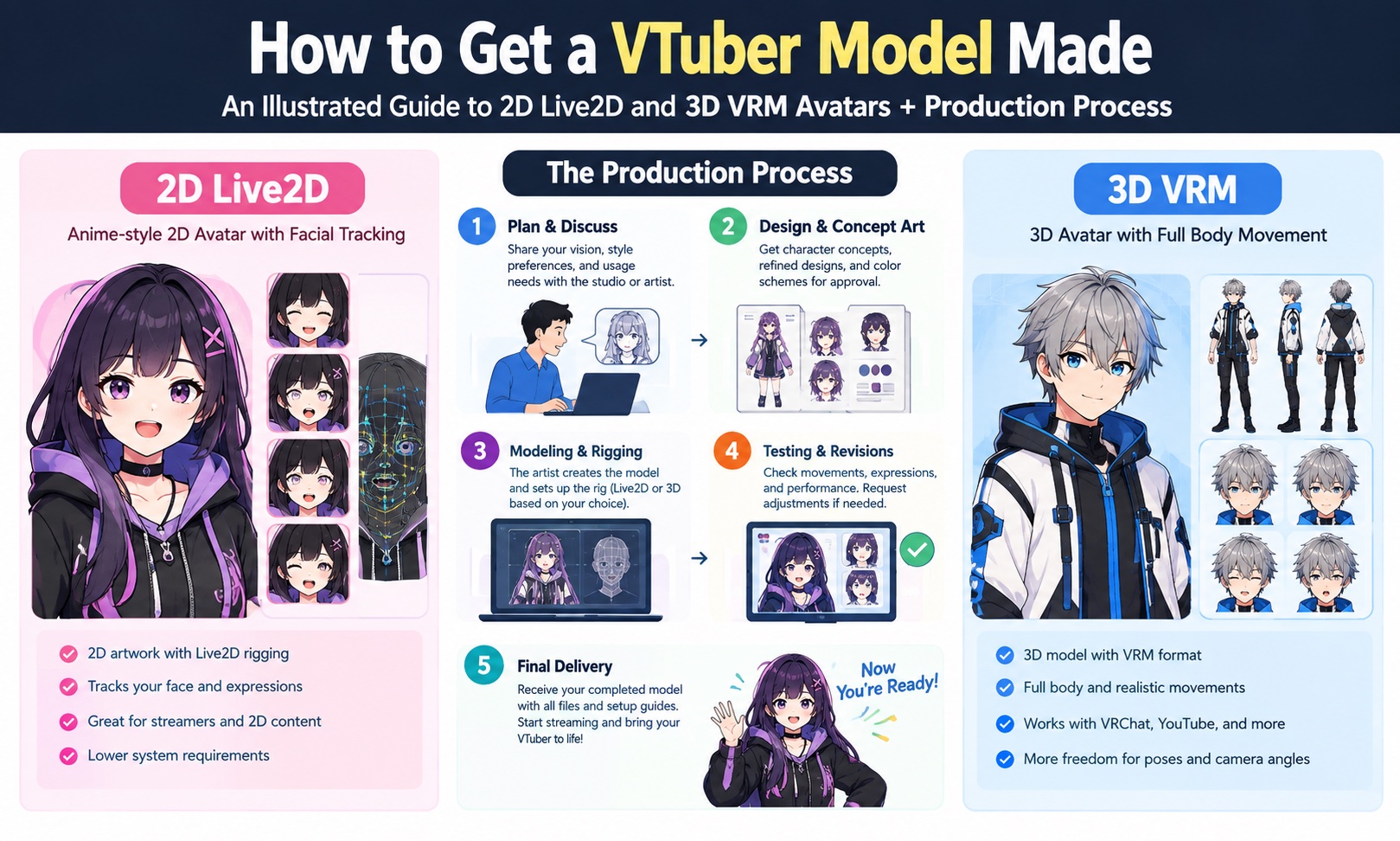
What a VTuber Model Actually Is
A VTuber model is a digital avatar that responds to a creator's real-time facial movements, tracked by a webcam or depth sensor, and displayed on screen in place of their face during live streams, recorded content, or virtual events. The model replaces the creator's physical appearance while preserving the personality and voice behind it.
There are three distinct model types in common use, each with a different technology, aesthetic, and production cost. Choosing between them is the first decision to make before you approach any artist or commission any work.
A layered illustration that has been rigged using Live2D Cubism software to simulate three-dimensional movement from a flat image. The artist separates the character into parts (hair, eyes, body, clothing) across dozens of layers, and the rigger adds deformation points that respond to face tracking data. The result preserves every brushstroke and linework detail from the original illustration exactly.
A full three-dimensional mesh in the open VRM format, built on GLTF, with bones, blend shapes, and standard metadata. Unlike Live2D, a VRM model can show 360-degree movement, full-body tracking, and is compatible with virtual reality applications including VRChat. VRM models are exported from tools such as VRoid Studio, Blender, or dedicated 3D sculpting software. They are tracked using VSeeFace or Warudo for desktop streaming.
A static or lightly animated illustration that switches between a small set of expressions triggered by audio input. There is no face tracking or rigging. PNG Tubers are displayed using Veadotube or similar software that swaps the image when the creator speaks or reacts. The format has a distinct lo-fi aesthetic that many creators use intentionally, and a commissioned PNG set typically costs $40 to $200 from a character artist.
The vast majority of working VTubers use the 2D Live2D format. It is the format used by Hololive and Nijisanji talents, the two agencies whose combined audience represents more than 60% of total VTuber views on YouTube. For new creators who want to look professional and feel native to the VTuber community, 2D Live2D is the right starting point for most situations.
The Four Paths to Getting a VTuber Model Made
Knowing how to get a vtuber model made starts with understanding that there are four fundamentally different routes, each with its own cost, timeline, and skill requirement. The right path depends on your budget, how quickly you need to go live, and how much you want the final result to be specifically yours.
You hire a character artist to design and draw your model to specification, then commission a rigger to animate the layers. This is two separate commissions, managed in sequence: the illustration comes first, the rigging follows once the layered PSD is complete. The result is a fully custom model with your visual identity, your expressions, and your preferences built in from the start. It is the most expensive and slowest option, and the one that produces the strongest creative result.
VRoid Studio is a free application from Pixiv that lets you build a 3D VRM avatar using sliders, presets, and texture painting without any 3D modeling experience. Most new users have a working avatar in 2 to 6 hours. For 2D, Live2D Cubism has a free tier and a paid professional licence, but the rigging process has a substantially steeper learning curve. DIY is the fastest path to a live model and costs nothing beyond your time, but the creative ceiling is lower than a custom commission unless you invest significant hours developing your skills.
A small number of tools now allow you to upload a selfie and receive an AI-generated 3D model built to resemble you, typically in under a minute. The models are photorealistic 3D avatars rather than anime-style illustrations, which positions them differently from what most VTuber audiences expect. These tools cost in the range of $8 for a one-time download. They are a practical option for creators who need to start immediately or who specifically want a photorealistic rather than illustrated avatar.
Artists sell finished, fully rigged models on platforms like Booth.pm and VGen. Pre-made models are available immediately, have already been tested for face tracking compatibility, and are significantly cheaper than custom commissions. The trade-off is that you are using a design that is not exclusive to you and may not match your planned visual identity. Pre-made models are a practical bridge between starting now and saving for a custom commission later, and many new VTubers begin this way.
How the Commission Process Works Step by Step
If you have decided to commission a custom 2D Live2D model, understanding how to get a vtuber model made through the commission route means understanding that it is a two-stage production process involving separate creative specialists. Most delays and misalignments happen when creators skip a stage or treat it as a single continuous job.
Before approaching any artist, you need a clear concept for your character. This means deciding on the visual style you want (the anime reference aesthetic), the character's personality and colour palette, any key design elements like a specific outfit or hair style, and whether you want full body or bust-up framing. A reference sheet of visual inspiration images, colour swatches, and written notes gives the artist a precise target rather than a vague direction. The more specific this material is, the less revision time you will need, and the fewer additional charges you will incur for major changes after sketch stage.
You approach a character artist whose portfolio includes VTuber model illustration experience. Verify that their work includes the specific layered, separated approach that rigging requires, not just standard character illustration. Commission terms typically include an initial sketch approval, then line art approval, then full colour approval. Each stage is a checkpoint where major revisions are still affordable. Payment is usually split between a deposit at sketch approval and the balance at final file delivery. The illustrator delivers a high-resolution layered PSD file, typically at 4,000 x 6,000 pixels at 300 DPI, with every body part on its own clearly named layer. For a guide on briefing the right studio for this type of work, see our article on how to brief an anime studio.
Once the layered PSD is delivered and you have approved all the illustration layers, you commission a Live2D rigger separately. The rigger imports your PSD into Live2D Cubism Editor and builds the deformer network, parameters, and physics simulation that makes the model move in response to face tracking data. Rigging includes eye blink, lip sync, head tilt, eyebrow movement, hair and clothing physics, and any hotkey-triggered expressions. The rigger exports the finished model as a Live2D runtime file set (.moc3, .model3.json, .physics3.json) ready for import into VTube Studio. Some artists offer illustration and rigging as a combined package, which simplifies coordination but may limit your choice of rigger style.
Before final delivery, the rigger typically provides a test build for you to load into VTube Studio and review with your webcam. This is your opportunity to check that the face tracking feels natural, the physics behave correctly for your planned content (hair physics that work for a still talking-head setup may clip during fast head turns), and all hotkey expressions trigger cleanly. Return clear written notes on any issues rather than vague feedback, as specific notes on which parameter or expression is behaving incorrectly allow the rigger to fix the exact issue rather than guessing at it.
Final delivery should include the runtime model files ready to import into VTube Studio, plus the source files you have agreed to receive. Confirm the source file package before paying the final balance. The model files without source files leave you unable to make future modifications independently. Source file ownership terms must be agreed in writing before any deposit is paid, as practices vary significantly between artists and studios. See the file ownership section below for what to ask for specifically.
Import the .model3.json file into VTube Studio via its model import screen. Configure your webcam as the face tracking source, calibrate the parameters to your facial range of movement, and assign hotkey expressions. VTube Studio then runs as a capture source that OBS Studio can pick up through a window or NDI source. For 3D VRM models, VSeeFace and Warudo handle the same tracking and output role. First-time setup typically takes 30 to 60 minutes to calibrate correctly. Many riggers include a basic setup guide with delivery.
VTuber Model Pricing by Tier
Pricing for 2D Live2D VTuber models reflects two separate costs: the illustrator's fee and the rigger's fee. The table below covers the 2026 market across both 2D and 3D formats. Note that illustrator and rigger pricing are additive for custom 2D commissions.
| Tier | What's Included | 2D Price Range | 3D Price Range | Timeline |
|---|---|---|---|---|
| PNG Tuber | Static character art, 2-4 expressions, audio-triggered switching via Veadotube. No rigging. | $40 – $200 | N/A | 1 – 2 weeks |
| Basic Live2D | Single outfit, bust-up, eye blink, lip sync, basic head movement, one or two hotkey expressions. | $200 – $500 | $1,000 – $3,000 | 2 – 4 weeks |
| Mid-Tier Live2D | Full body or bust-up, multi-layer expression set, hair and clothing physics, breathing animation, 4-8 hotkey expressions. | $500 – $1,500 | $3,000 – $7,000 | 4 – 8 weeks |
| Pro-Tier Live2D | Full body with advanced physics, multiple outfits, toggleable accessories, advanced expression blending, hand rigging. | $2,000 – $5,000+ | $7,000 – $15,000+ | 8 – 12 weeks |
| Agency-Level | Full production pipeline, full-body tracking integration, original concept design, multiple outfits, proprietary tracking setup. | $5,000+ | $15,000+ | 12+ weeks |
Important note on costs: For custom 2D Live2D models, the illustrator fee and the rigger fee are typically separate charges. A mid-tier commission might cost $400 to $600 for the illustration and $300 to $500 for the rigging, totalling $700 to $1,100 combined. When comparing quotes from studios offering combined packages versus separate specialists, confirm whether the quoted price includes both or just one stage of production.
Where to Find Artists and Riggers
The quality of your finished model depends almost entirely on the quality of the specialists you commission. These are the three main platforms where VTuber model creators find and book artists and riggers.
A commissions hub built specifically for creative professionals including VTuber artists, riggers, musicians, and editors. Every artist is human-verified, and the platform has dedicated categories for both VTuber model art and VTuber model rigging. VGen's review system and verification process make it the most reliable platform for VTuber-specific commissions, particularly for buyers who want clear communication, portfolio verification, and payment protection in one place.
A large general freelance marketplace with a substantial VTuber modelling and rigging section. The lower end of Fiverr's VTuber listings can be very affordable, but quality varies significantly. Looking at completed order reviews, portfolio samples that specifically include VTuber model work, and seller level badges is essential before committing. Combined illustration and rigging packages from established Fiverr sellers can represent good value for basic to mid-tier commissions.
Many professional VTuber artists and riggers maintain a Twitter presence and post commission openings, which are announcements that their commissions are accepting new clients. Following artists whose work you admire and turning on post notifications means you will see commission openings as they happen. Work found through Twitter is often from independent artists with established followings whose VGen or Carrd commission pages handle the actual booking. Twitter is a discovery layer rather than a booking platform.
Regardless of platform, never commission an artist without reviewing at least three completed VTuber model examples from their portfolio. General character art skills do not automatically translate to VTuber model production, which requires layered file preparation and expression sheet knowledge specific to the format.
What to Include in Your Commission Brief
A clear brief is the single most effective thing you can do to protect your timeline and budget when commissioning a VTuber model. Vague briefs produce rounds of revisions. Specific briefs produce work that requires fewer changes and arrives faster. These are the eight elements every brief for a 2D Live2D VTuber model should include.
- 1Character concept and personality. A short written description of who the character is. This does not need to be a full backstory but should cover the intended tone (playful, cool, mysterious, energetic) and any key personality traits that should be visible in the design. An artist who understands the character's energy produces a design that matches it; an artist working from pure visual description alone may produce something technically correct that feels wrong.
- 2Three specific visual style references. Name the anime shows, characters, or existing VTuber models whose visual style you want the work to feel closest to. Be specific about what you like: the eye shape, the colour palette handling, the linework weight, the shading approach. "Something like Hololive talent art" is too vague. "Eye shape and expressive linework similar to Calliope Mori's debut model, colour palette referencing Gawr Gura's muted blues and whites" is actionable.
- 3Colour palette. Provide your primary, secondary, and accent colours as hex codes if you have them, or as reference images of colours you want to match. Include notes on any colours to avoid. Colour is one of the first things the audience registers and one of the most important elements of VTuber identity consistency across thumbnails, overlays, and the model itself.
- 4Model framing and outfit details. Specify whether you want bust-up (from the waist up, standard for chat streaming) or full-body (visible from head to toe, needed for dancing content and some overlays). Describe the intended outfit in detail, or provide reference images. Note any accessories, hair accessories, weapons, props, or distinctive items that must be included. The more accurately you can specify these, the fewer revision rounds you will need at the sketch stage.
- 5Expression requirements. Specify how many expressions you need as hotkey toggles and what emotions those expressions should cover. A typical mid-tier set covers happy, sad, surprised, smug, angry, embarrassed, and a streaming-specific "reading superchat" expression. If you stream specific content types (horror, ASMR, FPS games) there may be expressions specific to those contexts worth including. Each additional expression set beyond the base quote adds to the rigger's fee, so agree on the list before the rig starts.
- 6Physics requirements. Note whether you want hair physics, clothing physics, accessory physics (chains, earrings, ribbons), and how realistic you want them to feel. Heavy physics on long hair require more computation and more rigging time. If you stream from a desktop with limited processing headroom, simpler physics that run efficiently are more practical than complex simulations that cause frame rate drops during live broadcasts.
- 7Budget and timeline. State your budget range clearly upfront. Artists price work to their queue and skill level, and a stated budget allows them to tell you immediately whether they can meet it or whether the scope you have described exceeds it. Being vague about budget to "see what they offer" typically results in quotes above what you wanted and a revision negotiation that wastes time for both parties.
- 8Source file ownership terms. Ask explicitly before signing any agreement whether the source files (PSD and Live2D .cmo3 project file) are included in the quoted price or available for an additional fee, and whether you will have the rights to modify the model with a different artist in the future. Confirm this in writing before paying any deposit. This single question protects your investment in the model for as long as you use it.
For more on this process in the context of commissioning anime-style animation broadly, our guide on how to commission anime animation covers the approval and revision workflow that applies across character-driven animation projects.
Files You Should Receive from Your Commission
Knowing which files you need to ask for is part of knowing how to get a vtuber model made correctly. Many new VTubers accept delivery of the runtime model files only to discover later that they cannot make modifications, add outfits, or work with a different artist without going back to the original studio. Ask for all of the following at the time of commissioning.
The original layered Photoshop or Clip Studio file from the illustrator. Contains every body part, expression, and design element on separate named layers at full resolution (typically 4,000 x 6,000px at 300 DPI). Essential for adding new outfits, changing colours, or passing to a different rigger.
The editable Live2D Cubism Editor source project. Contains all deformers, parameters, physics settings, and expression data. Without this file you cannot adjust tracking parameters, fix physics, or add new expressions without hiring the same rigger again or paying for a full re-rig.
The exported runtime model file that VTube Studio reads directly. This file references the .moc3 binary and the texture atlas. It is what you import to go live and should always be included in standard delivery.
Contains the physics simulation data for hair, clothing, and accessories. Delivered alongside the .model3.json as part of the standard runtime package. If you later want to adjust physics stiffness or add new physics elements, the rigger works from this file within the .cmo3 project.
The compiled texture map that the runtime model reads. Generated automatically when the rigger exports the model from Live2D Cubism. Delivered as part of the standard runtime file package. The texture atlas represents the model's visual detail at runtime.
One file per hotkey expression included in the rig. Each file stores the parameter overrides that produce a specific facial expression when triggered. You need these files to map expressions to keyboard shortcuts in VTube Studio's hotkey configuration screen.
Need a Custom Anime-Style VTuber Model?
Magic Motion Studio produces anime-style character animation and model production for content creators and brands. Talk to us about your project.
Four Mistakes That Delay or Damage VTuber Model Commissions
VTuber model illustration is a specialist discipline. The layered file structure required for Live2D rigging is significantly different from a standard character illustration. An artist who produces beautiful single-layer character art may have no experience preparing the dozens of separated layers that rigging demands. Always check that the artist's portfolio includes completed VTuber model examples, not just general character illustration. Ask specifically whether they deliver rig-ready layered files.
Studios and artists handle source file ownership differently. Some include source files as standard. Others retain them and charge an additional fee for access. Some retain commercial rights that limit how you can use the model. These terms must be agreed in writing before any payment changes hands, because changing terms after a deposit is placed creates disputes that are difficult to resolve. A commission contract that does not mention source files is not a safe assumption that you receive them.
Major revisions after sketch approval, such as changing the hair style, adding a new outfit element, or altering the character's body proportions, are among the most expensive things you can do during a commission. These changes require reworking line art and potentially restructuring the layer file. The sketch approval stage exists specifically for this reason: it is the checkpoint where fundamental design decisions should be confirmed. Review the sketch against your brief exhaustively before approving, because the cost of changes increases at every subsequent stage.
Attempting to coordinate the illustration and rigging simultaneously to save time typically backfires. A rigger cannot begin work until the full layered PSD is delivered and approved. If the illustration is delayed (which is common), the rigger's booked slot passes and they move to their next commission. You then re-enter their queue rather than starting immediately. The practical sequence is: complete illustration, approve all layers, then approach riggers and book with the finished PSD in hand. It is more reliable than attempting to run the stages in parallel.
Frequently Asked Questions
How long does it take to get a VTuber model made?
A standard 2D Live2D commission takes 2 to 3 weeks once the artist starts work. Premium commissions with detailed art and advanced rigging run 4 to 8 weeks. Pro-tier models with full physics, outfit toggles, and expression sets typically take 8 to 12 weeks. Popular artists and riggers often have waitlists, so the total time from enquiry to delivery can be significantly longer than the production time alone.
How much does a VTuber model cost?
A basic 2D Live2D VTuber model costs between $200 and $500. Mid-tier commissions with full expression sets and physics run $500 to $1,500. Pro-tier 2D models cost $2,000 to $5,000 or more. 3D VRM models start at $1,000 and can exceed $15,000 for premium full-body rigs. For custom 2D models, the illustrator's fee and the rigger's fee are charged separately and must both be factored into your total budget.
What is the difference between a 2D and 3D VTuber model?
A 2D VTuber model uses Live2D rigging to simulate depth and movement from a flat layered illustration. It preserves the illustrator's art style exactly and is the dominant format for Twitch and YouTube streaming. A 3D VTuber model is a full mesh that allows 360-degree movement, full-body tracking, and VRChat compatibility. 2D models are generally more affordable and are the standard choice for new VTubers. For more on the anime-style visual language that defines most VTuber model aesthetics, see our overview of what is anime animation.
Where do I find a VTuber model artist and rigger?
The three main platforms are VGen (a dedicated creative commissions hub with verified artists), Fiverr (a general freelance marketplace with a large VTuber section), and Twitter/X (where many independent artists post commission openings). VGen is generally the most reliable for VTuber-specific work. On any platform, review at least three completed VTuber model examples from the artist's portfolio before committing to a booking.
Do I need to own the source files from my VTuber commission?
Yes. Confirming source file ownership before commissioning is essential. The key files are the layered PSD illustration and the Live2D Cubism project file (.cmo3). Without these you cannot modify the model, add outfits, fix issues, or work with a different artist in the future. Confirm ownership terms in writing before paying any deposit. For a broader look at what commissioning anime-style production involves, see our guide on how to commission anime animation.
Can I use a free tool to make my own VTuber model?
Yes. VRoid Studio is a free Windows and Mac application that lets you build a 3D VRM avatar with no modeling experience required. Most new users have a working model in 2 to 6 hours. For 2D, Live2D Cubism has a free tier, though the learning curve is steeper. Both produce models compatible with VTube Studio and VSeeFace for real-time face tracking during live streams. The creative ceiling is lower than a custom commission, but DIY is a practical starting point while you save for a full commission.
Understanding how to get a vtuber model made well means understanding that the model is a long-term creative asset, not a one-time purchase. The clearer your brief, the more carefully you vet your artists, and the more thoroughly you confirm file ownership, the more control you retain over it as your channel grows and your production requirements evolve.
For creators interested in the broader anime visual language that defines VTuber aesthetics, our guide on what is anime animation explains the production form in depth. For brands exploring how anime-style video fits into a marketing strategy, our article on anime style video for brands covers the strategic and production considerations in detail.
Looking for a Studio to Build Your VTuber Model?
Magic Motion Studio specialises in anime-style character animation and production. Whether you need a custom character design or a full production pipeline for VTuber content, we can help you build something that stands out.
See Our Anime Animation Studio