
Complete Commission Guide
How to Commission Anime Animation: The Complete Guide
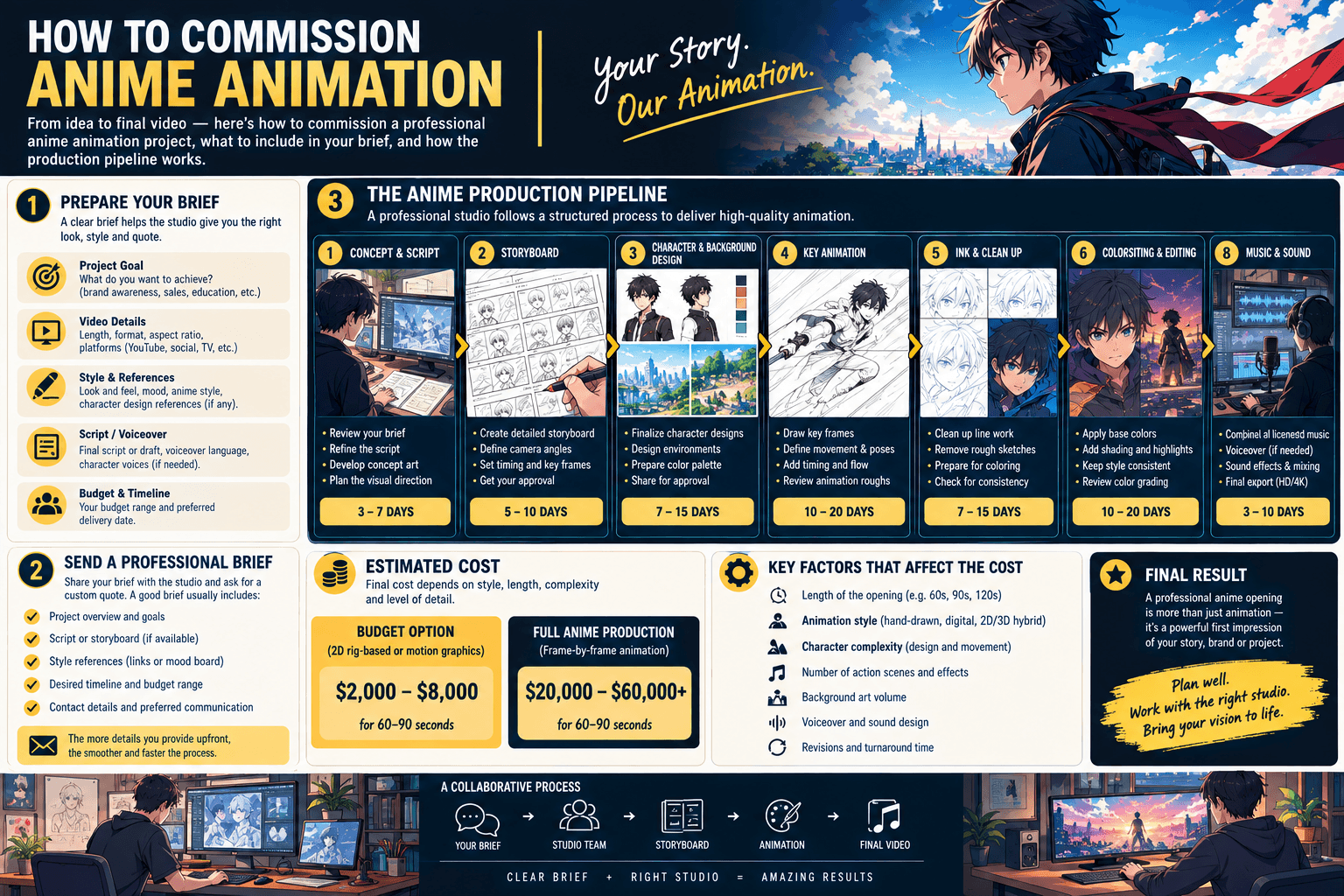
Commissioning anime animation is a distinct process from commissioning general animation. The production pipeline is different, the brief requirements are different, the quality signals to look for are different, and the mistakes that derail projects are different. This guide walks through every step, from defining your project to receiving final delivery, so your anime animation commission goes smoothly and produces the result your audience expects.
Quick Answer
To commission anime animation successfully, define your project type and runtime, prepare a brief with character references and visual style examples, verify the studio uses genuine frame-by-frame production with a full pipeline (settei, genga, douga, shiage), review the quote for milestone approvals and a rights clause, then sign off at each production stage before final delivery. The most common reason anime animation commissions fail is not budget or timeline. It is hiring a studio that approximates the anime visual style without using the anime production pipeline, which produces output that anime-native audiences immediately recognize as inauthentic. Getting the studio selection right is the most important decision in the entire process.
Context
Why Commissioning Anime Animation is Different from General Animation
Most guides to commissioning animation treat all animation as equivalent. They give you generic advice about writing a brief, setting a deadline, and agreeing on deliverables. That advice is not wrong, but it misses everything that is specific and critical about how to commission anime animation in particular. Every step of the process, from studio selection through final delivery, has anime-specific requirements that generic commissioning advice does not address.
Anime is not a visual style. It is a production method. The characteristic look, motion quality, weight, expressiveness, and cinematic language of anime animation comes from a specific production pipeline developed in Japan over decades: hand-drawn key animation (genga) producing principal poses, in-betweening (douga) completing the motion arcs between those poses, and cleanup and color (shiage) producing the broadcast-quality finished frames. Without this pipeline, you get animation that looks like anime at the surface level but moves and feels different in a way that any anime-native audience perceives immediately.
This matters for your commission in a practical way. There are many animation studios that will accept a commission to produce "anime-style animation" without using the anime production pipeline. They will use rigged digital characters with software-interpolated motion, apply an anime-influenced visual design to the characters and environments, and deliver a finished video that looks broadly anime-flavored. For an audience that casually enjoys anime, this may be adequate. For an audience that grew up watching hundreds of hours of genuine anime animation, it is immediately identifiable as inauthentic, and that audience is unlikely to respond to it the way you want them to.
The process of learning to commission anime animation properly therefore starts with learning how to identify genuine anime production capability, how to brief for the specific requirements of the anime format, and how to structure the approval process so that quality is verified at every stage before the next stage begins. Everything in this guide addresses those anime-specific requirements that generic animation commissioning guides ignore completely.
Who This Guide Is For
This guide is written for brands, independent producers, manga creators, game studios, and content creators who want to commission anime animation from a professional studio. It covers every project type from a 30-second anime trailer to a multi-episode pilot. The steps are the same regardless of project scale. What changes is the size of the brief, the length of the production timeline, and the number of approval rounds.
Define Your Project Type and Format
Before you approach any studio when looking to commission anime animation, you need to know exactly what you are commissioning. This sounds obvious, but many clients approach studios with a vague sense of wanting "anime animation" without having defined the format, length, or intended use. Studios cannot give you an accurate quote without this information, and the differences in production scope between project types are significant enough that a quote for one format cannot be repurposed for another.
There are seven primary anime animation project types that a studio typically handles. Each has distinct production requirements, typical runtimes, and brief expectations.
Anime Trailer
A 30 to 90-second promotional video introducing a series, game, or brand using anime animation. Typically combines high-impact action cuts with character reveals and title treatment. Brief must specify the series or product being promoted, key characters, and tone.
Typical length: 30-90 seconds
Anime Opening Sequence
A 60 to 90-second series opening sequence introducing characters and establishing visual identity. The most animation-dense format per second. Must be synchronized to a final music track. Brief must include music, all principal characters, and a clear visual direction.
Typical length: 60-90 seconds
Anime Pilot Episode
A short-form or full-length first episode produced at broadcast quality for platform pitching or direct release. Requires a complete creative package: script, character roster, world-building notes, and series bible. The most complex single commission type.
Typical length: 5-24 minutes
Anime Music Video
A 3 to 5-minute animated video set to a complete music track. Pacing and emotion are driven entirely by the music. Brief must include the final music track, the emotional arc the video should follow, and character or world references.
Typical length: 3-5 minutes
Brand or Marketing Content
Commercial animation in an authentic anime style for product launches, campaigns, or brand storytelling targeting the anime-native demographic. Brief must include brand guidelines, the product or message, and the specific audience segment being targeted.
Typical length: 15-120 seconds
Manga Adaptation
Animating panels from an existing manga into a moving sequence. Can range from a motion manga PV (minimal animation, panning over panels with voice acting) to fully animated scenes. Brief must include the source manga pages and clarification of animation depth required.
Typical length: 60 seconds to 10 minutes
Short-Format Series
A series of short episodes (2 to 10 minutes each) released episodically on YouTube, streaming platforms, or social media. Requires consistent character design and art direction across all episodes. Brief must include the episode count, episode runtime, and release schedule.
Typical length: 2-10 minutes per episode
Once you have identified your project type, define the specific runtime you need. A studio cannot quote accurately on "a short anime video." They need to know whether you want 30 seconds or 90 seconds, because the drawing count, background art volume, and compositing work scale linearly with runtime. Lock in the format and runtime before you write your brief or contact any studio. Clients who commission anime animation without a defined runtime almost always receive a quote that does not match their actual needs.
Understand the Production Pipeline You Are Buying
When you commission anime animation from a professional studio, you are buying the output of a multi-stage production pipeline. Understanding what each stage produces and when you will review it is essential to managing your commission effectively. It is also the most reliable way to confirm whether a studio actually produces genuine anime animation before you sign a contract.
A professional anime animation pipeline runs through four core production stages. Each stage produces output that you review and approve before the next stage begins. This is not bureaucracy. It is the mechanism that protects your budget. Changes at the storyboard stage cost a fraction of changes at the compositing stage. Understanding this pipeline before your commission starts means you will use your review opportunities at the cheapest possible point.
Character Design Sheets (Settei)
Before any animation begins, every character appearing in the production receives a full design sheet: front, side, three-quarter, and rear views at consistent scale, with an expression sheet covering the emotional range the character needs to show. Settei are the production's law. Every animator working on the project draws from these sheets to ensure character consistency across all cuts and scenes.
You review: design sheets for all charactersStoryboard and Animatic
The director maps every cut, character action, camera movement, and scene transition in a storyboard, then produces an animatic: a timed rough cut using sketch drawings synchronized to the music or audio track. This is the stage where the pacing, energy flow, and overall structure of the production is locked in. Changes at animatic stage are inexpensive. Changes after key animation has begun are not.
You review: pacing, cut order, scene structureKey Animation (Genga)
Senior animators draw the principal poses for every action in every cut. These are the drawings that carry the character's performance and establish the weight, timing, and expressiveness of every movement. Key animation is the most skilled and most expensive stage of production. A partial key animation review at the midpoint of production lets you catch any significant performance or characterization issues before the full animation is completed.
You review: character performance, movement qualityIn-Betweening, Cleanup, and Color (Douga and Shiage)
In-betweeners complete the motion arcs between key poses. Cleanup artists produce broadcast-quality line art from the rough animation drawings. Digital colorists apply the character's color palette per frame. These three stages run sequentially and produce the finished animation layers. The final composite then assembles animation, backgrounds, effects, and audio into the delivered production.
You review: final composite before deliveryWhen you contact a studio and commission anime animation, ask them to walk you through their pipeline and identify the stages above. A studio that uses genuine frame-by-frame production will describe this pipeline naturally and specifically. A studio that uses rig-based production will either describe a different workflow, give vague answers, or claim their production is "anime style" without describing the frame-by-frame process. The pipeline question is the clearest filter available to you before you look at a single portfolio piece.
For a deeper understanding of the frame-by-frame production method that distinguishes genuine anime animation, see Magic Motion Studio's guide to frame-by-frame anime animation.
Evaluate Studios Before You Commit
Studio evaluation is where most mistakes happen when clients commission anime animation for the first time. Clients look at a showreel with impressive clips and assume the studio can replicate that quality for their project. A showreel is a best-of selection, not a representative sample. The questions below are more reliable than any showreel at identifying whether a studio can deliver what your project requires.
6-Question Studio Evaluation Checklist
"Do you animate frame by frame, or do you use rigged characters?" This is the most important question. Frame-by-frame means a skilled animator draws every significant pose by hand. Rigged characters means a digital puppet is posed and animated with software. The motion quality these two methods produce is fundamentally different, and for an anime-native audience, the difference is immediately visible. A studio that hedges on this question or describes a hybrid workflow should be evaluated carefully.
"Can you show me character design sheets (settei) from a past production?" Every genuine anime production creates settei. A studio that cannot show you these from previous work is either not producing genuine anime animation or is not managing their production assets properly. Either answer is a red flag for a commission that depends on consistent character quality across multiple scenes or episodes.
"What software does your key animation team use?" Professional frame-by-frame anime animation uses Toon Boom Harmony, TVPaint, RETAS Studio, or Clip Studio Paint EX with drawing tablets. If the answer is primarily Adobe After Effects or Animate with character rigs, the output is rig-based. Software answers are objective and difficult to misrepresent once you know what to ask for.
"Can you show me a complete finished production at a similar scope to mine?" A showreel clip is not the same as a complete finished production. Ask to see a full finished anime trailer, a complete opening sequence, or a finished short film at a comparable runtime and character complexity to your project. The quality of complete productions is a much more reliable predictor of what you will receive than cherry-picked showreel moments.
"Do you take direct commissions, or do you require a network or platform deal?" Many of the largest US-based animation studios that produce anime-style content only work through network deals or platform partnerships. If you are an independent creator, a brand, or a producer without an existing distribution deal, confirm explicitly that the studio accepts direct client commissions before investing time in a proposal process.
"Who is my dedicated point of contact throughout production?" Production communication accountability matters as much as production quality in any commission. You need a single person who understands your brief, is responsible for managing the production against your timeline, and is reachable during your business hours. A studio that does not provide dedicated account management for client commissions is a studio where your project is more likely to slip, surprise you with scope changes, or require constant follow-up from your side.
Magic Motion Studio's anime animation studio service is built around answering all six of these questions clearly and positively. Frame-by-frame production, settei on every project, Toon Boom Harmony as the primary animation tool, direct commissions accepted for all project types, and dedicated account management from brief through delivery.
Write Your Anime Animation Brief
A brief is the document that turns your vision into instructions a studio can quote and produce against. Whether you commission anime animation for a platform pitch, a brand campaign, or an indie series, the quality of your brief directly determines the accuracy of the quote you receive and the smoothness of the production. A vague brief produces a vague quote with scope ambiguities that typically resolve as additional costs or disagreements mid-production. A specific brief produces an accurate quote and a production that delivers what you expected.
A complete anime animation brief contains eight elements. Each one is listed below with guidance on what level of detail is appropriate and why it matters for the production.
ELEMENT 01
Project Type and Runtime
State the project type (trailer, opening, pilot, music video, brand content) and the specific finished runtime you need. If you are unsure about the exact runtime, provide a range (for example, 60 to 90 seconds) and explain the constraints. Runtime is the single most direct driver of production cost and timeline, and studios need a specific number to quote accurately.
Be specific: "a 90-second anime opening" not "a short anime video"ELEMENT 02
Character Count and Descriptions
List every character who will appear in the production and provide a description of each: name, rough age and build, personality traits, and any distinctive visual characteristics. If you already have character designs in any form, even rough sketches, include them. The number of characters is a direct driver of settei production cost and drawing volume, so be precise about who appears and how much screen time each character receives.
Include existing character art even if rough. Any reference is better than none.ELEMENT 03
Target Aesthetic and Visual References
Describe the anime visual style you are targeting and provide specific show references. "I want it to look like Demon Slayer" and "I want it to look like K-On!" describe radically different production approaches. Specific episode or scene references (with timestamps if possible) are more useful than general show titles. The more precisely you can communicate what quality and aesthetic level you are aiming for, the more accurately the studio can confirm whether they can achieve it within your budget.
Give specific scenes, not just show names. Screenshots are even better.ELEMENT 04
Intended Platform and Use Case
State where the finished animation will be used: YouTube, a specific streaming platform, a Kickstarter campaign, broadcast TV, a theatrical release, or commercial advertising. Platform affects delivery specifications (resolution, frame rate, codec) and may also affect rights requirements. Commercial use, broadcast use, and non-commercial use have different licensing implications for any music or third-party assets used in the production.
List every platform the animation will appear on, not just the primary one.ELEMENT 05
Music Status
State clearly whether music is already in place or needs to be produced. If you have a finished music track, include it or link to it. The animatic, the pacing of every cut, and the synchronization of character actions to the music all depend on having the final track available. If music still needs to be composed or licensed, flag this as a parallel workstream that will need to be resolved before the animatic stage can be finalized.
Music must be final before the animatic is locked. Start this early.ELEMENT 06
Production Deadline
State your hard deadline and any intermediate milestones driving it (a launch date, a convention, a crowdfunding campaign start). Also state whether the deadline is fixed or has flexibility. A studio that understands your deadline constraints can plan the production schedule accordingly and flag potential issues before they become problems. A deadline presented without context prevents the studio from planning around it intelligently.
Identify which milestone dates are fixed versus flexible from the start.ELEMENT 07
Revision Rounds Required
State how many revision rounds you expect at each production stage. More revision rounds mean more time and cost built into the production plan. Fewer rounds mean a leaner production but require you to make decisions efficiently at each approval point. Most professional anime animation commissions include two to three rounds per stage. If your project has multiple stakeholders or an approval chain that requires extra review time, communicate this upfront so it can be factored into the timeline.
If you have multiple internal approvers, allow extra time per round.ELEMENT 08
IP Ownership Requirements
State who owns the finished animation and all production assets on delivery. For most commercial commissions, you should request full ownership of the finished deliverables and all production files including character design sheets (settei), background art files, and the final composite. Also confirm whether the studio is permitted to use your production in their promotional materials and, if so, under what conditions. IP terms should be settled in the contract before production begins, not negotiated after delivery.
Require ownership of settei and background files, not just the final video.Read Quotes and Spot Red Flags
Once you have sent your brief to studios and received quotes, comparing them requires knowing what a professional quote for an anime animation commission should contain and what warning signs indicate a studio that will underdeliver.
What a Professional Quote Includes
- Line-item cost breakdown by production stage
- Milestone payment schedule tied to stage approvals
- Explicit statement of production method (frame-by-frame)
- Character design sheet production listed as a line item
- Number of revision rounds per stage clearly stated
- Rights and ownership clause or reference to contract terms
- Specific delivery format and technical specifications
- Named point of contact for production communication
Red Flags in Any Quote
- Single lump-sum price with no stage breakdown
- No mention of settei or character design sheets
- Vague production method ("anime style" without specifying frame-by-frame)
- Unlimited revisions offered (unsustainable and undefined in practice)
- Full payment required before production begins
- No milestone approval schedule included
- No IP ownership terms or rights clause
- Portfolio only shows illustrations, not finished animation
When comparing quotes, resist the instinct to select the lowest price without understanding what is included. An anime animation commission that skips the settei stage, skips the animatic approval, or does not include line-item transparency on production stages will almost certainly produce budget surprises or quality shortfalls that are more expensive to address than the difference between the original quotes. See our full guide to anime animation cost for a detailed breakdown of what drives pricing at each production tier.
Managing Production Stage Approvals
Once production begins, your role as the client is to review and approve each stage before the next stage starts. This is the most important thing you can do to protect your budget after you commission anime animation and ensure the final result matches your brief. The cost of making changes rises dramatically with each stage that has been completed. Understanding the cost curve of changes helps you prioritize your attention at each review point.
Character Design Sheets (Settei)
Cheapest to changeReview all character design sheets before any animation begins. Check that each character's design matches your brief and visual references, that proportions and expressions are consistent with your creative intent, and that distinctive features are captured accurately. Character design changes at this stage cost only the time to redraw the affected sheets. The same changes requested after key animation has been completed require redrawing every frame featuring that character.
Storyboard Review
Cheapest to changeReview the storyboard to confirm the scene sequence, character actions, camera movements, and general structure of the production match your intent. This is the stage where you confirm whether the director's interpretation of your brief aligns with what you envisioned. Storyboard changes cost only the time to redraw affected panels. Changes to scene structure requested after animation is in progress require reanimating entire cuts.
Animatic Approval
Low cost to changeThe animatic is a timed rough cut of the production, synchronized to the music or audio track. Watch it in full at least twice before approving. This is your last opportunity to make significant changes to pacing, cut order, and timing before the animation labor cost escalates. Changes to individual cuts are still manageable at this stage. Structural changes (reordering large sections, changing the opening or closing of the sequence) should be flagged immediately if needed.
Key Animation Review
Moderate cost to changeMany studios offer a midpoint key animation review before in-betweening begins. Use this opportunity to verify that the character performances, movement quality, and the overall animation standard match your expectations. Minor performance adjustments can still be made at this stage. Major changes to character actions in a cut require redoing the key animation for that cut, which is significant work but less expensive than changes after in-betweening and cleanup are complete.
Color and Cleanup Review
Higher cost to changeReview the finished colored animation against the character design sheets to check for consistency in color, line weight, and model accuracy. Color corrections and minor cleanup issues can typically be addressed at this stage at reasonable cost. Animation or performance changes at this stage require returning to the key animation, which means redoing in-betweening, cleanup, and color for the affected cuts.
Final Composite Approval
Most costly to changeThe final composite is the fully assembled production: animation, backgrounds, effects, title typography, and audio mix in sync. Review it as an audience member first, then make a detailed notes pass. At this stage, compositing adjustments, color grading corrections, and audio mix changes are relatively affordable. Animation changes are the most expensive possible change at this point because they require returning to early pipeline stages, reprocessing through all subsequent stages, and recommpositing. Use your revision rounds at earlier stages to avoid this outcome.
Avoid These
Common Mistakes When You Commission Anime Animation
These are the six most common mistakes clients make when they commission anime animation for the first time. Recognizing them before you start is far less costly than discovering them mid-production or after delivery.
Every client who has successfully learned to commission anime animation well has avoided at least one of these. Most first-time commissions encounter at least two.
Each one is avoidable with the right preparation, and each one is significantly more expensive to correct after it has occurred than it would have been to prevent.Hiring a Rig-Based Studio for an Anime-Native Audience
The most expensive mistake. A rig-based studio can produce animation that looks anime-flavored on a still frame. As soon as characters move, an anime-native audience identifies it as rig animation. The production cost is spent, the audience is unimpressed, and the commission has to be redone from scratch to recover credibility.
Fix: Verify frame-by-frame production method before signing any contract.
Not Including Settei in the Contract
Many clients do not know what settei are or why they matter until a character looks different in cuts animated by different team members. A contract that does not explicitly include character design sheet production as a deliverable may result in no settei being produced, leaving character consistency entirely to animators working without reference.
Fix: Require settei production and delivery as a named line item in the contract.
Skipping the Animatic Approval
Clients who skip or rush through the animatic approval frequently discover that the production's pacing, scene structure, or musical sync does not match their vision after animation is already in progress. Making structural changes at that stage costs multiples of what they would have cost at the animatic stage.
Fix: Watch the animatic twice and provide thorough notes before approving.
Using Uncleared Music
Clients who commission anime animation to a music track without confirming the sync rights are cleared risk having the finished production blocked on every platform it is uploaded to. Sync rights issues discovered after delivery are expensive and sometimes impossible to resolve without replacing the music and redoing the audio production.
Fix: Confirm music licensing before the animatic stage. Resolve sync rights early.
Confusing Anime Style with Anime Pipeline
Some studios offer "anime-style animation" and mean they apply anime character design aesthetics to a fundamentally non-anime production method. The visual style and the production method are two different things. An anime-styled rig animation still moves like a rig animation. Ask for the pipeline, not the style description.
Fix: Ask about the specific production method, not the visual style.
Not Confirming IP Ownership Before Production Begins
IP ownership disputes are significantly harder to resolve after a production is complete. Clients who assume they own the production assets without having a signed contract confirming this sometimes find that the studio retains rights to the character designs or production files, limiting how the finished animation can be used or developed further.
Fix: Settle ownership of all production assets in the contract, before production starts.
The Pattern Behind Most Failed Commissions
The majority of anime animation commissions that fail to meet client expectations share one root cause: the client did not verify the studio's production method before signing. Everything else in this guide is important, but no amount of brief quality, contract detail, or review thoroughness compensates for commissioning a rig-based studio when you needed frame-by-frame. Verify the pipeline first. All other preparation builds on that foundation.
Ready to commission anime animation?
Magic Motion Studio accepts direct commissions for all anime project types. Frame-by-frame production, full pipeline, dedicated account management, and a free consultation to scope your project.
Frequently Asked Questions
How to Commission Anime Animation: FAQ
Commission Anime Animation with Magic Motion Studio
Direct commissions for all anime project types. Full frame-by-frame pipeline, settei on every production, dedicated account management, and a free consultation to scope your project.
Start Your Anime Commission