Deep-Dive Comparison · Updated September 2026
Anime vs Cartoon Animation:
Every Key Difference Explained
Anime and cartoon animation look similar on the surface but differ fundamentally in visual approach, production technique, storytelling philosophy, and cultural origin. This guide covers every meaningful difference, with verified production data and side-by-side examples.
Anime Animation
Japanese origin. All-ages. Serialized.
Originates in Japan. Uses detailed character design sheets, expressive character eyes, limited frame rates (8-12fps standard), and continuous serialized narratives across all genres and age groups.
Cartoon Animation
Western origin. Episodic. Family-forward.
Originates in Western countries, primarily the United States. Uses simplified, exaggerated character designs, higher or variable frame rates, and typically episodic story formats aimed at children or broad family audiences.
Section 01
The Core Difference Between Anime and Cartoon Animation
One sentence that captures the whole debate, then the nuance beneath it.
Quick Answer
Anime vs cartoon animation in plain terms
Anime animation is animation produced in Japan or following the Japanese production aesthetic: detailed character design sheets, large expressive eyes, limited frame rates used strategically, serialized narratives, and content for all ages. Cartoon animation refers to Western animated productions, typically from the United States, using simplified exaggerated designs, episodic stories, and content aimed primarily at children or families. Both are forms of animation. What separates them is origin, visual grammar, production philosophy, and cultural context.
The question of anime vs cartoon animation sounds simple until you dig into it. In Japan, the word "anime" (アニメ) simply means all animation, whether Japanese or American. So by that definition, every cartoon is anime. Outside Japan, the terms have diverged: "cartoon" means Western animated content, and "anime" means Japanese animated content with its distinctive visual and production conventions.
This geographic distinction is important, but it is not the whole story. The deeper differences between anime and cartoon animation are structural and philosophical. Anime was shaped by a century of Japanese visual culture, manga storytelling traditions, and production constraints that turned limitations into art. Cartoon animation was shaped by vaudeville, newspaper comics, and Hollywood entertainment culture. These different origins produced two forms of animation that look and feel fundamentally different even when they tackle the same subject matter.
There is also a practical overlap worth noting: some non-Japanese productions have adopted anime visual conventions so completely that audiences classify them as anime. Avatar: The Last Airbender is an American production made by American creators, but it drew so directly from anime visual language that many viewers consider it anime-adjacent. This blurring is evidence of how powerful and globally adopted the anime animation aesthetic has become.
Section 02
Full Comparison Table
Anime animation vs cartoon animation across every major dimension at a glance.
| Feature | Anime Animation | Cartoon Animation |
|---|---|---|
| Country of origin | Japan | Western countries (primarily USA) |
| Eye design | Large, detailed, emotionally expressive | Simplified, size varies by show style |
| Background art | Highly detailed, often painterly | Simpler, stylized, production-dependent |
| Character design sheets | Full settei: all angles, expressions, color models | Varies; generally less standardized |
| TV frame rate | 8-12fps (on threes/twos); 24fps for key scenes | 12-24fps; theatrical at 24fps full animation |
| Production pipeline | Genga (key animation), douga (in-betweening), shiage (cleanup/color) | Varies by studio; often more digitally composited |
| Narrative structure | Serialized, continuous story arcs with consequences | Episodic; each episode typically self-contained |
| Target audience | All ages via structured demographic system | Primarily children; adult cartoons exist but niche |
| Genre range | Full range: horror, romance, sports, thriller, comedy | Weighted toward comedy, action, family |
| Cultural foundation | Japanese aesthetics, manga tradition, Buddhist and Shinto influences | Western artistic traditions, vaudeville, newspaper comics |
| Emotional tone | Full spectrum including tragedy, grief, ambiguity | Generally optimistic, humor-forward, resolution-focused |
| Global market | $25B Japan market (2025); projected $77.2B global by 2033 | Major US studios dominate; global reach via streaming |
Section 03
Origins: Where Anime and Cartoons Came From
Verified historical origins for both animation traditions, from the 1400s to the streaming era.
Understanding where each tradition comes from makes every other difference make sense. Anime animation and cartoon animation did not simply diverge by chance; they were shaped by completely different cultural, economic, and technological contexts over more than a century of parallel development.
Anime Animation History
First Japanese Anime Films
Three animators independently released Japan's first anime animation: Oten Shimokawa, Junichi Kouchi, and Seitaro Kitayama. Their short films established anime as a Japanese art form from the start.
Astro Boy and TV Anime
Osamu Tezuka launched Astro Boy on Fuji TV on January 1, 1963. His studio Mushi Productions pioneered limited animation: 1,500-1,800 drawings per 25-minute episode, versus 18,000 for full animation. This 10x reduction made weekly TV anime viable.
Studio Ghibli Founded
Studio Ghibli, founded by Hayao Miyazaki and Isao Takahata, set the global standard for anime animation quality. Spirited Away (2001) became the first anime film to win the Academy Award for Best Animated Feature.
Streaming Goes Global
Netflix, Crunchyroll, and Amazon Prime made anime animation available worldwide simultaneously. Netflix reported over 100 million households watching anime in 2020 alone. Japan's anime market hit a record $25 billion in 2025.
Cartoon Animation History
The Word "Cartoon" Originates
The term "cartoon" derives from the Italian "cartone" (large paper), used as preparatory drawings by Renaissance artists including Leonardo da Vinci. These full-scale preliminary sketches were later called "cartoons" in English.
Gertie the Dinosaur
Winsor McCay released Gertie the Dinosaur, one of the first animated cartoon films demonstrating character personality and interaction. It established the foundation for American cartoon animation as a storytelling medium.
Steamboat Willie
Walt Disney's Steamboat Willie introduced Mickey Mouse and the first synchronized sound cartoon. Disney's full animation standard at 24fps became the benchmark Western cartoon productions aimed to reach.
The CGI Revolution
Toy Story (1995) launched the 3D CGI era for Western cartoon animation. Pixar, DreamWorks, and Disney transitioned from hand-drawn to computer-generated animation, while most anime continued with hand-drawn 2D production.
The most consequential historical moment in the anime vs cartoon divergence was Tezuka's invention of limited animation for TV production in 1963. The full-animation standard set by Disney required roughly 18,000 individual drawings per 25-minute episode. Tezuka's team produced the same length with 1,500-1,800 drawings, a reduction of approximately 90%. Rather than smooth motion, this forced anime to concentrate its visual investment into expressive still frames, detailed character design, and emotional close-ups. The constraint became the aesthetic.
Section 04
Visual Style: Anime vs Cartoon Animation
The design decisions that make each form instantly recognizable.
The visual difference between anime animation and cartoon animation is the first thing people notice, but the reasons behind those differences are more interesting than most realize. Every major visual convention in anime animation exists because it solves a specific storytelling or production problem. The same is true for cartoon conventions.
Character Eyes
Anime characters have large, highly detailed eyes that function as the primary emotional communication channel. The size, shape, pupil form, shine placement, and color of eyes in anime encode a character's personality, emotional state, and moral alignment. This is not stylistic whim: with limited movement budget, the still face must carry the emotional weight that movement would carry in full animation.
Character Eyes
Cartoon characters typically have smaller, simpler eyes with less variation in design. Emotional expression comes more from exaggerated whole-face movement and full-body squash-and-stretch dynamics. Eyes in cartoons are designed to read clearly in fast motion, rather than communicate nuance in a static frame. Disney's character animation school prioritized flowing movement as the primary storytelling vehicle.
Background Art
Anime backgrounds are typically detailed, painterly environments that function almost as standalone artwork. The deliberate contrast between highly detailed backgrounds and slightly simplified characters creates the impression that anime characters inhabit a real, complex world. Background art departments in major anime studios are independent specialist teams producing work comparable to illustration studios.
Background Art
Cartoon backgrounds range from highly stylized flat color planes to detailed rendered environments, depending on the production. Classic Looney Tunes and Tom and Jerry used painted watercolor backgrounds with considerable artistry. Modern CGI cartoon productions like those from Pixar create fully rendered three-dimensional environments. The range is wider than in anime, with no single standard approach defining the form.
Color and Palette
Anime uses a deliberate color language. Official color model sheets (settei) define each character's base color, shadow tone, and highlight tone. Dramatic scenes shift color temperature: cold blue-gray for tension or sorrow, warm amber for memory and safety, deep red for rage or power. The palette tells the emotional story in parallel with the visual narrative.
Color and Palette
Cartoon animation generally uses bold, flat, highly saturated primary colors that read clearly at television broadcast quality and across merchandise. The palette is designed for recognizability rather than emotional modulation. Characters are often defined by a consistent color signature: Mickey's red shorts, SpongeBob's yellow, Homer's skin tone. Brand consistency takes priority over emotional color coding.
Visual shorthand in anime vs cartoons
Both forms have developed visual shorthand for emotional states. Anime uses sweat drops for nervousness, vein marks for anger, chibi style for comedic deflation, and speed lines radiating from impact points. These conventions are so established that they function as a shared vocabulary. Cartoons developed their own shorthand: stars and birds circling a dazed character, jaws dropping to the floor, characters running off a cliff before looking down. Each form's shorthand reflects its cultural context and production history.
Section 05
Production Techniques: The Numbers Behind the Difference
Frame rates, drawing counts, and the production philosophies that create each look.
The production differences between anime animation and cartoon animation are where the debate gets most interesting for anyone actually making animation. These are not just aesthetic choices; they are fundamental decisions about where time, money, and artistic effort are allocated.
Frame rates: the most misunderstood difference
The conventional wisdom is that cartoon animation is smoother because it runs at 24fps while anime runs at 8-12fps. This is a simplification that misses the point. TV cartoon animation is also produced at limited frame rates in many cases. The real difference is in how the budget trade-off is spent. Western cartoon TV animation often reuses more cels and relies more on held shots and limited new drawings. Anime animation uses its lower frame rate to invest in more detailed individual drawings, more expressive single frames, and higher artistry per pose.
The Drawing Count Difference
Osamu Tezuka's Mushi Productions produced TV anime animation with approximately 1,500-1,800 drawings per 25-minute episode. Full animation at the Disney standard required approximately 18,000 drawings for the same length, roughly ten times as many. This production constraint forced anime to concentrate visual investment into expressive still frames, establishing the aesthetic that defines the medium today.
The anime production pipeline vs Western cartoon production
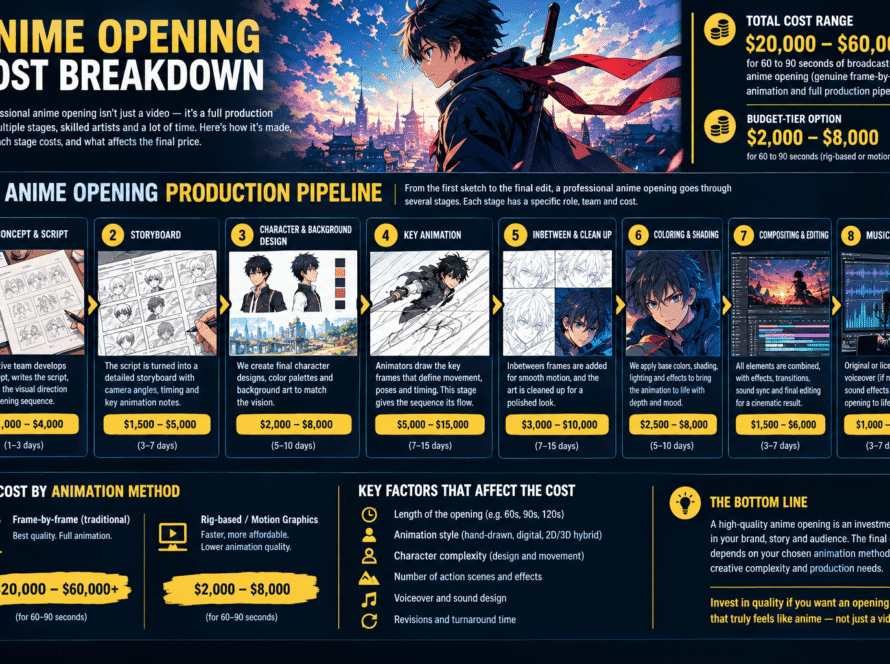
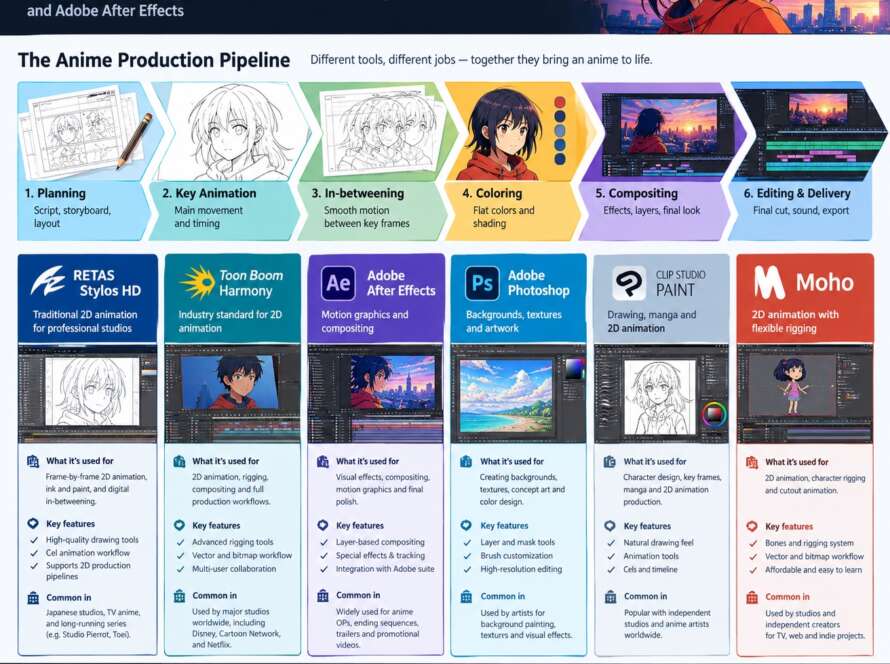
Anime animation follows a standardized pipeline developed in Japan: character design sheets (settei) define every character from multiple angles with approved color models; key animation (genga) is drawn by lead animators who define the principal poses in each movement; in-betweening (douga) fills the frames between key poses; cleanup and color (shiage) refines and digitally colors the line art; background art is painted separately and composited in post.
Western cartoon animation production varies much more widely by studio and project. The Disney theatrical animation tradition also uses key animation, rough animation, and clean-up stages, but at the full 24fps frame rate throughout. Modern cartoon productions, especially CGI ones from Pixar, DreamWorks, and smaller studios, have moved to fully 3D pipelines with rigged characters, eliminating the hand-drawn in-betweening stage entirely. There is no single "cartoon animation pipeline" in the way there is a recognizable anime production pipeline.
Digital anime animation vs digital cartoon animation
Both anime animation and cartoon animation have adopted digital tools. The difference is in what was digitized. Anime digitized the coloring and compositing stages (replacing physical cels with digital files) but largely kept key animation hand-drawn on paper or digital tablets. Western CGI cartoon production replaced the entire character animation stage with computer rigs and digital performance. Frame-by-frame anime animation keeps the full hand-drawn pipeline. This is why hand-drawn anime animation and CGI cartoon animation look so fundamentally different even when both are finished "digital" productions.
Need anime animation produced at genuine studio quality?
Full pipeline from character design sheets through final delivery.
Section 06
Storytelling: Serialized Anime vs Episodic Cartoons
The narrative philosophies that make each form feel the way it does.
Of all the differences between anime animation and cartoon animation, the storytelling divergence may be the most significant for viewers. The way each form handles narrative continuity, character development, and emotional stakes creates a completely different experience of the medium over time.
Anime Animation Storytelling
Serialized. Consequences. Development.
- Actions have permanent consequences that carry forward across episodes
- Characters age, grow, and change fundamentally through the story
- Death, loss, and failure are real outcomes, not reset by the next episode
- Narrative arcs can span hundreds of episodes before resolution
- Multiple plot threads develop in parallel and intersect
- Emotional complexity includes tragedy, moral ambiguity, and unresolved tension
- Draws from kishōtenketsu: a four-part Japanese narrative structure (introduction, development, twist, reconciliation)
Cartoon Animation Storytelling
Episodic. Reset. Accessible.
- Most episodes are self-contained stories that resolve fully within the episode
- Characters return to baseline at the start of each episode
- The status quo is preserved between episodes for easy re-entry at any point
- Three-act Western narrative structure: setup, confrontation, resolution
- Tone is generally optimistic with humor used to defuse tension
- Villain is defeated without permanent consequences in most cases
- Accessible entry: any episode works as an introduction to new viewers
Neither approach is objectively superior. Serialized anime storytelling creates emotional investment and narrative depth that episodic cartoons cannot match within a single viewing. But episodic cartoons allow viewers to tune in at any time without context, making them far more accessible for casual viewing and broadcast syndication. The serialized model requires a committed audience; the episodic model serves a broader, less invested one.
There are significant exceptions. Adventure Time, Steven Universe, and Gravity Falls are Western animated series that adopted serialized storytelling structures closer to anime animation than traditional cartoons. Meanwhile, some anime anthology series are fully episodic. The distinction is a tendency, not an absolute rule. But the tendency is strong enough that a viewer's expectation of continuity versus reset is one of the clearest ways to predict which form a given piece of animation comes from.
Emotional range: what each form allows itself to feel
Anime animation explores a full emotional spectrum including grief, romantic tragedy, moral failure, and narratives with no clear resolution or happy ending. Works like Grave of the Fireflies, Neon Genesis Evangelion, and Violet Evergarden treat difficult emotional experiences as their primary subject matter. Western cartoon animation, with its traditional roots in family entertainment, operates within a narrower emotional band in most cases. Comedy, adventure, and satisfying resolution are the defaults. This is not a limitation of the form, just a reflection of the audience expectation each tradition has built.
Section 07
Audience and Demographics
How each form categorizes and targets its viewers.
One of the most persistent misconceptions about anime animation vs cartoon animation is that anime is for adults and cartoons are for children. The reality is more nuanced. Both forms produce content for multiple age groups. The key difference is in how deliberately each form targets specific demographics.
The anime demographic system
Anime animation has a formalized demographic categorization built into its publishing and production system, inherited from the manga industry. This means content is designed from the ground up for a specific demographic rather than defaulting to family-friendly as the baseline.
Children
Kodomomuke
Anime made explicitly for young children. Simple themes, bright visuals, gentle humor. Examples: Doraemon, Pokemon, Crayon Shin-chan.
Young Men
Shonen
Targets teenage boys. Action, friendship, growth. The largest and most globally popular category. Examples: Naruto, My Hero Academia, Demon Slayer.
Young Women
Shojo
Targets teenage girls. Emotional relationships, personal growth. Distinctive visual style. Examples: Sailor Moon, Fruits Basket, Cardcaptor Sakura.
Adult Men
Seinen
Targets adult men. Complex themes, moral ambiguity, mature content. Some of the most critically respected anime. Examples: Berserk, Ghost in the Shell, Vinland Saga.
Adult Women
Josei
Targets adult women. Realistic relationships, career, adult life. More grounded than shojo. Examples: Nana, Chihayafuru, Paradise Kiss.
All Ages
Isekai / Genre
Cross-demographic appeal. Isekai (transported to another world), fantasy, and sports anime can span multiple demographic categories simultaneously.
How Western cartoon animation targets audiences
Western cartoon animation primarily targets children and families as its default audience. Adult cartoons like The Simpsons, South Park, Family Guy, and Archer exist and have large audiences, but they occupy a clearly separate category and are marked accordingly. There is no equivalent to anime's graduated demographic system built into the production structure of Western cartoon animation. A Western studio making an adult cartoon is making a deliberate, slightly unusual choice. A Japanese studio making seinen anime animation is making a standard industry decision within a well-established category.
Section 08
Cultural Roots and Themes
The cultural foundations that shape what each form values and how it portrays the world.
Anime animation and cartoon animation do not just look different; they reflect different cultural worldviews. These differences show up in how characters relate to authority, how conflict is resolved, what counts as a satisfying ending, and what moral frameworks the stories operate within.
Anime animation is deeply rooted in Japanese cultural traditions: a relationship with nature influenced by Shinto animism, a concept of duty and group obligation from Confucian ethics, and an aesthetic philosophy called mono no aware (the bittersweet awareness of impermanence) that makes loss and endings as valued as triumph. Studio Ghibli films are saturated with these values: the forest spirits in Princess Mononoke, the river god in Spirited Away, the quiet grief running through Grave of the Fireflies. These are not simply universal themes with Japanese clothing; they reflect a genuinely different relationship with the world.
Western cartoon animation grew from the vaudeville tradition, newspaper comic strips, and the optimistic American entertainment culture of the early 20th century. The dominant mode is comedic, the default resolution is victory, and the moral universe is generally clear. Good triumphs, evil is punished or reformed, and the hero gets what they deserve. This is not simplistic; it reflects a cultural commitment to resolution and legibility that has produced genuinely great storytelling. But it is structurally different from the anime tradition where ambiguity, tragedy, and unresolved tension are equally valid endings.
The manga tradition is another essential difference. Most anime animation adapts manga, a visual storytelling medium with its own grammar, pacing conventions, and audience relationship. Manga readers come to an anime adaptation with existing emotional investment, narrative expectations, and visual literacy. Western cartoon animation does not have an equivalent pipeline from a pre-existing visual medium with a comparable scale of readership and cultural embeddedness.
Section 09
Side-by-Side Examples
Anime animation vs cartoon animation in the same genre, showing the practical differences.
The clearest way to understand anime animation vs cartoon animation is to look at titles that tackle similar subject matter through different traditions. These comparisons show the concrete differences in storytelling approach, visual style, and audience expectations.
Anime Animation
Naruto (2002-2007)
720 episodes across two series. Characters age visibly. Deaths are permanent and emotionally significant. Naruto's growth from outcast to hero takes years of in-universe time with genuine setbacks throughout.
Cartoon Animation
Teen Titans (2003-2006)
5 seasons, largely episodic. Characters remain constant ages throughout. Emotional weight is present but reset between most episodes. Heavily anime-influenced in visual style, showing cross-pollination between traditions.
Anime Animation
Spirited Away (2001)
Miyazaki's film has no clear villain. The world operates on its own rules without explanation. Chihiro's parents become pigs as consequence of greed. The ending is bittersweet: she succeeds but cannot fully remember the journey. Academy Award winner.
Cartoon Animation
Moana (2016)
Disney film with a clear protagonist-antagonist arc, musical numbers, and fully resolved happy ending. Villain (Te Ka) is redeemed. The moral universe is clear and satisfying. Technically breathtaking CGI full animation at 24fps throughout.
Anime Animation
Death Note (2006-2007)
37 episodes of cat-and-mouse psychological warfare. The protagonist is morally compromised from the start and becomes the de facto antagonist. No redemption arc. The ending is deliberately unsatisfying. For adult audiences.
Cartoon Animation
Batman: The Animated Series (1992-1995)
Episodic with some arc serialization. Batman is unambiguously heroic. Villains are defeated each episode. The moral framework is clear even when villains receive sympathetic backstories. Widely considered the peak of Western cartoon animation storytelling.
Anime Animation
My Neighbor Totoro (1988)
A film for children with no villain and no traditional plot arc. The "conflict" is a mother's illness, never fully resolved. The story is about finding wonder and comfort in the world. Hand-drawn at theatrical quality throughout.
Cartoon Animation
The Lion King (1994)
Classic Disney formula: clear villain (Scar), protagonist must overcome loss and reclaim rightful place, triumphant musical finale. Emotionally complex for a children's cartoon but structurally conventional. One of the great achievements of hand-drawn Western cartoon animation.
Section 10
Which Is Right for Your Project?
Practical guidance on choosing between anime animation and cartoon animation for brands, creators, and filmmakers.
For brands, content creators, and independent filmmakers, the choice between anime animation and cartoon animation style is a strategic decision with real implications for audience, cost, timeline, and production approach.
Choose anime animation style when: your target audience includes globally-connected young adults aged 16-35 who are already part of anime fandom culture; you want serialized storytelling with emotional depth across multiple episodes or a short film with cinematic quality; your product or story benefits from the emotional precision of expressive character design; or your brand wants to signal cultural relevance to an audience that has grown up with the medium.
Choose cartoon animation style when: your primary audience is children or broad families; you need episodic content that works at any entry point without continuity context; you are targeting an audience that does not follow anime specifically; or your brand benefits from the optimistic, accessible, resolution-forward tone that cartoon animation delivers reliably.
The important practical note: production cost and timeline differ significantly. Frame-by-frame anime animation at genuine studio quality takes longer and costs more than digitally-produced cartoon animation, because every frame is hand-drawn individually through the genga, douga, and shiage pipeline. If the goal is authentic anime animation that the global anime audience will accept as genuine, the full production pipeline is required. A surface-level imitation of the anime visual style without the underlying production quality is immediately obvious to the audience most likely to respond to it.
Anime Style Marketing Video
Original anime animation produced in the authentic Japanese pipeline for brands targeting younger global audiences. Character design through compositing.
Explore this service ›Premium QualityFrame-by-Frame Anime Animation
The full hand-drawn pipeline: settei, genga, douga, shiage. Every frame drawn individually. The production method behind every major anime series and film.
Explore this service ›Related guides
Background reading
What Is Anime Animation?
A complete guide to anime animation: history, production pipeline, visual language, genres, and major studios.
Production services
Anime Animation Studio
Our full anime animation production services: character design, key animation, backgrounds, compositing, and delivery.
Section 11
Frequently Asked Questions
The most common questions about anime vs cartoon animation, answered directly.
The main difference between anime and cartoon animation is origin, visual approach, and storytelling philosophy. Anime animation originates from Japan and uses detailed character design sheets, expressive character eyes, limited frame rates (8-12fps standard), and continuous serialized narratives across all age demographics. Cartoon animation originates in Western countries and typically uses simpler exaggerated character designs, higher frame rates, and episodic storylines aimed primarily at children or family audiences.
Technically yes: anime is a form of animation, placing it under the broad animation category. However, in common usage outside Japan, "cartoon animation" and "anime animation" refer to distinctly different things. In Japan, the word "anime" means all animation regardless of origin, so by the Japanese definition, Western cartoons are a form of anime. Outside Japan, the distinction is cultural and production-based: anime refers specifically to Japanese animation or content following the Japanese aesthetic and production pipeline.
Anime looks different from cartoons because of deliberate production decisions developed over more than a century. The most important was Osamu Tezuka's invention of limited animation in 1963, which produced TV anime with around 1,800 drawings per 25-minute episode instead of the 18,000 needed for full animation. To compensate, anime concentrated visual investment in expressive still frames and detailed character design. Large eyes communicate emotion in a static frame. Detailed backgrounds create atmosphere without motion. Painterly environments substitute depth and artistry for movement fluency.
This is a misconception. Both forms serve all ages, but differently. Western cartoon animation defaults to children and family audiences, with adult cartoons as a separate, smaller category. Anime animation has a structured demographic system built into its production from the start: kodomomuke (children), shonen and shojo (young people), seinen and josei (adults). Adult-targeted anime is a mainstream, large category, not a niche exception. The key difference is that anime treats adult audiences as a standard target demographic, whereas Western cartoon animation treats them as an exception to the default.
Neither is objectively better, but they use different approaches. Anime animation typically favors serialized, continuous narratives where actions have permanent consequences and characters develop over time. Western cartoon animation traditionally uses episodic stories that reset between episodes, making them highly accessible. For complex long-form character development, anime animation's serialized format has a structural advantage. For self-contained, accessible entertainment that works at any entry point, episodic cartoon animation has advantages. Both formats have produced exceptional work within their respective approaches.
Yes. Anime animation style is increasingly used by brands in healthcare, technology, entertainment, and consumer goods. The critical factor is production authenticity: anime animation audiences are highly literate and immediately recognize the difference between genuine production quality and a surface imitation. Effective brand anime animation follows the same pipeline as entertainment productions: proper character design sheets, hand-drawn key animation, detailed backgrounds, and professional compositing. Our anime animation for brands service covers the full pipeline from brief to final delivery.
Magic Motion Studio · Anime Animation Production
Ready to produce anime animation
at the quality your audience expects?
Full pipeline: character design sheets, key animation, in-betweening, backgrounds, compositing, delivery.