
Animation Guide
Anime vs 2D Animation:
What Is Actually Different?
Most comparisons of anime vs 2D animation get the framing wrong. Anime is technically a form of 2D animation, but in practice, the two terms describe completely different production approaches, pipelines, and visual outputs. This guide explains the real distinction and what it means for your project.
Quick Answer
Anime is a subset of 2D animation, not a competitor to it. Both are produced in two dimensions, but "2D animation" in commercial practice usually refers to rig-based or puppet-style character animation, where a digital character model is moved and posed scene by scene. Anime animation uses a hand-drawn frame-by-frame pipeline, every key pose is uniquely drawn by a human animator, producing a fundamentally different quality of motion, expressiveness, and visual craft. When people ask "anime vs 2D animation," they are really asking about two production approaches: frame-by-frame hand drawing versus digital rigging.
Anime Animation
Hand-Drawn Frame by Frame
Rig-Based 2D Animation
Digital Puppet System
(AJA / Variety)
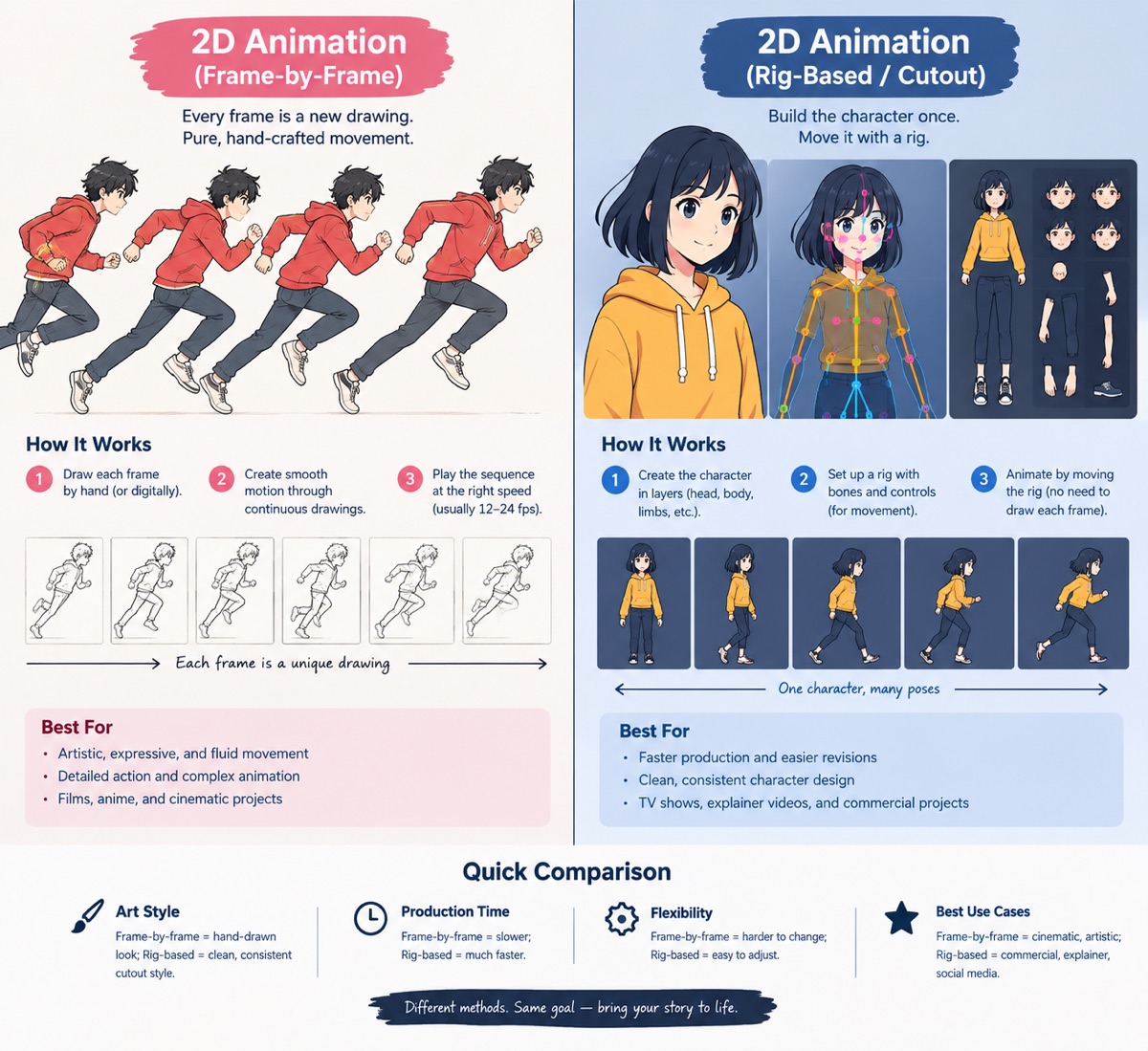
The Core Confusion
Why "Anime vs 2D Animation" Is a Tricky Comparison
When someone searches for "anime vs 2D animation," they are asking a question that contains a hidden assumption, that anime and 2D animation are two separate, competing categories. They are not. Anime is, by technical definition, a form of 2D animation. Traditional anime is produced entirely in two dimensions, using hand-drawn characters on flat planes composited over painted backgrounds. If you arranged every animated work in the world into categories, anime animation would sit inside the 2D animation category, not alongside it.
So why does this comparison exist? Because in commercial and production contexts, the phrase "2D animation" has drifted toward a specific meaning that most people understand as distinct from anime. When a marketing agency talks about "2D animation," they usually mean rig-based or puppet-style character animation: a digital character model built once and moved using software controls, without any redrawing. This is the kind of animation common in explainer videos, corporate content, and Western commercial productions.
This drift in usage has created a real and meaningful distinction in the anime vs 2D animation debate, even though both share a technical parent category. Understanding that difference is what actually helps you make a production decision.
Key Insight
The most useful way to frame anime vs 2D animation is not as two types of output, but as two production approaches: frame-by-frame hand drawing (what makes anime anime) versus digital rigging and puppeting (what most people mean when they say "2D animation" today). Same two-dimensional output category, fundamentally different creation process, completely different visual result.
Production Context
What "2D Animation" Actually Means in Commercial Practice
The term "2D animation" covers a wide family of techniques: hand-drawn cel animation, cut-out animation, motion graphics, rotoscope animation, whiteboard animation, and rig-based character animation. In commercial production in 2025, rig-based character animation dominates what people call "2D animation", especially for corporate video, marketing content, and digital entertainment.
The Types of 2D Animation
Rig-Based / Puppet Animation
The most common commercial form. A character is built as a layered digital model, limbs, head, eyes, mouth as separate layers, then controlled using software bones, constraints, and keyframes. The animator moves and poses the puppet; software interpolates between keyframes. Tools: Adobe Animate, Moho, Toon Boom Harmony (puppet mode), After Effects with character rigs. Used for explainers, corporate video, social content, Western cartoons.
Frame-by-Frame / Hand-Drawn Animation
Every frame is drawn by a human animator. Key poses (genga) are drawn first, then in-between frames (douga) are drawn to complete the motion. This is how anime animation is made, and also how classic traditional animation from Disney and Warner Bros. was produced. It is more expensive and time-intensive but produces organic, uniquely expressive motion that no software interpolation can replicate. Toon Boom Harmony (frame-by-frame mode), RETAS Studio, Clip Studio Paint.
Motion Graphics Animation
Text, shapes, icons, and UI elements animated using keyframes and easing curves. No character rigs or frame-by-frame drawing. Used for logo animations, data visualization, product demos, and explainer openers. Tools: After Effects, Cinema 4D Lite, Cavalry. Technically 2D animation but rarely described as such in creative briefs, it occupies its own category.
Cut-Out and Mixed Techniques
Flat illustrated shapes that are repositioned frame by frame (South Park's original paper technique, modernized digitally). Rotoscope animation traces over live footage to achieve realistic motion in a drawn style. Whiteboard animation simulates a marker being drawn on screen. These are niche production styles, each with specific use cases, that fall under the broad 2D animation umbrella but are rarely what clients mean when they say "2D animation."
When most clients, studios, and briefing documents say "2D animation," they mean rig-based character animation. That is the default assumption. When they say "anime animation," they mean the Japanese hand-drawn production approach. Knowing this distinction lets you ask the right questions and make informed production decisions, and it is exactly what separates a clear client brief from a confused one.
Side by Side
Anime vs 2D Animation: Full Comparison
The table below is an anime vs 2D animation comparison across every dimension that matters to a production decision, from drawing method and frame rate to audience perception and best-fit use cases.
| Dimension | Anime Animation | Rig-Based 2D Animation |
|---|---|---|
| Production method | Hand-drawn, frame by frame. Every key pose drawn uniquely by a human animator. | Digital puppet moved and posed using software controls. No frame-by-frame redrawing. |
| Drawing volume | ~1,800 drawings per 25-min episode (limited animation style) | Character drawn once; no redrawing required for additional scenes |
| Motion quality | Organic, expressive, with natural variation between poses and frames | Mechanically interpolated between keyframes; smoother but less expressive |
| Frame rate | 8-12fps for standard scenes, 24fps for key action. Strategic pacing. | Typically 24fps or higher. Consistent motion across all scenes. |
| Character design | Detailed settei (model sheets) define every angle, expression, and proportion | Character drawn and rigged once; same model used in all scenes |
| Background art | Detailed, painterly background art created separately by background artists (bijutsu) | Typically simple flat-color or illustrated backgrounds; rarely at anime complexity level |
| Expressiveness | Each frame can carry unique shape language; eyes, mouths, and silhouettes vary organically | Limited to what the rig allows; expressions controlled via blend shapes or replacement parts |
| Production time | 4-8 weeks per finished minute | 1-3 weeks per finished minute |
| Primary tools | Toon Boom Harmony, RETAS Studio, Clip Studio Paint, drawing tablets | Adobe Animate, Moho, Toon Boom Harmony (puppet mode), After Effects + rigs |
| Audience perception | Anime-native audiences immediately recognise production quality and authenticity | Familiar to general audiences; associated with corporate, educational, and explainer content |
| Sakuga potential | High, peak animation sequences possible with skilled animators | Not applicable, rig-based motion does not produce sakuga-quality output |
| Best for | Anime series, trailers, openings, brand storytelling, entertainment content | Explainers, corporate training, social media content, educational animation |
Comparison based on industry-standard production practices. Frame rate and timeline figures represent typical ranges.
How Anime Is Made
The Anime Animation Production Pipeline
Understanding why anime animation looks and moves the way it does requires understanding how it is made. The Japanese production pipeline is one of the most structured and craft-intensive workflows in animation, developed over more than a century from the earliest studios of 1917 to the digital workflows used in modern streaming productions. Every stage is distinct, every role is specialized, and the quality of the final output depends on the accumulated skill applied at each step.
Character Design Sheets
Every character is defined across multiple reference sheets: front, side, three-quarter, and back views, plus expression sheets showing the full emotional range, and size comparison sheets for every character in the production. These sheets are the law of the production, every animator must draw the character consistently across every scene, even when working on different episodes.
Storyboard / Animatic
The director or episode director draws the konte, a detailed storyboard defining every shot, camera move, and character staging across the episode. The konte is essentially a rough visual script that guides every department. Key timing decisions are made at this stage, including which scenes will receive high-frame-count key animation versus economy techniques.
Scene Composition
Layout artists take the konte and draw precise scene compositions showing exact character positions, perspective, and camera framing. Background artists use layout guides to paint the environments. The layout stage locks in the spatial and compositional decisions before a single frame of animation is drawn, preventing expensive revisions later in the pipeline.
Key Animation
Key animators (genga-ka) draw the principal poses that define each motion, the starting position, the peak of action, and the ending position. These are the most important drawings in an anime sequence; they carry the character's weight, personality, and emotional state. The quality of a production's animation lives or dies in the genga. Star key animators can command significant creative latitude over their assigned cuts.
In-Betweening
In-between animators (douga-ka) draw the transition frames between each key pose. The number of in-betweens determines the final frame rate of a scene: one in-between per key = "on twos" (roughly 12fps); no in-betweens = "on threes" (roughly 8fps). Standard anime television productions use a mix of techniques across a single episode, concentrating higher frame rates on action sequences and conserving them on dialogue and static shots.
Cleanup and Color
Cleanup artists (shiage-ka) trace over the rough key and in-between drawings with clean, consistent line work that matches the settei model sheets exactly. Digital coloring follows: flat color fills are applied to each frame according to the production's color scripts, including shadow colors, highlight colors, and effect colors. Modern anime uses dedicated compositing software to combine character layers over background art with lighting effects and final color grades.
The anime production pipeline's structured stages are what separate genuine anime animation from imitations. A production that draws inspiration from the anime visual style but bypasses this pipeline will produce work that anime-native audiences immediately recognize as inauthentic. The pipeline is not bureaucracy, it is the craft mechanism that produces the quality.
For more on the specific stages and what each contributes, see our complete guide to what anime animation is and how it works.
How Rig-Based 2D Animation Is Made
The Rig-Based 2D Animation Pipeline
Rig-based 2D animation works very differently from the anime approach. Instead of drawing a character thousands of times across the length of a production, a character is designed once, separated into layers, and then "rigged", connected by a digital skeleton that allows the animator to pose and move it without redrawing anything. The approach trades drawing volume for setup efficiency, and organic expressiveness for consistent, repeatable character movement.
Stage 1: Character Design and Layering
The character is designed flat, then separated into parts: head, torso, upper arms, lower arms, hands, upper legs, lower legs, feet, each as an individual layer or vector shape. Extra layers are created for different mouth positions, eye expressions, and alternate costume states. The quality of the initial layer separation determines how flexibly the character can be posed later. Good character design for rigging is different from good character design for frame-by-frame, angles and overlapping shapes that look beautiful in a single drawing can create problems when the parts need to move independently.
Stage 2: Rigging
The rigging artist connects the character's parts using a bone or constraint system. In Moho or Toon Boom Harmony's puppet mode, this means placing joints at the elbows, knees, shoulders, and neck, then assigning each body part to follow specific bones. The rig also includes controls for mouth shapes, eye blinks, and head rotations. A well-built rig allows the animator to produce a wide range of poses and expressions using only the control handles, without ever touching the underlying drawing. Complex productions include multiple rigs for the same character at different angles.
Stage 3: Scene Layout and Animation
The animator places rigged characters in the scene, sets keyframes for each pose, and adjusts easing curves to control how the software interpolates between positions. The scene camera is also keyframed for any movement. Because the character model is reused without redrawing, the same rigged character can appear in hundreds of scenes across a production without any additional character drawing work. Animators focus on timing, posing, and performance rather than draftsmanship.
Stage 4: Compositing and Output
Animated scenes are composited with background art and any motion graphic elements. Color correction, lighting overlays, and sound mixing are applied. Because rig-based 2D animation typically uses simpler backgrounds and fewer visual effects layers than anime, post-production is substantially faster. A 90-second rig-based 2D animated explainer video can move from approved script to final delivery in two to four weeks. An equivalent anime animation sequence takes considerably longer due to the drawing volume and pipeline stages involved.
Why This Matters
The rig-based approach is not inferior to frame-by-frame, it is optimized for different goals. When you need consistent character presentation across a long-form series, fast turnaround on a content calendar, or a cost-efficient animated explainer, rig-based 2D animation delivers. When you need cinematic quality, organic motion expressiveness, or production credibility with an anime-native audience, the hand-drawn frame-by-frame approach is the only path to that result. The right tool depends entirely on what the content needs to achieve.
The Fundamental Difference
Motion Quality: Frame-by-Frame vs Rig-Based
The single most important difference between anime animation and rig-based 2D animation is motion quality, and specifically the organic, human quality that frame-by-frame drawing produces. This is what separates anime animation from all other approaches in the 2D category, and it is what experienced viewers respond to whether or not they can articulate why.
What Hand-Drawn Animation Does That Rigging Cannot
When a skilled anime animator draws a running character, every frame reflects deliberate creative choices. The silhouette of the arm at frame 4 is not a mathematical interpolation of frames 3 and 5, it is drawn to maximize the sense of weight at that specific moment of the stride. The eyes at the peak of an emotional scene are drawn larger, more detailed, more expressive than the same eyes in a neutral scene. The body squashes and stretches with organic exaggeration that the animator controls drawing by drawing.
In rig-based animation, the software generates the frames between keyframes automatically. The arm at frame 4 is literally a blend of its position at frames 3 and 5, calculated by an easing curve. This produces consistent, predictable motion, which is valuable for many use cases, but it cannot produce the organic variation that the human eye reads as alive.
This difference becomes most visible in three situations: facial expressions in close-up, action sequences, and moments of high emotional intensity. These are exactly the moments that anime animation is built around. The entire pipeline, settei, genga, douga, shiage, exists to deliver those moments at the highest possible quality.
For brand and commercial content, this distinction matters when your audience includes people who know anime animation well. The global community of anime viewers is enormous, educated about production quality, and highly skeptical of content that approximates the visual style while cutting corners on the production method. A brand that invests in genuine anime animation production, frame-by-frame, proper pipeline, earns credibility with that audience. A brand that applies anime visual styling to rig-based 2D animation does not, regardless of how good the surface design looks.
What You See on Screen
Visual Style Differences
Beyond motion quality, the anime vs 2D animation difference extends to every visual layer of the frame: character design, background art, color treatment, line work, and camera composition. Here is how they compare across six key areas.
Character Design
Background Art
Line Work
Color and Shading
Camera and Composition
Special Effects
Need genuine anime animation for your project?
Magic Motion Studio produces frame-by-frame anime animation for series, trailers, openings, and brand content. Full pipeline from settei to final composite.
Practical Application
What Each Approach Is Built For
The anime vs 2D animation choice is not about which is better — it is about which is right for the job. Each approach is optimized for different content types, audiences, and production goals. Choosing the right one requires understanding what each is actually built to do.
Anime Animation Is Built For
Entertainment, Storytelling, and Authentic Brand Presence
Rig-Based 2D Animation Is Built For
Commercial, Corporate, and Content-Volume Use Cases
Notice that there is very little overlap in these lists. The anime vs 2D animation distinction maps directly to different project types, and the two approaches rarely compete for the same commission. The question is which one matches what your content needs to achieve and who it needs to reach.
If your content goal is brand storytelling that resonates with the 18-35 demographic who grew up watching Attack on Titan, Demon Slayer, and My Hero Academia, the rig-based 2D option will feel off to that audience, regardless of the visual style applied to the surface design. If your content goal is a clear, efficient explainer of a SaaS product for a general B2B audience, a full anime animation pipeline is a significant investment in the wrong direction.
Production Decision Guide
Anime vs 2D Animation: Which Is Right for Your Project?
The anime vs 2D animation decision comes down to four factors: your audience, your content purpose, your production timeline, and your quality expectations. Here is a practical framework for making the right call.
Choose Anime Animation When
- Your audience includes anime viewers or anime-adjacent communities
- You need emotional depth and cinematic quality in character performance
- You are building a series, pilot, trailer, or opening that will be judged on animation quality
- Your brand story depends on authentic storytelling, not just visual style
- You have a realistic timeline (the pipeline takes time, and that time produces quality)
- You want work that stands permanently apart from corporate animation conventions
- The content needs to earn credibility with a discerning, animation-literate audience
Choose Rig-Based 2D Animation When
- You need a clear explainer of a product, service, or process
- Your audience is general, not specifically anime-literate
- You have a tight turnaround and need fast production cycles
- You need consistent character use across many short pieces
- The content is primarily informational rather than entertainment-driven
- Budget efficiency per output minute is a primary production constraint
- You need a branded character that can be reused across many touchpoints
The "Anime Style" Trap
One of the most common mistakes in animation briefs is requesting "anime style" and expecting it to be achievable with a rig-based 2D animation workflow. The visual elements that define anime animation, large expressive eyes, dynamic action poses, organic secondary motion, detailed background environments, are partly a result of the production method. Applying anime-inspired surface design to a rig-based character produces a result that looks like an imitation, and anime audiences will experience it as exactly that.
This matters most for brand content. A brand that wants to reach the anime-native demographic needs to earn that audience's respect, not just their recognition. Genuine anime-style marketing video production, done with the correct frame-by-frame pipeline, delivers brand credibility that surface-level styling on a rig cannot. The audience knows the difference, often immediately.
What to Ask Your Studio
When evaluating a studio for an anime vs 2D animation project, ask three specific questions to determine whether they are offering true frame-by-frame anime production or rig-based animation with anime styling applied:
1. Do you produce frame-by-frame key animation (genga), or do you animate using rigs and puppet systems? A genuine anime animation studio will be able to explain the genga and douga stages of their workflow in detail.
2. Do you produce settei (character design sheets) showing multiple angles and expressions? Character model sheets are a baseline requirement of authentic anime production. A studio that skips this step will produce inconsistent character presentation across scenes.
3. Can you show examples of finished frame-by-frame animation from past productions? The motion quality in a showreel tells you immediately whether a studio is producing hand-drawn animation or rig-based content. The difference is visible within seconds of watching a character move.
Magic Motion Studio produces frame-by-frame anime animation using the full Japanese production pipeline. Every project begins with settei, proceeds through genga and douga key animation, and is completed with professional compositing. No rigs, no puppets, genuine hand-drawn animation.
Frequently Asked Questions
Anime vs 2D Animation: FAQ
Related reading: Anime vs Cartoon Animation, how anime differs from Western cartoon production, visual style, and storytelling approach.
Ready to Commission Genuine Anime Animation?
Magic Motion Studio produces authentic frame-by-frame anime animation for series, trailers, openings, and brand content. Full pipeline from character design sheets to final composite, no rigs, no shortcuts.
Get in Touch With Our Team