
2D Animation Services in Canberra: The Complete 2026 Buyer's Guide
Federal government, AUKUS defence, cyber security, space industry. Canberra's economy demands animation that explains the genuinely complex. Here is everything you need to know before you brief a studio.
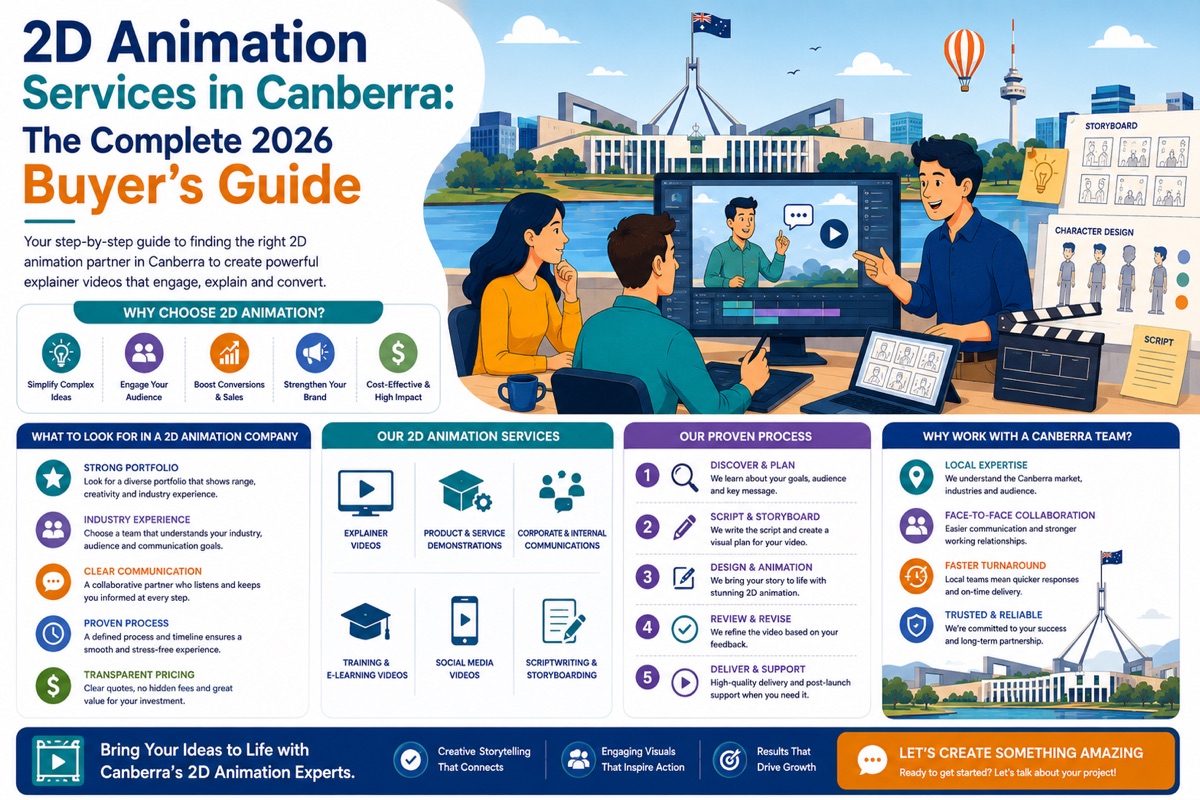
Canberra is one of Australia's most animation-intensive cities, and not for the reasons most buyers expect.
It is not a media hub with a large entertainment industry. It is not a startup ecosystem producing SaaS demos and product launch videos. It is Australia's national capital: home to 35 per cent of the entire Australian Public Service, a $4.3 billion defence industry, the country's cyber and quantum capital, a growing space sector anchored by ANU and Skykraft, and a $1.19 billion public health system. Every one of these sectors generates sustained, sophisticated demand for 2D animation production, and every one of them imposes requirements that a generalist commercial studio is unlikely to meet without prior government and defence experience.
This guide is for Canberra organisations commissioning 2D animation services in Canberra for the first time, or for buyers who have been through a disappointing production experience with a studio that did not understand their operating environment. It covers Canberra's key animation markets, the six animation styles that are actually appropriate for ACT clients, a detailed comparison of 2D versus 3D for government and defence briefs, and a complete evaluation framework for assessing any production partner before you commit budget and timeline.
Why Canberra Is One of Australia's Most Animation-Intensive Markets
The ACT's dominant industries all share a single characteristic: they require complex propositions to be communicated to audiences who are not subject-matter experts, in formats that work without a presenter in the room.
The Australian Public Service Commission's June 2025 employment data records a total APS workforce of 198,529, with the ACT accounting for 35 per cent of that total, approximately 69,500 federal public servants based in Canberra. These agencies produce policy documents, legislative changes, citizen-facing service announcements, internal training programmes, and parliamentary materials every week of the year. Every one of these communication outputs has an audience that did not choose to receive it and may not be familiar with the underlying subject matter. Animated video is the most effective format for bridging that gap at scale, with comprehension and recall rates that written text and static graphics cannot match for complex or unfamiliar content.
The ACT's defence sector adds a layer of demand that no other Australian city generates at the same intensity. KPMG estimates the defence industry contributes $4.3 billion in gross state product and supports 25,300 jobs in the Canberra region. The Australian Submarine Agency, headquartered in Canberra with a 2025-26 budget of $388.8 million, is the coordination point for an AUKUS investment pipeline that KPMG projects at $200 billion for the Canberra region. Major contractors including Northrop Grumman, Lockheed Martin Australia, BAE Systems, and Leonardo DRS all operate significant Canberra presences. Defence procurement requires capability communication that can reach panels across three nations and four time zones simultaneously, using animation to represent systems that cannot appear in live footage for classification reasons.
Beyond government and defence, Canberra's cyber security ecosystem, space industry, health sector, and university research institutions all generate demand for 2D animation services in Canberra that is qualitatively different from commercial animation briefs. These organisations do not need brand storytelling or product launch videos. They need technically accurate, accessible, WCAG 2.1 compliant, plain-language content that can survive scrutiny from policy advisors, procurement panels, clinical reviewers, and ministerial offices.
Six Canberra Industries Driving Demand for 2D Animation
Each of Canberra's primary sectors commissions 2D animation for different reasons, different audiences, and with different compliance requirements. Understanding which sector you are operating in will help you choose the right animation style, the right studio, and the right brief structure.
Federal Government and the APS
With approximately 69,500 APS employees in the ACT, federal government agencies are the largest and most consistent commissioners of 2D animation in Canberra. Policy communication, citizen-facing service explanations, internal onboarding and training, budget announcement summaries, and Machinery of Government change communications all generate ongoing demand. Government animation operates under specific constraints that commercial productions do not face: scripts must meet the Australian Government Style Manual plain language standard, content must be factually accurate and politically neutral, and all digital deliverables must comply with WCAG 2.1 accessibility guidelines under the Disability Discrimination Act 1992. Studios with no prior government experience consistently underestimate how different these constraints make the production process.
Defence and AUKUS Contractors
The ACT's defence industry contributes $4.3 billion in GSP and 25,300 jobs to the Canberra region. The Australian Submarine Agency, coordinating the $200 billion AUKUS submarine programme from its Canberra headquarters, is the largest single driver of new defence procurement activity in the ACT. Major contractors including Northrop Grumman, Lockheed Martin Australia, BAE Systems, and Leonardo DRS all maintain significant local presences. 2D animation is the preferred format for classified capability content because it eliminates the need to film on restricted sites, manage talent security clearances, or expose sensitive infrastructure in live footage. It is also far easier to update than live-action when procedures change across a multi-year programme.
Cyber Security and Quantum Technology
Canberra is Australia's cyber and quantum capital. The Canberra Cyber Hub represents a unified ecosystem of cyber, quantum, and space technology organisations, established in 2021 with ACT Government support. Australian organisations are expected to spend A$6.2 billion on information security and risk management in 2025, a 14.4 per cent year-on-year increase. Canberra-based QuintessenceLabs raised a $20 million quantum-resilient cybersecurity round led by the Australian Government. Cyber and quantum organisations face the most extreme version of the animation communication problem: their technology is so advanced that even technically literate audiences require a visual framework to understand it. 2D schematic animation that maps invisible digital processes onto visible, comprehensible diagrams is the standard format for this sector.
Space Industry
Canberra is Australia's national space hub. Skykraft, the ACT-based mini satellite designer and manufacturer, is building a constellation of more than 200 satellites providing space-based Air Traffic Management services, with operations commencing in 2025. The ANU Institute of Space has received $1.3 million for the Resilience Mission Project, developing OzFuel, a space-based bushfire detection platform. UNSW Canberra, EOS Space Systems, and multiple SmartSat CRC partners operate across the ACT. Space organisations produce the most challenging 2D animation brief of any sector: they must make genuinely novel technology credible to audiences with no existing reference point, while maintaining scientific accuracy for expert review. The right production partner can produce content that works simultaneously for a general public audience, an industry partner, and a government grants assessor.
Health and Medical Research
The 2025-26 ACT Budget delivers a record $1.19 billion investment in Canberra's public health system, the largest single health investment in Territory history. Investment includes the Canberra Hospital Master Plan, a new Pathology and Clinical Services Building, and expanded cancer screening services, with the Commonwealth delivering a 16 per cent hospital funding boost. Canberra Health Services, research institutions, medtech companies, and pharmaceutical organisations produce 2D animation for four distinct audience types: patients requiring accessible plain-language health education, clinicians receiving procedural training, investors evaluating commercial or research opportunity, and regulators reviewing clinical or safety evidence. Each audience needs a different depth of technical detail from the same underlying content. Animation handles that translation more efficiently and cost-effectively than any other format at comparable scale.
Universities and Research Institutions
Canberra is home to five universities including the Australian National University (ANU), consistently ranked in the global top 100 as one of Australia's Group of Eight research-intensive institutions. The University of Canberra, UNSW Canberra at ADFA, and CSIRO research facilities contribute to one of the highest concentrations of research activity of any Australian city relative to population. Research institutions use 2D animation primarily for three purposes: commercialising research findings to industry, government, and international partners; communicating complex study outcomes to public and policy audiences; and recruiting international students through content that works across language barriers without a presenter. For multilingual audiences across Asia, the Middle East, and Europe, 2D animation paired with subtitles delivers better comprehension and retention than any written or presenter-delivered format at equivalent cost.
Ready to commission your Canberra animation?
Tell us your sector, your audience, and what the animation needs to achieve. We respond within one business day.
2D Animation Styles for Canberra's Primary Sectors
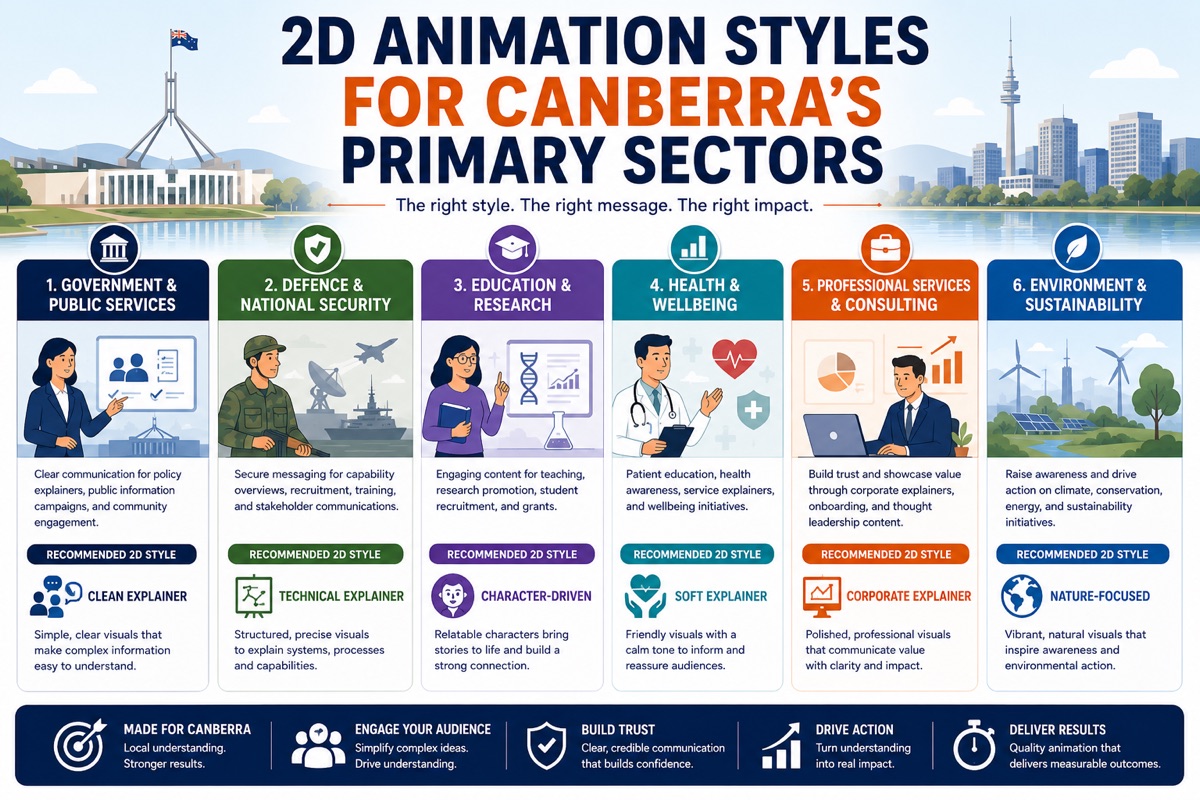
Animation style is a strategic decision, not an aesthetic preference. The wrong style signals the wrong things to Canberra's audiences before the script has finished. Government agencies, defence contractors, and research institutions are calibrated to institutional communication standards. A playful cartoon style on a serious policy communication will undermine the message before the viewer has registered the content.
Flat Design Motion Graphics
The most widely used 2D animation style for federal government and public sector communications. Clean geometric shapes, a controlled colour palette aligned with the Australian Government Design System, and minimal character illustration convey professionalism without being either overly formal or inappropriately playful. Flat design motion graphics can be produced at lower cost and faster timelines than character-driven styles while maintaining the visual quality expected by senior government audiences. This is the appropriate baseline style for policy explainers, citizen service announcements, and annual report summaries.
Character Animation
Character-driven 2D animation is appropriate when relatability and empathy are the primary communication goals: patient education videos, citizen services outreach, employee wellbeing programmes, and community engagement content. Illustrated characters allow viewers to see themselves in the content and build emotional engagement with the message at a level that icon-and-text motion graphics cannot achieve. For health campaigns targeting diverse communities, character animation with culturally representative characters consistently outperforms generic flat design on comprehension and behaviour-change metrics. Character animation takes longer to produce than motion graphics and costs more per minute of finished content.
Technical Schematic Animation
The appropriate style for AUKUS capability proposals, cyber security briefings, space technology communications, and defence procurement content. Technical schematic animation uses line-work, diagrammatic representation, and controlled colour coding to show how systems, processes, and technologies work at an accuracy level that both specialist and non-specialist audiences can trust. It signals precision and credibility rather than consumer-facing approachability, which is the correct register for a defence tender submission or a quantum computing capability brief. Live footage cannot achieve the same result for classified or novel technology: animation is the only format that can represent a system that does not yet exist in final form or cannot be filmed.
Cut-out and Rigged Character Animation
Cut-out animation uses digitally rigged character rigs in software such as Toon Boom Harmony to produce character-driven animation at lower cost than frame-by-frame production. It is well suited to training content, safety inductions, and onboarding videos where the same characters appear across multiple scenes or across a series of related videos. For a government department producing an APS onboarding video series, or a defence contractor producing a multi-module safety induction programme, cut-out rigged animation delivers consistent character appearance across the series at a cost point that frame-by-frame cannot match for long-form content.
Kinetic Typography and Data Animation
Text and data-driven animation is appropriate when statistics, timelines, and comparative information are the primary content. Budget announcements, research data summaries, annual report animations, and parliamentary committee briefings all contain structured numerical information that animated charts, graphs, and typographic sequences can make more immediately readable than equivalent static formats. For APS agencies releasing budget data or research institutions communicating study outcomes, kinetic data animation turns information that would otherwise require the viewer to interpret a static chart into a visual argument that makes the finding clear in seconds.
Whiteboard Animation
Whiteboard animation, in which a hand is shown drawing illustrations on a white background, was widely used in government and corporate communications from 2012 to 2018. It is now strongly associated with low-budget or outdated production. For Canberra's primary clients, government agencies, defence contractors, and research institutions with sophisticated procurement and communications teams, whiteboard animation signals low production investment before the content has been assessed. It remains appropriate only for very limited use cases where a deliberately informal, educational register is the brief, such as internal team communications or early-stage concept development videos. For any externally facing communication, choose one of the styles above.
2D vs 3D Animation: Which Is Right for Your Canberra Project?
The majority of Canberra clients who approach studios asking about 3D animation discover that 2D is a better fit for their actual brief once the communication objective and audience are clearly defined. Here is the honest comparison.
| Factor | 2D Animation | 3D Animation |
|---|---|---|
| Cost (60 seconds) | ✓ $5,000 to $12,000 | $12,000 to $35,000+ |
| Production timeline | ✓ 4 to 8 weeks | 8 to 16 weeks |
| Ease of revision | ✓ High. Asset-based production revises cleanly | Low to medium. 3D models require re-rendering on changes |
| WCAG accessibility | ✓ Easier to maintain contrast ratios in flat design | Requires additional post-production for accessibility compliance |
| Policy and training content | ✓ Ideal for most government and APS briefs | Overkill for most policy and training applications |
| Technical process animation | ✓ Appropriate for most defence and cyber briefs | Required only when spatial depth is essential to understanding |
| Product or engineering vis | Limited when precise 3D geometry is required | ✓ Superior for physical product demonstrations |
| Architectural walkthrough | Not appropriate | ✓ The standard format for built environment visualisation |
| Localisation and versioning | ✓ Subtitle tracks and audio swaps are straightforward | Re-rendering required for any text or label changes |
| Long-form series production | ✓ Cost-effective across multiple episodes | Per-episode cost remains high even with reused assets |
The practical rule for Canberra clients: if your content needs to communicate a process, policy, concept, or capability in a way that a non-specialist can follow, 2D animation will deliver better results at lower cost and faster turnaround than 3D. The only cases where 3D is genuinely superior are physical product demonstrations requiring photorealistic depth and spatial accuracy, and architectural or engineering visualisations where the three-dimensional geometry of a built environment is the content itself.
Government Animation in Canberra: What Compliance and Procurement Mean in Practice
Canberra's government animation market operates under a specific set of compliance requirements, procurement processes, and approval dynamics that no commercial animation brief replicates. Understanding them before you commission will save significant time and budget on both sides.
The Three Government Animation Requirements That Surprise Commercial Studios
1. WCAG 2.1 is non-negotiable, not optional. All federal government digital content must comply with Web Content Accessibility Guidelines 2.1 under the Disability Discrimination Act 1992 and the Digital Transformation Agency's Digital Service Standard. For 2D animation, this means closed captions for all spoken audio, audio descriptions for visual-only content not explained by the voiceover narration, a minimum colour contrast ratio of 4.5:1 for all on-screen text, and keyboard-accessible media players when content is embedded on government websites. Closed captions and subtitle files in .srt and .vtt formats should be delivered as standard items on every government animation project. Studios that treat these as optional extras have not previously worked on government productions.
2. Approval cycles are structured, not informal. Federal government communications require formal written sign-off at each production stage by a named approver with the authority to commit the agency. This is not a formality. It is a legal and accountability requirement. A studio that does not build written approval milestones into the production schedule at script, storyboard, and pre-final stages is planning for a commercial client. Government projects where approval has not been properly structured routinely run four to six weeks late because the studio discovers the approval process mid-production instead of designing around it from the start.
3. Plain language is a measurable standard. The Australian Government Style Manual requires government communication to use active voice, concrete language, short sentences, and terminology that a general reader can understand without subject-matter expertise. A studio that returns a first-draft script written in internal policy language has either reproduced department-authored content without editing it, or does not have experience in plain language communication. For Canberra animation projects aimed at public audiences, the plain language standard is the single most important factor in whether the video achieves its communication objective.
How to Evaluate 2D Animation Services in Canberra
Canberra's animation market includes full-service studios, generalist digital agencies offering animation among other services, freelancers operating under a studio identity, and offshore agencies with an Australian contact page. The production quality and communication expertise gap between these categories is large in any market. In Canberra, where primary clients include federal agencies with public accountability requirements, defence contractors with security considerations, and research institutions with technical credibility standards, the gap is larger and the cost of choosing incorrectly is higher.
- ✓Do you have portfolio examples from government, defence, cyber, health, or research? Canberra's primary sectors have communication requirements that commercial portfolio work does not demonstrate. Request examples specifically from technically complex or government-regulated contexts.
- ✓Are closed captions and WCAG 2.1 compliance standard deliverables? Studios with government animation experience will answer yes immediately. Studios without it will need to be asked several times before they understand the requirement.
- ✓Who writes the script, and what is their plain language background? Ask to see a script from a previous government or technical project. It should be written in plain English, active voice, and free of policy jargon. If the sample reads like a departmental brief, the studio is not editing client content.
- ✓Does the production schedule include written approval milestones with named dates? A professional production schedule shows a milestone date for script approval, storyboard approval, and pre-final review, each with a named approver position. A schedule that shows only a final delivery date is planned for a commercial client.
- ✓Is all animation produced in-house, or are elements subcontracted? This is a security consideration for any client handling sensitive, pre-public, or classified content. Ask specifically whether any third-party or offshore studios will have access to the brief, script, or visual assets at any stage.
- ✓What animation software does your team use? Professional 2D animation studios use Toon Boom Harmony or Adobe Animate for character and motion work, and After Effects for compositing and motion graphics. Studios using only Canva, Vyond, or similar template platforms are not producing custom animation.
- ✓How many revision rounds are included at script, storyboard, and animation stages? Two rounds at each stage is the professional standard. One round indicates a studio with low confidence in its output. Unlimited rounds with no milestone sign-off structure is a scope management failure waiting to happen.
- ✓What file formats are delivered, and are source files included? For government clients who may need to re-edit content as policy changes, source file access is important. Confirm whether the studio retains source files and for how long, and whether re-edit projects are available without committing to a new full-scope production.
- ✓Are all voiceover and music licences included for government distribution? Government animation is often distributed via department websites, social media channels, and internal intranet systems simultaneously. All audio licences must cover unlimited government distribution with no ongoing fees.
- ✓What are the IP ownership terms on final delivery? Full commercial and government rights to the completed animation should transfer to the client on final payment. Any ongoing licence arrangement, usage restriction, or per-platform fee structure is not the professional standard for custom animation production.
Red Flags When Evaluating 2D Animation Services in Canberra
- A portfolio with no government, defence, technical, or research content. Every studio's showreel reflects their real client base. If theirs is entirely startup launches, consumer brands, and product demos, they have not developed the communication skills required for Canberra's primary animation markets.
- No mention of WCAG 2.1 compliance in the initial proposal. Experienced government animation studios address accessibility as a standard part of scope, not after you ask. If it is absent from the proposal document, it is absent from their standard practice.
- A production timeline with no written approval milestones. Government productions that run late almost always do so because the approval structure was not built into the schedule from the start. A professional studio lists milestone dates, named approver positions, and client responsibilities in the production schedule before work begins.
- Template-based pricing before the brief has been discussed. Custom 2D animation cannot be accurately quoted from a form submission alone. Studios that send a flat rate without understanding your audience, approval chain, distribution context, and animation complexity are producing template animation, not custom production.
- Scripts that reproduce client-authored language without editing. If the studio's first script draft reads like the brief you sent them, they have reformatted your content rather than applied communication expertise to it. Plain language editing is a skill. Ask to see a comparison of before and after draft scripts from a previous government project.
- No in-house team. Many agencies present as animation studios while subcontracting all production to offshore teams. For any Canberra client handling sensitive content, this introduces both security risk and quality control risk. Ask for the names and locations of the people who will actually produce your animation.
Production Process for Canberra 2D Animation Projects
The four stages below apply to every 2D animation project. What changes for Canberra government and defence clients is the time allocated to each stage and the structure of client approval within each one.
Discovery and Script Development
A structured briefing call establishes your audience, the communication objective, the distribution context (website embed, internal training system, parliamentary submission, or public campaign), and any compliance or accessibility requirements specific to your agency or sector. We draft the script to the Australian Government Style Manual plain language standard, review it with your team, incorporate feedback, and confirm written sign-off before storyboard work begins. Government clients should allow five to seven business days for the internal approval of script at this stage. For defence and research clients with additional technical review requirements, allow seven to ten business days.
Storyboard and Style Frames
We produce a scene-by-scene storyboard with full style frames showing the visual approach, colour palette, character or graphic design direction, and typography. For government clients, style frames are reviewed against the Australian Government Design System colour and accessibility standards before they are submitted for approval. Written approval at storyboard stage locks the full visual scope before animation production begins, preventing costly late-stage scope changes. For defence and security-sensitive projects, storyboards are shared through secure channels as agreed with the client before production begins.
Animation and Audio Production
All animation is produced in-house using Toon Boom Harmony, our core production software for character and motion work. Professional voiceover is recorded from our approved talent pool or from a talent you specify. Once voiceover is locked, animation is produced to the approved storyboard and shared via a private Vimeo review link with timestamped commenting. Two revision rounds are included at animation stage. For government projects, review rounds may require a full internal approval cycle before feedback is consolidated and submitted, which is accounted for in the production timeline.
Final Delivery and Accessibility Outputs
Final files are delivered in MP4 and MOV broadcast formats, plus a web-optimised MP4 for online embedding. Closed captions are delivered in .srt and .vtt formats as standard on every production. Subtitle files for localised language versions are available on request. For government clients requiring an audio description track for WCAG 2.1 compliance, we produce this as part of the accessibility deliverable package. Social media cuts in square (1:1) and vertical (9:16) formats are available as an addition to scope. Full intellectual property transfer to the client is confirmed in writing on the final invoice, with no ongoing licence fees, usage restrictions, or per-platform charges.
How Magic Motion Studio Delivers 2D Animation Services in Canberra
Magic Motion Studio produces 2D animation for government agencies, defence contractors, cyber security firms, research institutions, and health organisations across Australia. Our Canberra production process is built specifically around the ACT's operating environment: written approval milestones in every schedule, WCAG 2.1 closed captions and subtitle files as standard, plain language scripting reviewed against the Australian Government Style Manual, and full IP transfer to the client on final payment.
All animation is produced in-house using Toon Boom Harmony by our core animation team. We do not subcontract production to offshore studios. This matters for Canberra clients handling sensitive, pre-public, or security-aware content. Client briefs, scripts, and visual assets are not shared with third parties at any stage of production. Source files are available on request and retained for 24 months for re-edit projects.
We have produced 2D animation for government agencies requiring plain language policy communication and accessible citizen-facing content, defence and AUKUS supply chain clients requiring technical capability animation that cannot appear in live footage, and research and health institutions requiring content that is simultaneously accessible to public audiences and credible to expert reviewers.
For a complete overview of our Canberra production capability, visit our Canberra explainer video production service page. For pricing guidance across animation styles and project lengths, our explainer video pricing guide covers the full range. For anime-style animation briefs, see our anime animation studio service. To see our companion guide covering explainer video production specifically for Canberra, read how to choose an explainer video company in Canberra.
Written Milestones on Every Project
Script approval, storyboard approval, and pre-final review all have confirmed dates and named approver positions before production begins. No government project runs late because of an unplanned approval round.
WCAG 2.1 as Standard
Closed captions (.srt and .vtt), audio descriptions on request, and compliant colour contrast on all on-screen text. Government accessibility requirements are built in, not added on.
No Offshore Subcontracting
All animation is produced by our in-house team. Client briefs, scripts, and visual assets are never shared with third parties. Relevant for any client handling sensitive, pre-public, or security-aware content.
Frequently Asked Questions
How much do 2D animation services in Canberra cost?
A standard 60-second 2D animation produced to professional broadcast standard typically starts from $5,000 to $10,000 in Australia, depending on animation style, script complexity, and revision rounds included. Flat design motion graphics sit at the lower end. Character animation and frame-by-frame illustration sit higher. Government projects with WCAG 2.1 compliance requirements, structured approval cycles, and multiple stakeholder review rounds will typically sit at the higher end of this range. Always request an itemised quote that separates scripting, storyboarding, animation, voiceover, closed captioning, and file licensing so you can compare production partners accurately.
How long does a 2D animation project take for a Canberra government client?
A standard 60 to 90 second 2D animation for a government client takes seven to ten weeks from confirmed brief to final delivery, accounting for structured internal approval rounds at script, storyboard, and pre-final stages. Commercial clients without internal approval requirements can expect four to six weeks for the same length. Rush timelines of two to three weeks are available for Senate committee deadlines, budget announcement communications, or ministerial office requirements, but require the client to be available for same-day approvals at key milestones.
What is the difference between 2D and 3D animation for government and defence projects?
2D animation builds movement on a flat plane using illustrated assets and motion paths. It is faster to produce, more cost-effective, easier to revise, and better suited to policy communication, training content, and public-facing explainer videos where clarity and accessibility matter more than photorealism. 3D animation constructs a full three-dimensional environment with modelled assets, making it appropriate for architectural walkthroughs, engineering visualisations, and physical product demonstrations where spatial accuracy is essential. For the majority of government, defence, cyber, and health communication briefs in Canberra, 2D animation services in Canberra deliver equivalent communication impact at lower cost and faster turnaround than 3D.
Can 2D animation be used for AUKUS and defence training content in Canberra?
Yes, and it is the preferred format for classified or security-sensitive defence content. 2D animation has a critical practical advantage over live-action in defence environments: there is no need to film on restricted sites, manage talent with specific security clearances, or expose sensitive infrastructure in live footage. Animated training content can accurately represent operational procedures, equipment use, and safety protocols without those constraints. It is also significantly easier to update when procedures change across a multi-year programme like the AUKUS submarine build coordinated through the Australian Submarine Agency in Canberra.
What 2D animation styles work best for federal government communications?
Flat design motion graphics are the most widely used style for federal government communications. The clean, geometric aesthetic aligns with the Australian Government Design System and signals professionalism without being either too formal or too informal. Character animation works well for citizen-facing content where relatability is a communication goal, such as welfare services, health campaigns, and community engagement. Technical schematic animation is appropriate for defence procurement and cyber security briefings where accuracy and credibility are the primary requirements. Avoid whiteboard and kinetic typography for externally facing government content as both signal low production investment to experienced government audiences.
Do I need to be in Canberra to work with a 2D animation studio?
No. Most professional studios operate fully remote production processes. Discovery and briefing calls run over video conference, script and storyboard review happens through shared cloud documents, and animation review uses Vimeo with timestamped commenting. Most of Canberra's government departments, defence agencies, and research institutions regularly commission animation from interstate studios. What matters is not the studio's postcode but whether they understand the ACT's operating environment: government approval cycles, WCAG 2.1 compliance, the Australian Government Style Manual, and the communication constraints specific to defence and research content.
What accessibility standards apply to government animation in Canberra?
All federal government digital content must comply with WCAG 2.1 under the Disability Discrimination Act 1992 and the Digital Transformation Agency's Digital Service Standard. For 2D animation this requires closed captions for all spoken audio, audio descriptions for visual-only content not explained by narration, a minimum colour contrast ratio of 4.5:1 for on-screen text and graphics, and keyboard-navigable media players when videos are embedded on government websites. Closed captions and subtitle files in .srt and .vtt formats should be standard deliverables on every 2D animation project for a government client, at no additional cost.
Ready to commission your Canberra 2D animation?
Tell us your sector, your audience, and what the animation needs to achieve. We will respond within one business day with a tailored approach, a written production schedule, and an itemised quote.
Get a Free Quote →