
Animation Guide
What Is Frame-by-Frame Animation?
The Complete Guide
Frame-by-frame animation is the craft behind every great animated film, every anime series, and every hand-drawn game you have ever loved. This guide explains exactly how it works, how the production pipeline runs, why it still dominates premium animation in 2026, and what separates a competent frame-by-frame animation studio from an exceptional one.
Quick Answer
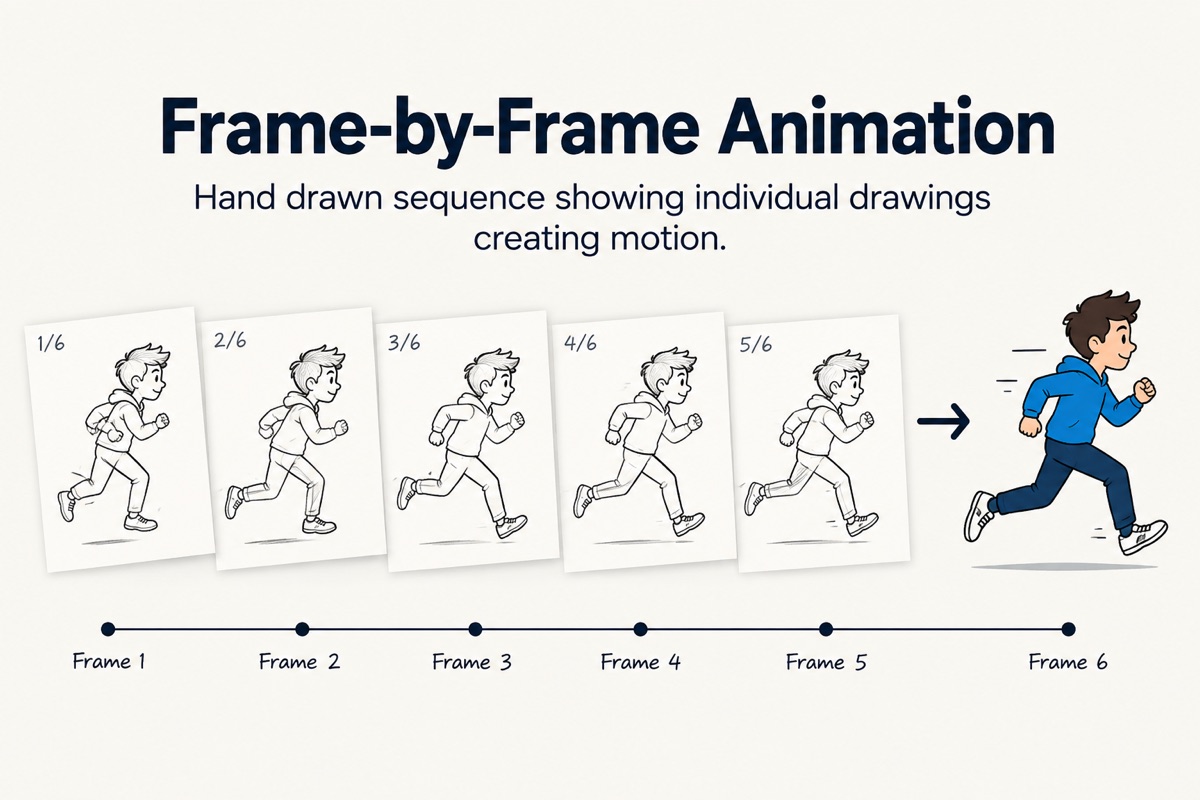
Frame-by-frame animation is a production technique where every individual frame is drawn or created separately by hand. When played in sequence at speed, the brain reads a series of still images as continuous motion. Unlike rig-based or tweened animation, where software generates the frames between poses automatically, frame-by-frame animation gives the animator full creative control over every single drawing in the sequence, producing organic, expressive motion that no other method can replicate. It is the production method behind all traditional anime, classic Disney films, Spider-Man: Into the Spider-Verse, and thousands of commercial productions worldwide.
The Fundamentals
How Frame-by-Frame Animation Works
The principle behind frame-by-frame animation is one of the oldest tricks in visual science: persistence of vision. The human brain retains an image for a fraction of a second after it disappears. When a sequence of slightly different still images is shown quickly enough, typically at 12 frames per second or faster, the brain interprets the rapid succession of stills as continuous movement. This is the foundation of all film, all animation, and all video.
What makes frame-by-frame animation distinct from other animation methods is that every frame is created individually by a human hand, either drawn on paper or digitally using a stylus and tablet. There is no software generating the transitions between poses automatically. Every drawing is a deliberate creative decision: where the arm is at this exact moment, how the face is expressing this precise emotion, what the silhouette of the whole figure looks like when it carries maximum weight at the peak of this specific action.
That deliberateness is what produces the quality. A viewer may not be able to articulate why hand-drawn animation moves differently from digitally rigged animation, but they feel it immediately. The organic variation between frames, the subtle imperfections, the weight and squash and stretch that an animator draws rather than calculates, these qualities register as alive in a way that interpolated motion never quite achieves.
The process of creating frame-by-frame animation breaks down into four core mechanical stages:
Keyframes (Key Drawings)
The animator begins by drawing the principal poses of a motion, called keyframes or key drawings. These are the most important moments in an action: the pose at the start, the extreme pose at the peak of the movement (the "extreme"), and the pose at the end. Keyframes define the timing, weight, and emotional content of the scene. In professional studios, senior animators are responsible for keyframes because this is where the character's performance lives. A technically skilled keyframe communicates everything the scene needs to say before a single in-between is drawn.
In-Betweening (Inbetweens)
In-between drawings fill the frames between each keyframe, completing the arc of the motion from one pose to the next. The number and placement of in-betweens determines the speed and easing of the movement. An action that needs to feel fast and snappy has very few in-betweens between the key poses. An action that needs to feel slow and heavy has many. In-between animators in professional studios are responsible for this stage; in Japanese anime studios, they are called douga-ka. The quality of in-betweening is what separates fluid, believable animation from jerky, mechanical-looking output.
Timing and Spacing
Timing refers to how many frames an action occupies: a fast punch might happen in 4 frames; a slow turn of the head might take 16. Spacing refers to the distance between drawings within a motion arc: drawings bunched close together create the appearance of deceleration; drawings spread far apart create the appearance of acceleration. These two tools, timing and spacing, are the most powerful elements in an animator's vocabulary. They are what allow frame-by-frame animation to convey weight, personality, physical laws, and emotional state through pure drawing rather than dialogue or music.
Cleanup and Color
Rough animation drawings are loose, gestural, and often messy. The cleanup stage produces the final clean line art by tracing over the rough drawings with precise, consistent line weights that match the character's established design. In anime production, this stage is called shiage. After cleanup, color is applied to each frame, using flat color fills for characters and detailed painting for background art. Modern digital workflows use compositing software to layer cleaned-up animation over backgrounds, add lighting effects, and render the final output at broadcast or cinema quality.
Frame Rate Fundamentals
Frame Rates in Frame-by-Frame Animation: On Ones, Twos, and Threes
One of the most misunderstood aspects of frame-by-frame animation is how professional studios manage frame rates without redrawing every single frame at 24fps. The answer is a simple but powerful technique: holding each drawing for multiple frames rather than one.
On Ones / Full Animation
A unique drawing for every single frame. 24 distinct drawings per second. Used for peak action sequences and Disney theatrical animation. Maximally smooth but extraordinarily time-intensive and expensive. Most productions reserve this rate for brief highlight moments rather than entire episodes.
On Twos / Standard Anime
Each drawing is held for two frames. 12 unique drawings per second that play back at 24fps. The standard technique for anime television production and most professional 2D animation. Reduces drawing volume by 50% while maintaining smooth, high-quality motion. The visual standard viewers associate with anime animation quality.
On Threes / Economy Animation
Each drawing held for three frames. 8 unique drawings per second. Used for dialogue-heavy scenes, slow movements, and budget-conscious TV production. Noticeably choppier than on twos for fast action, but effective for static character moments. Common in lower-budget anime TV production and webcomics animation.
These three rates are not simply budget tiers. Skilled directors use them as creative tools within the same production, even within the same scene. Animating a character on threes during a quiet dialogue exchange and then cutting to the same character on ones during a battle sequence creates a visceral sense of speed contrast that would be impossible to achieve if every scene ran at the same rate. This deliberate manipulation of frame rate is one of the most characteristic and sophisticated techniques in the anime animation tradition.
The Spider-Verse Technique
Spider-Man: Into the Spider-Verse (2018) used frame rates as a storytelling device in a way no production had attempted before. Miles Morales was animated on twos throughout the film. Kingpin and most background characters were animated on ones. Peter Parker's older, tired aesthetic was emphasized by animating him on threes. Each character's frame rate expressed something true about their personality and status, and the visual contrast between them created one of the most technically innovative animation films ever made.
From Flipbook to Digital
The History of Frame-by-Frame Animation
Frame-by-frame animation is not a technique that was invented by any single person at any single moment. It emerged from a century of experimentation with the science of motion and the mechanics of visual perception, and it has evolved continuously from hand-drawn paper cells to fully digital production pipelines without ever losing its fundamental defining characteristic: one human drawing per frame.
1830s
Pre-Cinema Optical Toys
The phenakistoscope (1832) and the zoetrope (1834) were the first devices that demonstrated persistence of vision by creating the illusion of movement from a sequence of still images. These toys established the scientific principle that all subsequent animation is built on: a brain shown images fast enough perceives motion where there is none.
1900s
First Animated Films
J. Stuart Blackton's "Humorous Phases of Funny Faces" (1906) and Emile Cohl's "Fantasmagorie" (1908) are among the earliest documented frame-by-frame animated films. Each frame was drawn individually on paper or chalkboard, photographed, then advanced to the next drawing. This is frame-by-frame animation in its purest historical form.
1914
Cel Animation Invented
Earl Hurd patented the process of drawing characters on transparent celluloid sheets (cels) laid over painted background art. This separated character animation from background painting for the first time, dramatically reducing the labor involved in redrawing entire scenes. Cel animation became the dominant production method for all studio animation for the next 80 years.
1937
Disney's Golden Age: Full Animation
Snow White and the Seven Dwarfs, Disney's first feature film, required approximately 750 artists and produced 2 million hand-drawn images. The production established the "full animation" standard with characters animated on ones for peak action, rich secondary motion on hair and clothing, and complex multiplane camera effects. This era defined what frame-by-frame animation could achieve at maximum craft investment.
1963
Tezuka's Limited Animation Revolution
Osamu Tezuka's Mushi Productions produced Astro Boy for Japanese television on a budget that required radical efficiency. Tezuka developed what is now called limited animation: animating on twos and threes, holding frames strategically, using camera pans and zooms to suggest motion without drawing it, and compensating for reduced frame counts with more expressive keyframe art. The result was approximately 1,800 drawings per 25-minute episode versus the 18,000 required for full animation. This approach became the economic and aesthetic foundation of all subsequent TV anime.
1990s
Digital Production Tools Emerge
Digital ink-and-paint replaced physical cel production, eliminating the cost of celluloid, reducing physical storage requirements, and allowing for easier corrections and color changes. Studios adopted software like Toon Boom Harmony and TVPaint for the frame-by-frame drawing workflow while retaining the same fundamental production pipeline. The drawings moved from paper to screen, but the craft of creating them remained entirely in human hands.
2018 to Present
frame-by-frame animation's Modern Renaissance
Spider-Man: Into the Spider-Verse demonstrated that frame-by-frame techniques could produce theatrical 3D-hybrid animation with a visual identity more distinctive than any fully computer-generated film. Demon Slayer's Ufotable studio pushed the boundaries of hand-drawn animation combined with CG effects. Streaming demand for anime exploded globally, driving massive investment in new frame-by-frame productions. Far from being replaced by digital alternatives, frame-by-frame animation is experiencing the most commercially significant period in its history.
Production Methods
5 Types of Frame-by-Frame Animation
Frame-by-frame animation is not a single technique but a family of related production methods that all share the same defining characteristic: every frame is created individually. Here are the five main types in active use today.
Most Common
Traditional Hand-Drawn (Cel Animation)
Characters and elements drawn on transparent cel sheets over painted background art. The original industrial frame-by-frame method, developed in the 1910s and used for all classic Disney, Warner Bros., and Fleischer productions. Still produced today in hybrid digital workflows that replicate the cel aesthetic digitally. Examples: classic Disney features, Studio Ghibli films, early Looney Tunes.
Industry Standard
Digital Hand-Drawn Animation
The modern professional standard. Animators draw every frame digitally using a stylus and drawing tablet, in software like Toon Boom Harmony or TVPaint. The production pipeline mirrors the traditional cel workflow (keyframes, in-betweening, cleanup, color) but is executed entirely in digital tools. All contemporary anime television and film production uses this method. No paper, no cels, but every drawing is still made by a human hand.
Physical Technique
Stop-Motion Animation
Physical objects, models, or puppets are repositioned incrementally and photographed frame by frame. Each photograph is one frame; played in sequence, the physical objects appear to move. Subtypes include claymation (clay models: Wallace and Gromit), puppet stop-motion (Kubo and the Two Strings), and object animation. Stop-motion is technically frame-by-frame animation because every frame is a unique captured image, but the creation method is physical rather than drawn.
Hybrid Technique
Rotoscope Animation
Rotoscoping is a frame-by-frame technique where animators trace over live-action footage frame by frame to produce realistic, naturalistic movement. Developed by Max Fleischer in 1915 and still in active use. Disney used rotoscoping extensively for human character motion in Snow White and Fantasia. Richard Linklater's "Waking Life" and "A Scanner Darkly" are contemporary examples. The drawn result has the fluidity of live-action motion while retaining the visual identity of illustration.
Games and Digital
Pixel Art Animation
Frame-by-frame animation at very low resolution, where every pixel is placed deliberately, typically in a grid of 16x16 to 256x256 pixels. Each animation frame is a separate sprite drawn pixel by pixel. The aesthetic communicates retro game culture and is used for indie games (Celeste, Undertale, Hollow Knight), illustrations, and digital art. Despite its constrained format, high-quality pixel art animation applies all the same timing and spacing principles as any other frame-by-frame technique.
Physical Toy Format
Flipbook Animation
The simplest and oldest form of frame-by-frame animation: sequential drawings on pages of a book, flipped rapidly by thumb. Each page is a unique drawing; flipping through them creates the illusion of motion. Flipbooks have no commercial production use, but they demonstrate the fundamental principle of frame-by-frame animation in a tangible, hands-on form. They remain a valuable learning tool for understanding how timing, spacing, and drawing-per-frame decisions directly produce motion quality.
The Professional Standard
Anime Animation: The Gold Standard of Frame-by-Frame Production
Of all the contexts in which frame-by-frame animation is produced commercially today, anime animation represents the most structured, most refined, and most economically significant application of the technique. The global anime industry, valued at approximately $25 billion in 2025 (AJA / Variety), is built entirely on hand-drawn frame-by-frame production. Every anime series, every anime film, and every anime commercial in professional production is created using a pipeline that has been refined over six decades of continuous development.
Understanding this pipeline is what separates people who can describe frame-by-frame animation theoretically from people who can actually commission, produce, or evaluate it. Here is how the anime frame-by-frame animation pipeline works in practice.
Character Design Sheets
Every character is fully defined before animation begins. Settei sheets show the character from multiple angles (front, side, three-quarter, rear), with a complete expression sheet for the full emotional range, size comparison sheets relative to other characters, and notes on hair, costume, and design details. These sheets are the production's law: every animator across the production draws to the settei. There is no equivalent of settei in rig-based animation because the character model is built once and reused. In frame-by-frame animation, the model must be re-established by every animator in every drawing.
Storyboard and Animatic
The episode director draws the konte, a detailed storyboard defining every shot, camera angle, character staging, and approximate timing across the entire episode. The konte determines which scenes will receive high frame-count key animation and which will use economy techniques. An approved konte is then timed into an animatic, a rough moving version of the episode with placeholder drawings and sound, used to lock timing before full animation begins.
Scene Composition
Layout artists draw precise scene compositions for every shot: exact character positioning, camera angles, perspective grids, and background framing guides. Background artists use layout guides to paint the environments. The layout stage locks all spatial decisions before drawing begins, ensuring that character animation, background art, and camera movement all work together without costly revisions later in the pipeline.
Key Animation
Senior key animators (genga-ka) draw the principal poses that define each motion: the starting position, the extreme poses at peak action, and the ending position. These are the most creatively significant drawings in the entire production. The quality and expressiveness of a production's animation lives in the genga. At major studios, lead key animators are celebrated for their distinctive personal styles and given significant creative freedom over their assigned cuts. Sakuga, the celebrated "good drawing" sequences in anime, is produced by lead key animators at their peak.
In-Betweening
In-between animators (douga-ka) draw the transitional frames between each key pose. The number of in-betweens per cut is determined by the timing chart on the genga drawings, which specifies whether each section of the motion runs on ones, twos, or threes. A high-action cut might use mostly on-ones for maximum fluidity. A dialogue scene might use on-threes for maximum economy. Skilled douga-ka understand not just how to split the distance between two poses but how to draw in-betweens that enhance the motion's sense of weight and arc.
Cleanup, Color, and Composite
Cleanup artists (shiage-ka) trace over rough animation with precise clean lines matching the settei model sheets. Digital coloring applies flat color fills, shadow colors, and highlight colors per-frame according to the production's color scripts. Background art is composited with the cleaned-up character animation layers. Lighting effects, lens flares, particle effects, and color grades are added at the compositing stage using specialist software. The final output is rendered, sound-mixed, and delivered to broadcast specifications.
This pipeline is what makes anime animation different from every other frame-by-frame animation tradition. It is not simply "drawing a lot of frames" but a deeply structured collaborative system where each stage feeds the next, every specialist has a defined role, and the accumulated decisions from settei through shiage produce the final quality of motion that audiences experience on screen.
See our dedicated guide to what anime animation is and how it works, and our frame-by-frame anime animation service for production details.
Side by Side
Frame-by-Frame Animation vs Rig-Based Animation
The most common question in commercial animation commissioning is whether to use frame-by-frame animation or rig-based (puppet) animation. Here is a complete comparison across every dimension that matters for a production decision.
| Dimension | Frame-by-Frame Animation | Rig-Based Animation |
|---|---|---|
| How characters are created | Every frame drawn by hand. Character re-drawn from scratch in every scene. | Character built once as a layered digital model. Never redrawn. |
| Motion quality | Organic, expressive, unique variation between every frame | Software-interpolated between keyframes; smooth but mechanical |
| Expressiveness | Unlimited; every frame can carry unique shape language and exaggeration | Limited to what the rig allows; controlled via blend shapes and swap layers |
| Sakuga potential | Yes: peak animation quality achievable by skilled key animators | No: rig interpolation cannot produce sakuga-quality output |
| Production time per minute | 4-8 weeks | 1-3 weeks |
| Drawing volume | High (hundreds to thousands of unique drawings per minute) | Low (character drawn once; poses placed and keyframed) |
| Background art | Painted by dedicated background artists; atmospheric and detailed | Often simpler flat-color or illustrated environments |
| Audience perception | Anime-literate audiences immediately recognise hand-drawn quality | Read as commercial or corporate animation by animation-educated viewers |
| Primary tools | Toon Boom Harmony, TVPaint, Clip Studio Paint, RETAS Studio | Adobe Animate, Moho, Toon Boom Harmony (puppet mode), After Effects rigs |
| Best content types | Anime series, trailers, openings, pilots, brand storytelling | Explainer videos, corporate training, social content, educational animation |
For a detailed breakdown of this comparison, see our complete guide to anime vs 2D animation, which covers the production method distinction in full.
Production Tools
Software Used for Frame-by-Frame Animation
The tool does not make the animator, but choosing the right software for your production type makes every stage of the frame-by-frame animation workflow more efficient. Here are the five most widely used tools in professional and independent frame-by-frame production today.
Toon Boom Harmony
The professional industry standard for anime and high-quality commercial frame-by-frame animation. Used by major anime studios, Disney Television, Cartoon Network, and most North American commercial animation studios. Harmony supports both hand-drawn frame-by-frame workflows and rig-based puppeting in the same application. Its scene compositing, effects, and camera tools are built for broadcast and cinema output. Steep learning curve; the correct tool for professional production.
Professional Anime StandardTVPaint Animation
The preferred frame-by-frame tool for European animation studios. Used by Cartoon Saloon (Wolfwalkers, The Secret of Kells), Studio Chizu (Belle), and independent feature animators worldwide. TVPaint's drawing engine is widely regarded as the most natural and responsive digital drawing experience available, making it a favorite for productions where drawing quality is the primary concern. Compositing capabilities are more limited than Toon Boom Harmony.
European Studio StandardClip Studio Paint EX
The dominant tool for manga artists and anime-style digital illustrators who need frame-by-frame animation capabilities. Clip Studio Paint EX includes a full animation timeline, onion skinning, and export to standard video formats. Its drawing tools are optimized for manga and anime line art aesthetics, and its lower price point makes it accessible for independent animators and small studios producing anime-style content at shorter formats.
Anime and Manga StyleAdobe Animate
Supports both frame-by-frame and rig-based workflows within the same application. Widely used for commercial and digital frame-by-frame animation, web animation, and short-form content. Less specialized for the full anime production pipeline than Toon Boom Harmony or TVPaint, but more accessible for animators already in the Adobe Creative Cloud ecosystem. Good for shorter-format digital content where the full broadcast-quality pipeline is not required.
Commercial and WebProcreate (iPad)
Procreate's animation assist mode supports basic frame-by-frame animation on iPad, making it accessible for indie animators and short-form social media content. The drawing experience is widely praised for its natural feel and responsiveness. Not suitable for broadcast-quality production due to its limited compositing and export capabilities, but an excellent starting point for learning frame-by-frame animation and for creating short-form animated content for digital platforms.
Indie and SocialKrita (Free)
A powerful free and open-source digital painting application with a frame-by-frame animation timeline. Krita is used by independent animators, student productions, and budget-constrained projects that need a capable drawing environment without a software subscription cost. Its animation tools are more limited than professional applications, but its drawing engine is high-quality and its output can be composited in other tools to reach broadcast specifications.
Free / Open SourceNeed professional frame-by-frame anime animation?
Magic Motion Studio produces hand-drawn frame-by-frame anime animation for series, trailers, brand content, and openings. Full pipeline from settei to final composite.
Commercial Application
Why Brands Commission Frame-by-Frame Animation Today
Frame-by-frame animation is not just a historical technique or an artistic affectation. It is an active commercial production choice that brands, studios, and content creators make for specific strategic reasons. Here is why the demand for genuine hand-drawn frame-by-frame animation is growing, not shrinking, in the current media landscape.
Authentic Quality Signals
In a content landscape flooded with rig-based animation, AI-generated imagery, and template-driven motion graphics, frame-by-frame animation stands out immediately as something that required skilled human craft. For brands, this translates directly into perceived quality and production investment. An audience that sees genuine hand-drawn animation associates the brand with care, craft, and seriousness, regardless of whether they can articulate the production method. The quality signal works even on viewers who have no technical knowledge of how animation is produced.
Anime-Native Audience Credibility
The global demographic that grew up watching Demon Slayer, Attack on Titan, and My Hero Academia is one of the most commercially valuable and brand-resistant audiences in existence. This audience has watched thousands of hours of anime animation, and they immediately recognize the difference between genuine hand-drawn frame-by-frame production and an approximation of the anime visual style applied to a rig-based puppet. Brands that want credibility with this demographic must invest in the real production method, not the surface aesthetic.
Emotional Depth in Storytelling
frame-by-frame animation produces a level of character expressiveness that other techniques cannot match, particularly in close-up emotional scenes. This matters for brand storytelling because emotional connection drives retention and conversion far more effectively than information delivery. A brand film that makes a viewer feel something will be remembered and shared. frame-by-frame animation, with its organic motion arcs, hand-crafted facial expressions, and character performance quality, is uniquely suited to producing that emotional response.
Visual Identity That Stands Alone
Every piece of frame-by-frame animation looks different from every other piece of frame-by-frame animation because it carries the mark of the individual animators who made it. Rig-based animation, by contrast, shares visual characteristics with every other production using the same tools and templates. For brands building a visual identity, frame-by-frame animation offers genuine uniqueness: a character design, a motion style, and a visual world that is specific to that brand and cannot be replicated by switching template systems. This differentiation has long-term brand equity value.
Brands in healthcare, technology, entertainment, gaming, and consumer goods are actively commissioning original frame-by-frame animation for product launches, brand films, social media campaigns, and long-form content series. The investment is higher than rig-based alternatives, and the production timeline is longer, but the output quality and audience credibility returns are commensurate with that investment.
For brand commissions, our anime-style marketing video service covers frame-by-frame production for commercial brand content specifically. For series and long-form production, see our anime animation studio overview.
Frequently Asked Questions
Frame-by-Frame Animation: FAQ
Commission Frame-by-Frame Anime Animation
Magic Motion Studio produces authentic hand-drawn frame-by-frame anime animation for series, trailers, openings, and brand films. Every project uses the full professional pipeline: settei, genga, douga, shiage, and final composite.
Talk to Our Animation Studio