
How to Choose the Best Explainer Video Company in Canberra (2026 Guide)
The best explainer video company in Canberra understands the ACT's unique business environment: Australia's national capital, home to 35 per cent of the entire Australian Public Service, a $4.3 billion defence industry, the country's cyber and quantum capital, and a growing space sector anchored by ANU and Skykraft. This guide covers Canberra's economic landscape, the six industries that commission the most explainer video production in the ACT, a complete buyer evaluation framework, and every question to ask before signing with any studio.
Canberra operates differently from every other Australian capital city. It is not a commercial hub driven by financial services, a port city shaped by international trade, or a resource economy dependent on commodity exports. It is the seat of national government, the administrative home of more than 69,000 federal public servants, the base of Australia's most sensitive defence and security functions, and one of the highest-educated cities in the world. The organisations that operate here face communication challenges that no generalist studio based in Melbourne or Sydney has ever encountered at scale.
A federal agency explaining a new policy to citizens who did not ask for it. A defence contractor presenting a classified capability to a tri-national AUKUS procurement panel. A quantum computing company translating its research into a funding pitch for a government commercialisation grant. A university research group explaining a space technology breakthrough to industry partners across Asia and Europe. These are not standard corporate explainer video briefs. They require a production partner that understands what government communication actually demands: plain language, WCAG 2.1 accessibility compliance, structured approval cycles, and content that holds up under scrutiny from policy advisors, legal reviewers, and ministerial offices.
Choosing the right explainer video company in Canberra means finding a studio that understands these constraints, not one that applies a commercial video playbook to a government brief and wonders why the approval process takes three times as long. This guide gives you the full framework to evaluate, compare, and commission a production partner that can deliver in the ACT's unique operating environment.
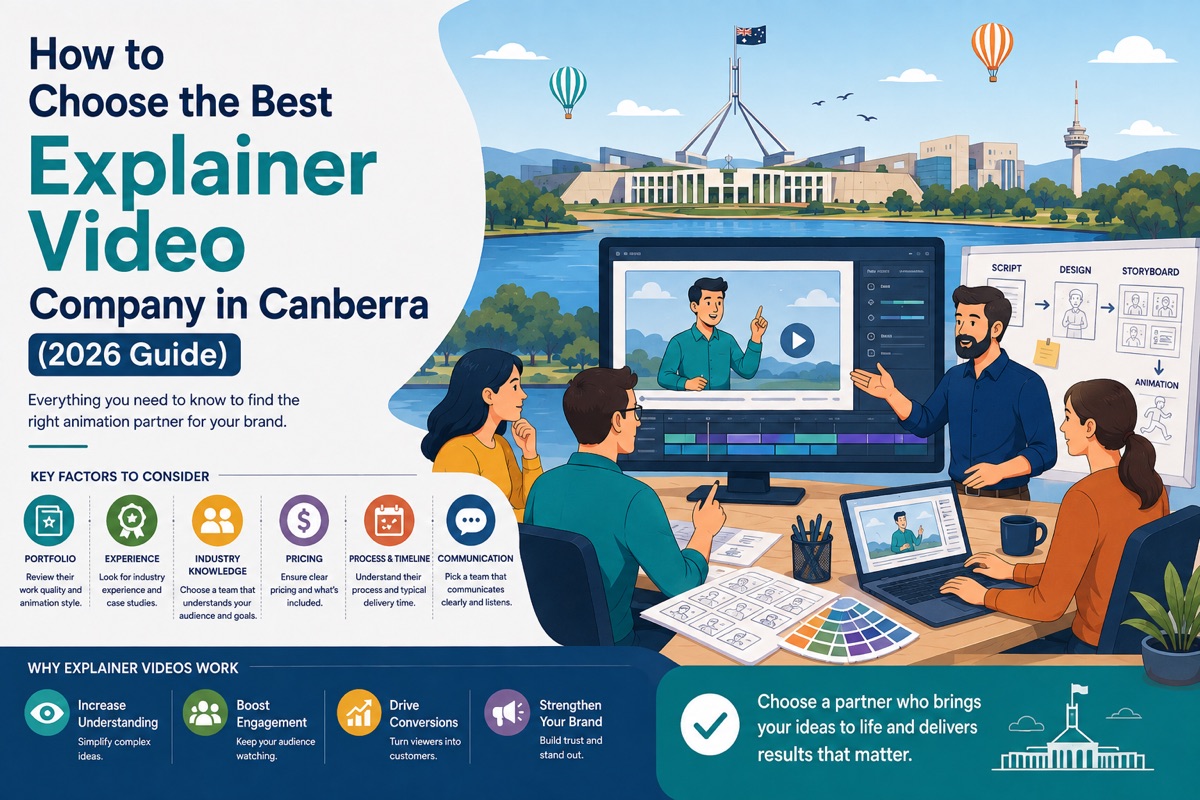
Why Canberra Organisations Have Distinct Explainer Video Requirements
Canberra is the only Australian city where the primary employer is the federal government. The Australian Public Service Commission's June 2025 employment data records a total APS workforce of 198,529. The ACT accounts for 35 per cent of that total, meaning approximately 69,500 federal public servants work in and around Canberra. These organisations are not typical commercial clients. They operate under the Australian Government Style Manual, the Digital Service Standard, the Disability Discrimination Act 1992, and, for video content, the WCAG 2.1 accessibility guidelines. Every piece of public-facing communication is scrutinised by policy advisors, communications directors, accessibility officers, and, for anything politically sensitive, ministerial offices.
The practical consequence for any studio producing an explainer video for a Canberra government client is that the production schedule must include structured internal approval checkpoints, the script must be written to the plain language standard, the final delivery must include closed captions and subtitle files, and the content itself must be factually accurate and politically neutral. Studios that have only worked with commercial clients regularly underestimate how different this brief is. The discovery call sounds familiar. The revision cycle does not.
Beyond government, Canberra's defence sector, cyber and quantum ecosystem, space industry, health research institutions, and universities all share a related characteristic: they are communicating highly complex technical propositions to audiences who are not subject-matter experts. A defence contractor needs a procurement panel to understand a system they have never seen. A quantum computing company needs a government grants assessor to understand technology that does not yet exist in production form. A health research institution needs patients, clinicians, and investors to all understand the same clinical trial from different starting points of knowledge. Animated explainer video is the most efficient format for this specific challenge, and a specialist explainer video company in Canberra will produce a materially better result than a generalist digital marketing agency that lists video as one of its services.
Canberra Industries That Commission Explainer Videos
Canberra's economy is more diverse than its government-capital identity suggests. Defence, cyber security, quantum technology, space, health research, and education all sit alongside the federal public service as major buyers of animated video production. Each sector has specific content requirements that make choosing an experienced production partner more important than it would be in a purely commercial market. The right explainer video company in Canberra will have demonstrable experience in at least two of these verticals and will understand the approval dynamics, audience characteristics, and communication constraints that define each one.
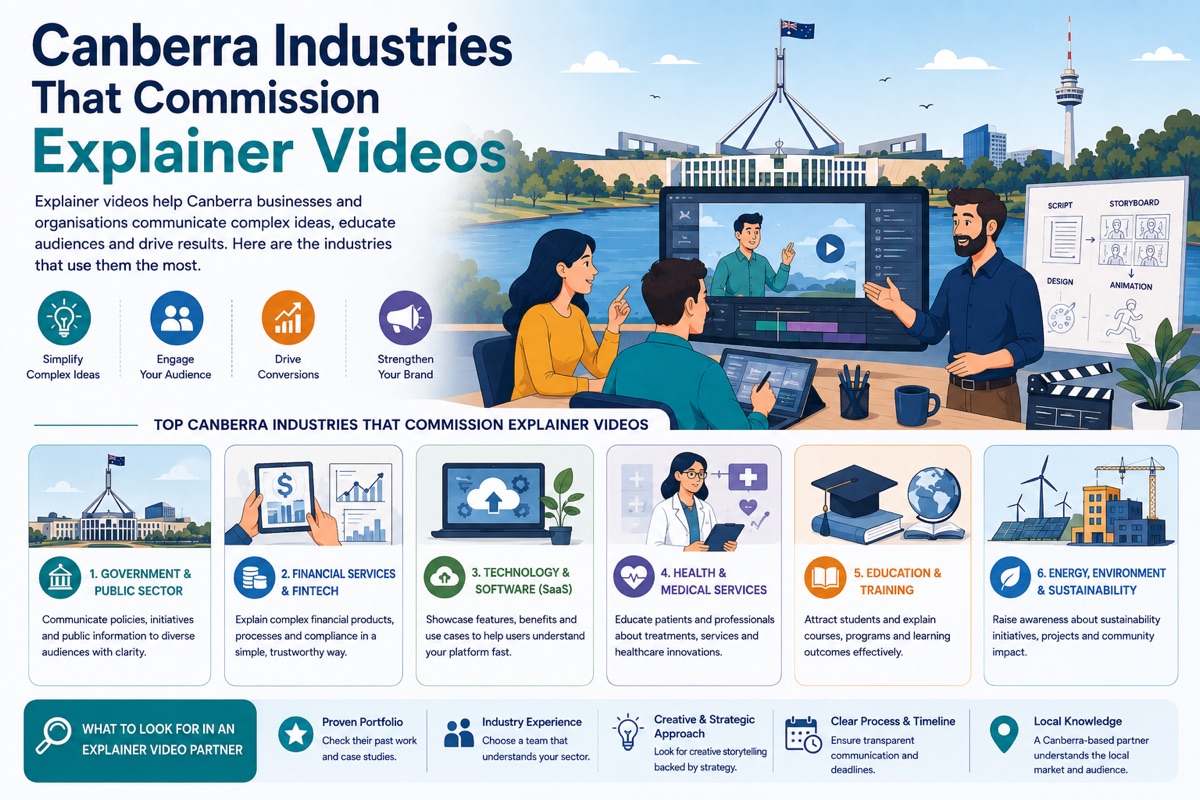 explainer videos: federal government, AUKUS defence, cyber security, space, health research, and education in the ACT" width="1200" height="800" loading="lazy">
With approximately 69,500 APS employees in the ACT, federal government agencies are the largest single buyer of explainer video production in Canberra. Policy communication, citizen-facing service explanations, internal training, budget announcement summaries, and parliamentary committee materials all generate sustained demand for animated video content. Government explainer videos must meet the Australian Government Style Manual plain language standard, WCAG 2.1 accessibility guidelines, and internal communications approval requirements. Departments regularly use animated explainer videos for digital service launches, Machinery of Government change announcements, and statutory reporting summaries aimed at non-specialist audiences including the media, parliamentary staff, and the general public.
The ACT defence industry contributes $4.3 billion in gross state product and supports 25,300 jobs in the Canberra region. The Australian Submarine Agency, headquartered in Canberra with a 2025-26 budget of $388.8 million, coordinates the $200 billion AUKUS submarine procurement programme across three partner nations. Northrop Grumman, Lockheed Martin Australia, BAE Systems, and Leonardo DRS all maintain significant Canberra presences. Defence contractors in Canberra face a specific communication challenge: capability proposals must persuade procurement panels that include Australian, US, and UK personnel reviewing independently across different time zones. Animation can illustrate systems and capabilities that cannot appear in live footage for classification reasons, making it the standard format for defence tender submissions and AUKUS capability briefs.
Canberra is Australia's cyber and quantum capital. The Canberra Cyber Hub, established in 2021 with ACT Government support, represents a unified ecosystem of cyber, quantum, and space technology organisations. Australian organisations are expected to spend A$6.2 billion on information security and risk management in 2025, a 14.4 per cent increase year on year. Canberra-based QuintessenceLabs raised $20 million in quantum-resilient cybersecurity investment led by the Australian Government through the National Reconstruction Fund. Quantum Brilliance, also Canberra-based, has secured significant investment as the quantum sector accelerates. These organisations share a common communication problem: their technology is so advanced that the audiences they need to persuade (government grants assessors, enterprise security buyers, international partners, and investment committees) do not yet have a reference point for what the technology does or why it matters. Animated explainer video is the most effective format for building that understanding from zero.
Canberra is Australia's national space hub. The ACT is home to Skykraft, the Canberra-based mini satellite designer and manufacturer building a constellation of more than 200 satellites to provide space-based Air Traffic Management services, with operations commencing in 2025. The ANU Institute of Space has received $1.3 million for the Resilience Mission Project, developing OzFuel, a space-based sensor platform for bushfire detection and prevention. UNSW Canberra, EOS Space Systems, and multiple SmartSat CRC partners operate from the ACT as the territory cements its position as Australia's space research and development base. Space organisations face the most challenging explainer video brief of any sector: they need to make genuinely novel technology credible to audiences who have no existing knowledge base, while maintaining technical accuracy that can withstand expert review. The right studio produces content that works for both a Year 10 student and a NASA programme manager.
The 2025-26 ACT Budget delivers a record $1.19 billion investment in Canberra's public health system, the largest single health investment in the Territory's history. This includes continued work on the Canberra Hospital Master Plan, a new Pathology and Clinical Services Building, and expanded cancer screening and specialist services. The ACT received a 16 per cent Commonwealth funding boost for hospitals. Canberra Health Services Research Strategy 2021-2025 identifies clinical research, education, and patient communication as strategic priorities. Hospitals, research institutions, health technology companies, and pharmaceutical organisations in Canberra all generate demand for explainer video production serving four distinct audiences simultaneously: patients requiring plain-language education, clinicians receiving procedural training, investors evaluating commercial opportunity, and regulators reviewing clinical evidence. Animated video is uniquely suited to addressing all four from a single production.
Canberra is home to five universities and several nationally significant research institutions including the Australian National University (ANU), one of Australia's Group of Eight research-intensive universities ranked consistently in the global top 100, the University of Canberra, UNSW Canberra at ADFA, and the Australian Capital Territory's CSIRO research facilities. ANU and its partners collaborate with government and industry on research commercialisation across defence, space, quantum computing, and environmental science. Research institutions use animated explainer videos for three primary purposes: commercialising research findings to industry and government partners, communicating complex study outcomes to public and policy audiences, and recruiting international students by making programme value clear in plain English without relying on a presenter. For multilingual audiences across Asia, the Middle East, and Europe, animation paired with subtitles outperforms every other format at comparable cost.
The Government Communication Difference: What Makes Canberra Briefs Unique
The majority of explainer video production guides are written for commercial clients: startups, SaaS companies, product businesses, and professional services firms. The Canberra market does not fit that template. If you are commissioning an explainer video on behalf of a federal agency, defence contractor, research institution, or ACT Government department, the production requirements, approval dynamics, and evaluation criteria are meaningfully different from a commercial brief. Understanding these differences before you commission will save you significant time and budget.
Cycles
2.1
Language
How to Evaluate an Explainer Video Company in Canberra
Canberra's video production market includes full-service animation studios, generalist digital agencies offering animation as one service among many, freelancers operating under a studio name, and offshore production companies with an Australian contact page. The quality gap between these categories is significant in any market. In Canberra, where clients include federal agencies with public accountability requirements, AUKUS defence contractors with security considerations, and research institutions with technical credibility standards, the gap matters more than elsewhere. Use the questions and criteria below to evaluate any explainer video company in Canberra or interstate studio before committing budget and timeline.
Questions to Ask Before You Sign
- Do you have portfolio examples from government, defence, cyber security, health, or research, the primary sectors that commission explainer video production in Canberra?
- Who writes the script, and do they have experience communicating complex policy, technical, or scientific content to non-specialist audiences?
- Does your production schedule include written approval milestones at script, storyboard, and pre-final stages, with specific dates confirmed before production begins?
- Are closed captions and subtitle files included as standard deliverables, and does your output meet WCAG 2.1 accessibility guidelines?
- Is all animation produced in-house, or are elements subcontracted to third-party or offshore studios?
- What animation software does your team use, and will I receive source files on final delivery if required for future edits?
- How many revision rounds are included at each stage: script, storyboard, and completed animation?
- Are voiceover talent and music licensed for unlimited commercial use including internal government distribution and paid digital advertising?
- What file formats will I receive, and are social media format cuts and a square or vertical version included in scope?
- Do I receive full commercial and government rights to the completed animation on final payment, with no ongoing licence fees?
Red Flags to Watch For When Commissioning in Canberra
- A showreel that contains no government, defence, research, or technical content. Canberra's primary industries are unlike those in Sydney or Melbourne. A studio whose entire portfolio is commercial product explainer videos or startup landing pages has not built the communication skills required for the ACT's dominant brief types.
- No mention of WCAG 2.1 compliance in the proposal. If a studio does not proactively address accessibility requirements for government video, they have not produced government video before. Captions, subtitle files, and accessible player considerations should appear in the proposal without you asking.
- A flat production timeline with no written approval checkpoints. Government clients require written sign-off at script, storyboard, and pre-final stages. Studios that provide a single delivery date without milestone approval windows are planning for a commercial client, not a government one.
- Pricing quoted before the brief has been discussed. Accurate pricing for a government explainer video requires understanding your audience, the approval chain, WCAG requirements, distribution context, and animation complexity. Fixed-price quotes from a form submission alone indicate template production, not a custom government communication.
- Outsourced animation production. Many agencies manage the Canberra client relationship while contracting animation to offshore studios. This adds cost, reduces quality control, and creates security considerations for any client handling sensitive or pre-public content. Ask directly whether all animation is produced by the in-house team and whether any third-party subcontractors will have access to the brief or content.
- Scripts written in internal departmental language. A studio that returns a first draft full of policy acronyms, passive constructions, and procedural phrasing has either used department-authored content without editing it, or lacks experience in plain language communication. Plain language is not a stylistic preference in government communication. It is the measurable standard by which government video content is evaluated.
Ready to Discuss Your Canberra Explainer Video Project?
Tell us about your sector, your audience, and what you need the video to achieve. We respond within one business day with a tailored approach, a production schedule, and a clear milestone structure.
See Our Canberra Explainer Video Service →Production Timelines for Canberra Clients
Timeline expectations for an explainer video produced for a Canberra client should be set differently from a commercial brief. The production stages are the same: discovery, script, storyboard, animation, audio, delivery. The time allocated to each stage is not, because government and research clients have internal approval requirements that commercial clients do not. Studios that set Canberra client expectations using commercial timelines create a production process that feels late from week two, even when the studio is delivering to schedule.
| Production Stage | Standard Commercial | Government / Defence | Research / Technical |
|---|---|---|---|
| Discovery and Brief | 2-3 days | 5-7 days | 3-5 days |
| Script Development | 3-5 days | 5-7 days | 5-10 days |
| Client Script Approval | 2-3 days | 7-21 days | 5-10 days |
| Storyboard and Style Frames | 5-7 days | 7-10 days | 7-10 days |
| Client Storyboard Approval | 2-3 days | 7-14 days | 5-7 days |
| Voiceover Recording | 2-3 days | 2-3 days | 2-3 days |
| Animation Production | 7-10 days | 10-14 days | 10-14 days |
| Review and Revisions | 3-5 days | 7-14 days | 5-7 days |
| Total Elapsed Time | 4-6 weeks | 7-11 weeks | 6-8 weeks |
Rush timelines are available for time-sensitive requirements such as Senate committee submissions, budget announcement communications, minister's office deadlines, or defence tender submissions with a fixed close date. A standard 60 to 90 second animation can be produced in two to three weeks with rush production, which compresses the approval window and may require client availability for same-day feedback at key stages. Rush production should be discussed before brief sign-off, not after the standard timeline proves too long.
For complex technical animations covering cyber systems, space technology, or defence capabilities, ten to twelve weeks is a realistic baseline. The animation complexity required to accurately represent quantum computing processes, satellite orbital mechanics, or submarine capability systems is significantly higher than a standard SaaS product explainer. Attempting to compress these timelines produces animations that simplify to the point of technical inaccuracy, which is counterproductive when the audience includes subject-matter experts.
Animation Styles That Work for Canberra's Primary Sectors
Animation style choice is a strategic decision in Canberra's market in a way that it is not for commercial clients. The wrong style signals the wrong things to an audience that is calibrated to institutional communication standards. A government agency using cartoon-style character animation for a serious policy communication will undermine the message before the script has finished. A defence contractor using bright, playful motion graphics in a procurement proposal will not be taken seriously by an evaluation panel. Understanding which animation styles are appropriate for Canberra's primary sectors will help you evaluate studio portfolios and brief your production partner more effectively.
| Sector | Recommended Style | Why It Works | Styles to Avoid |
|---|---|---|---|
| Federal Government | Clean 2D motion graphics with flat character illustration | Professional, accessible, aligns with Australian Government design system aesthetics | Cartoon characters, loud colour palettes, fast-cut montage styles |
| Defence and AUKUS | Technical 2D schematic animation with controlled colour palette | Conveys precision, credibility, and technical accuracy required for procurement panels | Playful styles, stock-footage composites, heavily branded consumer aesthetics |
| Cyber Security and Quantum | Dark-mode technical 2D animation with data visualisation elements | Matches industry visual language, conveys technical sophistication to specialist audiences | Whiteboard animation, bright consumer palettes, generic tech stock imagery |
| Space Industry | High-fidelity 2D or 3D space environment animation | Makes orbital and physical concepts visually accurate and compelling for public and specialist audiences | Cartoon styles that undermine technical credibility |
| Health and Research | Clean 2D character animation with medical illustration accuracy | Balances accessibility for patient audiences with accuracy required for clinical and regulatory reviewers | Overly stylised animation that prioritises aesthetics over anatomical or procedural accuracy |
| Universities | Modern flat 2D with strong typographic hierarchy | Works across domestic and international audiences, legible at small sizes for mobile viewing | Dated whiteboard or kinetic typography styles that signal low production investment |
How Magic Motion Studio Works with Canberra Clients
Magic Motion Studio produces animated explainer videos for government agencies, defence contractors, cyber security firms, research institutions, and health organisations across Australia. Our Canberra explainer video production service is built specifically around the ACT's operating environment: written approval milestones built into every production schedule, WCAG 2.1 closed captions and subtitle files as standard deliverables, plain language scripting reviewed against the Australian Government Style Manual, and full commercial rights transfer to the client on final delivery.
All animation is produced in-house using Toon Boom Harmony by our core team, with no offshore subcontracting. This matters for Canberra clients handling sensitive, pre-public, or security-aware content. We do not share client briefs, scripts, or content with third parties at any stage of production. Source files are available on request and are retained for 24 months after delivery for future edit projects.
Our production process follows four stages with written sign-off at each:
- Discovery and Script: A structured briefing call establishes your audience, the communication objective, the distribution context, and any approval or accessibility requirements. We draft the script, review it with you, and confirm written approval before storyboard work begins.
- Storyboard and Style Frames: We produce a scene-by-scene storyboard with style frames showing the visual approach, colour palette, and character or graphic design direction. Written approval at this stage locks the visual scope before animation begins, preventing costly late-stage revisions.
- Animation and Audio: Professional voiceover is recorded from our approved talent pool, or we work with a talent you specify. Animation is produced to the approved storyboard, with a review link shared via Vimeo for timestamped feedback. Two revision rounds are included.
- Delivery: Final files are delivered in MP4, MOV, and web-optimised formats. Closed captions and subtitle files (.srt and .vtt) are included as standard. Social media cuts (square and vertical) are available as an addition to scope. Full IP transfer is confirmed in writing on final invoice.
For explainer video pricing and timeline estimates, visit our pricing guide or contact us directly with your brief. We respond within one business day with a tailored approach. For clients who need 2D animation services beyond a single explainer video, including training series, recruitment campaigns, or multi-format content programmes, we produce custom scopes on request.
Frequently Asked Questions
Yes, and the majority of Canberra's government departments and major contractors already commission creative services from interstate and international providers. Our production process is entirely remote-first: discovery and briefing calls over video conference, shared script and storyboard review via cloud documents, and Vimeo review links for timestamped feedback at animation stage. Canberra clients regularly tell us that our process is faster and more structured than working with a generalist local studio, because every milestone is in writing with a confirmed date before production begins.
Federal government agencies and APS departments are the largest buyers of explainer video in Canberra, followed by AUKUS defence contractors and capability suppliers, cyber security and quantum technology firms, space industry organisations including ANU and Skykraft, health and medical research institutions, and universities commercialising research. Each sector has distinct requirements: government agencies prioritise WCAG 2.1 compliance and plain-language communication, while defence contractors need animation capable of illustrating classified systems without live footage.
The entire process runs online. After an initial discovery call, we develop a tailored script and review it with you, produce a storyboard and style frames for approval, record professional voiceover, animate, and deliver the final video with closed captions and subtitle files. Review rounds happen via shared Vimeo links with timestamped comments. For government clients we follow structured approval cycles with written sign-off at script, storyboard, and pre-final stages, and all deliverables meet WCAG 2.1 accessibility standards as standard.
A standard 60 to 90 second explainer video for a government client takes seven to eleven weeks from confirmed brief to final delivery, accounting for structured internal approval rounds at script, storyboard, and pre-final stages. Commercial clients without internal approval requirements can receive the same video in four to six weeks. Rush production timelines of two to three weeks are available for Senate committee deadlines, budget announcement communications, or defence tender submissions with a fixed close date. Complex technical animations for cyber, space, or defence applications may take ten to twelve weeks.
WCAG 2.1 is the Web Content Accessibility Guidelines standard required for all federal government digital content under the Disability Discrimination Act 1992 and the Digital Service Standard. For explainer videos, compliance requires closed captions for all spoken audio, audio descriptions for visual-only content not explained by narration, sufficient colour contrast in on-screen text, and keyboard-navigable media players when embedded on government websites. All videos produced for government and public-sector clients include closed captions and subtitle files as standard deliverables, at no additional cost.
AUKUS procurement decisions are reviewed by panels that include Australian, US, and UK personnel, often working across different time zones and reviewing submissions independently. The Australian Submarine Agency, headquartered in Canberra with a 2025-26 budget of $388.8 million, coordinates procurement processes that require capability communication across all three partner nations. A professionally produced animated capability video gives a Canberra-based defence supplier a consistent, high-quality argument that does not vary by presenter, geography, or time zone. Animation can also accurately illustrate systems and capabilities that cannot appear in live footage for classification reasons, making it the standard format for AUKUS capability briefs and defence tender submissions.
Federal government explainer videos must meet three requirements simultaneously. First, plain language: policy, regulatory, and service information must be written to the Australian Government Style Manual standard using active voice, short sentences, and jargon-free language. Second, accessibility: WCAG 2.1 compliance is mandatory for all federal digital content. Third, stakeholder neutrality: government communications must be factually accurate and politically neutral, with scripts reviewed against ministerial approval requirements before production begins. Studios that have only worked with commercial clients regularly underestimate the complexity of the government brief. An experienced explainer video production partner for Canberra builds approval checkpoints into the production schedule as a default, not as an afterthought.
Ready to commission your Canberra explainer video?
Tell us your sector, your audience, and what you need the video to achieve. We will respond within one business day with a tailored approach, a written production schedule, and a clear milestone structure built for the ACT's approval environment.
Get a Free Quote →