
2D Animation Services in Adelaide: The Complete 2026 Buyer's Guide
AUKUS defence, Lot Fourteen space tech, BioMed City health research. Adelaide's economy demands animation that explains the complex. Here is what to know before you brief a studio.
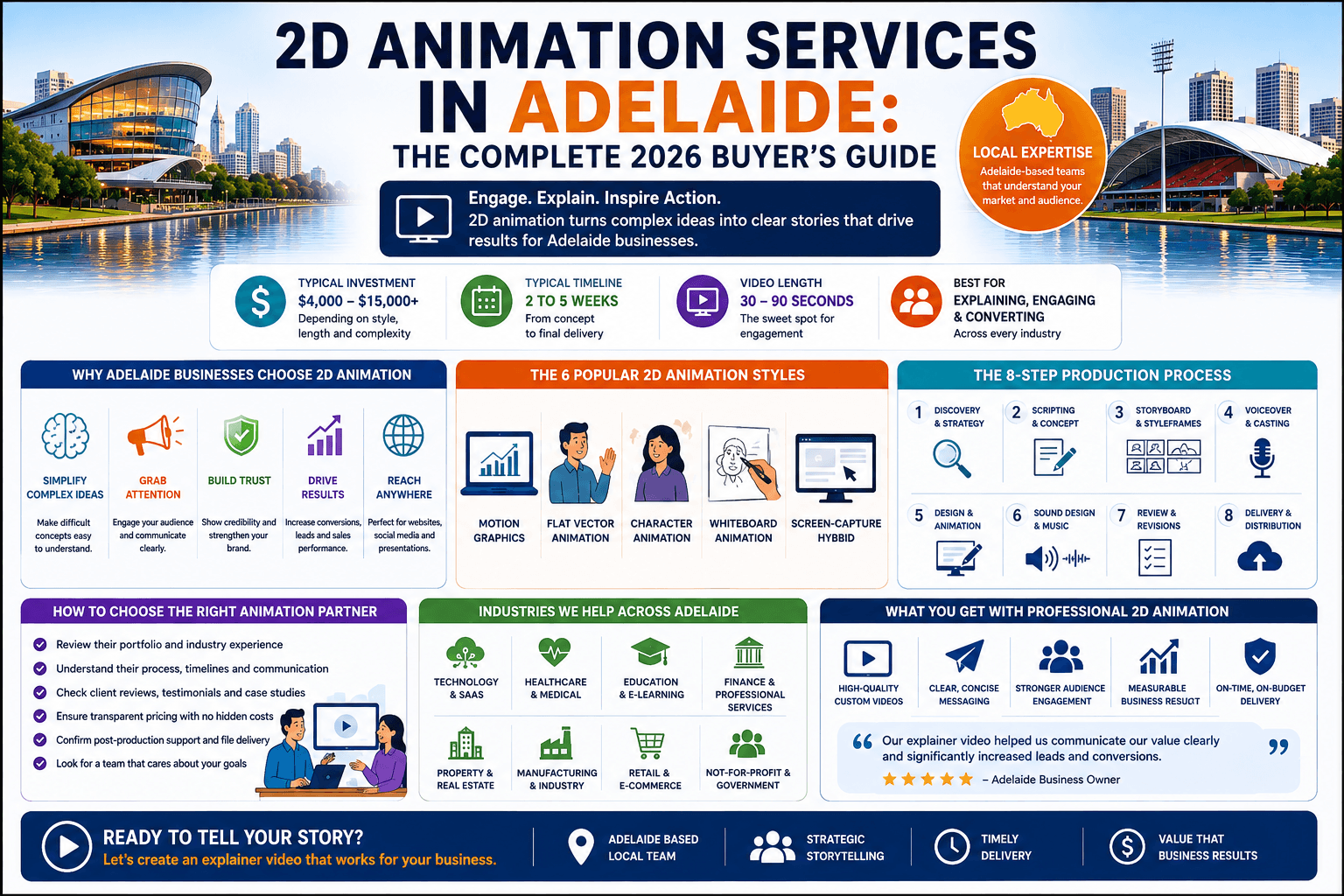
Adelaide has become one of the most animation-hungry cities in Australia, and not for the reasons most buyers expect.
The South Australian Film Corporation reported a $129 million contribution to the SA economy from screen production in FY2024-25, supporting more than 3,400 jobs across cast, crew, and performing talent. At Glenside, animation studio Monkeystack (29 staff, founded 2004) has produced work for Adult Swim, ABC, Nickelodeon, and the federal government, including the first Adult Swim series ever commissioned outside the United States. At Lot Fourteen, the former Royal Adelaide Hospital site now houses the Australian Space Agency and more than 100 space technology organisations, all of which need to explain complex ideas to investors, government stakeholders, and the public.
Yet if you search for 2D animation services in Adelaide today, most results are Melbourne and Brisbane studios that have published a city landing page. Their content is polished. Their case studies are generic. Their phone number is a national 1300 line. And none of them mention AUKUS, BioMed City, or the SA Film Corporation.
This guide covers what Adelaide's economy actually needs from a 2D animation studio, how to distinguish genuine local production houses from location pages, and what every buyer should resolve before committing to a brief.
Which Sectors Drive Demand for 2D Animation in Adelaide?
Adelaide's economy is built on sectors that deal in complexity: classified defence technology, frontier space research, medical science, and agricultural export into markets that speak different languages. Each generates sustained demand for 2D animation production that live-action video cannot replicate at the same cost, speed, or reach.
Defence and AUKUS
The Osborne Naval Shipyard is home to the $480 million AUKUS Skills and Training Academy, one of the largest defence workforce training investments in SA history. The Australian Submarine Corporation has already awarded a $2 million contract for AUKUS and Collins Class submarine workforce training design and development. 2D animation is the preferred format for classified training environments: no filming on restricted sites, no clearance requirements for on-screen talent, and content that is straightforward to update when procedures change. Major contractors in this sector include BAE Systems, Lockheed Martin, Raytheon, and ASC.
Space Technology and Lot Fourteen
Lot Fourteen, the 7-hectare innovation precinct on the former Royal Adelaide Hospital site in the CBD, houses the Australian Space Agency headquarters and more than 100 space technology organisations. Start-ups and scale-ups in this precinct regularly need animated explainer video content to pitch to international investors, demonstrate capability to government procurement teams, and communicate mission objectives to the public. The Australian Space Discovery Centre at Lot Fourteen uses animation for interactive educational experiences as well.
Health and BioMed City
Adelaide BioMed City is the largest health and medical research precinct in the Southern Hemisphere, with $3.6 billion in committed investment across the Royal Adelaide Hospital, SA Health, Flinders Medical Centre, the University of Adelaide, and UniSA. Institutions here use animation for patient education, clinical procedure explainers, health literacy campaigns, and research communication for grant applications and public-facing reports. Medical animation removes the cost and complexity of live clinical filming while producing accurate, repeatable content.
Wine and Agribusiness Export
South Australia produces approximately 50% of Australia's total wine output, across the Barossa Valley, McLaren Vale, Clare Valley, Adelaide Hills, and Coonawarra. Major labels including Penfolds and Jacob's Creek operate here. For export markets in Asia, Europe, and North America, animated brand storytelling bypasses language barriers in ways that interview-style live-action cannot. Agri-food technology companies also use motion graphics to explain traceability systems and sustainable farming methods to international retail buyers.
Universities and eLearning
Adelaide hosts three major universities: the University of Adelaide, UniSA, and Flinders University, all of which run eLearning programmes at scale. At an institutional level, universities commission animated eLearning modules, course introduction videos, and research communication content for online enrolment funnels and international student recruitment. TAFEs and registered training organisations in SA add significant additional volume in vocational training content, much of which now requires WCAG 2.1 accessible formats.
SA Government and Public Sector
SA Government departments are major buyers of animation services, procuring explainer content for public health campaigns, infrastructure communications, regulatory compliance, and community education. Government animation briefs carry specific requirements: WCAG 2.1 AA accessibility compliance, closed captions, plain language scripting, and compatibility with government platforms. Animation is often preferred over live-action for sensitive subject matter including family services, mental health, and court process explainers, where generic visual styles communicate without identifying real individuals.
Ready to brief a 2D animation studio?
See transparent production tiers, what revision rounds are included at each level, and what every quote should cover before you sign anything.
What a Genuine Animation Partner Actually Delivers
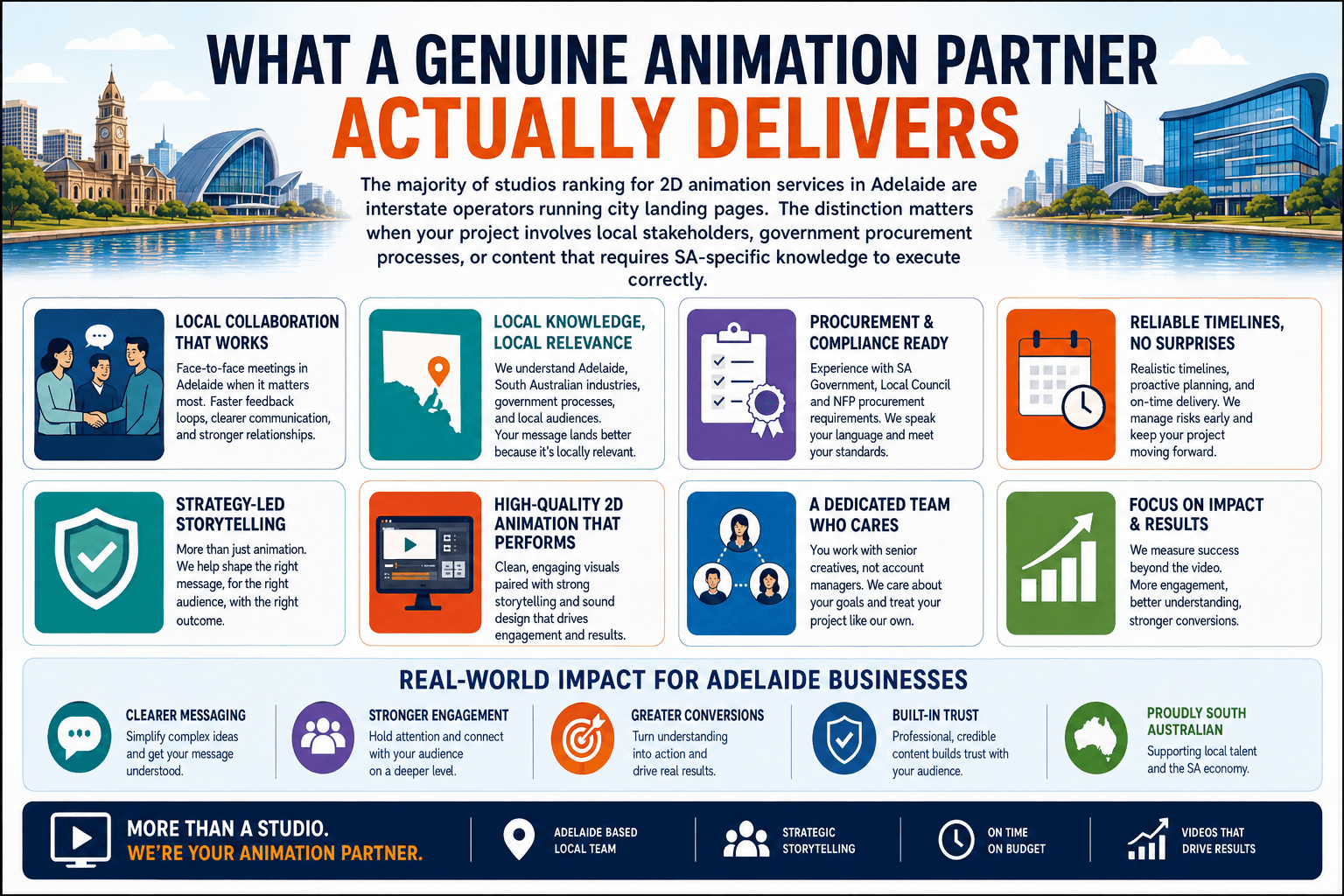
The majority of studios ranking for 2D animation services in Adelaide are interstate operators running city landing pages. The distinction matters when your project involves local stakeholders, government procurement processes, or content that requires SA-specific knowledge to execute correctly.
Magic Motion Studio is a dedicated 2D animation studio with an in-house production team. Every project, from scripting through to sound design and final file delivery, is handled internally. Nothing is passed to a network of offshore freelancers with no accountability to the original brief.
Our production workflow runs on Toon Boom Harmony, the same platform used by Monkeystack for the YOLO series and by broadcast studios worldwide for professional character animation. We also produce motion graphics, animated explainer video content, whiteboard animation, and isometric illustration, so we can match the right visual style to the right brief rather than producing everything in a single house style.
In-house from brief to delivery
Script, voice direction, storyboard, animation, sound design, and file mastering all happen under one roof. No mid-project handoffs to unknown contractors.
Toon Boom Harmony workflow
Broadcast-quality character animation rigged and produced in the industry standard software. Source file transfer is available on request for ongoing content programmes.
Fixed scope before work begins
Every project starts with a written statement of work: deliverables, revision rounds included, timeline, and all fees agreed before a single frame is drawn.
Accessibility-ready output
Closed captions, WCAG-compliant contrast ratios, audio description versions, and government-ready delivery formats are included as standard, not charged as extras.
Australian English scripting
All scripts are written in Australian English by native speakers. No American spelling, no generic global copy, and no idioms that read as foreign to an SA audience.
Full IP transfer on final payment
You own the final delivered video files outright. Portfolio rights are revocable on request for confidential projects. No ongoing licence fees or usage restrictions.
For organisations comparing explainer video production options, the key question is not only who can make the video. It is who will still be accountable for it six months later when a revision, an accessibility update, or a Mandarin-language version for an export pitch is needed.
The six main 2D animation styles and their primary use cases across Adelaide's defence, health, government, and export sectors.
Which Style of 2D Animation Does Your Project Need?
Choosing the wrong visual style for your audience is one of the most common briefing mistakes. The six styles below cover the full range of what professional 2D animation services offer, with guidance on which suits each of Adelaide's primary industry use cases.
Flat and Character Animation
Illustrated characters moving through a narrative. The most versatile style for brand storytelling, social content, and general audience explainers. Works well for Lot Fourteen start-ups, university recruitment, and wine export brand videos. Typically the mid-range option for cost and production time across most animation company Adelaide engagements.
Motion Graphics
Text, icons, data, and shapes animated without characters. The fastest style to produce and most effective for data-heavy content: annual reports, infrastructure project communications, financial explainers, and government budget summaries. Widely used by SA Government departments for campaign content and by Lot Fourteen companies presenting metrics to international investors.
Technical Process Animation
Diagrammatic animation showing how systems, machines, or procedures work. The preferred format for defence training, engineering inductions, medical device explainers, and manufacturing process documentation. Strong demand at Osborne Naval Shipyard and across BioMed City institutions. Precise technical illustration is essential in this style: inaccuracies in a training video can have direct safety consequences.
Whiteboard Animation
A simulated hand-drawn style where content appears progressively on a white background. Common in educational and compliance contexts because the sequential reveal supports step-by-step comprehension. Used extensively in TAFE training packages, legal compliance modules, and community health education programmes across SA Health and affiliated organisations.
Isometric Animation
Three-dimensional-looking environments rendered in a 2D isometric perspective. Popular for SaaS product demonstrations, government infrastructure visualisations, smart city communications, and technology ecosystem maps. Creates visual depth without the cost or production complexity of true 3D. Used by start-ups at Lot Fourteen to visualise interconnected systems and platforms.
Frame-by-Frame Animation
Traditional animation drawn frame by frame, producing fluid organic movement that no other style replicates. The highest-cost and most time-intensive format. Reserved for premium brand campaigns, broadcast content, and projects where craft is the point, as demonstrated by Monkeystack's Adult Swim commissions from Adelaide Studios at Glenside.
2D Animation vs 3D: Which Format Does Your Brief Actually Need?
Most projects that enquire about 3D end up in 2D because the use case does not require the physical depth and realism that 3D production justifies. Here is how the two formats compare across the criteria that matter most to Adelaide buyers sourcing 2D animation services.
| Factor | 2D Animation | 3D Animation |
|---|---|---|
| Production cost (60-sec) | Lower starting point | Significantly higher |
| Typical turnaround | 4 to 8 weeks | 8 to 20 weeks |
| Revision ease | Straightforward at most stages | Complex, especially post-modelling |
| Best use case | Explainers, training, eLearning, social | Product visualisation, architecture, engineering |
| Classified environments | Yes: no on-site filming needed | Yes: no on-site filming needed |
| Style range | Extensive: flat, motion graphics, whiteboard, isometric, frame-by-frame | Limited to 3D realism or 3D stylised |
| Accessibility compliance | Straightforward to add captions and audio description | Straightforward to add captions and audio description |
| Government procurement fit | Widely accepted, lower risk, faster delivery timelines | Justified only for specific engineering or product requirements |
For AUKUS training content, BioMed City patient education, university eLearning modules, and SA Government explainer campaigns, 2D animation delivers the required output faster, at lower cost, and with simpler revision workflows than 3D. 3D is the right answer when the product itself is physically three-dimensional and needs to be shown rotating, opening, or operating in space.
How a 2D Animation Project Moves from Brief to Delivery
Every animation studio describes a process. What separates good studios from poor ones is whether each stage has a defined approval gate, a clear scope of revisions included, and a written record of what was agreed before work moved forward.
Discovery and Brief
A structured intake session that establishes the target audience, the single action the video must drive, the tone and visual references, the distribution channels, and any constraints (budget, timeline, compliance requirements). This stage is documented in a written brief before any creative work begins. Studios that skip this stage produce generic scripts and expensive revisions.
Script and Voiceover
A 60-second animation contains approximately 140 to 160 words, which means every word is load-bearing. The script goes through client approval before voice talent is selected and recorded, because changes after recording add direct cost. Voice direction, diction, and pace are matched to the target audience and platform. Australian English scripting is standard on all our productions.
Storyboard and Style Frames
The storyboard maps every scene to the approved script, showing composition, character placement, and narrative flow. Style frames show the full colour visual treatment before animation begins. Approving the storyboard locks the structure of the video. Changes after this point are the most expensive revision type because they may require re-animating completed scenes from scratch.
Animation Production
Animation is produced scene by scene in the approved visual style. A rough cut is shared for client review before final polish and compositing. The number of consolidated revision rounds at this stage should be defined in the statement of work: typically one to two rounds for a standard project. Feedback submitted as a single consolidated document keeps the revision process on schedule and on budget. See our production process for a full breakdown of what each stage includes.
Sound Design and Final Delivery
Music, sound effects, and the final audio mix are added after animation is approved. Final delivery formats depend on distribution channels: broadcast-ready files, web-optimised MP4, vertical social cuts (9:16), closed caption files (SRT or VTT), and audio description versions for WCAG compliance. Full IP ownership transfers to the client on receipt of final payment.
For Adelaide organisations running government or defence procurement processes, a written statement of work with defined deliverables and payment milestones is not just best practice: it is a procurement requirement. Our animation pricing guide covers what every SOW should include before a project is signed off.
The Location Page Problem: Is That "Adelaide" Studio Actually in Adelaide?
This is the question no competitor in the Adelaide animation market will answer directly. When buyers search for 2D animation services in Adelaide, a significant proportion of the top results are Melbourne and Brisbane studios that have built dedicated Adelaide landing pages.
These pages are typically well-optimised and professionally written. But the studios behind them are based in other cities, with no physical Adelaide presence, no local market knowledge, and no ability to attend a stakeholder briefing in person. This is not inherently a problem for every project. A national studio can produce competent animation from anywhere. But for SA Government procurement, AUKUS-adjacent briefs where local context matters, or any project that requires on-site meetings with legal, compliance, or executive stakeholders, knowing where your studio is actually based is material information.
The research for this guide identified several Melbourne-based studios ranking prominently for animation company Adelaide and animation studio Adelaide search terms. All of them produce credible work. None of them are based in South Australia.
How to identify a genuinely Adelaide-based animation studio
- ✓08 area code phone number: Genuine Adelaide studios have an 08 number visible on their site. National 1300 and 1800 numbers do not confirm a physical location.
- ✓Adelaide street address: A real office address in the CBD, Glenside, Tonsley, Mawson Lakes, or inner Adelaide suburbs. Not a registered agent address or a shared virtual office.
- ✓SA client case studies: Genuine local studios reference SA organisations by name, not just "a health organisation" or "a government department." Actual named SA clients are the key signal.
- ✓SA Film Corporation knowledge: Any studio active in Adelaide's professional screen ecosystem knows the SAFC and its incentive programmes. Ask them about it directly.
- ✓Adelaide-based team members: LinkedIn profiles, bios referencing SA universities or local production credits, or team photos taken in recognisable Adelaide locations.
- ✓Ability to meet in person: A genuine local studio can schedule a face-to-face briefing in Adelaide within reasonable notice. An interstate studio cannot do this without travel costs and significant lead time.
Red flags that suggest a location page rather than a genuine local studio
- Generic "Adelaide" page with no SA client names, no local team, and no SA industry knowledge beyond what appears in a broad internet search
- Case studies that are all from Melbourne, Sydney, or interstate clients despite the Adelaide branding
- No mention of SAFC, Adelaide Studios, or SA screen industry despite claiming animation expertise in SA
- "We service Adelaide" language rather than "we are based in Adelaide"
- ABN registration in Victoria or Queensland despite an Adelaide-branded website
For straightforward commercial projects where studio location is irrelevant to the brief, this issue may not matter at all. For projects involving SA Government procurement, defence-adjacent clients, or sensitive sectors where stakeholder trust is built in person, verifying your studio's actual location is worth ten minutes before you sign a statement of work.
You can also see how we approach SA-specific briefs across sector contexts in our explainer video production overview for Adelaide.
The SA Film Corporation and Adelaide's Professional Animation Talent Pool
Adelaide's credibility as an animation production city is not based on marketing claims. It is built on a verified track record, sustained over two decades by the SA Film Corporation and a cluster of genuinely world-class studios whose work has been screened internationally.
SA Film Corporation: Key Facts for Adelaide Animation Buyers
The SAFC contributed $129 million to the SA economy from screen production in FY2024-25, supporting 3,400+ jobs. Its incentive structure is unique in Australia: a 10% rebate on SA production spend, combinable with the federal Post, Digital and Visual Effects (PDV) Offset for a total of up to 40% on qualifying production expenditure. For productions with significant post-production and VFX components, the SA-plus-federal stack is the most competitive incentive arrangement available in the country.
SAFC manages Adelaide Studios at Glenside, a professional-grade screen production facility. In FY2024-25, SA-based VFX and post-production teams contributed to international productions including Sinners, A Minecraft Movie, Thunderbolts, and Disney's Lilo and Stitch remake. This reflects a workforce operating at a global professional standard, not a provincial market.
Commercial animation studios do not typically access SAFC production grants directly. But the SAFC ecosystem has trained and sustained the professional talent pool that Adelaide's commercial sector draws from.
Monkeystack, based at Adelaide Studios since its founding in 2004 by Justin Wight, Troy Bellchambers, and Shane Bevin, has produced work for Adult Swim, ABC, Nickelodeon, Nike, the Transport Accident Commission, and the federal Smartraveller campaign (15.5 million Instagram views). Its 2020 commission for YOLO Crystal Fantasy was the first Adult Swim series ever produced outside the United States. The People's Republic of Animation, based at 33 Pirie Street, had its short film The Cat Piano (2009) shortlisted for the Academy Award for Best Animated Short Film.
These are not the credentials of a city punching above its weight. They are the credentials of a city with an established, professional animation industry. When buyers commission 2D animation services in Adelaide, they are drawing on a talent ecosystem built by this professional foundation, not a remote-work arrangement managed from another state.
For organisations looking to commission 2D animation with a genuine understanding of the SA market and stakeholder context, the question is not whether Adelaide has the capability. It clearly does. The question is which studio is the right fit for your specific brief, budget, and approval process.
Five Questions to Resolve Before Briefing Any Animation Studio
The quality of your brief determines the quality of your quote and the quality of your finished video. Studios that receive a complete brief produce better work with fewer surprises. Here is what every brief should resolve before you approach any animation company.
1. The single action you want the viewer to take. Not "raise awareness" or "educate our audience." A specific action: visit this page, complete this training module, submit this form, call this number, share this content with a colleague. Every creative decision in the video should serve that single action. If you cannot name it precisely, the video will not achieve it reliably.
2. Your audience, defined narrowly. "General public" is not an audience. "SA Government procurement managers evaluating AUKUS workforce training solutions" is an audience. "BioMed City researchers applying for NHMRC grants" is an audience. The narrower the audience definition, the more effective the script and the more appropriate the visual style will be. Generic audiences produce generic animation.
3. Your distribution channels. Where the video lives determines the format it needs: widescreen 16:9 for YouTube and website; vertical 9:16 for Instagram Reels and TikTok; square 1:1 for LinkedIn and Facebook feed; broadcast-ready files for television or event screens. Distribution also determines captioning requirements and accessibility compliance obligations under SA Government and federal procurement rules.
4. Your approval chain. How many people need to sign off at each stage, and who has final authority? A project with a single approver and clear decision authority will move in four to six weeks. A project with six stakeholders and no defined decision-maker will take four to six months. Both are legitimate, but both have different cost structures. Define the chain before briefing so the studio can quote the right timeline and revision allocation.
5. Whether confidentiality is required. If the project involves unreleased products, classified processes, or information subject to government security protocols, tell the studio before you brief them. Any reputable animation studio will sign a mutual NDA before the brief is shared. Disclosing sensitive information to a studio that has not signed an NDA creates IP and compliance risk from the first conversation.
With these five questions resolved, a studio can give you a meaningful fixed quote. Without them, any price is a guess. See our explainer video pricing guide for a full breakdown of what drives cost at each production stage, and what a complete SOW should include before any work begins.
Common Questions About 2D Animation in Adelaide
How much do 2D animation services in Adelaide cost?
A standard 60-second 2D animation produced to professional broadcast quality typically starts from around $5,000 to $10,000 in Australia, depending on the studio, animation style, and number of revision rounds included. Motion graphics and whiteboard styles sit at the lower end. Character animation and frame-by-frame styles sit higher. Always request an itemised quote that separates scripting, storyboarding, animation, voiceover, sound design, and file licensing so you can compare studios on a like-for-like basis. See our full animation pricing breakdown for a stage-by-stage view of what drives cost.
How long does a 2D animation project take?
A typical 60-to-90-second 2D animation takes four to eight weeks from brief sign-off to final delivery, assuming timely client approvals at each stage. Motion graphics projects can move faster at three to four weeks. Character-driven productions with multiple scenes and custom voiceover can take eight to twelve weeks. The single biggest driver of timeline blowout is late or fragmented client feedback, not studio capacity. Rush timelines are possible but attract a premium because they require rescheduling other active projects.
What is the difference between 2D and 3D animation?
2D animation builds movement on a flat plane using illustrated assets, motion paths, and compositing. It is faster to produce, more cost-effective, easier to revise, and works across every screen size and platform. 3D animation constructs a full three-dimensional environment with modelled assets, making it ideal for product visualisation, architectural walkthroughs, and engineering demonstrations where physical depth and realism are essential. For most explainer video, training, and social content use cases, 2D animation delivers comparable impact at lower cost and faster turnaround than 3D.
Can 2D animation be used for defence and government training content?
Yes. 2D animation is widely used for defence training, safety inductions, and operational procedure content. Its key advantage over live-action in classified environments is that there is no need to film on restricted sites, manage talent with specific security clearances, or handle physical production logistics on sensitive facilities. Animated training content is also easier to update when procedures change, which matters for long-running programmes like the AUKUS submarine build at Osborne. The Australian Submarine Corporation has already documented a $2 million AUKUS workforce training design and development contract as part of the $480 million Skills and Training Academy commitment at Osborne Naval Shipyard.
Do I need to be in Adelaide to work with an Adelaide-based animation studio?
No. Most animation projects are completed remotely with video calls for brief sessions, shared review links for storyboard and animation approvals, and email sign-offs at each production stage. That said, working with a studio genuinely based in Adelaide, rather than a Melbourne or Sydney studio running a location page, has real advantages: SA market knowledge, familiarity with SA Government procurement processes, and the ability to attend a stakeholder briefing in person when a complex or sensitive brief calls for it.
What industries use 2D animation services in Adelaide?
Adelaide's economy generates sustained demand for 2D animation across defence and AUKUS contracts at Osborne, Lot Fourteen space technology organisations, BioMed City health and research institutions, SA Government departments, wine and agribusiness exporters, and the three major universities. Each sector has specific format requirements: defence training uses technical process animation; government content needs WCAG-compliant accessible formats; export-facing content needs to work without relying on spoken language. The industry cards above cover each sector's specific use cases and animation format preferences in detail.
How do I know if an Adelaide animation studio is actually based in Adelaide?
Check for an 08 area code phone number, a genuine Adelaide street address, and SA client references in their case studies. A studio genuinely based in Adelaide can reference the SA Film Corporation, name local SA clients, and schedule an in-person meeting. Studios running location pages typically list only a national 1300 number, have no Adelaide team photos, and their case studies will not feature any SA organisations. The buyer's checklist in this guide covers all the verification steps.
What role does the SA Film Corporation play in Adelaide's animation industry?
The SAFC supports SA's screen industry with production investment grants, a 10% rebate on SA production spend, and a combined total of up to 40% when stacked with the federal PDV Offset. SAFC manages Adelaide Studios at Glenside, home to Monkeystack (29 staff, founded 2004), which produced YOLO Crystal Fantasy, the first Adult Swim series commissioned outside the United States, along with the Smartraveller social campaign (15.5 million Instagram views) and work for ABC, Nickelodeon, and Nike. Commercial studios do not typically access SAFC grants directly, but the SAFC ecosystem underpins the professional talent pool that Adelaide's commercial animation sector draws from. Our production team operates within this broader professional environment and applies that standard to commercial briefs of all sizes.
Ready to Start Your Adelaide 2D Animation Project?
Tell us about your brief and we will come back with a clear scope, production timeline, and fixed quote. No lock-in, no vague estimates.
Start the Conversation